
Business
The Finance Houses Association announces revision of Self-Regulation Code


The Finance Houses Association of Sri Lanka (FHA) the apex body of all Registered Finance companies has announced the introduction of its revised Self-Regulation Code which has been voluntarily practised by member companies over a long period of time, but has to be adapted to changing times.
The timely revisions to the Code were effected with a view to maintaining the highest standards on strategic and business operations in Sri Lanka’s Non-Banking Financial and Leasing Institutions (NBFI) sector.
The FHA collective of 39 Licensed Finance Companies (LFCs) is the driver of financial inclusion of Sri Lanka’s MSME sector which has a large footprint in the Bottom of the Pyramid segment of the country. The MSME sector is no less than the backbone of Sri Lankan economy involving over 70% of businesses in Sri Lanka, providing employment for 45% of the labor force and generating 52% of GDP.
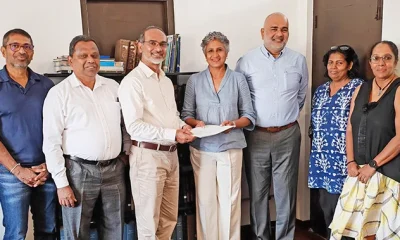
Titled “Code of Conduct of Licensed Finance Companies Sri Lanka” the updated instrument was handed over to the Governor of Central Bank of Sri Lanka Prof. W. D. Lakshman and Bank’s officials by FHA Council members on March 18 at the Central Bank premises.
Niroshan Udage, chairman of FHA elaborated: “FHA’s time tested gentlemen’s agreement that was codified some time ago needed revisions and updates as per the requirements of today’s changing times. The overall objectives of updating the Code were to comply to all current regulatory and legal requirements while adhering to industry best practices. We take humble pride in the fact that the Code was not imposed on our sector by any authority but was self-introduced by all FHA members on their own will, which demonstrates the members’ strong commitment to sectoral integrity and their social responsibility.”
On March 18 members of FHA also handed over their Sustainability Mandate to the Governor of Central Bank Prof. W. D. Lakshman and top officials of the Bank. “The purpose of the Sustainability Mandate is to serve as the guideline for the LFCs to integrate sustainability principles holistically into their businesses, enabling sustainable value creation through their own financing approaches, in line with defined sustainability guidelines that would ultimately contribute towards national sustainability agenda and UN Sustainable Development Goals” said chairman Niroshan Udage.

Business
Renowned Indian economist questions why Sri Lanka’s early social gains haven’t fueled lasting growth

Celebrated Indian economist Dr. Arvind Subramanian urged Sri Lanka to look beyond its current economic stabilisation, warning that the nation’s early human capital gains have historically lagged to translate into long-term, resilient growth.
Delivering a thought-provoking lecture at the Central Bank of Sri Lanka last week, the former Chief Economic Advisor to the Government of India placed human capital at the centre of Sri Lanka’s economic performance and what he described as puzzles – for which he knew no answers.
While acknowledging talks of regained stability and a growth shift here in Sri Lanka, Dr. Subramanian cautioned strongly against complacency. “Do not take stability for granted,” he emphasised, noting that macroeconomic stability has been very elusive in Sri Lanka’s past and that the recent crisis severely eroded living standards for ordinary citizens.
Quoting Austrian economist Joseph Schumpeter, he remarked: “The spirit of the people, its cultural level, its social structure… everything is written in fiscal history.” A country’s tax and expenditure patterns, he stressed, reveal deep truths about its societal and economic priorities.
Drawing a sharp contrast with India, he observed that while Sri Lanka achieved impressive early advances in health and education through deliberate state policy, India’s human capital improvements came largely after economic growth.
“In India, significant improvements in human capital indicators came after and because of economic growth. It happened despite society and despite the state, largely due to economic growth. Then growth boosted state resources for education and prompted families to invest in education spurring the rise of private institutions,” he explained.
“In contrast, Sri Lanka’s human capital space was characterised by early state-led achievements in health and education, preceding significant economic growth – a path that has not yielded the expected growth dividend,” he pointed out.
His analysis showed that Sri Lanka had a pressing intellectual and policy challenge:
In essence, it asked, why has Sri Lanka’s historical investments in people not driven more robust and sustained economic progress? And what must change in the country’s fiscal and economic strategy to turn its human potential into a true engine of secure and shared prosperity?
The lecture served as both a warning against complacency and an invitation to re-examine the fragile links between fiscal policy, human capital, and long-term economic destiny. For a nation on a fragile path to recovery, what he meant was: “Lasting stability must be built on tangible gains from its people’s capabilities.”
Despite Sri Lanka’s justifiable pride in its skilled workforce and social achievements, Dr. Subramanian’s insights revealed a different reality – one that calls for reflection and renewed strategy from the country’s policymakers.
However, a notable gap in the analysis was the absence of a contrast regarding Sri Lanka’s social fabric. While Dr. Subramanian powerfully quoted Schumpeter – that a nation’s spirit and social structure are written in its fiscal history, – he did not apply this lens to compare the cultural values and social structures of Sri Lanka and India, factors that may be critical to understanding the very paradox he outlined.
By Sanath Nanayakkare
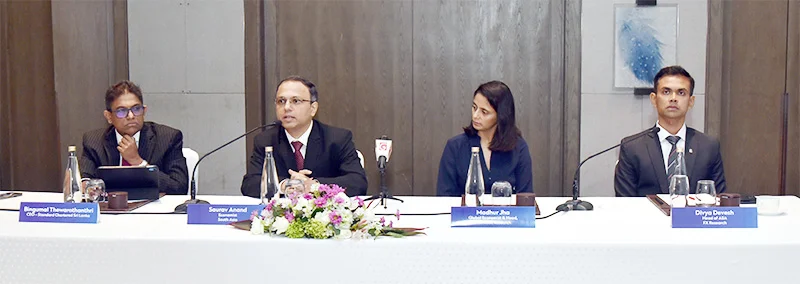
As Sri Lanka moves further away from its economic crisis, bolstered by an expected period of sustained political stability, the economic conditions are shifting from recovery to long-term stability, experts said at the Global Research Briefing hosted by Standard Chartered Bank in Colombo.
Calling a discussion with the financial press on 20th January, they outlined an outlook for Sri Lanka in 2026 that balances optimism with a necessary cautious view of the challenges ahead.
A primary point of discussion was the stance of the Central Bank of Sri Lanka (CBSL). Analysts believe the CBSL will maintain a cautious outlook throughout 2026. This vigilance is largely driven by sustained private-sector credit growth, which is currently trending above 20%. While such growth often signals a reviving economy, it carries the risk of an adverse impact on external-sector stability. Specifically, a surge in credit could fuel a spike in consumption imports, potentially straining the country’s hard-earned reserves.
The researchers’ report highlights that Sri Lanka’s 2026 outlook is significantly bolstered by political stability and policy continuity. Following the 2024 parliamentary elections, where the president’s party secured a more than two-thirds majority, the legislative path for continued reforms appears clear. Although provincial elections are anticipated in the first half of 2026, researchers suggest these are unlikely to derail the current policy trajectory, providing a predictable environment for both domestic and foreign investors.
In the foreign exchange markets, a gradual depreciation of the Sri Lankan Rupee (LKR) against the US Dollar (USD) is expected as the year progresses. Standard Chartered has maintained its USD-LKR forecasts at 309 for mid-2026, reaching 315 by the end of the year.
This shift is closely linked to the narrowing of the current account (C/A) surplus. While the C/A is expected to remain in positive territory, it is projected to narrow to approximately 1% of GDP in 2026, down from an estimated 1.8% in 2025. This narrowing is a byproduct of a strong growth recovery which naturally drives up demand for both consumption and investment-related imports. However, this pressure will be partially mitigated by a decline in car imports, they believe.
They further note that:
Despite the narrowing surplus, two critical pillars of the Sri Lankan economy – tourism and remittances – remain robust. Tourism is forecasted to grow by 5-10% in 2026, continuing its role as a vital supporter of the current account. Similarly, worker remittances are expected to stay strong, even as growth rates moderate from the high 20% levels seen in 2025.
In summary, the consensus from the briefing was clear: ‘Stay the course on reforms because that’s the essential ‘brick by brick’ strategy required to ensure the sustainability of Sri Lanka’s economic future.
By Sanath Nanayakkare
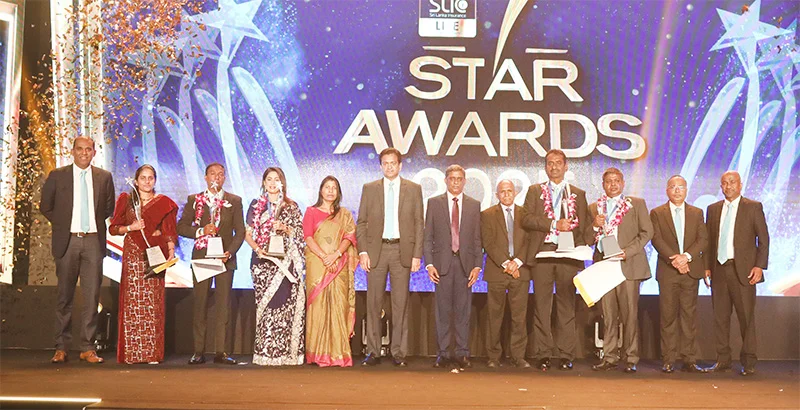
Sri Lanka Insurance Life celebrated its top sales performers at the Star Awards 2025 gala held at Cinnamon Life, Colombo. Under the theme “Rise of the Legends,” the event honored over 300 high achievers for their exceptional 2024 performance.
The awards recognized excellence across categories, including top Insurance Advisors, Branch Managers, and Bancassurance professionals. Key winners included All Island Best Regional Manager P. Sathiyan and All Island Best Advisor K.G.A.S.L. Weerasinghe.
Chairman Nusith Kumaratunga, CEO Nalin Subasinghe, and the corporate management joined over 350 attendees to celebrate the achievers. The evening reinforced the company’s culture of excellence as it strives to be the nation’s leading life insurer.

Royal Navy of Oman Ship ‘AL SEEB’ leaves island

Gold tops $5,000 for first time ever, adding to historic rally

Showers will occur in the Northern, North-central, Eastern, North-western, Western, Sabaragamuwa and Uva provinces and in Matale, Matara, Galle and Nuwara-Eliya districts

U – 19 World Cup: Andrew, McKenzie deliver West Indies comfortable win

U – 19 World Cup: Bowlers, Hogan help Australia breeze past South Africa

Abhishek blasts 14-ball fifty to hand India unassailable 3-0 lead against New Zealand

‘Dates have the highest sugar content to fight Coronavirus’

Sunday Island 27 December – Headlines

#SundayIsland 17th December – Headlines

Sunday Island – 28th March

Sunday Island Headlines – 21 March

Sunday Island – 21st February – Headlines
-
 Business22 hours ago
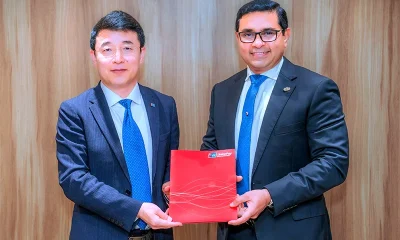
ComBank, UnionPay launch SplendorPlus Card for travelers to China
-
 Business2 days ago
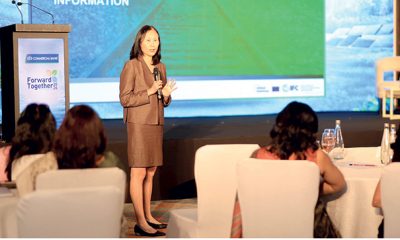
ComBank advances ForwardTogether agenda with event on sustainable business transformation
-

 Opinion7 days ago
American rulers’ hatred for Venezuela and its leaders
-

 Opinion5 days ago
Remembering Cedric, who helped neutralise LTTE terrorism
-
 Business5 days ago
CORALL Conservation Trust Fund – a historic first for SL
-

 Opinion4 days ago
A puppet show?
-
 Opinion2 days ago
Conference “Microfinance and Credit Regulatory Authority Bill: Neither Here, Nor There”
-

 Opinion7 days ago
History of St. Sebastian’s National Shrine Kandana