
Features
THE EASTERN AIRLINES FLIGHT 401 ACCIDENT

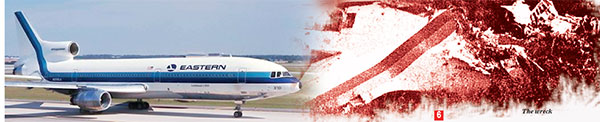
The Lockheed TriStar L 1011 aircraft was well ahead of its time. It is said that the manufacturers, Lockheed built two automatic pilots first and then built an aircraft around them. It was a ‘wide body’ aircraft with two isles and a nose like a Dolphin. The Flight Deck was very spacious when compared to other airliners. It also had a lower galley (service area) which could be accessed by two lifts. It could carry out automatic landings far superior to any other airliners of that era. The airline pilots of the day would describe the automatic functions of the TriStar in three letters ‘P F M’ (Pure Magic). Some said that the only thing the computers couldn’t do was to play ‘Star Spangled Banner’ (the American National Anthem)
Some of the technology was far superior to even the fly by wire Airbus aircraft that arrived 10 to fifteen years later! It was a good match between man and machine. That was because Lockheed being a builder of Military aircraft benefited from the spinoff from space technology which in turn trickled down to Civil Aviation.  Unfortunately, the Rolls Royce (RR) RB 211 Trent Engines that were chosen to power it had some teething problems which delayed the L 1011 project and almost made RR go ‘belly up’. As a result, the McDonald Douglas DC10, another three-engine aircraft, stole a march over them, commercially.
One of the launch customers for the L 1011 TriStar was Eastern Airlines of USA. On the night of 29 December 1972 a Lockheed 1011 TriStar, registration N310EA (See Picture) just four months old, took off from the John F Kennedy Airport, New York to Miami International Airport, Florida, under the Command of Capt. Robert Loft. The First Officer was flying this sector. From some of our ex Eastern Airlines colleagues who flew TriStars with us later in Air Lanka, we gathered that Capt Loft was a bit high-strung even at normal times. The rest of the crew that night were First Officer Alfred Stockstill and Flight Engineer Don Repo. There was also a ground engineer Angelo Danadio occupying the fourth seat in the Flight Deck.
The following is the reconstruction of the crash using the information from the Flight Data Recorder (FDR) and the Cockpit Voice Recorder (CVR), which is recorded on a common timeline; it was done by the National Transport Safety Board (NTSB) USA. The flight was uneventful until the landing approach at Miami. The crew, after they selected the undercarriage (wheels) down, observed that the nose gear down and locked indicator green light was not lit up. In the Flight Deck there were three green lights (one for each wheel unit) to indicate that all wheels were down and locked. Since there were only two green lights instead of three, the Captain decided to recycle the landing gear up and then down again hoping that the problem will sort itself out. There was no change in the number of green lights.
The next thing they did was to test the light system by pressing a button in the overhead panel to illuminate all the lights in the forward and overhead panel, just in case there was a bulb failure. The TriStar crews called the test system, the ‘Christmas Tree Lights’ as all the caution, advisory and warning lights that were supposed to flash intermittently did so like a Christmas tree.
The nose gear down and locked indication light didn’t come on during the light test.
See figures 2 ,3 ,4
It confirmed that both bulbs in the Nose
Light assembly were unserviceable. (In each Landing Gear light assembly there were two small light bulbs). Then again, how if there was a triple failure of the Nose wheel Lock and Bulbs? The crew had to know for sure, before they attempted to land. They had already lined up for the landing. So, to buy some time, the Captain Loft informed the Air Traffic Control Tower that they had a problem. The Control Tower instructed them to discontinue the landing, go around and climb to 2000ft and turn left towards the swamps called the Miami Everglades. It was a dark, moonless night.
After reaching 2000 feet the Captain instructed First Officer Stockstill to engage one of the two automatic pilots which was capable of holding the altitude.
See figure 5
In the TriStar L 1011 the only time, both autopilots (Autopilot A and B) are simultaneously engaged is when the Automatic Landing System is engaged. Each of the two autopilot switches have three positions Off, CWS and CMD. When the Autopilot is switched on, the First Officer Stockstill would have switched on the one  allocated to him (Autopilot B) upwards from ‘OFF’ to ‘CMD’ through a ‘CWS’ position known as ‘Control Wheel Steering’ position. CWS is an intermediate position where the autopilot will be directly controlled through the Control Wheel and not through programming any switches in the automatic pilot control panel. In the CMD position Autopilot B would have maintained 2000ft as instructed, provided 2000ft is set on the altitude window and the ALT Hold button is on. If however some pressure was exerted on the control wheel (15 to 20 lbs.) the CMD selection switch would drop back to the intermediate position of CWS and the ALT Hold button would deselect with the ALT light will go off without any audio warning to the pilots. This was how the system was designed to work at the start.
While the aircraft was flying with the Autopilot ‘B’ engaged at 2000ft, the crew proceeded to trouble shoot. F/O Stockstill had managed to remove the light assembly with great difficulty and tried to replace the two small peanut size light bulbs. This too was extremely difficult. Spare light bulbs of all types and sizes were carried at the Flight engineer’s station.
On Lofts’ remark, “To hell with it”
Stockstill gave up replacing the bulbs and when trying to reinstall the Nose wheel light assembly, it got stuck. And now he was struggling to put it back. Everyone in the flight deck were involved. It is believed that F/O Stockstill tried to replace it by erroneously turning it 90 degrees sideways into the recess (holder) and jammed the assembly. The lens did say ‘Nose’, when inserted in the correct way up but it could be seen only when it lit up and that did not happen as the bulbs were not replaced.
Capt Loft told F/O Sockstill, “Just leave it there”
Now that it was confirmed that the indicator bulbs had fused and the only sure way of positively checking whether wheel was down and locked was go down to the electronics bay below the Flight Deck.
Capt Loft tells F/E Repo impatiently “To hell with it …. Go down and see whether it is lined up on the red line …. That’s all we care.”
Then he laughed at himself and said “Screwing around with a 20 cent piece of light equipment … in this plane”
There through a ‘peep hole’ (facing backwards) one could see Red coloured marks that should be mechanically aligned. So accordingly, Flight Engineer Repo went down to the electronics bay (Popularly known at Eastern Airlines as the ‘Hell Hole’) to check. On his first visit Repo couldn’t see the alignment marks as the wheel well light wasn’t on. So he had to come up and ask Capt Loft to switch it on. When Repo asked for the wheel well light, which was on the overhead panel to be switched on, the positioning Ground Engineer Dinadio was still seated behind the captain and eager to help. Turning around, Capt Loft requested him to go and help F/E Repo to locate the mechanical indicators for the nose landing gear.
The NTSB investigators believed that when turning around in his seat, to speak to Ground Engineer Dinadio, Capt Loft may have accidently applied some forward pressure on the Control Wheel which made the Autopilot switch drop from CMD to CWS deactivating the ALT hold button and thereby initiating a gentle, unperceived, descent. Usually when there is a deviation of 250 feet from the selected altitude, in the autopilot altitude window, a ‘C cord’ chime is activated for a duration of half a second. This unfortunately was missed by the operating crew who were deeply engrossed in solving the nose landing gear indication problem. The chime occurs at the Flight Engineer’s Station and Don Repo was down in the ‘Hell Hole’
When the aircraft was at about 900ft above ground the Air Traffic Controller noticed it and casually asked,
“Eastern, ah, four oh one how are things comin’ along out there?”
However, he did not instruct Eastern 401 to get back to the assigned altitude of 2000 feet!
The L 1011 also had a radio altimeter which bounced radio signals off the ground and went off close to the ground. By the time Capt Loft and F/O Stockstill realised that they were very close to the ground, it was too late.
The aircraft impacted with the ground killing 5 of 13 crew and 96 of the 103 passengers. While Capt Loft and F/E Repo were badly injured, F/O Stockstill died on the spot. The Captain succumbed to his injuries before he was rescued while F/E Repo died in hospital. Ground Engineer Angelo Denadio’s injuries were less serious and he survived. The subsequent postmortem of Capt. Loft revealed that he had a brain tumour which may have affected his peripheral vision which also plays a part in night flying ability. It was later disregarded as past reports of other crew members didn’t indicate any obvious deficiencies in his ability.
There was a guy named Bob Marquis in an Air Boat hunting for Sulphur belly frogs in the swamp. He saw the aircraft flying low overhead and hit the ground and rushed to the spot. The first rescue helicopter pilot to arrive couldn’t initially find the wreck, till he saw the flickering light of Marquis, the frog catcher’s battery powered light on his headband. He then switched on his powerful ‘Night Sun’ helicopter spot light. Because of the debris being picked up by the rotor, the pilot couldn’t land close to the wreck, but had to land about 200 yards away and depend on Marquis’ Air Boat to ferry the survivors. Other helicopters arrived later. The rescue operations went on till morning. The helicopter pilots could see all three wheel marks on the ground before the L-1011 disintegrated on impact.
The aircraft automatic systems assumed that it was doing a normal landing with the leading edge and trailing edge devices of the wings out and wheels down. That is why the Ground Proximity Warning System (GPWS), another safety device on board did not trigger off. The GPWS has a series of voice warning call outs such as “Terrain, Terrain”, “Too Low Gear”, “Too Low Flaps” , “Sink Rate” and “Woop woop pull up” when not in the ‘Landing Configuration.’ In this instance Eastern 401 was in the Landing Configuration.
See figure 6
The NTSB Investigators declared that
· The three flight crew members were preoccupied in an attempt to ascertain the position of the nose landing gear.
· The flight crew did not hear the aural altitude alert which sounded as the aircraft descended through 1,750 feet mean sea level
· There were several manual thrust reductions during the final descent.
· The flight crew did not monitor the flight instruments, during the final descent until seconds before impact.
· The captain failed to assure that a pilot was monitoring the progress of the aircraft at all times.
The NTSB determined that “The probable cause of the accident was the failure of the crew to monitor the flight instruments during the final 4 minutes of the flight and to detect an unexpected descent soon enough to prevent an impact with the ground. Preoccupation with the malfunction of, the nose landing gear position indicating system distracted the crew’s attention from the instruments and allowed the descent to go unnoticed.”
In short “No one was minding the shop” and as a result they lost ‘Situational Awareness’ or what is going on around them.
The NTSB Investigators had the benefit of using the Flight Data Recorder (FDR) and the Cockpit Voice Recorder (CVR) which had been mandated.
As a direct result of this accident and another DC 8 accident in 1978 at Portland, Oregon, USA, airlines realised that pilots need to be taught ‘soft skills’ known as Cockpit Resource Management (CRM) using actual accidents and studies of ‘Human Factors’. A pioneer on these studies was WWII veteran, author and BOAC Capt. David Beaty who was born in Hatton, Ceylon, a son of a Methodist Minister and an old boy of Kingswood College, Kandy.
All airlines have built in ‘Human Factors’ to their Standard Operating Procedures (SOP’s). For example, now there is a designated ‘Flying Pilot’ and a ‘Monitoring Pilot’. The Flying pilot must ‘mind the shop’ and get the other crew members to carry out necessary tasks at his behest.
The priorities being to Fly, Navigate and Communicate, in that order. Once in two years it is now mandatory that all crew undergo CRM training and now known as Crew Resource Management, because it is not only the Cockpit Crew but all the associated team members inside and outside the Flight Deck, play a part in safe operations. For instance Behavioural Scientists wondered as to why in the Eastern 401 accident the Air Traffic Controller didn’t mention to the pilots that they were supposed to be at 2000 ft. Their studies showed that there was a great pay and conditions gap and hence a status gap between the Air Traffic Controllers and Airline Captains and therefore there was a natural hesitancy to admonish or at least volunteer information which may have saved the day!
There were also a few modifications done to the L-1011 too. Lockheed installed a loud ‘wailer’ to indicate that the autopilot switch had dropped off from the CMD position. The half a second altitude deviation chime was increased to one second duration. The square lens of the green landing lights had the word ‘TOP’ etched on it, so that no mistake could be made when fitting the assembly back. Another wheel well light switch was fitted in parallel in the hat rack close to the trap door to the ‘Hell hole’.
Postscript: Some of the parts like the galleys from the almost new N310EA, Eastern 401 Flight, that survived crash were re-used on other newly delivered Eastern Airline L-1011’s. Subsequently there were documented reports that the ghost of F/E Don Repo was spotted in those aircraft. Eastern tried to supress information of these sightings by replacing the log books with new ones! This was confirmed by of our ex- Eastern Airlines colleagues that worked with us in Air Lanka in the early days. But that’s another story!



 by Kaushalya Perera
Time has, by and large, stood still in the business of academic staff recruitment to state universities. Qualifications have proliferated and evolved to be more interdisciplinary, but our selection processes and evaluation criteria are unchanged since at least the late 1990s. But before I delve into the problems, I will describe the existing processes and schemes of recruitment. The discussion is limited to UGC-governed state universities (and does not include recruitment to medical and engineering sectors) though the problems may be relevant to other higher education institutions (HEIs).
How recruitment happens currently in SL state universities
Academic ranks in Sri Lankan state universities can be divided into three tiers (subdivisions are not discussed).
* Lecturer (Probationary)
– recruited with a four-year undergraduate degree. A tiny step higher is the Lecturer (Unconfirmed), recruited with a postgraduate degree but no teaching experience.
* A Senior Lecturer can be recruited with certain postgraduate qualifications and some number of years of teaching and research.
* Above this is the professor (of four types), which can be left out of this discussion since only one of those (Chair Professor) is by application.
State universities cannot hire permanent academic staff as and when they wish. Prior to advertising a vacancy, approval to recruit is obtained through a mind-numbing and time-consuming process (months!) ending at the Department of Management Services. The call for applications must list all ranks up to Senior Lecturer. All eligible candidates for Probationary to Senior Lecturer are interviewed, e.g., if a Department wants someone with a doctoral degree, they must still advertise for and interview candidates for all ranks, not only candidates with a doctoral degree. In the evaluation criteria, the first degree is more important than the doctoral degree (more on this strange phenomenon later). All of this is only possible when universities are not under a ‘hiring freeze’, which governments declare regularly and generally lasts several years.
Problem type 1
– Archaic processes and evaluation criteria
Twenty-five years ago, as a probationary lecturer with a first degree, I was a typical hire. We would be recruited, work some years and obtain postgraduate degrees (ideally using the privilege of paid study leave to attend a reputed university in the first world). State universities are primarily undergraduate teaching spaces, and when doctoral degrees were scarce, hiring probationary lecturers may have been a practical solution. The path to a higher degree was through the academic job. Now, due to availability of candidates with postgraduate qualifications and the problems of retaining academics who find foreign postgraduate opportunities, preference for candidates applying with a postgraduate qualification is growing. The evaluation scheme, however, prioritises the first degree over the candidate’s postgraduate education. Were I to apply to a Faculty of Education, despite a PhD on language teaching and research in education, I may not even be interviewed since my undergraduate degree is not in education. The ‘first degree first’ phenomenon shows that universities essentially ignore the intellectual development of a person beyond their early twenties. It also ignores the breadth of disciplines and their overlap with other fields.
This can be helped (not solved) by a simple fix, which can also reduce brain drain: give precedence to the doctoral degree in the required field, regardless of the candidate’s first degree, effected by a UGC circular. The suggestion is not fool-proof. It is a first step, and offered with the understanding that any selection process, however well the evaluation criteria are articulated, will be beset by multiple issues, including that of bias. Like other Sri Lankan institutions, universities, too, have tribal tendencies, surfacing in the form of a preference for one’s own alumni. Nevertheless, there are other problems that are, arguably, more pressing as I discuss next. In relation to the evaluation criteria, a problem is the narrow interpretation of any regulation, e.g., deciding the degree’s suitability based on the title rather than considering courses in the transcript. Despite rhetoric promoting internationalising and inter-disciplinarity, decision-making administrative and academic bodies have very literal expectations of candidates’ qualifications, e.g., a candidate with knowledge of digital literacy should show this through the title of the degree!
Problem type 2 – The mess of badly regulated higher education
A direct consequence of the contemporary expansion of higher education is a large number of applicants with myriad qualifications. The diversity of degree programmes cited makes the responsibility of selecting a suitable candidate for the job a challenging but very important one. After all, the job is for life – it is very difficult to fire a permanent employer in the state sector.
Widely varying undergraduate degree programmes.
At present, Sri Lankan undergraduates bring qualifications (at times more than one) from multiple types of higher education institutions: a degree from a UGC-affiliated state university, a state university external to the UGC, a state institution that is not a university, a foreign university, or a private HEI aka ‘private university’. It could be a degree received by attending on-site, in Sri Lanka or abroad. It could be from a private HEI’s affiliated foreign university or an external degree from a state university or an online only degree from a private HEI that is ‘UGC-approved’ or ‘Ministry of Education approved’, i.e., never studied in a university setting. Needless to say, the diversity (and their differences in quality) are dizzying. Unfortunately, under the evaluation scheme all degrees ‘recognised’ by the UGC are assigned the same marks. The same goes for the candidates’ merits or distinctions, first classes, etc., regardless of how difficult or easy the degree programme may be and even when capabilities, exposure, input, etc are obviously different.
Similar issues are faced when we consider postgraduate qualifications, though to a lesser degree. In my discipline(s), at least, a postgraduate degree obtained on-site from a first-world university is preferable to one from a local university (which usually have weekend or evening classes similar to part-time study) or online from a foreign university. Elitist this may be, but even the best local postgraduate degrees cannot provide the experience and intellectual growth gained by being in a university that gives you access to six million books and teaching and supervision by internationally-recognised scholars. Unfortunately, in the evaluation schemes for recruitment, the worst postgraduate qualification you know of will receive the same marks as one from NUS, Harvard or Leiden.
The problem is clear but what about a solution?
Recruitment to state universities needs to change to meet contemporary needs. We need evaluation criteria that allows us to get rid of the dross as well as a more sophisticated institutional understanding of using them. Recruitment is key if we want our institutions (and our country) to progress. I reiterate here the recommendations proposed in ‘Considerations for Higher Education Reform’ circulated previously by Kuppi Collective:
* Change bond regulations to be more just, in order to retain better qualified academics.
* Update the schemes of recruitment to reflect present-day realities of inter-disciplinary and multi-disciplinary training in order to recruit suitably qualified candidates.
* Ensure recruitment processes are made transparent by university administrations.
Kaushalya Perera is a senior lecturer at the University of Colombo.
(Kuppi is a politics and pedagogy happening on the margins of the lecture hall that parodies, subverts, and simultaneously reaffirms social hierarchies.)
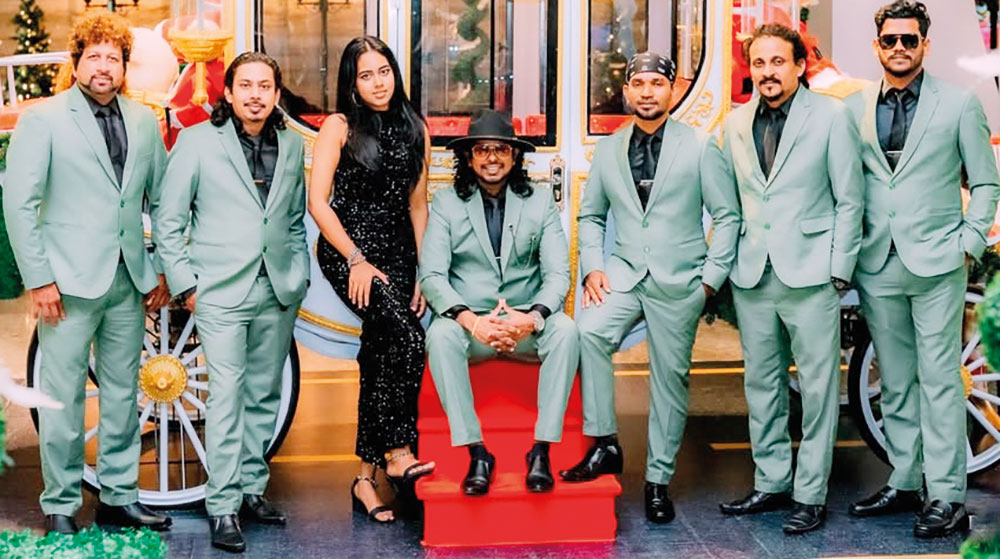
 This week, too, the spotlight is on an outfit that has gained popularity, mainly through social media.
Last week we had MISTER Band in our scene, and on 10th February, Yellow Beatz – both social media favourites.
Talento is a seven-piece band that plays all types of music, from the ‘60s to the modern tracks of today.
The band has reached many heights, since its inception in 2012, and has gained recognition as a leading wedding and dance band in the scene here.
The members that makeup the outfit have a solid musical background, which comes through years of hard work and dedication
Their portfolio of music contains a mix of both western and eastern songs and are carefully selected, they say, to match the requirements of the intended audience, occasion, or event.
Although the baila is a specialty, which is inherent to this group, that originates from Moratuwa, their repertoire is made up of a vast collection of love, classic, oldies and modern-day hits.
The musicians, who make up Talento, are:
Prabuddha Geetharuchi:

Geilee Fonseka: Dynamic and charismatic vocalist

Prabuddha Geetharuchi: The main man behind the band Talento
(Vocalist/ Frontman). He is an avid music enthusiast and was mentored by a lot of famous musicians, and trainers, since he was a child. Growing up with them influenced him to take on western songs, as well as other music styles. A Peterite, he is the main man behind the band Talento and is a versatile singer/entertainer who never fails to get the crowd going.
Geilee Fonseka (Vocals):
A dynamic and charismatic vocalist whose vibrant stage presence, and powerful voice, bring a fresh spark to every performance. Young, energetic, and musically refined, she is an artiste who effortlessly blends passion with precision – captivating audiences from the very first note. Blessed with an immense vocal range, Geilee is a truly versatile singer, confidently delivering Western and Eastern music across multiple languages and genres.
Chandana Perera (Drummer):
His expertise and exceptional skills have earned him recognition as one of the finest acoustic drummers in Sri Lanka. With over 40 tours under his belt, Chandana has demonstrated his dedication and passion for music, embodying the essential role of a drummer as the heartbeat of any band.
Harsha Soysa:
(Bassist/Vocalist). He a chorister of the western choir of St. Sebastian’s College, Moratuwa, who began his musical education under famous voice trainers, as well as bass guitar trainers in Sri Lanka. He has also performed at events overseas. He acts as the second singer of the band
Udara Jayakody:
(Keyboardist). He is also a qualified pianist, adding technical flavour to Talento’s music. His singing and harmonising skills are an extra asset to the band. From his childhood he has been a part of a number of orchestras as a pianist. He has also previously performed with several famous western bands.
Aruna Madushanka:
(Saxophonist). His proficiciency in playing various instruments, including the saxophone, soprano saxophone, and western flute, showcases his versatility as a musician, and his musical repertoire is further enhanced by his remarkable singing ability.
Prashan Pramuditha:
(Lead guitar). He has the ability to play different styles, both oriental and western music, and he also creates unique tones and patterns with the guitar..
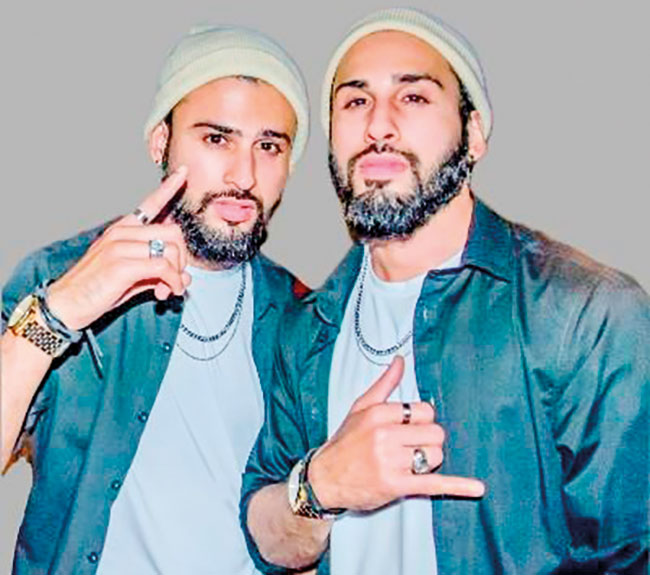
The JJ Twins, the Sri Lankan musical duo, performing in the Maldives, and known for blending R&B, Hip Hop, and Sri Lankan rhythms, thereby creating a unique sound, have come out with a brand-new single ‘Me Mawathe.’
In fact, it’s a very special milestone for the twin brothers, Julian and Jason Prins, as ‘Me Mawathe’ is their first ever Sinhala song!
‘Me Mawathe’ showcases a fresh new sound, while staying true to the signature harmony and emotion that their fans love.
This heartfelt track captures the beauty of love, journey, and connection, brought to life through powerful vocals and captivating melodies.
It marks an exciting new chapter for the JJ Twins as they expand their musical journey and connect with audiences in a whole new way.
Their recent album, ‘CONCLUDED,’ explores themes of love, heartbreak, and healing, and include hits like ‘Can’t Get You Off My Mind’ and ‘You Left Me Here to Die’ which showcase their emotional intensity.
Readers could stay connected and follow JJ Twins on social media for exclusive updates, behind-the-scenes moments, and upcoming releases:
Instagram: http://instagram.com/jjtwinsofficial
TikTok: http://tiktok.com/@jjtwinsmusic
Facebook: http://facebook.com/jjtwinssingers
YouTube: http://youtube.com/jjtwins
Six US soldiers killed in Iranian strike on Kuwait base

Israel attacks presidential office in Tehran as reported death toll in Iran rises to 787

Attorney At Law S K Sangakkara pasess away

SriLankan Airlines Update on Middle East Operations

Trump says Iran war projected to last 4 to 5 weeks, could go ‘far longer’

Qatar downs two Iranian fighter jets as conflict widens

‘Dates have the highest sugar content to fight Coronavirus’

Sunday Island 27 December – Headlines

#SundayIsland 17th December – Headlines

Sunday Island – 28th March

Sunday Island Headlines – 21 March

Sunday Island – 21st February – Headlines
-

 Opinion5 days ago
Jamming and re-setting the world: What is the role of Donald Trump?
-

 Features5 days ago
An innocent bystander or a passive onlooker?
-
 Features6 days ago
Ratmalana Airport: The Truth, The Whole Truth, And Nothing But The Truth
-

 Features2 days ago
Brilliant Navy officer no more
-

 Business7 days ago
Dialog partners with Xiaomi to introduce Redmi Note 15 5G Series in Sri Lanka
-

 Features7 days ago
Building on Sand: The Indian market trap
-
 Opinion7 days ago
Future must be won
-

 Opinion2 days ago
Sri Lanka – world’s worst facilities for cricket fans