
Features
The Decline and Fall of the British State

Part the First
By Michael Patrick O’Leary
There is a certain class of Sri Lankan citizen who believes that their country would be better if still ruled by the British as part of its benevolent Empire. This is pure fantasy because the Empire was never benevolent and there would be no chance of Britain ruling again in any of its former colonies. Today Britain cannot govern itself but retains its imperial arrogance in trying to tell the rest of the world how to conduct itself. The UK’s persistent criticisms of Sri Lanka at the UNHRC while ignoring its own misdeeds in recent times is an example of this arrogant impudence. I will not here go into the bungled invasions of Afghanistan and Iraq, the atrocities committed by British troops and the shambolic withdrawal.
Declining Years
I took an interest in UK and US politics from my early teens and later got an Honours degree in American Studies. I noticed even in the early 60s a vogue for writings about the decline of Britain. There was much lamentation about poor productivity, idle and obstructive workers, poor management, failing exports. Britain was much weakened by the effort put in to win the war against the Nazis and there was much resentment when the West German and Japanese economies began to do rather well while Britain agonized over poor GDP and balance of trade deficits and national debts.
The war would not have been won without the Empire but the country was so weakened by the war that it could no longer afford to run an empire. British troops, including young boys conscripted under National Service (luckily I was too young to enjoy that treat) continued to fight bloody colonial wars in Malaya and Cyprus, as well as helping the Americans out in Korea. Harold Wilson has not been given enough credit for keeping Britain out of Vietnam. The UK realized that it had to grant independence throughout the Empire. The Empire became the Commonwealth. Britain’s first colony, Ireland, became independent in 1922 and refused to join the Commonwealth. (It has still not joined, although other countries’ colonies such as Rwanda and Mozambique have. Ireland has also not joined NATO but has long been an enthusiastic member of the EU.) Ireland formally became a republic in 1949, a year after Ceylon becoming independent.
Good things happened such as the foundation of the National Health Service and the Welfare State but right wing critics saw these institutions as part of Britain’s problem rather than a glorious achievement. Those views have become stronger today.
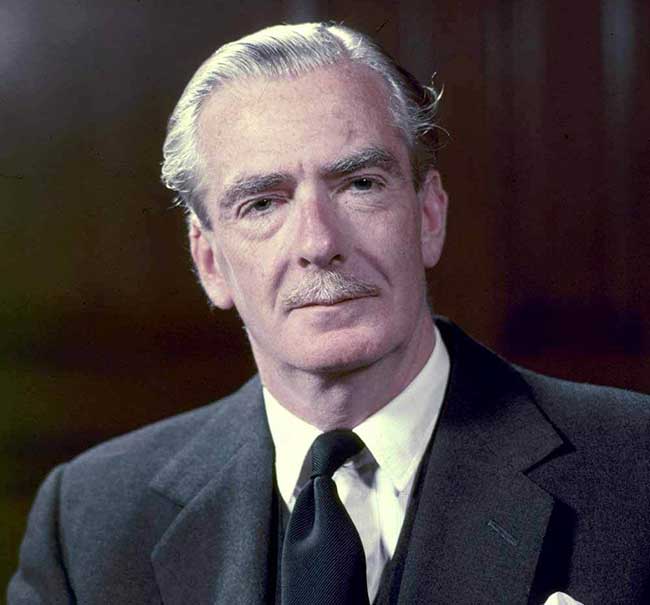
Britain still tried to punch above its weight. The year 1956 is seen as a symbolic marker of Britain’s decline. Sir Anthony Eden was a weak but arrogant prime minister. When Colonel Nasser took over the Suez Canal, Eden, expecting American support, sent in British troops to take it back. Egypt had not been officially a British colony, but it was one of those countries, Argentina was another, where Britain exerted undue influence. British intervention in Suez went very badly and the nation’s reputation never recovered.
The IMF recently forecast that the UK GDP would shrink by 0.6 % over the course of this year, making it the only country in the G7 to fall into recession. This compared with 1.2 % growth in Canada, 1 % in the US and Japan, 0.9 % in France, 0.1 % in Italy and 0 % in Germany. Even Russia’s heavily sanctioned economy is expected to expand by 1 % this year.
Industrial Relations
Popular culture, with films like I’m All Right Jack, portrayed the British worker as an obstructive layabout ready to down tools at the slightest excuse. The Callaghan Labour government lost power to Thatcher’s Conservatives in 1979 because of the Winter of Discontent with local authority workers among those going on strike leaving corpses piled up in morgues and rubbish filling the streets. I remember going to see Robert Altman’s film A Wedding at a Manchester cinema and experiencing a large rat running across my foot.
Today’s deputy prime minister (he could be gone by the time this is published) contributed to a book, Britannia Unchained, which carried on the theme of lazy British workers. Former short-lived pm Liz Truss also contributed to the book.
Look who is striking today. Nurses and medical staff were applauded during the worst days of the pandemic but the government continues to cut their pay and will not even talk to them. Sunak’s contribution to the debate is to rehearse the old canard of the Labour Party being in hock to union paymasters.
The Office for National Statistics confirms that 2022 was the worst period of strike action since 1989 – with 850,000 working days lost in December alone. 4.1 million working days were lost to strikes in 1989.
NHS
I spent most of 2022 in the UK and saw and experienced the difficulties people have dealing with the NHS. Rather than try to describe the problems myself. I will rely on the BMA (British Medical Association). On their website they list the following:
Chronic under-staffing – Staff shortages have been growing in the NHS for years. This has been driven by inadequate workforce planning and lack of government accountability – including insufficient funding and infrastructure to train enough new doctors. This is exacerbated by poor retention. Demoralized staff do not want to stay.
Declining well-being – Excessive workloads are normalized by continuously requiring overstretched staff to fill gaps that should not exist. The physical and emotional toll includes rising prevalence of stress, fatigue, burnout as well as suffering mental health and well-being through chronic stress
Growing pressure on general practice – Stagnation in the growth of the GP workforce has meant the average number of patients per FTE (full-time equivalent) GP has increased by 15% since 2015. This puts increasing clinical and administrative burden on them and other practice staff.
Insufficient funding – Recent funding injections on the back of below-average growth in the health budget in recent years.
Deteriorating fabric – After years of insufficient capital spending, parts of the NHS estate are increasingly unfit for purpose. The cost of bringing deteriorating assets back to suitable working order (known as the maintenance backlog) rises each year.
Shortage of beds -The number of general and acute beds available in English hospitals has been rapidly falling since 2010. The UK now has one of the lowest number of beds per head in Europe, an insufficient critical care capacity that has been exposed by the pandemic.
Long waits and waiting lists for patients – In recent years, patients have been waiting longer for emergency, routine and cancer treatment. The NHS has been increasingly struggling to treat patients within safe operational standards.
To be continued


 by Prof. C. A. Saliya
(The fourth instalment in a five-part series on
the business of gambling, legal and illegal)
Here’s a puzzle worth thinking about. For well over a century, Sri Lankan law has treated a village card game as a criminal offence, punishable by fine or imprisonment. In that same period, it has treated betting on horse racing as a perfectly legitimate, taxable business, one the state has actively collected revenue from for generations, under a Horse Racing Betting Ordinance older than most of the country’s other gambling law. Same basic activity, risking money on an uncertain outcome, one version illegal since 1889, the other legal the entire time.
Why? Follow the money, and the class lines, back to the colonial era. Horse racing arrived in Ceylon as a pastime of the British administrative and planter class, a “sport,” played and watched at clubs and racecourses, with betting bolted on as a respectable, even sophisticated, accompaniment. Card games played by ordinary people in villages, on the other hand, were exactly the kind of activity the same colonial authorities were eager to label a vice and criminalise. It’s the same pattern we saw with casinos in Part 2: gambling done by the wealthy tends to get called a sport, a tradition, or an investment. Gambling done by everyone else tends to get called a crime.
That history matters, but the economics of horse racing betting matter just as much, because once you understand how a bookmaker actually prices a race, you understand something that applies to almost every form of sports betting on Earth, from a Colombo racecourse to a global football sportsbook.
How a bookmaker guarantees a profit
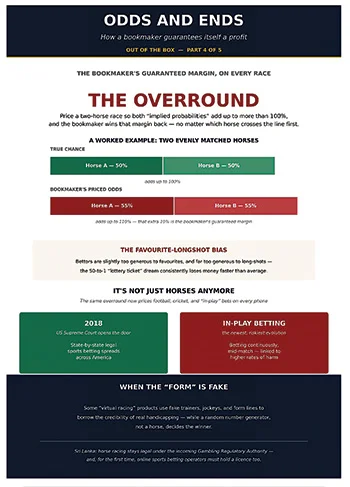
Imagine a simple race with only two horses running, and imagine, just for the sake of the maths, that both horses genuinely have an exactly 50-50 chance of winning. A perfectly fair bookmaker, offering perfectly fair odds, would price both horses at even money: bet 100 rupees, win 100 rupees plus your stake back, on either horse.
No real bookmaker does this. Instead, they’ll price both horses slightly below their true odds, say, offering odds that imply each horse has a 55 percent chance of winning, even though the true chance is only 50 percent. Add those two implied percentages together and you get 110 percent, not 100. That extra 10 percent is called the “overround,” or sometimes the “vig” (short for vigorish), and it is the bookmaker’s guaranteed margin, built directly into the prices on the board before a single horse leaves the starting gate. It doesn’t matter which horse wins. The bookmaker’s overround wins regardless, on every single race, all day, every day.
There’s a second, subtler effect that decades of studying racing data has confirmed again and again, all over the world: bettors as a group are slightly too generous to favourites and slightly too generous to long-shots. Favourites tend to win a bit more often than their odds suggest they should, meaning betting on the favourite loses you money slightly more slowly than average over the long run, while betting on the rank outsider, the 50-to-1 shot that everyone secretly dreams will come in, loses you money considerably faster than average, because the public consistently overpays for that lottery-ticket dream. Bookmakers know this. It’s baked into their pricing, and it has a name: the favourite-longshot bias.
It’s not just horses anymore
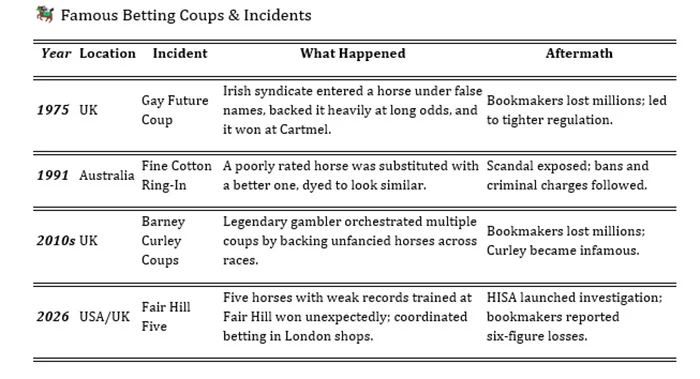
Horse racing used to be the flagship product of the entire betting industry. It still matters enormously, including here in Sri Lanka, where it remains one of the very few genuinely legal betting products, but globally, its share of the total betting market has shrunk as sports betting on football, cricket, tennis and everything else has exploded, especially since a landmark 2018 United States Supreme Court ruling opened the door to state-by-state legal sports betting across America.
The newest and, frankly, most dangerous evolution of all this is “in-play” or “live” betting, placing bets not before a match starts, but continuously, in real time, on what happens in the next five minutes: the next corner, the next wicket, the next point. Regulators studying gambling harm consistently find that in-play betting produces worse outcomes fo bettors than traditional pre-match betting, precisely because there are so many more moments to place a bet, so much less time to think between decisions, and so much more opportunity to chase a loss five minutes after you made it.
Where the skill actually is, and isn’t
 Now, a confession from this column, which has spent plenty of ink over the years analysing racecards: professional handicapping, studying trainer and jockey form, course and distance records, the draw, the going, the weight a horse is carrying, is a genuinely real skill, and it can meaningfully improve your chances of picking a winner compared to a random guess. That’s not a myth. Good handicapping works, in the narrow sense that it improves your odds of identifying the horse most likely to win any given race.
But “improving your odds of picking a winner” and “beating the house edge” are two completely different things, and this is the single most important distinction in this entire series. Even the sharpest, most statistically literate handicapper in the country is still betting into odds that already have the bookmaker’s overround baked in. Skill can narrow the gap. It essentially never closes it completely over the long run, for the simple reason that the house built the gap on purpose, and prices every race to make sure it stays open.
When the “form” is fake: Virtual meetings
One genuinely strange wrinkle worth flagging here: some betting products dress themselves up in the full costume of horse racing, trainer names, jockey silks, past form lines, even fake race commentary, while actually being nothing more than a random number generator behind the scenes, deciding the winner with no horses, no trainers, and no real race involved at all; just a computer simulation.
These “virtual racing” products exist specifically to borrow the credibility that real handicapping has earned over more than a century, and apply it to something that has no skill element whatsoever, chance and chance alone. It’s worth knowing the difference, because the two products look almost identical on a betting slip, and only one of them rewards the kind of analysis this column has always tried to teach.
Are manipulations possible?
 Bookmakers don’t secretly insert horses into races to beat favorites instead they simply publish odds based on form and betting demand. The real risk comes from insiders with knowledge, such as trainers or syndicates, who can exploit undervalued horses to stage betting coups. These events are rare but welldocumented, leaving a lasting mark on regulation. In the past, bookmakers were reactive, allowing coups to succeed before odds adjusted. Today, they are far more proactive, using AI systems and integrity units to detect anomalies quickly. Even so, insider coups still occur, though they are rarer and swiftly investigated. The balance has shifted: bookmakers now lose less often, but punters continue to chase “value” in overlooked horses, keeping the contest alive between house margins and human ingenuity.
Betting Coups: When the Odds Tilt
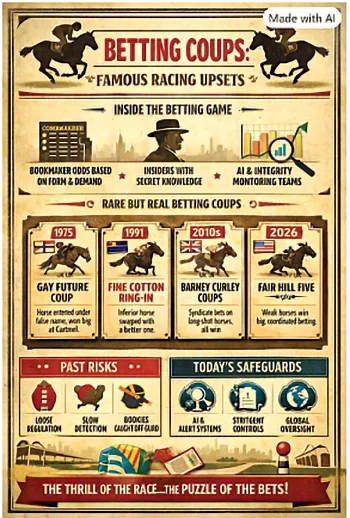
Horse racing has always carried a mystique of glamour and risk, but behind the silks and starting gates lies a business model designed to ensure bookmakers never lose. As explained earlier, the “overround”, that invisible margin built into every price, guarantees profit before the first horse even breaks stride. Yet history shows that punters, syndicates, and insiders have occasionally turned the tables, staging coups that shook the industry and exposed its vulnerabilities. Timeline of such incidents are shown in the Table.
These stories remind us that while bookmakers build their margins into every race, the human element, ambition, deception, or sheer audacity, can still disrupt the system. Today’s safeguards, from AIdriven monitoring to integrity units, make coups rarer, but not impossible. And that tension between certainty and surprise is precisely what keeps the public fascinated. Horse racing is not just about speed and stamina; it is about the eternal contest between the house edge and human ingenuity.
The road ahead for racing in Sri Lanka
Horse racing’s legal status in Sri Lanka looks set to remain intact under the new Gambling Regulatory Authority, folded alongside casinos and licensed online sports betting operators. What’s new is that offshore online platforms, which have long taken bets from Sri Lankan customers without local approval, are now—at least on paper—being brought under the same regulatory umbrella as the racecourse. Whether this shift results in genuine oversight or simply adds a licence requirement that foreign operators quietly ignore remains an open question, one to be explored in the final instalment of this series as we assess what fair, joinedup gambling regulation would truly require.
Next week:
Part 5, the final instalment, Closing the Book, on what real gambling reform would look like, and whether Sri Lanka’s new law gets us there.
(Prof. C. A. Saliya, is a charted accountant, academic, researcher and former banker. He is the author of SAMAJA GAVESHAKAYA and Springer Publication DOING SOCIAL RESEARCH. He can be contacted at saliya.ca@gmail.com. The views expressed in this article are his own and do not necessarily represent those of the organisations with which he is affiliated.)
An unhealthy politics still rents the finished war — and that is why society stays divided
by Mahil Dole
Senior Superintendent of
Police (Retd.)
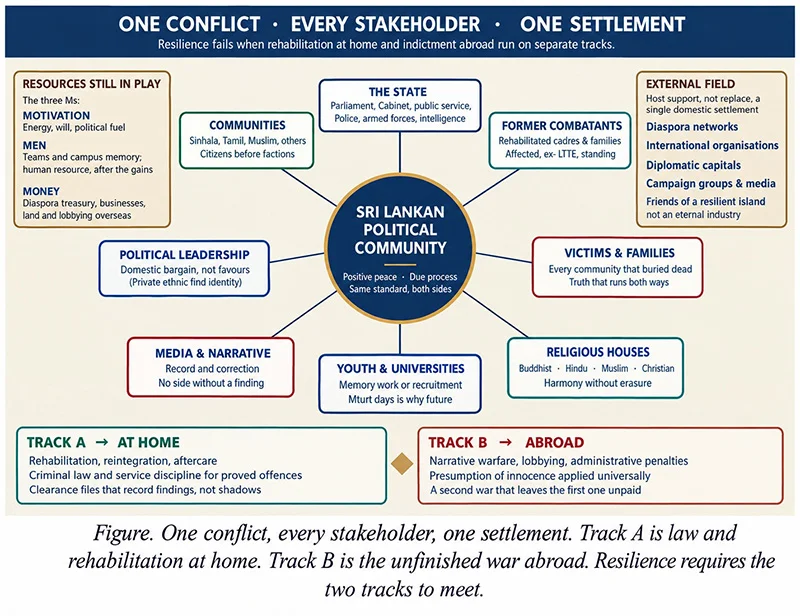
True national stability requires a transition this country has postponed for seventeen years: from a military victory to civic reforms that penalise divisive actors and build a unified identity. Last week showed, with unusual clarity, why that transition keeps failing. It was not a failure of slogans. It was a failure of consistency. Democracy, in the narrow sense of ballots and benches, is still standing. What is unhealthy is the use to which those ballots and benches are put. An unhealthy politics does not close a war. It rents it.
Three scenes, one week
In Chavakachcheri, President Anura Kumara Dissanayake told a housing gathering that racism would not be tolerated in any form, against Sinhalese, Tamils or Muslims, in the North, South or East. He named the old kindling: heritage sites and religious places still used to ignite tension. He spoke of houses for the displaced and a stadium for children in Jaffna. Those are the right words for a head of State. A country that meant them would be doing the unglamorous work of peace: making the next generation less useful to anyone who needs a quarrel.
In Anuradhapura, on an SLPP stage, a different performance was under way. Jaffna Member of Parliament Archchuna Ramanathan referred to himself as a “Tiger” and to the elected President as a “fox”. The name of a proscribed organisation was spoken in a town that carries the memory of the sacred-city attack. Party figures who have spent years treating any mention of the LTTE as contamination were reported to have cheered. By Monday a civil-society group styling itself the “Joint Opposition” had taken a complaint to the CID. The Police confirmed receipt. Opposition voices had already raised the alarm on Sunday.
Let the record be exact, because the rumour was not. The complaint now on the CID file is that remarks on an SLPP stage, and the cheer that met them, crossed from political insult toward promotion of a banned group. The government, for its part, has said there is no room for LTTE promotion and that remembrance of the dead is another matter. Those are two different files. Mixing them is itself a kind of politics.
A third voice belonged to the same week. Professor Savitri Goonesekere spoke with the clarity that public law, when it is still a discipline and not a campaign colour, can still produce: thoughtful, articulate, addressed to the country rather than to a faction. The speech deserves the praise it has received. The caution it invites is as important as the praise. Worthy slogans, unity, an end to racism, one law for all, are easily hijacked. They are most easily hijacked by those whose own conduct is under scrutiny, and who need the language of virtue more than they need the discipline of it. A speech of that quality raises the standard. It does not lower the duty to watch who picks the slogan up next.
What an unhealthy democracy does
People vote. Governments change. Parliament sits. That is not a failed democracy in the textbook sense. It is also not a healthy one. A healthy system converts a military victory into civic rules that bind the winners as well as the defeated, and that make division expensive. An unhealthy system keeps the war useful. It farms fear. It treats identity as a turnout machine. It issues a guarantee against racism in one district and applauds a banned name in another. That practice is not a lapse of taste. It is a structural reason society remains split.
Duplicity is the method. The same platform that built a career on the defeat of terrorism can, when the arithmetic of a rally requires it, tolerate the self-description of a Tiger. The same voices that demand a ban on LTTE propaganda can discover, the following week, that a rival’s meeting is the real offence. The same guarantee against racism can be issued in the North on one day and left unenforced in the South on the next. Two standards, again — not between Colombo and an overseas capital this time, but between the microphone and the statute book.
The LTTE remains a proscribed organisation. That is law, not a mood. Remembrance of the dead is a human act and must be protected as such. Glorification of the organisation that killed them is not remembrance. A serious State draws that line once, publishes it, and applies it without regard to who is speaking and which party owns the stage. Selective outrage is not law enforcement. It is campaigning.
The same is true of the word “racism”. No President can abolish it by declaring that he will not tolerate it. The declaration is necessary. It is not sufficient. Racism in this country has rarely been only a private vice. It has been a public business model: a way to harvest fear, postpone reform, and keep a constituency enlisted after the guns fell silent. Heritage sites and religious places become kindling because someone lights them. Universities become martyr theatres because someone books the hall. A Member of Parliament can call himself a Tiger on a southern stage because someone calculated that the cheer would be louder than the cost.
Why this divides a people
Division is not produced only by the last war and not only by those who live outside the island. It is produced, week by week, by a politics that cannot address a crowd except through Sinhala, Tamil or Muslim injury. A politics of that kind is not representing a community. It is farming one. The young, who have no memory of the last bunker, inherit the quarrel instead of a country. Serving officers watch the treatment of their predecessors and the theatre of their politicians and draw a rational conclusion about what the country values. Families who lost their own to the LTTE hear “Tiger” cheered and conclude that their dead have been repriced. Families who lost their own to the State hear a pledge against racism and wait to see whether the pledge runs south as well as north.
That is how an interval is mistaken for peace. The guns are silent. The inventory is not. “Tiger” and “traitor”, “racist” and “patriot”, remain stock in trade. So long as those words pay, in applause, in airtime, in a complaint that wounds an opponent, someone will keep them in circulation. Professor Goonesekere’s warning sits exactly there. Leadership means going beyond rhetoric. The law is not written for those who already respect it. It is written for those who violate it. When violation carries no cost, the slogan itself becomes a form of impunity.
What civic reform would actually look like
The work is unglamorous, which is why it is avoided. First, equal enforcement. If the organisation is proscribed, the prohibition travels with the speaker. An SLPP stage in Anuradhapura and a commemoration in the North are not two legal systems. The CID complaint now on the file should be treated as a test of that rule, not as a trophy for whoever lodged it.
Second, an end to ethnic first-identity as an electoral method. A civic identity, Sri Lankan first, faith and language held without being turned into a passport, will not appear by exhortation. It appears when the dividend for division falls and the dividend for competence rises.
Third, a cost for lighting kindling. Heritage sites and religious places are not campaign props. Universities are not martyr calendars. Media that carry a charge must carry the correction. Records that hold an untested allegation must not shadow a working life after the allegation has failed.
Fourth, one standard for those who served the State and those who fought it. Wrongdoers on every side belong in a court, not in a diplomatic weather system and not in a rally chant. Collective punishment of a profession is not accountability. A cheer for a banned name is not unity. A slogan against racism is not a policy until it binds the speaker’s own side.
None of this requires a new brand of commission. It requires a State that stops allowing division to be a career. South Africa’s imperfect bargain at least tried to bind both sides inside one process. Colombia wrote one jurisdiction for guerrillas, paramilitaries and State forces. We have preferred two international ledgers and a third, domestic one on which the war is rented out by the evening. Last week’s scenes, a guarantee in Chavakachcheri, a cheer in Anuradhapura, a serious speech that must not be stolen, are not opposites. They are the same unfinished settlement, spoken in three registers.
The President’s sentence should be kept, and then made expensive to break. Professor Goonesekere’s standard should be kept, and then applied to those who clap for it. Racism will not be defeated by a rally, and a proscribed organisation will not be dissolved by a complaint. They will be reduced only when the State, and the parties that live off the State, stop treating the finished war as inventory. True national stability is not the memory of a victory. It is the construction of a civic order that no longer needs that victory to be refought, in Anuradhapura or in Geneva, in order for someone to remain relevant.
The writer is a retired Senior Superintendent of Police who served in intelligence and counter-terrorism. He is the author of Security Beyond Enforcement: Practical Approaches for a Safer Nation. This column is a stand-alone extension of an earlier argument on two standards in one conflict. Views expressed are his own.
by Jehan Perera
International Peace Day was observed on 21 September. It finds Sri Lanka with a genuine achievement to record and a demanding test to meet. The UN’s theme this year was “Invest in Peace: For Everyone, Everywhere, Every Day.” It also honoured the “everyday architects of peace”—people driving local action and building a lasting peace from the ground up. In the 2026 Global Peace Index, Sri Lanka rose 30 places, from 97th to 67th among 163 countries. Over the same period, global peacefulness declined for the twelfth consecutive year to its lowest level since the index began, and South Asia suffered the sharpest regional deterioration. The test is whether the government will protect the civic space in which those architects of peace work.
Sri Lanka’s improvement is real and deserves acknowledgement. In this year’s review, issued a few weeks ago, the UN High Commissioner for Human Rights acknowledged progress in the form of action against corruption, arrests and investigations linked to political killings, enforced disappearances and the 2019 Easter Sunday attacks, and continued official denunciation of racism. A ranking, however, records conditions at a particular moment. It does not guarantee that they will last. Sustainable peace will depend on three factors. These are whether the government addresses the unresolved causes of conflict, whether it strengthens accountability for past and present abuses, and whether it protects the civic space in which peace is built from below. On the first two the record is incomplete. On the third, the draft NGO law threatens to weaken the very organisations that press for the other two.
What holds Sri Lanka back from a higher place are the same things that fed the war at home and also feed international conflict that rages elsewhere in the world. These are racism or ethnic nationalism that is narrow-focused, corruption and lawlessness. Equality, accountability and the rule of law are their remedies. The present government has committed itself to these, and is a significant improvement over governments of the recent past. But these pillars are not held up by governments alone. Peace is made in villages, workplaces and university campuses. It is made by families who insist on the truth about their disappeared, by journalists and lawyers who expose abuse, and by community organisations that bring Tamils, Muslims and Sinhalese into practical cooperation.
Unfinished Work
The UN High Commissioner’s report to the current Human Rights Council session, covering October 2025 to July 2026, shows how much remains to be done. The Prevention of Terrorism Act is still being applied, producing arbitrary arrests and long detention without charge. The report calls for a moratorium pending repeal and for the release of long-term detainees. Military-occupied land has not been released, memorialisation lacks support, and tensions over land and religious sites persist. The Batticaloa district illustrates how such problems endure. In the past three years, two Presidents, Ranil Wickremesinghe and Anura Kumara Dissanayake, have visited and instructed that the dispute over grazing land in Mailaththamadu and Mathavanai be resolved. It is a dispute between Tamil cattle farmers and outside Sinhala cultivators, and it has not been resolved. When two Presidents issue instructions and nothing changes, the fault lies in the machinery of State. An unresolved dispute does not stand still. It hardens into the next grievance.
Accountability shows the same pattern. The report documents torture and deaths in custody, and surveillance and intimidation of activists, journalists and civil society. Serious cases remain stalled for years, among them the killing of seventeen aid workers of Action Contre la Faim in Muttur two decades ago. Sharper still is the case of the Eastern University refugee camp at Vantharamoolai, where in 1990 the army took away 158 persons in a single day. They were never seen again. The camp’s officer-in-charge, Dr T. Jayasingam, later Vice Chancellor of the university, identified the officers responsible. More than three decades on, those officers have not been questioned. These cases are still remembered because families, survivors and independent witnesses have refused to let them be forgotten. Meanwhile several commissions of inquiry have completed their investigations but nothing further has happened.
What South Africa, Argentina and other post-conflict societies have found indispensable are four pillars of what is called “Transitional Justice” which are truth, accountability, reparations and non-recurrence. In Sri Lanka’s circumstances, truth means credible, independent investigation of what happened to the disappeared, and support for memorialisation. Accountability means prosecuting Muttur, Vantharamoolai and comparable cases, and removing credibly accused persons from senior office. Reparations mean compensation for victims and the return of military-held land. Non-recurrence means repealing the Prevention of Terrorism Act, releasing those held under it in the meantime, and resolving local disputes such as Mailaththamadu before delay hardens them. A country that buries its past does not escape it. The past returns in the next generation.
Civil Society
It is against this background that the draft NGO law is most troubling. The proposed legislation contains sweeping provisions for State oversight and control of civil society organisations. Among these are enforcing a licensing requirement on NGOs, which is to be renewed every three years, and severe penalties for not submitting reports on time, or for spending on emergency flood relief (for instance) when the NGOs mandate is peacebuilding (as an example) with possible sanctions including deregistration and having to shut down. Civil society groups have warned that it would confer excessive discretion over their registration and operations. Officials in Sri Lanka have abused such powers in the past. Additional power without effective checks invites further abuse. Sound regulation would have clear criteria for registration, an independent registrar and a right of appeal to the courts. What cannot be justified is a regime in which registration becomes a licence to be withheld from organisations that scrutinise policy, expose abuses or advocate for the rights of citizens.
Democracy is based on checks and balances. Those who press for accountability are part of those checks. The contradiction is plain. A government that has pledged accountability, equality and the rule of law ought not to be preparing to weaken the very organisations that press for their fulfilment. The organisations most exposed are those working on disappearances, land, memorialisation and reconciliation in the North and East, where the State’s record is weakest and the need for independent witnesses greatest. Silencing them would not remove the grievances they document. It would remove the channel through which those grievances are addressed peacefully. The government appears to be relenting, which is welcome, but a pause is not a withdrawal. The bill should be withdrawn and any replacement drafted in genuine consultation with those it would govern.
Investment in peace as called for by the UN in its International Peace Day theme implies commitment over time, with returns that come slowly. Sri Lanka’s 30-place rise on the Global Peace Index is a first dividend and nothing more. It can be built upon only if the government matches its commitments with action: withdrawing or fundamentally redrafting the NGO law, repealing or suspending the Prevention of Terrorism Act, and bringing Muttur, Vantharamoolai and Mailaththamadu to resolution. A higher place in a global index is not a certificate of success. Sri Lanka’s higher ranking is an encouraging start, but it will endure only if the space in which citizens speak, question and organise is protected. Peace is built from below, and a government that is serious about it will treat civil society as a partner rather than a threat.

Will Jacks five-for seals comfortable England defence of 265

Showers above 100 mm are likely in the Western, Sabaragamuwa, Central and North-western provinces and in Galle and Matara Districts

Mastermind Naufer Moulavi among 15 found guilty

No referendum needed for passage of 22 A: SC

One clause in Anti-Corruption (Amendment) Bill requires referendu: SC

NSC issues humanitarian appeal on behalf of Sri Lankan facing death sentence in Saudi Arabia

‘Dates have the highest sugar content to fight Coronavirus’

Sunday Island 27 December – Headlines

#SundayIsland 17th December – Headlines

Sunday Island – 28th March

Sunday Island Headlines – 21 March

Sunday Island – 21st February – Headlines
-

 News6 days ago
US embassy won’t comment on IGP’s probe into joint drug raid
-

 News4 days ago
Shanakiyan urges urgent action over reported death sentence for Lankan in Saudi Arabia
-

 News5 days ago
Bid for Basil’s extradition nears final stage: Police
-

 Business6 days ago
All-new Bolero MaXX unveiled in Sri Lanka
-

 News3 days ago
Namal Rajapaksa Buddhist gambit fails, bail denied
-
 Opinion6 days ago
A journalist who wrote across the divide
-

 Features3 days ago
Why the spelling Sri Lankan names in English vary
-

 Features3 days ago
Three bands, a new identity: Sri Lankan wolf snake recognised as distinct species