
Features
The Collapse of the Old Guard and the Wait for the Young Turks


by Rajan Philips
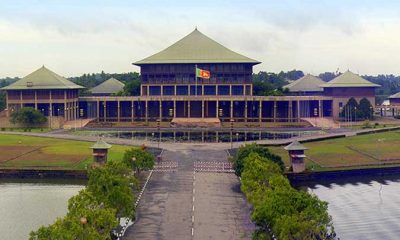
President Wickremesinghe’s political days are numbered in more ways than one. There are virtually none left for Mahinda Rajapaksa. The oldest of them, R. Sampanthan, is under pressure to formally retire. Vasudeva Nanayakkara has not been heard in a while, but he too belongs to the cohort of politicians who entered parliament in 1970 or 1977. They respectively came from Colombo, Hambantota, Galle/Kiriella and Trincomalee, and belonged to the UNP, the SLFP, the TULF and the LSSP – four parties that spanned the entire political spectrum of Sri Lanka in the 20th century.
Vasudeva Nanayakkara was 30 years old, and Mahinda Rajapaksa was 25, when they entered parliament in 1970. Ranil Wickremesinghe was 28 and Sampanthan was 44 when they entered parliament seven years later in 1977. As they are on their way out they are also symptomatic of the state of their political parties, if not the state of politics in the country. Not to mention the economy.
Not many are waiting in the wings to replace them. The public focus is on two men: Anura Kumara Dissanayake (55) and Sajith Premadasa (56). The latter leads the SJB with a larger representation in parliament and is the leader of the opposition. The former has only two JVP/NPP MPs with him in parliament, but is steadily rising in political popularity in the country. Both are untested in national leadership, and they are waiting for their turn at a time when the country is waiting to overcome the most trying challenges it has ever faced in its modern history.
Historical Parallels
Historical parallels may not mean much but are useful to assess the seriousness of the current challenges and the scarceness of national capacity to meet them. Politics in 1970 and 1977 was both energizing and optimistic with two opposing visions that were advocated by impressively talented leaders. The public was engaged and had clear alternative choices. Neither is the case now. That does not mean either Dissanayake or Premadasa cannot mobilize their organizations and rise to the occasion. It only means that the onus is on them to show what they are made of and what teams they will assemble for the next parliament – teams with depths of talent and dedication, and nothing of the corrupt and the incompetent. The time for demonstration is now, well in advance of whatever election that comes first sometimes next year.
Another parallel can be drawn from the time of independence when political competition was between DS Senanayake, who was emerging as the elder statesman – from being nobody to somebody, as Kumari Jayawardena has chronicled, and the young Turks of the time – SWRD Bandaranaike, GG Ponnambalam and Philip Gunawardena. For nearly 15 years preceding independence, the three men, with remarkable abilities and even more remarkable ambitions, had been stalking DS Senanayake to wrest control of the country’s political leadership. Each was on his own path that was exclusive to himself either egotistically or ideologically. Yet their politics was of a high order.
SWRD was the centrist of the three, jostling for position both within and outside the orbit of DS Senanayake, discreetly building his independent base through the Sinhala Maha Sabha, and being strategically ambivalent in confronting colonial rule. GG Ponnambalam was unabashedly pro-colonial and was trying to project himself as the representational champion of the minorities with his technically sound but politically untenable 50-50 cry. Philip Gunawardena was the implacable anti-imperialist, cantankerous by nature, but yet the inspirational leader of Sri Lanka’s first political party, the LSSP.
What was common to all three men was that each was convinced that he was far more able and equipped for political leadership than DS Senanayake during what were clearly the twilight years of colonial rule. But the wily old Senanayake bested them all. Bandaranaike and Ponnambalam became Ministers in the first Senanayake cabinet, although Mr. Bandaranaike would soon leave to set up his own political party, the SLFP that became his vehicle to power in 1956. Ponnambalam dazzled for a while, but his fortunes dwindled soon after DS Senanayake’s sudden death in 1952. Philip became isolated even within the left movement and except for a brief cameo as a consequential cabinet minister in 1956, his early promises gradually evaporated.
Contrast DS Senanayake and his detractors with Ranil Wickremesinghe and his rivals. Nothing more needs to be said. Or contrast the promises of that time with the predicaments of today. The predicaments that our current contenders for power, Anura Kumara Dissanayake and Sajith Premadasa, have to deal with had their origins in the political questions that preoccupied the time of independence and the years after it. The 20th century legacies of the constitution, the ethnic question and the economy are haunting us still.
20th Century Legacies
First, there was and there is, the constitution. Independence arrived on the back of a new constitution, the Soulbury Constitution; rather, the Jennings Constitution. Dr. Nihal Jayawickrama recently described it as the finest of the three constitutions we have had over 75 years. The late Newton Gunasinghe, Marxist and Socialist, used to say the same thing. Here we are today debating the possibility of reverting back to parliamentary democracy that characterized the Jennings Constitution, and jettisoning the current presidential system that is enshrined by the Jayewardene Constitution.
Second, and inextricably tied to the constitution was, and is, the ethnic question. The Jennings Constitution was predicated on what AJ Wilson called the “communal compact,” a supposed understanding between the leaders of the different ethnic communities about the constitutional safeguards for minority rights.
The safeguards were primarily Section 29 of the Constitution, public sector hiring, and the formula for political representation based on population and electoral areas. As it turned out, the safeguards were breached almost from the morrow of independence. The judiciary was independent, but often sided with the government on constitutional questions.
The first breach was the disenfranchisement of the estate Tamils soon after independence. The mass of stateless people in the estates along with the mass of settlers from the south colonizing the eastern province, totally invalidated the constitutional formula for minority representation in parliament. Then came the language question and the opening of the floodgates first in public sector hiring and later in university admissions. The 1972 and 1978 constitutions simply removed the pretense of safeguards that the 1947 constitution had included in its provisions.
The 13th Amendment to the current Constitution belatedly addressed the earlier breaches, but there is more debate about 13A-plus than there is real commitment to implementing what is already part of the constitution. In addition to the 13th Amendment, the citizenship question of the estate Tamils has also been ‘resolved.’ There was never going to be an equitable resolution after nearly half the estate population was repatriated to India, but there is now some finality to it.
It so happens that this month of November marks the bicentenary of the first arrival of the ancestors of the estate Tamils as indentured labourers from Tamil Nadu. The have been commemorations and celebrations throughout this year under the rubric, “Naam 200” (We are 200), but the most recent one at the Sugathadasa Stadium in Colombo would seem to have bordered on the farcical.
The event was organized under the auspices of Jeevan Thondaman in his capacity as Minister of Water Supply and Estate Infrastructure Development (another instance of Ranil Wickremesinghe’s bizarre mixing of ministerial portfolios). More famously, the young Thondaman is the grandson of the CWC patriarch, the late S. Thondaman. The event had more to do with who was invited and who was excluded, and less to with the people on the estates. And the invitations were selectively extended to the BJP in India and the BJP put on a better show in Colombo than it could ever do in Chennai.
The resolution of the citizenship of the estate Tamils, the emergence of territorially defined Muslim political parties, and the exodus of Sri Lankan Tamils, have transformed the ethnic question from what it was for most of the 20th century. The Sri Lankan Tamils are no longer the ‘majority’ in the minority question. The tri-lingual fluency of the Muslims and the estate Tamils is also transforming the linguistic landscape of the island. The retirement of the TNA leader, R. Sampanthan will create its own unique vacuum. President Wickremesinghe tried to fast track reconciliation, but his efforts were undone because his motives were self-serving.
It was known then that it was Sampanthan who persuaded Ranil Wickremesinghe to support Maithripala Sirisena as the common opposition candidate for the 2015 presidential election. Now, there are no indications as to which way the minority political parties will sway, and what offers will be made by Anura Kumara Dissanayake or Sajith Premadasa to make them (minorities) sway their way.
The elephant in the room of course is the economy. It was the most promising of all the prospects at the time of independence. Today it is biggest burden on the country and its future. Ranil Wickremesinghe often brags about the state of the economy under DS Senanayake, even though much of the economy at that time was leftover from colonial rule. Anura Kumara Dissanayake, on the other hand, once blamed the entire political history after independence for the economic mess that Gotabaya Rajapaksa singlehandedly created.
Mr. Dissanayake’s rhetoric was obviously over the top although it was understandable in the context of his insisting two years ago that the JVP/NPP was ready to take over the leadership of the country. Now that Mr. Dissanayake is becoming a real contender for power, the people will expect to hear from him as much substance as political rhetoric. There will be similar expectations and pressure on Sajith Premadasa who is currently trailing the JVP leader by some distance in opinion polling. It is always a long way to power. The journey is still starting.








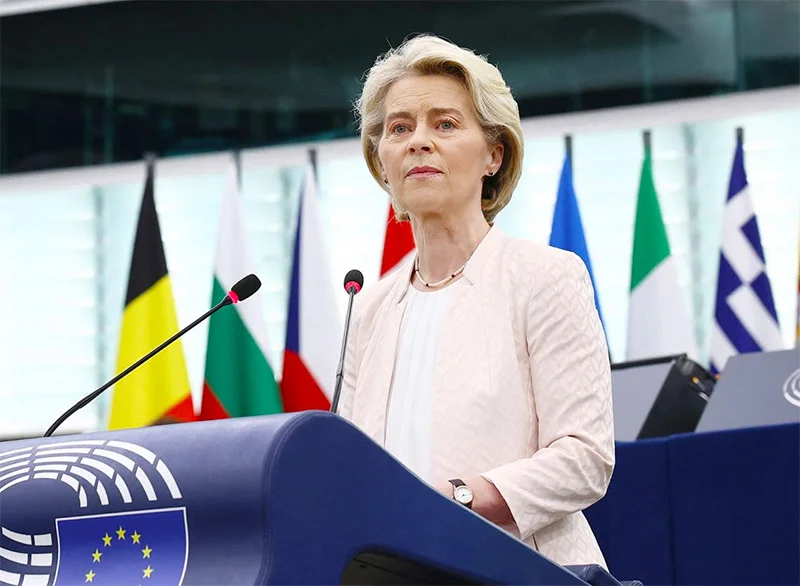
 European Commission President Ursula von der Leyen addressing the World Economic Forum in Davos, Switzerland on Tuesday put forward the EU’s viewpoint on current questions in international politics with a clarity, coherence and eloquence that was noteworthy. Essentially, she aimed to leave no one in doubt that a ‘new form of European independence’ had emerged and that European solidarity was at a peak.
These comments emerge against the backdrop of speculation in some international quarters that the Post-World War Two global political and economic order is unraveling. For example, if there was a general tacit presumption that US- Western European ties in particular were more or less rock-solid, that proposition apparently could no longer be taken for granted.
For instance, while US President Donald Trump is on record that he would bring Greenland under US administrative control even by using force against any opposition, if necessary, the EU Commission President was forthright that the EU stood for Greenland’s continued sovereignty and independence.
In fact at the time of writing, small military contingents from France, Germany, Sweden, Norway and the Netherlands are reportedly already in Greenland’s capital of Nook for what are described as limited reconnaissance operations. Such moves acquire added importance in view of a further comment by von der Leyen to the effect that the EU would be acting ‘in full solidarity with Greenland and Denmark’; the latter being the current governing entity of Greenland.
It is also of note that the EU Commission President went on to say that the ‘EU has an unwavering commitment to UK’s independence.’ The immediate backdrop to this observation was a UK decision to hand over administrative control over the strategically important Indian Ocean island of Diego Garcia to Mauritius in the face of opposition by the Trump administration. That is, European unity in the face of present controversial moves by the US with regard to Greenland and other matters of contention is an unshakable ‘given’.
It is probably the fact that some prominent EU members, who also hold membership of NATO, are firmly behind the EU in its current stand-offs with the US that is prompting the view that the Post-World War Two order is beginning to unravel. This is, however, a matter for the future. It will be in the interests of the contending quarters concerned and probably the world to ensure that the present tensions do not degenerate into an armed confrontation which would have implications for world peace.
However, it is quite some time since the Post-World War Two order began to face challenges. Observers need to take their minds back to the Balkan crisis and the subsequent US invasions of Afghanistan and Iraq in the immediate Post-Cold War years, for example, to trace the basic historic contours of how the challenges emerged. In the above developments the seeds of global ‘disorder’ were sown.
Such ‘disorder’ was further aggravated by the Russian invasion of Ukraine four years ago. Now it may seem that the world is reaping the proverbial whirlwind. It is relevant to also note that the EU Commission President was on record as pledging to extend material and financial support to Ukraine in its travails.
Currently, the international law and order situation is such that sections of the world cannot be faulted for seeing the Post World War Two international order as relentlessly unraveling, as it were. It will be in the interests of all concerned for negotiated solutions to be found to these global tangles. In fact von der Leyen has committed the EU to finding diplomatic solutions to the issues at hand, including the US-inspired tariff-related squabbles.
Given the apparent helplessness of the UN system, a pre-World War Two situation seems to be unfolding, with those states wielding the most armed might trying to mould international power relations in their favour. In the lead-up to the Second World War, the Hitlerian regime in Germany invaded unopposed one Eastern European country after another as the League of Nations stood idly by. World War Two was the result of the Allied Powers finally jerking themselves out of their complacency and taking on Germany and its allies in a full-blown world war.
However, unlike in the late thirties of the last century, the seeming number one aggressor, which is the US this time around, is not going unchallenged. The EU which has within its fold the foremost of Western democracies has done well to indicate to the US that its power games in Europe are not going unmonitored and unchecked. If the US’ designs to take control of Greenland and Denmark, for instance, are not defeated the world could very well be having on its hands, sooner rather than later, a pre-World War Two type situation.
Ironically, it is the ‘World’s Mightiest Democracy’ which is today allowing itself to be seen as the prime aggressor in the present round of global tensions. In the current confrontations, democratic opinion the world over is obliged to back the EU, since it has emerged as the principal opponent of the US, which is allowing itself to be seen as a fascist power.
Hopefully sane counsel would prevail among the chief antagonists in the present standoff growing, once again, out of uncontainable territorial ambitions. The EU is obliged to lead from the front in resolving the current crisis by diplomatic means since a region-wide armed conflict, for instance, could lead to unbearable ill-consequences for the world.
It does not follow that the UN has no role to play currently. Given the existing power realities within the UN Security Council, the UN cannot be faulted for coming to be seen as helpless in the face of the present tensions. However, it will need to continue with and build on its worldwide development activities since the global South in particular needs them very badly.
The UN needs to strive in the latter directions more than ever before since multi-billionaires are now in the seats of power in the principle state of the global North, the US. As the charity Oxfam has pointed out, such financially all-powerful persons and allied institutions are multiplying virtually incalculably. It follows from these realities that the poor of the world would suffer continuous neglect. The UN would need to redouble its efforts to help these needy sections before widespread poverty leads to hemispheric discontent.

 Hi! This week I’ve come up with tips to brighten up your skin.
* Turmeric and Yoghurt Face Pack:
You will need 01 teaspoon of turmeric powder and 02 tablespoons of fresh yoghurt.
Mix the turmeric and yoghurt into a smooth paste and apply evenly on clean skin. Leave it for 15–20 minutes and then rinse with lukewarm water
Benefits:
Reduces pigmentation, brightens dull skin and fights acne-causing bacteria.
* Lemon and Honey Glow Pack:
Mix 01teaspoon lemon juice and 01 tablespoon honey and apply it gently to the face. Leave for 10–15 minutes and then wash off with cool water.
Benefits:
Lightens dark spots, improves skin tone and deeply moisturises. By the way, use only 01–02 times a week and avoid sun exposure after use.
* Aloe Vera Gel Treatment:
All you need is fresh aloe vera gel which you can extract from an aloe leaf. Apply a thin layer, before bedtime, leave it overnight, and then wash face in the morning.
Benefits:
Repairs damaged skin, lightens pigmentation and adds natural glow.
* Rice Flour and Milk Scrub:
You will need 01 tablespoon rice flour and 02 tablespoons fresh milk.
Mix the rice flour and milk into a thick paste and then massage gently in circular motions. Leave for 10 minutes and then rinse with water.
Benefits:
Removes dead skin cells, improves complexion, and smoothens skin.
* Tomato Pulp Mask:
Apply the tomato pulp directly, leave for 15 minutes, and then rinse with cool water
Benefits:
Controls excess oil, reduces tan, and brightens skin naturally.
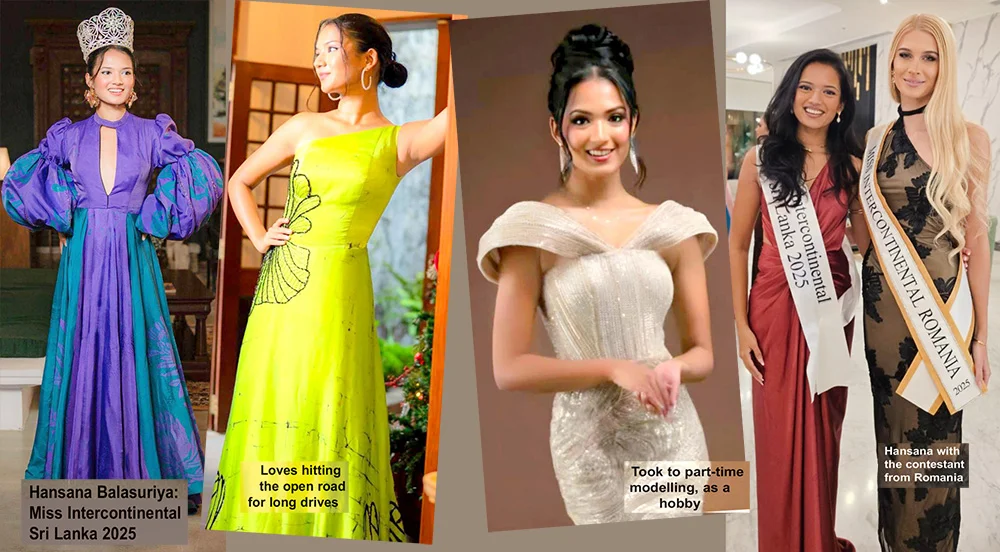
 That’s precisely what 25-year-old Hansana Balasuriya has in mind – shooting for the stars – when she was selected to represent Sri Lanka on the international stage at Miss Intercontinental 2025, in Sahl Hasheesh, Egypt.
The grand finale is next Thursday, 29th January, and Hansana is all geared up to make her presence felt in a big way.
Her journey is a testament to her fearless spirit and multifaceted talents … yes, her life is a whirlwind of passion, purpose, and pageantry.
Raised in a family of water babies (Director of The Deep End and Glory Swim Shop), Hansana’s love affair with swimming began in childhood and then she branched out to master the “art of 8 limbs” as a Muay Thai fighter, nailed Karate and Kickboxing (3-time black belt holder), and even threw herself into athletics (literally!), especially throwing events, and netball, as well.
A proud Bishop’s College alumna, Hansana’s leadership skills also shone bright as Senior Choir Leader.
She earned a BA (Hons) in Business Administration from Esoft Metropolitan University, and then the world became her playground.
Before long, modelling and pageantry also came into her scene.
She says she took to part-time modelling, as a hobby, and that led to pageants, grabbing 2nd Runner-up titles at Miss Nature Queen and Miss World Sri Lanka 2025.
When she’s not ruling the stage, or pool, Hansana’s belting tunes with Soul Sounds, Sri Lanka’s largest female ensemble.
What’s more, her artistry extends to drawing, and she loves hitting the open road for long drives, she says.
This water warrior is also on a mission – as Founder of Wave of Safety,
Hansana happens to be the youngest Executive Committee Member of the Sri Lanka Aquatic Sports Union (SLASU) and, as founder of Wave of Safety, she’s spreading water safety awareness and saving lives.
Today is Hansana’s ninth day in Egypt and the itinerary for today, says National Director for Sri Lanka, Brian Kerkoven, is ‘Jeep Safari and Sunset at the Desert.’
And … the all-important day at Miss Intercontinental 2025 is next Thursday, 29th January.
Well, good luck to Hansana.

Mechanism to be established involving university academics and experts for Education Reforms – President

New integrated framework to bring all stakeholders together to safeguard and rebuild Central highlands – President

ICC T20 World Cup Trophy tour in Sri Lanka launched under President’s patronage

Rasooli, Atal and Mujeeb seal Afghanistan series win

U – 19 World Cup: Afghanistan’s Nooristani Omarzai blows Tanzania away

U – 19 World Cup: Mayes’ 191 helps England crush Scotland

‘Dates have the highest sugar content to fight Coronavirus’

Sunday Island 27 December – Headlines

#SundayIsland 17th December – Headlines

Sunday Island – 28th March

Sunday Island Headlines – 21 March

Sunday Island – 21st February – Headlines
-

 Editorial4 days ago
Illusory rule of law
-
 News5 days ago
UNDP’s assessment confirms widespread economic fallout from Cyclone Ditwah
-
 Editorial5 days ago
Crime and cops
-
 Features4 days ago
Daydreams on a winter’s day
-

 Editorial6 days ago
The Chakka Clash
-
 Features4 days ago
Surprise move of both the Minister and myself from Agriculture to Education
-
 Features3 days ago
Extended mind thesis:A Buddhist perspective
-
 Features4 days ago
The Story of Furniture in Sri Lanka