
Features
The Chimerican Divorce:

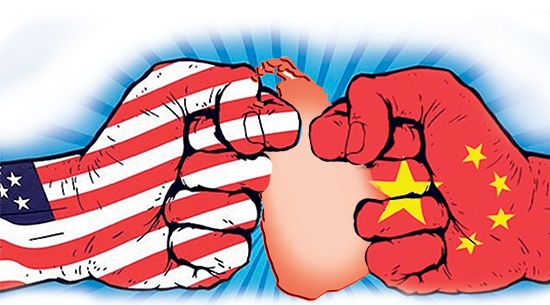
Is Sri Lanka truly ‘Non-Aligned’
by Kusum Wijetilleke
(kusumw@gmail.com)
and
Rienzie Wijetilleke
(rienzietwij@gmail.com)
Sino-Sri Lankan relations date back long before the much-acclaimed rubber rice pact of 1952. The Chinese Monk Faxian documented his visit to the island around the fourth century. King Alakeshvara, ruler of the Kingdom of Kotte, battled a Ming Dynasty fleet in the 1400s. His defeat and capture led to the ascension of King Parakramabahu VI, a known proponent for trade with the ancient Chinese empire. Chinese history has recorded that King Parakramabahu VI was nominated by the Yongle Emperor based on the advice of the Sinhalese present at the Ming Court and installed as King with the backing of Admiral Zheng He and his fleet.
The modern relationship gathered pace after Sri Lanka’s early recognition of the Peoples Republic of China, in 1957. Sri Lanka is also reliant on the United States, the world’s pre-eminent super power and recent comments made by the visiting Secretary of State, Mr. Mike Pompeo, reveal the very public divorce and necessitates a delicate balancing act on the part of Sri Lanka.
China’s economic success has been largely facilitated by the United States and other liberal democracies through multinational corporations operating within a free trade environment. “Chimerica”, a term introduced by Economist Moritz Schularick and Historian Niall Ferguson in 2006, is a term that describes the symbiotic economic relationship between the United States and China. This period of historic economic expansion, amid the booms and busts, is also broadly considered to be the height of the neo-liberal economic project. Chimerica allowed many long established American multinationals to continue their growth stories in the Far East, leading to a mass exodus of American manufacturing to China. In return, the world’s pre-eminent consumerist mecca swallowed up cheaper goods imported from the East. This seemed like a win-win situation; China would lift literally hundreds of millions out of poverty while the US satiated its hunger for cheap products and kept its hyper-consumerist economy trudging along. Yet by the time the 2008 financial crisis struck, China seemed the clear winner. American multinationals were creating extreme levels of wealth but with very little ‘trickle down’ to ordinary US citizens. Wages of the American middle class stagnated, and entire regions of the US, once proud cities built by the manufacturing industry, began collapsing.
Sri Lanka on the String of Pearls
In the meantime, the Chinese Communist Party (CCP) with its centralised structure of economic planning, had begun its next phase of development. The Belt and Road Initiative, had already taken root in Sri Lanka, well before its official launch by Chairman Xi Jinping in 2013. Starting in the 1970s, China had provided grants for infrastructure development to Sri Lanka, the most famous being the BMICH. However since the early 2000s, Chinese investments in Sri Lanka took the form of interest bearing loans and FDI. The Norocholai Power Station in 2006, the Hambantota Port Project in 2007, the Matala Airport and the Colombo Port City investment in 2010 are just some examples.
Sri Lanka was clearly of strategic importance to China and while the global economy ticked along there was little concern, the CCP had become a reliable development partner. The Chimerican project on the other hand, was running into trouble. Schularick and Ferguson note that even in the lead up to 2008, China had been building up its currency reserves and using these to buy more and more US securities. Essentially, China was saving while the US was over-spending. American over-spending was only possible due to cheap debt and cheap debt was always likely to lead to those troublesome economic “bubbles”.
In 2008, demand in the US plummeted and China had to fortify its own economy through an economic stimulus plan around the same time that the US treasury launched the American Troubled Asset Relief Program (TARP). The Chinese Central Bank, PBOC, lifted restrictions on commercial bank lending and the State Council invested somewhere in the region of 4 trillion Yuan, equivalent to USD 600 Bn, in infrastructure and welfare services between 2008 and 2010. A decade or so later and China has had to revisit a stimulus package by way of tax cuts and improving liquidity. China’s double digit GDP growth was always unlikely to last, the inevitable slow-down was managed by the CCP until the unforeseeable external headwinds of the Trump trade war and the pandemic. It is worth noting that the CCP did not publish an economic growth target for 2019, an unprecedented policy that continued through 2020. Despite a rebound in industrial output in the second half of 2020, official unemployment figures remain at around 6% while economists argue that the actual unemployment rate might be double this. Thus China, for all its incredible growth and financial might, is not infallible and must manage its risks and rewards like any other nation. Sri Lanka should take note, an endless Chinese appetite for Sri Lankan infrastructure lending is by no means guaranteed.
Cold War 2.0: The End of an Affair
The inevitable eastward shift of manufacturing, accelerated by neo-liberal trade policies and the automation and technological revolution, altered the lives of millions of working Americans. Many in these towns and cities took note when candidate Trump oversimplified the complex case of US international trade with a view of trade tariffs not shared by many economists. President Trump was always likely to accelerate the eventual divorce or evolution of the Chimerican relationship. The US Treasury department, having taken the historic step of labeling China a currency manipulator in August 2019, changed course a mere 5 months later as part of its Phase One trade deal. The US, UK and a few other European countries have taken steps to ban technology from Chinese telco giant Huawei in their 5G roll-out. These are all facets of the emerging Cold War 2.0. During the original Cold War, two major powers engaged in proxy wars, an arms race and the space race, in a battle for technological superiority. Cold War 2.0 might seem to be all about trade imbalances and intellectual property theft, yet the technological race is critical. China and the US are vying for superiority in various tech fields including semiconductors, quantum computing, 5G, artificial intelligence and data science.
The symbiotic economic relationship is at risk. What remains to be seen is whether Chimerica complete their divorce or arrive at an amicable compromise; an evolution of the relationship. The latter seems less contentious and will moderate short-term shocks to the global economy. However, the current signs seem to suggest the former, and Sri Lanka may find itself in the midst of a rather messy divorce.
Twin Alignment and Anti-Americanism
Secretary Pompeo’s visit and comments, certainly caused a stir. Sri Lanka has always had a strong center-left/ leftist political tradition and anti-Americanism comes with the territory.
The JVP began the festivities on the front page of a daily by stating the obvious: “Sri Lanka doesn’t need Foreign Interventions” (suffice to say, we actually do, we are inviting it in some quarters). The LSSP cautioned the government not to “fall into a trap”, Prof. Tissa Vitharana warning that signing agreements like the SOFA will lead to thousands of US forces utilizing the whole of Sri Lanka as a base. He stated, rather confusingly, that “even staying neutral is tacit approval” and urged the Sri Lankan Government to “take a non-aligned stance and support China”. Note the contradictions.
As much as Sri Lanka would prefer to be “non-aligned”, it remains very much aligned with the East Asian super power through borrowings, agreements and investments whilst performing an intricate balancing act with its number one export destination: the United States. The truth is that Sri Lanka is far from non-aligned, in fact one could argue that Sri Lanka has a ‘twin alignment’ with the two major economic and military powers in the world.
The United States is our top single-nation export destination by a considerable distance, and has also provided some $2.5 Bn in aid over the past several decades through various programmes and institutions. It also funds and thus holds considerable sway in many multilateral institutions such as the World Bank, Asian Development Bank and the IMF. Beyond its economic cooperation, the US also assisted Sri Lanka in some key aspects during the war on terrorism. Naval floating armories were tracked and destroyed using US intelligence, US naval blockades reduced the illegal arms trade in the Indian Ocean and supported the belated proscription of the LTTE in the post 9/11 world.
On the flipside, the US has also sponsored multiple resolutions against Sri Lanka in the United Nations Human Rights Council and even banned the current Army Commander. US backed INGOs and NGOs have long been perceived as assisting or being sympathetic towards the LTTE. Hand-wringing and fist shaking seem to have become the traditional Sri Lankan welcome for American officials visiting the country.
However, Sri Lankans should understand that regardless of the emotional reactions to western imperialism, the country’s economy cannot survive without its trading relationship with the United States.
A Belt around the Neck?
While the US has longstanding military and defense relationships with Sri Lanka, the escalation of hostilities with the LTTE led to restrictions in US military aid to Sri Lanka in 2007. China filled the gap providing direct military aid and equipment. China has since provided a range of modern armaments to the Sri Lankan military whilst also voting against the many US sponsored resolutions at the UNHRC. In return, Sri Lanka has steadfastly supported China at many diplomatic junctures including being one of 50 signatories defending its treatment of Uyghurs and Muslim Minorities in Xinjiang and most recently supporting China’s controversial National Security Law in Hong Kong.
Critics of Sri Lanka’s Sino-relations cite Chinese debt diplomacy and exhibit 1 is the Hambantota Port Debt/ Equity swap. Sri Lanka would appear to be a prime candidate for a potential Chinese debt trap, however the numbers on the surface do not support this claim. Analysts have shown that total debt to China is slightly above 10% of total debt and 60% of Chinese debt can be categorized as ‘concessionary’, though what constitutes ‘concessionary’ might be debated. Various commentators have stated that describing the deal as a debt/ equity swap is misleading. While Sri Lanka received just over USD 1 Bn from China for a 70% stake on a 99 year lease, the agreement did not involve the cancellation of loans from China. The Administration of the time used a small portion of this inflow to settle some short term debt unrelated to the construction of the Port and the remainder was used to bolster foreign exchange reserves.
It is inaccurate to claim that a Chinese debt trap is engulfing Sri Lanka, however non-concessionary debt as a percentage of total debt has been steadily increasing. The more you borrow, the higher your risk profile, the less concessionary future debt becomes. This is simply a natural law of debt and Chinese or not, Sri Lanka is falling into a debt trap. Balance of Payment deficits, budget deficits, investments in major projects without adequate planning, leading to under-performing assets and political manipulations of government revenue generation leads to a weakening of the nation’s credit worthiness. Government officials and ministers as well as members of the business community turn their noses up at conditional borrowings from institutions such as the IMF and view these conditions as suspicious. It is worth considering that these conditions may be better for the country’s long term financial stability.
As is often the case, this requires a trade off against short-term spending which complicates the political sphere. The facts are straight forward, successive Sri Lankan administrations have taken the easy route by simply borrowing to cover budget deficits and to shore up foreign exchange reserves without taking the painful steps required to bring some measure of financial discipline to government spending.
Another aspect of Chinese debt diplomacy that merits discussion are the projects themselves. In 2019, Pakistan cancelled a USD 2 Bn Chinese coal plant project as well as reducing their exposure to loans from Chinese entities. Myanmar scaled down a deep water port project from USD 7.3 Bn to USD 1.3 Bn having decided that debt levels were too high. A proposed Sino-Omani Industrial City that was proposed to cost USD 10 Bn has stalled completely. The Khorgos Gateway in Kazakhstan, 49% owned by China and meant to be the central ‘jewel’ of the modern silk road is basically an under-performing dry port surrounded by an empty 500 hectare field that was slated to become a special economic zone. Some of these projects should sound oddly familiar to anyone with knowledge of the Hambantota port project.
Lending for infrastructure projects require detailed viability studies to ensure the project is not only necessary but able to generate adequate revenue to operate whilst repaying loans. It seems that for many of these projects funded by Chinese banks, viability and revenue generation were not primary concerns for the lending institutions, another suspicious aspect of the BRI.
As a concept, the BRI raises many questions around the motives of the Chinese Communist Party. Sri Lanka had seemingly limited alternatives but to engage China as post war Sri Lanka needed significant investment and dependable partners. The CCP was really the only player and it just so happened that China already had very specific designs on Sri Lanka.
Neo-Imperialism
Politicians and the media, especially those on the center-left, are extremely suspicious about the MCC grant and the security agreements (SOFA and ACSA), accusing the US of using these agreements as tools establish military bases and take control of land assets amongst other nefarious motives. The idea that the US needs a grant of USD 500 Mn to exert influence on Sri Lanka seems farfetched. As noted before the US already has significant influence over Sri Lanka through its trading relationship with exports averaging USD 2.0 Bn annually, a tariff of a few percent would diminish Sri Lanka’s export revenue significantly.
The ACSA and SOFA may have different implications. Sri Lanka first signed a SOFA with the US in 1995 and if certain clauses in the renewal agreement are undesirable, for example those relating to protections and privileges for visiting American troops, these must be negotiated. Everything in Foreign Relations can be bargaining chip. The question to be asked is not whether Sri Lanka should sign the SOFA and ACSA, but what the government should ask for in return. A Foreign ministry official, as per Asia.Nikkei.com, stated that Sri Lanka did not want to seem too closely aligned with any nation and that signing a SOFA would lead to complications. Is Sri Lanka not already too closely aligned with China judging by this benchmark? There are other costs to bear in mind, namely the relationship with Sri Lanka’s immediate neighbor: India. The US has been forging ever closer relations with New Delhi, as part of the ‘American Pivot to Asia’ and India is the perfect foil for the US in the Cold War 2.0.
The over-arching narrative, driven by the exploitative and extractive effects of colonialism, is that the Western establishment spent the better part of the last few centuries exploiting the developing world. Modern day military invasions and interventions across the globe, political interference through international organizations and pressure brought by multinationals prove that the suspicion is warranted. More concerning is that many appear to view massive Chinese investment as purely transactional and any consequent cloud of imperialism as benign.
To believe in a benign form of imperialism is akin to the acceptance of a dictator as benevolent. Even if we ignore the 1989 massacre of Tiananmen Square and the hundreds of deaths, we must still contend with the power wielded by the CCP in Hong Kong, with student protestors now under arrest in the mainland. The Tibetan uprising led to over 85,000 deaths as per the CCP, Tibetans in exile claim the toll was much higher. Territorial disputes in the South China Sea with Indonesia, The Philippines, Malaysia and Vietnam and disputes in the East China Sea with Japan still linger. China would also prefer that its support for the Khmer Rouge is forgotten while the media highlights with the plight of the Uighur minority in the Xinjiang region.
It seems rational to turn a suspicious eye towards Chinese investment and deeper entanglement in view of the ever closer alignment. Sri Lankans will notice the increased numbers of Chinese workers in Sri Lanka and their effect on the local job market. There are multiple large scale government contracts being carried out by Chinese companies using Chinese labour and machinery that dilute the benefits to Sri Lanka. Why is there so much overt anti-Americanism when it is China that was able to maneuver itself in to a position from which to negotiate a long term lease of a port, a port that was funded by Chinese bank loans? There is already much speculation that the Colombo Port City will eventually become a Chinese addendum to Sri Lanka.
Sri Lanka has been a developing country for several decades since independence. The slow march towards the Sri Lankan promise continues. At this crucial juncture, with our economy in peril in the midst of global challenges and intrigue, can Sri Lanka afford anti-Americanism? Should the west not at least serve as a counterbalance to be used against the Chinese at the negotiating table? Certainly, Sri Lanka will have to continue to negotiate with the CCP, and must quickly become more effective at this negotiation to ensure the best possible bargain is struck, one that neither antagonizes the West nor betrays the East. The twin alignment remains in the balance.








by Kapila Chinthaka Premarathne
Head of the Department of Agricultural Systems and a Senior Lecturer in Agricultural Economics at the Faculty of Agriculture,
Rajarata University of Sri Lanka
Beyond the Graduate Unemployment Number
Sri Lanka’s economic recovery has improved macroeconomic stability, but youth unemployment remains a significant labour-market concern. Around 43% of Sri Lankan youth aged 15–24 with postsecondary education are unemployed, the highest among the Asian economies compared in the IMF analysis, compared with about 36% in Bangladesh and 13.2% in Thailand. This reflects a problem of skills mismatches and the difficulty of connecting higher education with changing labour-market demand. The concern goes beyond unemployment itself. Sri Lanka has invested heavily in educating its younger population, yet the conventional labour market is not creating enough opportunities to convert these qualifications into income. Many young people possess degrees, technical knowledge and growing digital familiarity, but remain outside formal employment because suitable jobs may not exist in the right place, at the right time or under conditions compatible with their circumstances. This makes it necessary to think beyond traditional employment models and explore new ways of connecting Sri Lanka’s educated youth with economic opportunities.
This is where Sri Lanka needs to reconsider how it understands employment
Employment has traditionally been viewed through the employer–employee relationship, with qualifications leading to a formal job and regular salary. While this model remains important, digital platforms are creating new ways to generate income, allowing individuals to work for multiple clients across geographical boundaries without permanent employment. Sri Lanka therefore needs to look beyond simply creating conventional jobs and consider whether it is building the conditions for its educated population to participate in the growing global market for digital services.
The Opportunity of the Gig Economy
The gig economy extends far beyond ride-hailing and delivery services. Digital platforms increasingly connect skilled individuals with opportunities in software development, design, accounting, data analysis, digital marketing, translation, online education, research and consultancy. This is particularly relevant to Sri Lanka, where a highly educated population faces a relatively limited domestic market for specialised skills. Digital platforms can overcome geographical constraints by connecting Sri Lankan workers directly with international clients.
As highlighted in my previous LSE South Asia article on women and the gig economy, such work should not replace formal employment but can create additional income opportunities when supported by appropriate skills, digital infrastructure, training and institutional support. A skilled person in Anuradhapura, Jaffna, Batticaloa or Monaragala could potentially serve clients in London, Melbourne or Dubai without first relocating to Colombo. This makes the gig economy relevant not only to employment but also to Sri Lanka’s emerging digital services-export strategy.
A Digitally Familiar Generation
Sri Lanka’s younger generation is growing up with smartphones, social media, online learning, digital applications and digital financial services, giving them a level of digital familiarity that previous generations did not have. However, digital familiarity does not automatically translate into digital employability. The challenge is to transform everyday digital use into productive skills such as data analysis, artificial intelligence, software development, digital marketing, financial analysis and online professional services.
Sri Lanka therefore needs to move young people from being consumers of digital services to producers of digital value. Universities, vocational institutions and training providers can play an important role in converting existing digital familiarity into marketable skills that connect young people with both domestic and international opportunities. This is increasingly important as technological change and AI reshape labour markets and intensify the need for skills that match emerging forms of work.
The Gender Dimension
The gig economy may be particularly relevant to women, who often face barriers to conventional employment arising from childcare, eldercare, mobility, social expectations and rigid working arrangements. For mothers and women living outside major urban centres, fixed working hours and daily commuting can make formal employment difficult even when suitable jobs exist.
Digital gig work can provide greater flexibility, allowing women to undertake professional assignments from home or their communities and potentially serve international clients without relocating. As discussed in my earlier LSE South Asia article, this opportunity is most meaningful when supported by digital infrastructure, skills training, virtual work hubs, mentorship and appropriate institutional support. However, flexibility should expand women’s economic choices rather than simply add paid work to existing unpaid household responsibilities.
Pressure on Labour-Market Opportunity
The value of a job cannot be judged by salary alone, as commuting, working hours and household responsibilities can significantly affect its real economic value. Flexible digital work can potentially reduce some of these costs by allowing people to work from home or nearby digital hubs and participate in employment on a part-time or project basis. While gig work cannot solve all household pressures, a more flexible organisation of work can create additional employment opportunities while helping households manage their limited time and resources more effectively.
A Possible Third Option Between Unemployment and Migration
Sri Lanka’s migration and brain-drain concerns highlight the need to explore employment opportunities beyond the domestic labour market. While overseas migration will remain an important individual and economic choice, digital work can provide another pathway by allowing skilled Sri Lankans to serve international clients without physically leaving the country. Software developers, designers, analysts, researchers, translators and consultants can potentially earn from global markets while remaining in Sri Lanka. Digital gig work cannot eliminate migration or reverse brain drain, but it can create an additional option between domestic unemployment and physical migration—working for the world while remaining in Sri Lanka.
Recognising and Making Digital Work Reputable
A major institutional gap is that conventional systems are designed around salaried employment, while a freelancer may earn from multiple clients without a single employer or salary certificate. This can make legitimate digital workers difficult to recognise when they seek loans, leasing, insurance or business finance. Sri Lanka could address this through a voluntary digital-worker or independent-professional registration mechanism, providing a recognised economic identity based on qualifications, verified skills, platform activity and documented income, without creating unnecessary bureaucracy.
Such recognition should also make digital income bankable. Banks could assess verified platform earnings, bank transactions, contracts, invoices, tax records, savings and repayment history alongside conventional employment documents. A standardised digital income statement could further help workers demonstrate their financial capacity. The key shift is from asking “Who is your employer?” to asking “Can your income be verified and is it sufficiently stable?”. This would allow successful digital workers to build financial credibility and use their earnings to access credit, acquire assets and develop their own businesses.
Digital Payments Are Part of the Labour Market
Access to reliable international payment systems is essential if Sri Lankans are to participate effectively in the global digital economy. Recent developments in PayPal’s local banking arrangements, including its partnerships with Sampath Bank and Commercial Bank, indicate progress in this direction. However, the broader priority should be a regulated and efficient digital-payment ecosystem that allows workers to receive international earnings, transfer them to Sri Lankan bank accounts, document their income and meet relevant financial and tax requirements with minimal friction. International payment infrastructure is therefore not simply a technology issue; it is an essential component of Sri Lanka’s emerging services-export economy.
Building Infrastructure Outside Colombo
Digital familiarity alone is insufficient without reliable internet, electricity, computers, software and suitable working environments, particularly in rural and underserved areas. To ensure that the gig economy supports regional development rather than becoming another Colombo-centred opportunity, Sri Lanka could establish regional digital-work hubs through universities, vocational institutions, libraries and public-private partnerships. These hubs could provide connectivity, equipment, training, mentoring and assistance with platform registration and international payments. If graduates must migrate to Colombo simply to access such infrastructure, the geographical advantage of digital work is significantly reduced.
From Freelancer to Entrepreneur
Gig work should not be viewed as an end in itself. A person may begin with small online assignments, develop regular clients and professional credibility, and eventually establish a small digital enterprise. This creates a potential pathway from graduate to freelancer, professional service provider and entrepreneur, allowing individuals to create markets around their own skills rather than waiting for conventional vacancies. Universities can support this transition by teaching students not only subject knowledge but also portfolio development, market identification, client communication, digital platforms and contract management. A degree demonstrates educational attainment, while a professional portfolio demonstrates what a graduate can offer to the market.
Facilitation Must Be Matched by Protection
Promoting the gig economy without appropriate safeguards could simply transfer employment risks from institutions to individuals. Digital workers may face uncertain incomes, weak bargaining power and limited social protection. Sri Lanka should therefore facilitate digital work while also ensuring opportunities for independent workers to build savings, access insurance and participate in portable social-protection mechanisms. Flexibility should create greater economic choice without compromising long-term financial security, particularly for women.
A regional Example from India: Think Globally and act Locally
India provides a useful regional example of how the gig economy can be approached as a policy issue rather than simply as informal or temporary work. NITI Aayog has estimated the size and future employment potential of India’s gig and platform economy and has developed recommendations covering employment generation, skills, financial inclusion and social protection. More importantly, India has begun creating institutional mechanisms around these workers. Its e-Shram portal provides a national database of unorganised workers, including gig and platform workers, creating a recognised identity through which workers can potentially access employment, skills development and social-security services. India has also explored platform-led skills development through skill certificates, skill passports and on-the-job training, while NITI Aayog has proposed cash-flow-based lending models that could allow platform workers to demonstrate creditworthiness through their earnings rather than conventional employment or collateral.
Social protection has also entered the policy framework. India’s Code on Social Security, 2020 formally recognises gig and platform workers and provides a basis for schemes covering areas such as accident insurance, health, maternity, disability and old-age protection. India is still developing and refining these arrangements, and Sri Lanka need not replicate the Indian model.
However, the experience demonstrates an important policy lesson: the gig economy can be supported through a system that identifies workers, develops their skills, makes their income more visible to financial institutions and extends appropriate social protection. Sri Lanka could develop its own simpler framework suited to its smaller economy, beginning with recognising digital workers and building the institutional conditions that allow their skills and earnings to become part of the formal economy.
Rethinking Employment and the Next Opportunity
The 43 percent figure for educated young Sri Lankans should encourage a wider discussion about the changing nature of work. Sri Lanka will continue to need conventional employment through firms, industries, farms, professional organisations and public institutions, but the changing labour market also requires new opportunities to connect educated Sri Lankans with global digital markets. The gig economy can provide an additional pathway to increase female labour-force participation, reduce the pressure for migration and brain drain, and connect Sri Lankan skills with markets beyond geographical boundaries.
This does not require a complicated bureaucracy. It requires recognising legitimate digital workers, facilitating access to international platforms and payment systems, allowing verified digital income to support credit assessment, developing portable social protection, and strengthening digital infrastructure and skills beyond major urban centres. Better data on digital workers would also help policymakers develop evidence-based interventions.
The future of work is therefore not only about creating more jobs, but about creating more ways for Sri Lankans to work, earn and build livelihoods while continuing to live and contribute in Sri Lanka. The gig economy should be recognised as part of an emerging digital labour market and services-export economy, where workers can build professional identities, earn internationally, access finance and eventually develop their own enterprises.

by Dr Upul Wijayawardhana
We are living in an era of astonishingly rapid scientific advancement. From the time Apple launched the ‘iPhone’ in January 2007, the first targeting the mass market, smartphones have taken over the world, making them indispensable. According to the latest statistics, there are around 8.1 billion mobile phones with 7.4 billion active smartphones, for the world population of 8.25 billion. Except for a tiny minority of the very poor, most people have at least one smartphone.
We are now entering the era of Artificial Intelligence (AI) and smart robots. Recently, a ‘Chinese’ robot ran 100 metres faster than Usain Bolt! Though Alan Turing proposed the idea of ‘Thinking Machines’ way back in 1950, the real AI boom commenced with the release of the generative AI chatbot, ChatGPT, by OpenAI in November 2020. Number of technology firms in the US as well as in China have joined the race, China catching up very fast, quite unexpectedly. There is a frenzy at the moment, raising expectations, as the imminent floating of these companies is likely to value the two leaders, OpenAI and Anthropic, trillion dollars each!
However, trouble is brewing in the AI field. On top of the concerns raised by environmentalists regarding the huge power drain by AI centres, there are recent reports of some AI models hacking independently into other systems, without human input. Worse still, a senior researcher at Anthropic, who has previously worked for OpenAI as well, resigned in early September on ethical grounds stating that the way the two companies are fast-tracking AI poses an existential threat to humanity. Surprisingly, instead of a rebuttal the head of Anthropic supported his view, soon joined by three more heads of leading AI developers. Whilst they agreed on slowing progress, President Trump has claimed that slowing is totally unnecessary as long as a super intelligent President like himself is at the helm! There does not seem to be an end to Trump’s grandiosity! He was joined by Tony Blair. In contrast, King Charles held a summit with representatives of all AI developers to find a way AI could be developed without a threat to humanity. That is how wise leaders act!
Less sophisticated AI tools are already in widespread use and installed in computers, laptops and smartphones. Some of us are using these automatically. However, the more advanced AI tools like ChatGPT can change even reality. For instance, AI can generate videos hardly distinguishable from real ones. What you enjoy watching on YouTube may be just the creations of AI! Some people use AI to write articles; only a few of them admit that they do so. Very soon we may be reading stories AI creates and listening to music, courtesy of AI. Technology seems to be fast becoming the new religion? Or, will the existential threat move us more towards religion?
Religion, perhaps, is as old as humanity itself; various belief systems evolving and disappearing coupled with the fortunes of the associated civilizations. Just like AI, religion is also a creation of the human mind which our ancestors did to explain many phenomena which appeared, at that time, to be supernatural. Starting with Animism, perceiving the divine in the natural world around, humans went on to Polytheism, believing in many gods like in Hinduism, culminating in the concept of Monotheism.
World’s oldest religion, Hinduism, still in wide practice, is devoid of a founder or a single text. The earliest scriptures, Rigveda, is considered to be around 3,500 years old but archaeologists have discovered symbols of importance to Hinduism as far back as 7,000 BCE. Though it is considered to be Polytheistic, it can be argued that it was the precursor of Monotheism, the concept of a creator God, as Brahma was the creator in the triad, Trimurti, Vishnu being the preserver and Shiva being the destroyer. It seems to be a sensible balancing act; create, destroy and repair with improvements.
It is pretty obvious that as science expands, the importance of religion contracts but it is hardly likely religions would be totally redundant. We have no choice as to which family we are born to and that invariably determines what your religion would be, if any. Religion is the first brainwashing a child encounters and most remain in the same faith, often trying to defend even the indefensible, but some change through conviction or conversion due to one of many reasons. Further, religious rituals have social values and religious practices often come to one’s solace at times of distress. Therefore, many will continue with the religion they were born to but with declining enthusiasm, at times. However, some religions seem to be facing problems like falling attendances in places of worship. With education and tech savviness expanding, one would expect the youth to be less enthusiastic about religion but the converse is true in some religions, some youth becoming very militant unfortunately.
While most religions make you subservient to a supernatural power, the Buddha was wise and bold enough to remove those shackles. He proclaimed that one’s destiny is in one’s own hands. However, many Buddhists appear to attach greater significance to rituals than to practising the Dhamma.
Buddhism as a religion may become less relevant as the frontiers of science expands but the Buddha Dhamma, especially Abhidhamma and Vipassana, would receive increasing recognition, the Buddha remaining an authority on consciousness and the mind.
Scientific progress should be for the betterment of society but AI developers are taking huge risks, taking massive loans threatening the world economy, for one aim: profit! Some do not seem to care even if their actions pose an existential threat to humanity.
Perhaps, if the Four Sublime Attitudes (Sathara Brahma Vihara) expounded by the Buddha; loving kindness (Metta), compassion (Karuna), empathetic joy (Muditha) and equanimity (Upekkha) are adopted as universal values, the world would become a safer place to live in, with or without AI.

Tales of Mystery and Suspense 21
by Prof. Rajiva Wijesinha
Another book that is part of a series, today—one that is fun without the brooding concentration on criminality in different forms that marks the Rebus novels. This one about the Thursday Murder Club, is a romp as its two predecessors were interspersed with deaths and what might be deaths.
The Bullet that Missed
begins with a meeting with the presenter of ‘South East Tonight’, a programme about the area, in which Coopers Chase is situated. The meeting is held because the club has decided to look into the murder of the producer’s assistant, Bethany Waites, whose car was found at the bottom of a cliff ten years ago. There was blood in it, but the body was never found.
Or, rather, the book begins with an account of Bethany Waites deciding, on the night she vanished, to meet someone in connection with a case of massive fraud that she had been investigating, after sending the producer, Mike Waghorn, a message that she had found new evidence though he had no idea what it was. The night she died, she sent him another message: “I don’t say this often enough, but thank you.”
CCTV cameras showed her leaving her place, but then the vehicle vanished, before being sighted near the cliff, with two people in it. Investigation of the fraud had led to the imprisonment of a woman, Heather Garbutt, though it proved impossible to pin anything on Jack Mason, the mastermind for whom she had worked.
The Club conducts investigations on several fronts, including through Connie Johnson, the drug dealer they had helped imprison in the earlier book. The psychiatrist Ibrahim, the most respectable member of the Club, interviews her in an attempt to get her to find out more from Heather, who is in the same prison as she. They also investigate the CCTV record of the night Bethany vanished, and deduce that she went to an apartment block and exited from its other side, and that is why she was not seen leaving the town. But some time had elapsed between her being seen in the town and then on the cliff.
Meanwhile, Elizabeth has been kidnapped, along with her husband, and taken to a house in Staffordshire, where she is told by a man called the Viking that she must kill a former KGB agent now in London, who has a profitable career in money laundering. The Viking tells her he will inform Viktor that she was responsible for stealing the diamonds, the story of which is told in the previous Murder Club Mystery, and Viktor will then kill her.
Elizabeth, who has an affair with Viktor, knows he will not kill her, but when the Viking says he will also send Viktor a picture of Joyce, she decides she must act, and goes to see Viktor, and fires when she gets him in the bathroom. But, of course, she fired into the ceiling, and Viktor is then taken to Coopers Chase, to stay with Joyce until they have dealt with the Viking. And Viktor then enjoys the camaraderie of the retirement home so much that he wonders whether he too should settle there.
Elizabeth does trace the Viking, or rather her husband does, for he has noticed rare books on the shelves in his library, and an antiquarian book dealer friend managed to find out who bought them. But before they could confront him, he comes to Coopers Chase, for he has seen the bullet hole in the bathroom of Viktor’s flat and realized he was fooled.
But he cannot bring himself to kill Joyce straight away, and she knocks him out with a drug in a cup of tea. When he meets Viktor, they both decide to fall in with the plans of the Club.
Before this, Heather has been found dead in her cell, with a note saying that ‘they’ were going to kill her, and only Connie could help. Before that she had admitted that she was frightened to name the man behind the fraud. Jack Mason said the same, after Ron had won his confidence. The Club had deduced by then that the body was buried in the garden of Heather’s house which Jack had bought, after she had been jailed, and digging reveals a gun and money, but no body. Jack tells them that the mastermind had said that Bethany was buried with a bullet with his DNA on it.
The Club is now working with the Chief Constable of Kent, Andrew Everton, who writes thrillers himself, but in the form of e-books. He is in search of a publisher, and delighted when Mike Waghorn puts him on his programme, as is Donna, who is substituted at the last minute for Chris.
The Club finds out whom Bethany visited in the apartment block—Mike’s assistant Pauline, who tells them later what she and Bethany had been doing. But this is after the man behind the fraud has been unmasked up in the house in Staffordshire, where he was trying to hire the Viking and Viktor to find the money that he had stashed away, using accounts that he could no longer trace. He has also confessed to murdering Bethany, hoping this will persuade the two money launderers to help him, but it turns out that he did not do this. Nor did he kill Heather, the incriminating note having been placed in her room by Connie, who decided that Heather’s suicide should be treated as murder so that the person who had been blackmailing her should be found out.
It was Jack Mason’s murder that was brought home to the crook. It turns out that Bethany, her appearance altered by Pauline, has vanished, to a new life in Dubai, where she has taken control of the missing millions. She has gone there because the threat, she received through the bullet she was looking at in the preamble, was to Mike and she wanted him out of danger.
Yet another whimsical conclusion to a whimsical book with enough loose ends left hanging for another sequel.

Landslide Early Warnings issued to the districts of Colombo, Galle, Gampaha, Hambanthota, Kalutara, Kandy, Kegalle, Kurunegala, Matara, Nuwara Eliya and Ratnapura

Showers in the Western, Uva and Sabaragamuwa provinces and in Galle, Matara, Kandy, Nuwara-Eliya, Batticaloa and Ampara districts.

22A, Judicature Amendment Bills passed with 2/3 majority

TIN mandatory for key transactions from Nov. 1

Navy brings 25 Indonesian fishermen ashore after trawler capsizes

Former Mineral Sands Chairman arrested over recruitment irregularities

‘Dates have the highest sugar content to fight Coronavirus’

Sunday Island 27 December – Headlines

#SundayIsland 17th December – Headlines

Sunday Island – 28th March

Sunday Island Headlines – 21 March

Sunday Island – 21st February – Headlines
-

 News7 days ago
Namal Rajapaksa Buddhist gambit fails, bail denied
-

 Features7 days ago
Why the spelling Sri Lankan names in English vary
-

 Features7 days ago
Three bands, a new identity: Sri Lankan wolf snake recognised as distinct species
-
 Business7 days ago
SLIIT holds largest-ever convocation
-

 News7 days ago
Vehicle prices drop by up to Rs. 1 mn, says importers’ body
-

 News7 days ago
Govt monitors reported Saudi death sentence – Foreign Ministry
-

 Business7 days ago
Lanka’s famed beach shack battles demolition
-

 Business7 days ago
All-new Bolero MaXX Pik-Up unveiled in Lanka