
News
Thanks to its generosity to gas station owners, CPC bleeding to death, says FSP

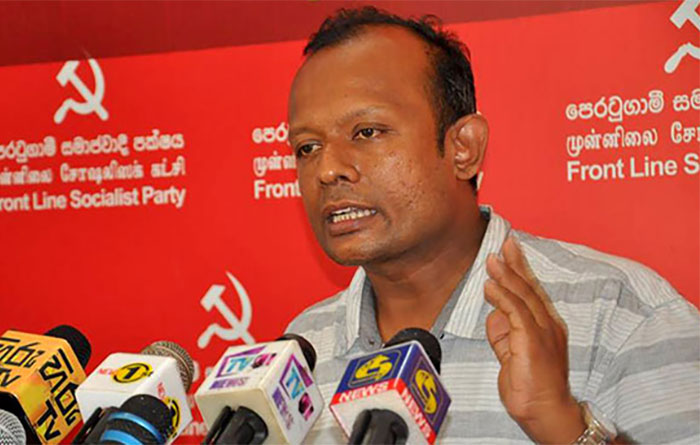
The Ceylon Petroleum Corporation (CPC) will lose about Rs. 25 billion in the coming 12 months at current rates, if it does not adjust the commission paid to gas station owners, Education Secretary of the Frontline Socialist Party (FSP), Pubudu Jagoda, told The Island yesterday.Jagoda said that the CPC made losses, mainly due to the bad decisions of its management. “For example, the CPC gives a commission to the gas station owners. Until mid-2019, CPC paid 2.5 percent of the price of a litre of fuel as a commission. So, for example when a litre of 92 octane petrol was Rs. 117, the gas station owner made a commission of Rs. 2.92. They insisted that the percentage was not enough and in July 2019, and it was increased to 3%.
The CPC also decided to place upper and lower caps because they didn’t want to pay colossal amounts as commissions, in case fuel prices went through the roof,” Jagoda said.
The CPC also decided that for Octane 92 petrol, the upper cap would be Rs. 167 and the lower cap would be Rs. 117 . “So, no matter how much the price increased, the CPC only pays three percent of Rs. 167 as the commission per a litre of 92 Octane petrol. For Octane 95 petrol, the upper cap would be Rs. 184 and the lower cap would be Rs. 128. For auto diesel, the upper cap would be Rs. 121 and the lower cap would be Rs 95. For super diesel, the upper cap would be Rs. 145 and the lower cap would be Rs. 110,” he said.Jagoda said that fuel prices had been revised in December 2021. The price of 92 Octane petrol was increased to Rs. 177 a litre and 95 Octane to Rs. 207 a litre.
“Instead of capping them at 167 and 184, the CPC paid three percent of the new prices as commission to gas station owners. On 18 January 2022, the Deputy General Manager, Finance, figured out something was wrong and wrote to the General Manager asking him what could be done. The General Manager sent a circular to gas stations on 10 March 2022, saying that the CPC had overpaid them and asked the owners to return the amount. Four gas station owners met the Minister in charge, Gamini Lokuge, who insisted that there was no need to pay and buoyed by that gas station owners went to court and got an injunction against the circular,” Jagoda said.
At that time, the CPC was losing Rs. 80 million a day as a result, Jagoda said. Despite that, the CPC lawyers did not appear on the first Court date, and on the second Court date, they agreed to extend the injunction.
“On the third day, the injunction was lifted but the CPC did nothing to collect the money. The problem is many ministers, and senior officials, have gas stations and they profit from this. Still the CPC pays extra to gas station owners. If this is stopped, the CP can reduce the prices of 92 Octane petrol by Rs. 9.17 , 95 Octane petrol by Rs. 12 rupees, auto diesel by Rs. 9.27 rupees, and super diesel by Rs. 10.95. The CPC pays Rs. 67.9 million extra a day to gas stations. If this continues, at the current price, and volume, the CPC will lose 25 billion in the next 12 months,” Jagoda said.

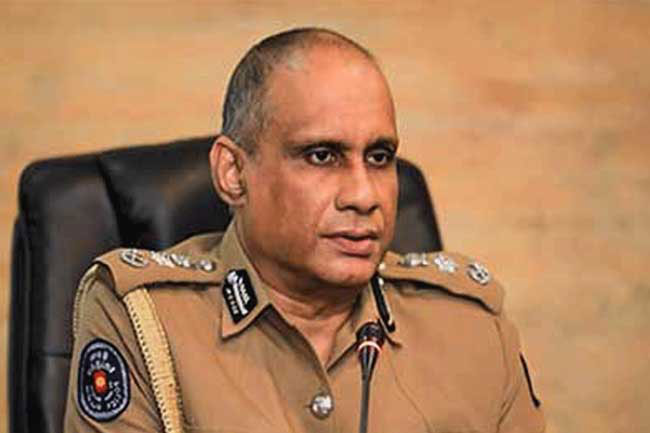
He was examining security officer’s new weapon while waiting for his wife to join him on a morning walk
Friday’s shock death of former IGP Chandana Wickramaratne due to gunshot injuries on his chest was possibly due to an accidental discharge of his personal security officer’s (PSO’s) pistol. Wickramaratne, who was kitted for his walk and waiting on the verandah for his wife to join him, was examining the PSO’s new weapon, knowledgeable sources said.
These sources said the wife who was putting on her shoes inside the house heard a bang and found Wickramaratne fallen on the verandah.
The retired IGP had noticed the security officer carrying a new weapon and had asked to examine it. Saying he carried a similar weapon years ago, he found no magazine and said, “are you planning to accompany me on my walk with a pistol without a magazine?”
The PSO had then handed the loaded magazine and gone into the house to fetch a requested bottle of water when the weapon had gone off.
The sources said that Wickramaratne was in no way depressed and had attended an Ananda College old boy’s event a few days ago, had dinner with friends and chatted with them. He had an appointment to meet a friend on Saturday.
Friends and family saw no reason for Wickramaratne to take his own life and there was no evidence whatever of an external agent shooting him. The former IGP was pronounced dead at the Colombo East Teaching Hospital to which he was rushed.
Police said investigations were proceeding and an autopsy report was awaited.
Wickramaratne was appointed the 35th Inspector General on November 25, 2020 and retired three years later in 2023. He had also set a record as the longest serving acting IGP since his naming to that position in May 2019 after his predecessor Pujith Jayasundara was sent on compulsory leave.
He joined as a trainee Assistant Superintendent in June 1986 after graduating from the Colombo University. He was absorbed to the National Intelligence Bureau where he worked till 1995. Thereafter he reverted to the uniform service and had been posted across the country, including the northern and eastern areas at the height of the war.
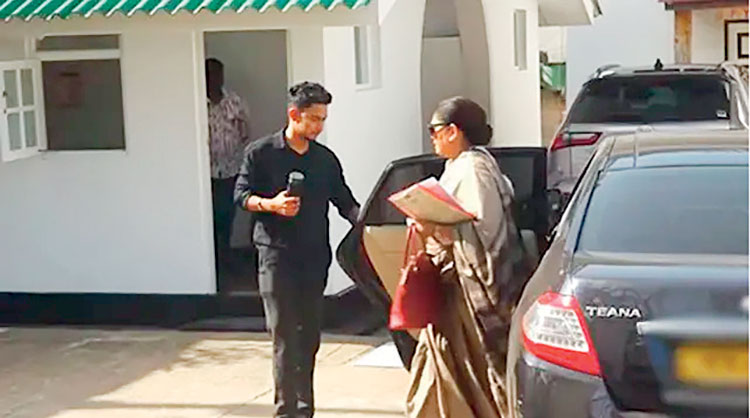
Former Colombo Mayor Rosy Senanayake appeared before the Presidential Commission of Inquiry appointed to investigate allegations of corruption and fraud at the Colombo Municipal Council (CMC) on Friday (17).
Speaking to the media after appearing before the commission, Senanayake said she had been summoned to provide information regarding a food voucher programme implemented during her tenure as Mayor amid the COVID-19 pandemic and the economic crisis.
She said the programme, carried out through state-owned Lanka Sathosa, was introduced to provide assistance to low-income and vulnerable families affected by the economic hardships during the period.
“We gave food vouchers from Sathosa to the poor during the pandemic and economic crisis.
They wanted answers to some questions they had regarding the programme,” Senanayake said.The Presidential Commission is currently investigating allegations relating to financial irregularities, corruption and other misconduct within the Colombo Municipal Council.

A police constable has been suspended from service following an inquiry into allegations that he sat on the lap of a female police constable while under the influence of alcohol at the Makalugaswewa Police Station.
Police said the constable had reported for duty at a musical concert held at the Dambulla Gam Udawa Stadium on July 15 and later returned to the police station to resume duties.
According to initial reports, the constable allegedly sat on the female officer’s lap after seeing her seated on a chair at the station.
The female police constable subsequently lodged a complaint with the Assistant Superintendent of Police (ASP) in charge of the area through the Officer-in-Charge (OIC) of the police station.
A preliminary investigation into the incident found that the constable had allegedly been under the influence of alcohol at the time of the incident.
Following the inquiry into the alleged harassment of the female officer and the constable’s conduct while on duty, police authorities took steps to suspend his service pending further action.
by Norman Palihawadane ✍️

Showers will occur in the Western, Sabaragamuwa and North-western provinces and in Kandy, Nuwara-Eliya, Galle and Matara districts

Former IGP’s death likely due to an accidental weapon discharge

Rosy Senanayake appears before CMC corruption probe commission

Cop suspended after sitting on female cop’s lap

Arrest warrants issued for Deputy Minister Eranga Gunasekara, MP Jagath Manuwarna

America at 250: Most unfitting President, Biggest World Cup Tournament

‘Dates have the highest sugar content to fight Coronavirus’

Sunday Island 27 December – Headlines

#SundayIsland 17th December – Headlines

Sunday Island – 28th March

Sunday Island Headlines – 21 March

Sunday Island – 21st February – Headlines
-
 Features4 days ago
Dirty Money
-
 News1 day ago
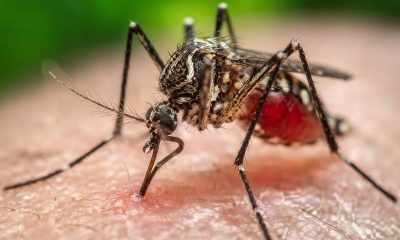
Dengue outbreak gallops ahead: Infections surpasses 73,455, leaving 50 dead
-
 News1 day ago
Evidence recorded in money laundering case against Yoshitha Rajapaksa
-

 News2 days ago
Money laundering case against Yoshitha, fixed for pre-trial conference
-
 Latest News20 hours ago
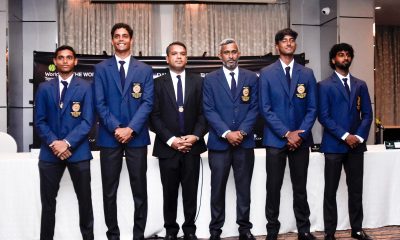
Davis cup Asia/Oceania Group IV 2026 to be held in Colombo from 20th to 25th July
-
 Midweek Review4 days ago
The sordid tale of theft and tragedy at Finance Ministry
-
 Latest News5 days ago
Oil prices hit 1-month high as US-Iran attacks dim Strait of Hormuz outlook
-

 Editorial2 days ago
Overwhelming fire power and stubborn resilience