
Foreign News
Thailand deports dozens of Uyghurs to China

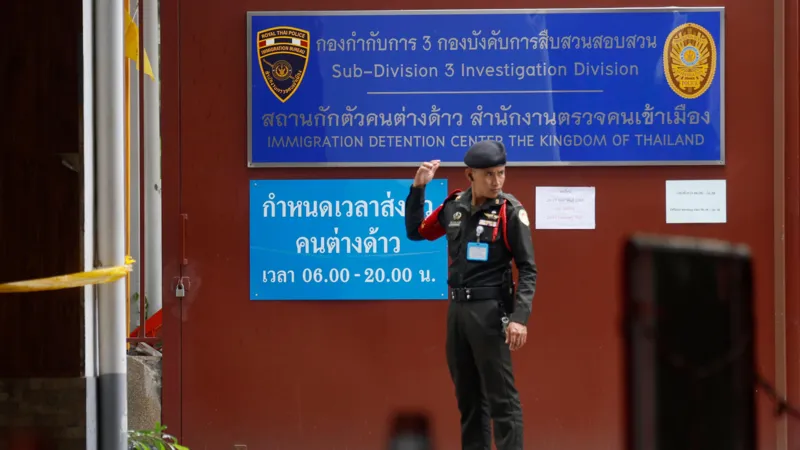
At least 40 Uyghurs have been deported to China, the Thai authorities have confirmed, despite warnings from rights groups that they face possible torture and even death.
The group is thought to have been flown back to China’s Xinjiang region on Thursday, after being held for 10 years in a Bangkok detention centre.
China has been accused of committing crimes against humanity and possibly genocide against the Uyghur population and other mostly Muslim ethnic groups in the north-western region of Xinjiang. Beijing denies all of the allegations.
It is the first time Thailand has deported Uyghurs since 2015.
The deportation has been shrouded in secrecy after serious concerns were raised by the United States and United Nations.
Thai media reported that several trucks, some with windows blocked with sheets of black plastic, left Bangkok’s main immigration detention centre in the early hours of Thursday morning.
Hours later, tracker Flightrader24 showed an unscheduled China Southern Airlines flight leaving Bangkok, eventually arriving in Xinjiang. It was not immediately clear how many people had been deported.
The Thai defence minister told Reuters news agency that Beijing had given assurances the deportees would be looked after.
Beijing said that 40 Chinese illegal immigrants were repatriated from Thailand, but refused to confirm that the group were Uyghurs.
“The repatriation was carried out in accordance with the laws of China and Thailand, international law and international practice,” the foreign ministry said.
Chinese state media said the group had been bewitched by criminal organisations and were stranded in Thailand after illegally leaving the country.
Thailand’s Prime Minister Paetongtarn Shinawatra did not initially confirm any deportations had taken place when asked by reporters.
“In any country in the world actions must adhere to the principles of law, international processes, and human rights,” she said.
The group is thought to be the last of more than 300 Uyghurs who were detained at the Thai border in 2014 after fleeing repression in Xinjiang.
Many were sent to Turkey, which usually offers Uyghurs asylum, while others were deported back to China in 2015 – prompting a storm of protest from governments and human rights groups.
“What is the Thai government doing?” asked opposition lawmaker Kannavee Suebsang on social media on Thursday.
“There must not be Uyghur deportation to face persecution. They were jailed for 11 years. We violated their human rights for too long.”
The detention centre where the Uyghurs – who had been charged with no crime, apart from entering Thailand without a visa – were kept was known to be unsanitary and overcrowded. Five Uyghurs died in custody.
In a statement on Thursday, Human Rights Watch said the group now face a high risk of torture, enforced disappearance and long-term imprisonment.
“Thailand’s transfer of Uyghur detainees to China constitutes a blatant violation of Thailand’s obligations under domestic and international laws,” said the organisation’s Asia director, Elaine Pearson.
“Until yesterday [Wednesday], senior Thai officials had made multiple public assurances that these men would not be transferred, including to allies and UN officials.”
Phil Robertson, director of the Asia Human Rights and Labour Advocates (AHRLA) group, said that the deportations “totally destroyed” the “charade” that the current Thai government was different to the previous one “when it comes to transnational repression and cooperating with authoritarian neighbours”.
Amnesty International described the deportations as “unimaginably cruel”.
Bipartisan members of the US House China Committee on Wednesday issued a statement warning that the deportations “would constitute a clear violation of international human rights norms to which the Kingdom of Thailand is obligated under international law”.
The UN said that it “deeply regrets” the deportations.
There are about 12 million Uyghurs, mostly Muslim, living in Xinjiang, which is officially known as the Xinjiang Uyghur Autonomous Region (XUAR).
The Uyghurs speak their own language, which is similar to Turkish, and see themselves as culturally and ethnically close to Central Asian nations. They make up less than half of the Xinjiang population.
Recent decades have seen a mass migration of Han Chinese (China’s ethnic majority) into Xinjiang, allegedly orchestrated by the state to dilute the minority population there.
China has also been accused of targeting Muslim religious figures and banning religious practices in the region, as well as destroying mosques and tombs.
[BBC]

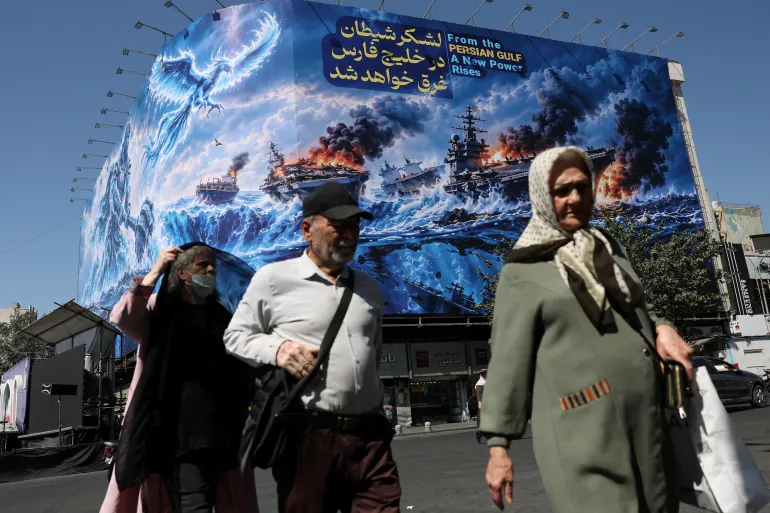
Hours after US President Donald Trump rejected a diplomatic solution put forward by Iran to reopen the Strait of Hormuz, explosions were heard in the waterway, according to Iranian media.
Reports of blasts near southern Iran’s Qeshm Island in the Strait of Hormuz suggested that multiple antiship missiles and drones were fired at vessels transiting the waterway against Tehran’s wishes.
While Iranian authorities did not confirm any attacks in the Strait of Hormuz that day, shipping continues to be attacked in the waters, including an Indian cargo ship last week which killed a sailor.
The Islamic Revolutionary Guard Corps (IRGC) maintains that the strait is closed to any ship that does not coordinate with Iranian authorities. On Sunday afternoon, it released video of what it said was a second US underwater drone seizd this month.
Tehran has issued instructions to shipping companies transiting the Strait of Hormuz to use a temporary route approved by Iranian authorities and pay relevant fees. But it has also said the strait will not fully reopen until the US blockade on Iranian ports ends.
Iran’s Persian Gulf Strait Authority announced on Saturday that it would blacklist any shipping charterer company which orders crews to use routes it considers to be unauthorised.
It also published what it described as an apology from an unnamed shipowner blaming commercial pressure from its charterer for trying to pass through the strait.
(Aljazeera
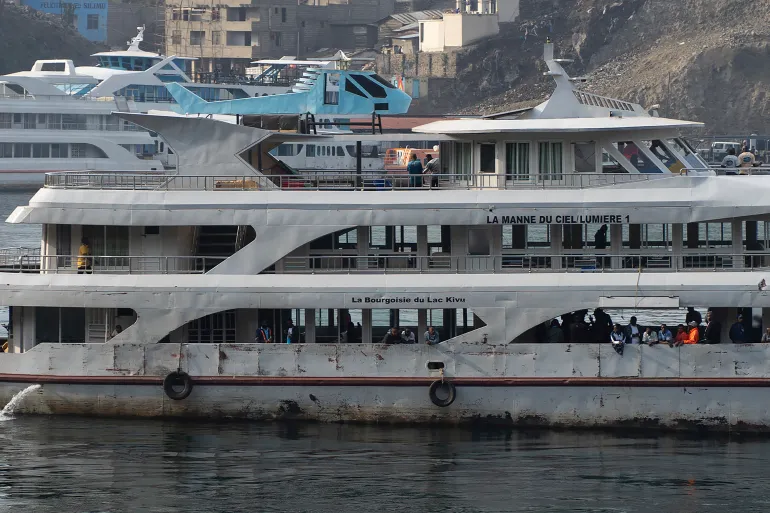
At least 41 people have died, and 49 others have been rescued, after a boat capsized on Lake Tanganyika in the Democratic Republic of the Congo (DRC).
Norris Mulongoyi, the provincial transport minister for DRC’s Tanganyika province, told The Associated Press news agency that search operations were under way to locate the remaining passengers
The boat was reportedly carrying about 100 people and cargo when it capsized near the Congolese village of Mapera.
The vessel was travelling from the port of Kigoma in Tanzania to the city of Kalemie in DRC when it sank on Thursday.
A survivor identified as Annie Moyoni told Radio Okapi, a UN-backed Congolese broadcaster, that passengers were awakened at about 1am and found the boat tilting to one side.
It is unclear what caused the vessel to capsize, but hundreds of people have been killed in boat disasters in the DRC in recent years, according to the AP. Vessels are often overloaded and lack life jackets.
For many in the DRC, travelling by boat is the cheapest and most affordable way to get around. The country is one of the poorest in the world and lacks sufficient infrastructure for its more than 100 million people.
The sinking was the second loss of a Congolese vessel on the Kigoma-Kalemie route in less than a month.
On August 28, the Congolese vessel MV Pacifique caught fire and exploded at the port of Kigoma while loading fuel, according to Radio Okapi.
Six crew members were killed, and a seventh was reported missing, Radio Okapi said, citing port authorities. The vessel operated between Kigoma and Kalemie and was used to transport fuel.
At least 20 people also died when a wooden boat carrying students returning from state exams sank in central DRC in July.
(Aljazeera)
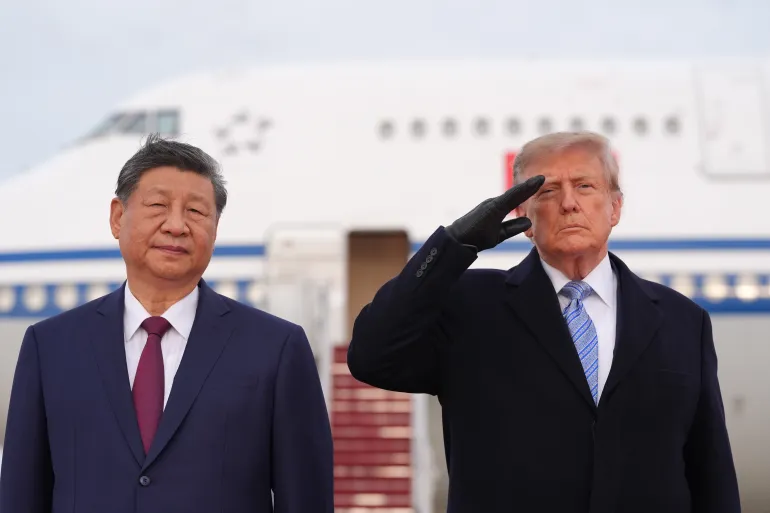
United States President Donald Trump has welcomed Chinese President Xi Jinping as he arrived in the US for a three-day trip focused on issues such as security, trade and technology.
Trump took the rare step of meeting the Chinese leader in person at Joint Base Andrews in the state of Maryland on Wednesday, the first president to do so in recent memory.
The US president and First Lady Melania Trump greeted Xi and his wife on the tarmac during a welcoming ceremony, where a red carpet was rolled out and the couples exchanged handshakes. Trump and Xi then walked side by side, flanked by US soldiers, before standing for a gunfire salute and the US national anthem
The in-person greeting is a sign of the significance that Washington ascribes to its relationship with Beijing, whose meteoric economic rise over the last several decades has transformed it into a global superpower capable of rivalling the United States.
Despite tense relations that worsened after the Trump administration placed high tariffs on Chinese goods – a move that was met with retaliatory measures from Beijing – Trump has expressed personal affinity for Xi and his desire for strong ties with China.
The Chinese president’s trip to the US will include a state dinner, attended by leaders of the country’s powerful tech industry, a military ceremony at the White House, and a visit to the National Archives, home to documents of historical and cultural significance such as the US Constitution and the Declaration of Independence
But both countries remain wary of the other as they compete for political and economic influence. The trip is likely to include discussion of issues such as the US war on Iran, trade, technology, rare-earth minerals and US ties to Taiwan, the self-governing island that China claims as part of its territory
(Aljazeera)

Out, not-out, out: England secure bizarre run-out in Oval victory

Strait of Hormuz tensions linger as Iran and US move further from a deal

Showers will occur in the Western, Eastern, Uva and Sabaragamuwa provinces and in Galle, Matara, Kandy, Nuwara-Eliya, Polonnaruwa and Mullativu districts

Sajith rejects Jt. Opp. protest sabotage claim; SJB TU chief demands remedial action

Police remove Thileepan statue in Jaffna

NPP, Lal agree to disagree

‘Dates have the highest sugar content to fight Coronavirus’

Sunday Island 27 December – Headlines

#SundayIsland 17th December – Headlines

Sunday Island – 28th March

Sunday Island Headlines – 21 March

Sunday Island – 21st February – Headlines
-

 News5 days ago
Mastermind Naufer Moulavi among 15 found guilty
-
 News6 days ago
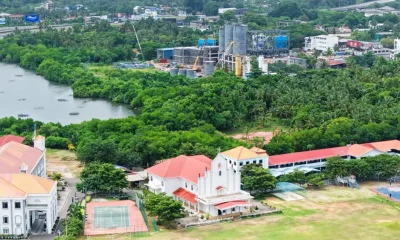
Protest against setting up of cement factory in highly populated area near BIA
-

 Midweek Review5 days ago
Thileepan’s fast unto death: An authentic narrative that many missed
-
 Latest News4 days ago
Showers above 100 mm are likely at some places in the Western, Sabaragamuwa, Central and North-western provinces and in Galle and Matara Districts
-

 Editorial6 days ago
Trouble beginning in earnest
-
Editorial5 days ago
Big Bad Bills
-

 News6 days ago
Govt. confident of 2/3 majority despite NPP split speculation
-

 News6 days ago
Police may seek clarification from US