
Business
Thaala Bentota spearheads sustainable efforts in conserving endangered Ratha Milla mangrove species


Thaala Bentota Resort by Browns Hotels & Resorts, in collaboration with the Department of Wildlife Conservation, recently unveiled a unique conservation initiative aimed at safeguarding Bentota’s vital mangrove ecosystem. The program aims to focus on the Ratha Milla plant (Lumnitzera littorea), a critically endangered true mangrove species native to Sri Lanka.
The Ratha Milla mangrove, previously thought to be limited to the Madu River Ramsar until recently, has now been rediscovered in the Bentota estuary and the Dedduwa lagoon area, with over 100 young plants aged between 10 to 20 years, where it was last recorded a century ago.
A series of informative signs were unveiled at the Bentota mangrove site on the 4th of April to raise awareness amongst visitors on the significance of this distinct ecosystem. The Thaala Bentota team, led by Channa Ekanayake, General Manager of the property, hosted an education and awareness session at the Bentota Dewapriya Rama Temple, bringing together tourists, officials from the Department of Wildlife Conservation and the local community. The discussion highlighted the importance of mangroves around the coastal areas and the need to preserve the critically endangered Ratha Milla plant while mitigating numerous threats to its survival. The program additionally emphasised the need to foster a deeper appreciation for local biodiversity and its ecological importance.
“We are optimistic that this initiative will provide crucial support for the regeneration of the Ratha Milla mangrove species. Through our collaboration with the Department of Wildlife Conservation, we are committed to making a tangible difference in securing the long-term viability of these invaluable ecosystems. Through continued efforts and community involvement, we can work towards a sustainable future where mangroves thrive for generations to come” said Eksath Wijeratne, CEO of Browns Hotels & Resorts.
“The mangroves in Bentota serve as the backbone of our coastal ecosystem, essential for preserving biodiversity and shielding coastal communities from the ravages of climate change. The recent discovery of the Ratha Milla mangrove population presents an invaluable opportunity for seed propagation and advancing conservation endeavors. Through our partnership with Thaala Bentota Resort, our primary objective is to mitigate human-induced threats through educational initiatives” stated Asanka Gunawardane – Head of Marine Division, Hikkaduwa, Department of Wildlife Conservation.
Browns Hotels & Resorts (BH&R) stands as a beacon of luxury and hospitality with a distinguished portfolio comprising some of Sri Lanka’s most enchanting properties: Club Hotel Dolphin, The Calm Resort & Spa, Hotel Sigiriya, Thaala Bentota Resort, Dickwella Resort, Occidental Eden Beruwala, Occidental Paradise Dambulla, and the Reveal Boutique Collection. Beyond providing unparalleled experiences to its guests, BH&R is committed to fostering sustainable practices and community development initiatives. From dedicated wildlife conservation endeavours to impactful community empowerment projects, Browns Hotels & Resorts diligently strives to make a positive impact on both the environment and society at large.
Aligned under the expansive framework of Browns Investments (BI), the investment arm of LOLC Holdings PLC, BH&R is part of the most diversified conglomerate, the Browns Group. With this robust foundation, BH&R is poised to continue its legacy of excellence, innovation and social responsibility in the realm of hospitality, setting new standards for the industry while enriching the lives of communities and preserving the natural wonders of Sri Lanka.








Sri Lanka’s Renewable Energy Project Development Plan, branded GREAT 2025–2030 (Green Energy Acceleration Targets), reads like a confident pivot toward a cleaner, cheaper power system. With more than 2,600 MW of new renewable capacity planned—dominated by solar and wind—and a strong push on storage and grid stabilisation, the strategy signals intent. Yet beneath the headline numbers lies a harder business truth: generation is racing ahead of the grid, and unless infrastructure and control catch up fast, value will leak from an otherwise compelling transition.
At the core of GREAT is scale. Solar leads with 1,571 MW across multiple zones, while wind contributes 1,004 MW, primarily from Mannar, Kilinochchi and the North-Western belt.
Smaller but steady additions are planned in mini-hydro (51 MW) and biomass (38 MW). On paper, the mix lowers marginal costs, cuts imports, and insulates the economy from fuel price shocks—outcomes financiers and policymakers both welcome.
But a senior retired electrical engineer, who spent decades inside Sri Lanka’s power system, cautions that capacity alone doesn’t create reliability—or returns.
“We are adding megawatts faster than we are adding visibility and control,” he said. “Rooftop solar has already exceeded 1,350 MW, much of it invisible to operators. From a grid perspective, that is unmanaged generation, and unmanaged generation is risk.”
The business implications are immediate. Transmission bottlenecks, particularly delays in 220 kV and 400 kV lines, are constraining renewable evacuation. Projects commissioned on time can still face curtailment, eroding project IRRs and shaking investor confidence.
At the same time, electricity demand has softened amid economic pressures, compressing the system’s ability to absorb intermittent power—especially on Sundays and holidays, when demand dips but solar output peaks.
“Low demand days are now the stress test,” the engineer noted. “Without storage and grid-forming assets, you’re forced to back down renewables or keep thermal units running for stability. Both options cost money.”
GREAT attempts to address this with 650 MW / 2,250 MWh of Battery Energy Storage Systems (BESS) and 600 MW of pumped storage at Maha Oya by 2034, alongside synchronous condensers to maintain inertia. These are not optional add-ons; they are value enablers. Storage smooths volatility, captures excess midday solar, and shifts energy to peak hours—turning stranded electrons into bankable revenue.
Yet timing matters. Storage, controls, and transmission must arrive before or with new generation. Otherwise, developers face curtailment risk, lenders price in uncertainty, and tariffs fail to fall as promised.
The plan’s institutional fixes are equally commercial. A Renewable Energy Control Desk (from 2026), Distribution Control Centers in high rooftop solar areas, smart meter mandates, and grid digitalisation are designed to restore operational visibility. Time-of-use tariffs, paired with daytime EV charging and industrial load-shifting, aim to reshape demand—turning a system problem into a market opportunity.
“Tariffs are signals,” the engineer said. “If you want power used at noon, price it right. If EVs and factories move load to the day, solar becomes an asset, not a headache.”
For investors, the message is nuanced but clear. Sri Lanka’s renewable pipeline is real and sizeable.
The policy direction favours clean energy, and the cost curve is attractive. However, project bankability will increasingly hinge on grid-readiness—access to storage, firm evacuation paths, and participation in smart, controllable networks.
For policymakers, GREAT’s success will be measured not by megawatts announced, but by megawatt-hours delivered reliably and profitably. Accelerating transmission approvals, fast-tracking BESS procurement, and enforcing smart metering for distributed generation are the difference between a virtuous transition and a congested one.
“The transition is inevitable,” the engineer concluded.
“The question is whether we do it cheaply and safely, or pay twice—once for generation, and again for the fixes we delayed.”
GREAT 2025–2030 sets Sri Lanka on the right path. The business case now depends on execution—where grids, markets, and management must move at the same speed as ambition, he added.
By Ifham Nizam
Business
Zone24x7 enters 2026 with strong momentum, reinforcing its role as an enterprise AI and automation partner


Zone24x7 concluded 2025 with significant industry recognition, securing seven awards across three leading technology competitions—marking one of the strongest years in the company’s 22-year journey. The awards recognized the Industrial Vending Machine solution developed for a client in Australia. It earned both national and regional honors, including Second Runner-up at the Asia Pacific ICT Alliance (APICTA) Awards 2025.
More than accolades, the recognition showcases Zone24x7’s ability to deliver practical, enterprise-ready solutions that create measurable business impact. Competing against leading technology companies across the Asia Pacific region, the wins highlight the company’s growing global footprint and its focus on translating innovation into operational value for customers.

Neschae Fernando, CEO of Zone24x7
Zone24x7’s award run began at the SLASSCOM National Ingenuity Awards 2025, where the company secured National Winner for Best Innovative Product in Manufacturing, National 1st Runner-up for Best Innovative Product (General), and two Provincial Winner titles in the Western Province. This success continued at the National ICT Awards (NBQSA 2025), with Gold in Manufacturing, Engineering & Construction, and the IoT Technology of the Year Award.
“2025 validated our approach of building technology around real business needs,” said Neschae Fernando, CEO of Zone24x7. “As we move into 2026, our focus is on helping enterprises improve productivity, visibility, and decision-making by applying AI, automation, and connected systems in ways that go far beyond standalone tools or chat-based solutions.”
Headquartered in the United States with a world-class technology hub in Sri Lanka, Zone24x7 serves over 50 enterprise customers across multiple industries. The company specializes in integrating artificial intelligence, IoT, and enterprise platforms to solve complex operational challenges at scale.
Its portfolio includes Generative AI capabilities that enhance workflows, system intelligence, and human productivity; AI-powered automation platforms that connect digital and physical data sources; and a Cognitive Vision Analytics Platform that delivers real-time insights from video and image data. In addition, Zone24x7 provides RFID-enabled solutions and Warehouse Management Systems that improve inventory accuracy, asset visibility, and supply chain performance.
“The value we bring lies in how we combine hardware, software, and AI into cohesive solutions that fit seamlessly into existing enterprise environments,” said Vipula Liyanaarachchi, General Manager at Zone24x7. “As organisations look ahead to 2026, we are focused on helping them scale efficiently, modernise operations, and unlock greater value from their data without disruption.”
The award-winning Industrial Vending Machine reflects this approach, integrating IoT hardware, intelligent software, and analytics to automate inventory control and enhance efficiency in manufacturing and industrial settings. Rather than being a standalone product, it demonstrates how Zone24x7 partners with clients to design solutions aligned to specific operational goals.
With more than two decades of experience and a strong research and development foundation, Zone24x7 is now investing further in advanced AI-driven automation, intelligent analytics, and system-agnostic architectures. As businesses navigate rapid technological change, the company is positioning itself as a long-term partner—helping enterprises adopt AI responsibly, enhance workforce productivity, and build resilient operations into 2026 and beyond.
Business
India’s Mazagon Dock Shipbuilders makes mandatory offer to buy remaining shares of Colombo Dockyard

India’s Mazagon Dock Shipbuilders Limited has made a mandatory offer to buy the remaining shares of Colombo Dockyard at Rs 40 each, following a 41.73 percent stake acquisition last month.The mandatory offer targets 58.27 percent of the company.
At the recent rights issue, Mazagon Dock Shipbuilders bought 164,916,229 ordinary shares of Colombo Dockyard from the unsubscribed rights entitlement of previous stakeholder Onomichi Dockyard Company.
Mazagon paid Rs 40 per share amounting to a total Rs 6,596,649,160 .
Both indices moved upwards. The All Share Price Index went up by 67.5 points, while the S and P SL20 rose by 23.57 points. Turnover stood at Rs 9.1 billion with 16 crossings.
Top seven crossings were reported as follows: Commercial Bank 9.7 million shares crossed to the tune of Rs 1.2 billion and its shares traded at Rs 224.50, TJ Lanka 14.3 million shares crossed to the tune of Rs 549.7 million; its shares sold at Rs 38.50, Renuka Hotels one million shares crossed to the tune of Rs 250 million; its shares sold at Rs 250, Melstacorp one million shares crossed to the tune of Rs 178 million; its shares fetched Rs 179, Sampath Bank 930,000 shares crossed for Rs 145 million and its shares traded at Rs 150, Sierra Cables two million shares crossed for Rs 74 million; its shares sold at Rs 37 and Lanka Milk Food one million shares crossed for Rs 71 million; its shares fetched Rs 71.
In the retail market companies that mainly contributed to the turnover were; Colombo Dockyard Rs 514 million (3.3 million shares traded), Ceylon Land Equity Rs 349 million (15.6 million shares traded), Sierra Cables Rs 339 million (1.4 million shares traded), Commercial Bank Rs 307 million (1.4 million shares traded), TJ Lanka Rs 247 million (6.5 million shares traded), Luminex Rs 232 million (19.6 million shares traded) and Renuka Foods Rs 180 million (11 million shares traded). During the day 311 million share volumes changed hands in 50661 transactions.
It is said that the market showed mixed reactions. The banking sector actively participated, especially Commercial Bank. The manufacturing sector also performed well.
Yesterday the rupee was quoted at Rs 309.30/40 to the US dollar in the spot market, stronger from Rs 309.45/50 the previous day, while bond yields continued to edge lower on the the mid- to long end of the yield curve, dealers said.
A bond maturing on 15.06.2029 was quoted at 9.45/50 percent.
A bond maturing on 15.09.2029 was quoted at 9.50/55 percent.
A bond maturing on 15.12.2029 was quoted at 9.52/58 percent, down from 9.55/60 percent.
A bond maturing on 01.07.2030 was quoted at 9.68/71 percent.
A bond maturing on 01.10.2032 was quoted at 10.21/24 percent, down from 10.23/25 percent.
A bond maturing on 01.06.2033 was quoted at 10.55/60 percent, down from 10.57/60 percent.
A bond maturing on 15.06.2034 was quoted at 10.77/80 percent.
A bond maturing on 15.06.2035 was quoted at 10.80/86 percent, down from 10.82/87 percent
By Hiran H Senewiratne

Trump threatens tariffs for countries trading with Iran

Advisory for Severe Lightning for the Western and Sabaragamuwa provinces and Galle and Matara districts

Decisions and judgments of the Supreme Court are a reflection of justice in the country – PM

INS GHARIAL departs island

Pakistan ask Netherlands to bat in T20 World Cup opener

Stop the collection of funds from parents at school level for Smart Boards — PM

‘Dates have the highest sugar content to fight Coronavirus’

Sunday Island 27 December – Headlines

#SundayIsland 17th December – Headlines

Sunday Island – 28th March

Sunday Island Headlines – 21 March

Sunday Island – 21st February – Headlines
-

 Business4 days ago
SLIM-Kantar People’s Awards 2026 to recognise Sri Lanka’s most trusted brands and personalities
-

 Business6 days ago
Altair issues over 100+ title deeds post ownership change
-

 Business6 days ago
Sri Lanka opens first country pavilion at London exhibition
-

 Business5 days ago
All set for Global Synergy Awards 2026 at Waters Edge
-
 Business4 days ago
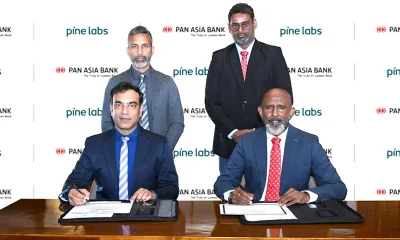
API-first card issuing and processing platform for Pan Asia Bank
-

 Business6 days ago
ESOFT UNI Kandy leads the charge in promoting rugby among private universities
-

 Editorial2 days ago
All’s not well that ends well?
-

 Features2 days ago
Phew! The heat …