
Business
Temporary closure of share trading based on pragmatic considerations – CSE

By Sanath Nanayakkara and Hiran Senewiratne
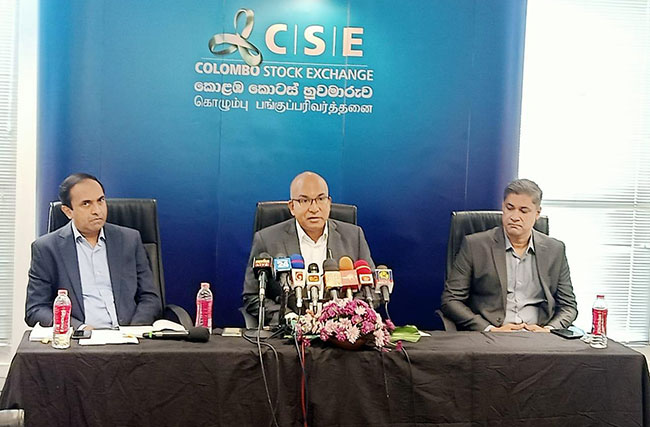
Colombo Stock Exchange (CSE) said yesterday that it recommended the Securities and Exchange Commission (SEC) to temporarily close trading activities of the CSE based on ‘uncertain’ information, yet with a most pragmatic view of the unprecedented crisis situation in the country, with its statutory obligations and overall investor protection at heart.
CSE Chairman Dumith Fernando, CEO Rajeeva Bandaranayake and Director Dilshan Wirasekera made these comments at a press briefing held to explain their decision to halt the business of CSE for five days from April 18 to April April 22.
CSE Chairman Dumith Fernando said,” We accept that there is no answer that is 100% or 100% wrong. There are parties and individuals some supporting the decision and some others opposing it. This was a difficult decision. We have multiple stakeholders. It is the responsibility of the CSE to give the general public the key factors that led to this decision.”
He further said:
“CSE needs to be consistent with the duties and responsibilities placed on the Board by the new SEC Act. In this context, we are obligated to ensure the long term sustainability the stock market. So we have to look at the evolving events and act to ensure the long term sustainability of the stock market. And then we need to understand the public interest, particularly in relation to investors. SEC Act stipulates a very clear responsibility to CSE to give particular attention to public interest in terms of investor protection.”
“We used the information available to us to make this decision which is in large part was uncertain information. So it was a tough call, but it being our responsibility, we had to meet with that tough call.”
“We have three primary stakeholders – this is not to ignore other stakeholders – one is the intermediaries, then you have listed companies, the core of the CSE. Thirdly you have investors. There is a broad range within investors; foreign investors, institutional investors, high net-worth investors and retail investors. The Stock Exchange has to look at things in totality and make decisions to protect overall interests of all of these investors. Given the responsibility in accordance with the new SEC Act, this decision heavily leaned on investor protection. In the old SEC Act, there was very little described in terms of responsibilities of the Stock Exchange which dealt with who can apply to CSE, granting of licences, establishing rules of the Exchange, but there weren’t any expressive provisions on the duties of CSE. The new SEC Act is quite clear. According to Section 24 of part two, we need to maintain a fair, orderly, transparent and efficient securities market in Sri Lanka. Two; we need to enhance effective and efficient functioning of the securities market, and thirdly we need to mitigate systemic risks. Those are the objectives of a market institution. Section 27 speaks most specifically about our duties and responsibilities as a stock exchange. It says that it shall be the duty of an Exchange to ensure an orderly and fair market in securities. It further says that the Exchange shall act in the public interest. Having particular regard for the protection of investors should supersede any other requirements. Section 30 stipulates that SEC under consultation with the Exchange can decide to close the market in certain circumstances including natural disasters, or in an economic or financial crises or other similar circumstances within or outside Sri Lanka.”
“There is a statutory obligation for us to look after the public interest especially with regard to investor protection. One of our key responsibilities is to ensure fair, efficient and orderly market. A fair market is one that includes the market that reflects the forces of supply and demand of shares. Not artificial supply and demand. So one factor that we looked at was achieving a natural demand and supply of shares driven by fundamentals. One of the issues that led to the fall of the market in the last month was ‘forced selling’ by margin providers and stockbrokers whose clients have taken shares on credit. Margin providers and stockbrokers force sell when portfolio values of clients go to certain levels which is in fact within the rules. Now the question is whether it’s a fair market. When there is a systemic drive to force sell, actually the selling side outweighs the fundamental interest in those stocks creating an imbalance. Such artificial pressure was one factor we took into consideration. Secondly, to create an efficient market, there has to be efficient information. The news that came out on preemptive foreign debt was followed by an extended holiday. We don’t believe that investors, investment advisors had enough time to digest and understand what the impact of that announcement would be. Without that transparency of information, it is very difficult for investor to have the transparency of efficient information to operate an efficient market.
‘Another factor of a fair market is that a market should remain liquid which means that it is kept open. Our natural instinct is that market should remain open. We don’t believe that the market should remain indiscriminately closed. The market should remain open and provide liquidity- that is the fundamental pledge we have made to our stakeholders. But when you want to provide a fair and orderly market, now there are factors in conflict with each other. To keep the market open, we might undermine some of the other factors that create an orderly market. So this decision was not about one set of pros and one set of cons. So, this decision was made on the fact that we have these duties and responsibilities under the new SEC Act. Disposing of these duties can be an offence under the Act. We had to make this decision based on the unprecedented crisis situation prevailing in the country in order to cool it off and then be able to make more informed decisions and resume fair, transparent trade activites soon.”


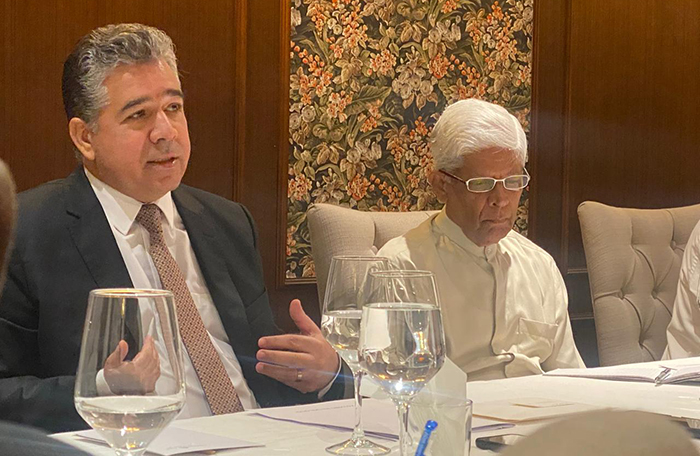
The Turkish government’s foreign policy priorities in a period of heightened global turbulence, stressing diplomacy, dialogue, and cooperation are essential tools for navigating an increasingly unstable international environment, Turkey’s Ambassador to Sri Lanka Dr. Semih Lütfü Turgut said.
‘The turbulence and uncertainty of recent years have carried forward into 2026, with unresolved conflicts, shifting power balances and declining respect for a rules-based international order, Dr. Turgut explained at a foreign policy round table conducted recently by the Pathfinder Foundation Sri Lanka at the Colombo Club, Hotel Taj Samudra. It was presided over by Pathfinder Foundation Chairman, retired Ambassador Dr. Bernard Goonatilleke.
The Turkish ambassador stressed that while geography may separate Türkiye and Sri Lanka, both countries share a common aspiration for peace, stability and sustainable development at regional and global levels and emphasised the importance of strengthening bilateral, regional and multilateral cooperation at a time when collaboration is of the utmost importance.
Dr. Turgut added: ‘International relations are increasingly shaped by differing perspectives and interpretations of geography, history, and power.
‘Conflicts in seemingly distant regions can have significant ripple effects worldwide, reinforcing the need for informed and flexible foreign policy approaches.
‘The ongoing wars in Ukraine and Gaza are defining crises of the present era.
‘These conflicts demonstrate both the limits of military power and the deep humanitarian costs of war, while also exposing a certain duplicity in the international system. The fragile nature of ceasefire efforts, particularly in Gaza, called for sustained international engagement to prevent further escalation and human suffering.
‘Of considerable note is the continued instability in the Middle East, including developments in Yemen, Iran and the Horn of Africa, as well as rising tensions in Europe and East Asia.
‘Increasing militarisation, proxy rivalries and geopolitical competition risk further erosion of global stability, while economic pressures and austerity measures could fuel political extremism in many regions.
‘Ankara’s approach is anchored in regional peace, stability, and independence. Türkiye continues efforts to mediate between Russia and Ukraine, emphasising the importance of securing the Black Sea for global food security.
‘Full membership of the European Union remains a strategic priority for Türkiye and its engagement in Central Asia through the Organization of Turkic States with its focus on economic cooperation in energy along with transport corridors is important. Diplomacy remains the most effective and least costly instrument of foreign policy, particularly at a time of resource constraints and global uncertainty.
‘The international community needs to prioritise dialogue over confrontation and should uphold the principles of sovereignty, non-interference and cooperation in the pursuit of lasting peace.’
By Hiran H Senewiratne ✍️
Business
Local entrepreneurs propose high-quality saree manufacturing in Sri Lanka to curb forex outflow

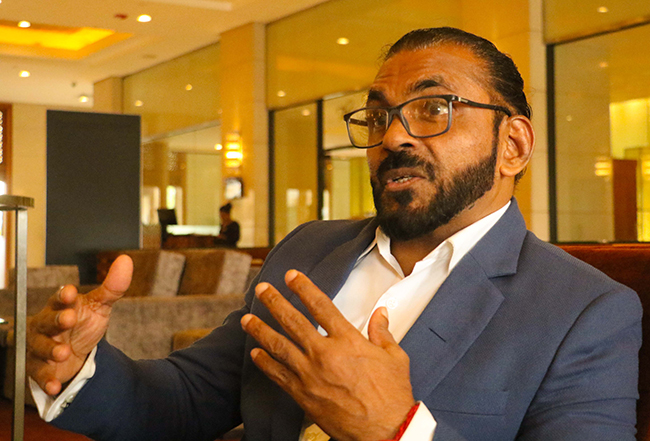
A group of local entrepreneurs is urging the government to overhaul the nation’s textile import policy, proposing a bold shift toward domestic saree manufacturing to stem the critical outflow of foreign exchange.
Sidambaram Karunanithi, a Pettah-based entrepreneur with deep roots in India and the textile trade, told The Island Financial Review that approximately 100,000 sarees are sold daily across Sri Lanka. He argued that the total reliance on Indian imports for this high-volume commodity represents an “unnecessary drain” on the country’s precarious dollar reserves.
The consortium, led by Karunanithi, has drafted a comprehensive roadmap to achieve self-sufficiency in the sector. The plan envisions the establishment of nine specialised factories – one in each province – to decentralize the industry.
“Our strategy is to import raw materials, specifically high-quality yarn, from India and conduct the entire manufacturing process locally,” Karunanithi explained. “By producing within the provinces, we eliminate significant freight costs as well as the need for regional dealers to travel to Pettah. These logistical savings will be passed directly to the end-consumer.”
The entrepreneurs intend to utilize advanced industrial multi-head systems sourced from leading Chinese manufacturers, capable of producing high-speed air-jet and jacquard weaves. Karunanithi emphasised that this technology would allow the local industry to reach a 50% value-addition threshold – more than the 35% standard often requested by the government for other sectors.
“India achieved global manufacturing status through partnerships like Hero Honda and Maruti Suzuki. There is no reason we cannot do the same with sarees. If there is a will, there is a way,” he noted.
Addressing the technical gap, the group plans to initially import skilled labor from India to facilitate a year-long technology and skills transfer. “Within 12 to 18 months, these foreign workers will be entirely replaced by a trained Sri Lankan workforce,” he said.
The proposal includes a request for the government to restrict Indian saree imports over one year to provide the necessary market protection for local startups. Karunanithi stressed that the group is not seeking concessional bank facilities, stating they are prepared to invest in private lands if state land is unavailable.
The entrepreneurs are calling for a meeting with President Anura Kumara Dissanayake and the Ministry of Industries to present their financial profiles and technical capacity.
“We urge the authorities not to make half-hearted or inconsistent policy decisions. If the country allows the manufacture of alcohol, why not sarees?” Karunanithi asked, adding that the foreign currency saved could be vital for the health and education sectors.
By Sanath Nanayakkare ✍️
Business
LOLC Holdings, PickMe and Browns EV collaborate to accelerate Sri Lanka’s transition to inclusive electric mobility
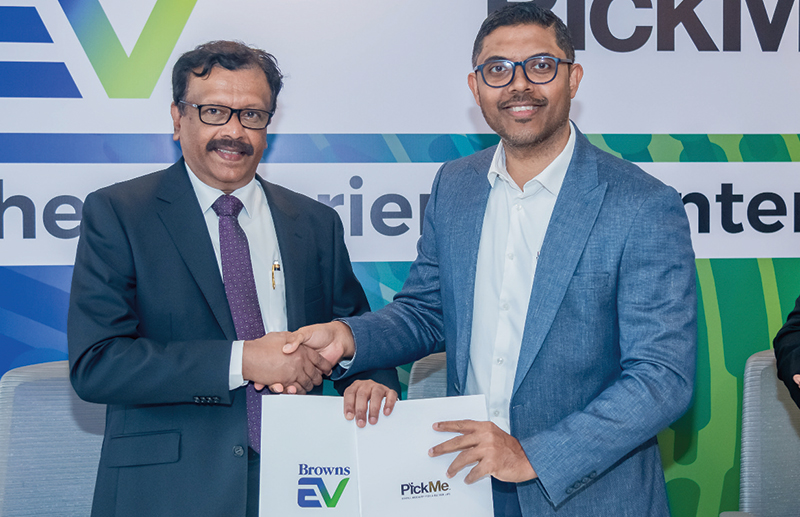
LOLC Holdings PLC has entered into a strategic mobility collaboration with PickMe, to accelerate the adoption of electric vehicles (EVs) while creating an inclusive and sustainable vehicle ownership pathway for independent ride-hailing drivers across the country. Anchored by Browns EV, the LOLC Group’s latest electric mobility venture marks a significant step towards redefining access to clean, affordable, and future-ready transportation in Sri Lanka.
At the centre of this initiative is a direct rent-to-own facility offered by LOLC to independent third- party drivers that engage with the PickMe platform. Under this model, LOLC provides Browns EV vehicles directly to these independent drivers. The programme allows the drivers to choose to operate EVs by committing to a daily rental structured by LOLC, with the full ownership transferred at the end of a six-year tenure, which is managed solely by LOLC. For the convenience of the drivers, daily rental payments are remitted through the PickMe platform’s digital interface based on driver authorization, assisting them in managing their personal financial obligations while enabling long-term asset creation.
A key milestone of the collaboration was marked with the official opening of the Browns EV Experience Centre on 09th of January 2026 at the Browns EV Showroom premises. Designed as a dedicated resource hub, for independent drivers that engage with the PickMe platform, the Centre allows these entrepreneurs to explore a variety of electric vehicle options and engage directly with LOLC representatives. At the Centre, drivers can independently evaluate LOLC ’s daily rental model, assess their individual eligibility, and complete their registration process directly with LOLC. This streamlined environment provides a one-stop location for drivers managing their own independent business growth.
The launch event also featured the formal signing of a strategic collaboration agreement between Kapila Jayawardena, Group Managing Director/CEO of LOLC Holdings PLC, and Jiffry Zulfer, Founder and Chief Executive Officer of PickMe Sri Lanka.
Commenting on the initiative, Kapila Jayawardena stated, “At LOLC, we believe that meaningful progress is achieved by empowering people through access, opportunity, and innovation. This strategic collaboration with PickMe, supported by Browns EV, brings together financial innovation, responsible asset ownership, and affordable electric mobility to strengthen livelihoods while advancing Sri Lanka’s national sustainability priorities. Following years of import restrictions that limited access to vehicle ownership, this initiative responds directly to pent-up demand by making high-quality, future-ready electric vehicles genuinely accessible to independent entrepreneurs who depend on mobility for their livelihoods.”
Browns EV recently launched a line-up of electric vehicles positioned to expand affordable mobility across Sri Lanka. In partnership with global automotive leaders SAIC-GM-Wuling Automobile (SGMW) and Beijing Auto Works (BAW), Browns EV has introduced models designed to cater to diverse consumer and commercial segments. Wuling, the world’s second-largest EV brand, has produced over three million units globally, while Beijing Auto Works is among China’s oldest and largest automotive manufacturers. Their expertise, combined with Browns’ 150-year legacy in Sri Lanka, ensures quality, safety, and long-term value for consumers.
Drivers exploring options through the Browns EV Experience Centre can view a diverse portfolio of Browns EV models, including the BAW E6, BAW E7, BAW E7 Pro, Wuling Binguo, and Wuling Cloud.
Emphasising the synergy unlocked through the collaboration, the CEO of PickMe stated, “Collaborating with LOLC Holdings, an institution defined by scale, credibility and long-term value creation, marks a significant milestone in PickMe’s journey. Alongside Browns EV, this collaboration integrates finance, technology and sustainable mobility into a unified ecosystem. By combining PickMe’s digital platform with LOLC’s financial strength and Browns EV’s electric vehicle expertise, we are not only accelerating the adoption of clean mobility but also empowering independent mobility entrepreneurs across Sri Lanka with access, opportunity and long-term economic resilience”.
Together, the collaboration between LOLC Holdings, PickMe, and Browns EV establishes a scalable and future-focused model for electric mobility in Sri Lanka, one that seamlessly integrates financing, technology, and vehicle access within a unified ecosystem. By lowering barriers to EV adoption and facilitating long-term asset ownership for independent drivers, the initiative supports national sustainability goals while strengthening livelihoods and entrepreneurship.

Navy divers restore sluice gate of Bomburuella Reservoir

Gujarat Giants comfortably overcome sloppy UP Warriorz

After fall from grace, Asalanka aims to bat on for Sri Lanka

PM holds High-Level meetings with EU, UNDP, and corporate leadership at World Economic Forum

Trump withdraws Canada’s invite to join Board of Peace

Vampire film Sinners breaks Oscar nominations record

‘Dates have the highest sugar content to fight Coronavirus’

Sunday Island 27 December – Headlines

#SundayIsland 17th December – Headlines

Sunday Island – 28th March

Sunday Island Headlines – 21 March

Sunday Island – 21st February – Headlines
-

 Editorial5 days ago
Illusory rule of law
-
 News6 days ago
UNDP’s assessment confirms widespread economic fallout from Cyclone Ditwah
-
 Editorial6 days ago
Crime and cops
-
 Features5 days ago
Daydreams on a winter’s day
-
 Features5 days ago
Surprise move of both the Minister and myself from Agriculture to Education
-

 Features4 days ago
Extended mind thesis:A Buddhist perspective
-
 Features5 days ago
The Story of Furniture in Sri Lanka
-

 Opinion3 days ago
American rulers’ hatred for Venezuela and its leaders