
Business
TCL 20 Pro 5G with awe-inspiring visuals wins CES 2022 Innovation Award


Consumer Electronic Show (CES) the most influential tech event in the world, is a proving ground for breakthrough technologies and global innovators. It’s where the world’s biggest brands do business and meet new partners, and the sharpest innovators hit the stage. TCL’s next-generation smartphone flagship, the TCL 20 Pro 5G offering awe-inspiring visuals with true-to-life color, clarity and contrast across its powerful 6.67-inch AMOLED display has been selected as the CES 2022 Innovation Award Honoree.
TCL 20 Pro 5G comes with the upgrade NXTVISION, advanced display optimization technology which is an exclusive experience showcasing sharper details and greater contrast boosting colour accuracy to enhance the user’s real-life visual experience while offering elevated levels of eye protection to reduce eye strain and it boasts the TÜV Rheinland low blue light certification. It offers revolutionary speeds, faster streaming, quicker downloads, and enhanced AI features with its Qualcomm Snapdragon processor. Both front and back-facing cameras leverage premium Sony IMX sensors, accompanied by Optical Image Stabilization technology and Backlight Selfie mode.
Equipped with a mega 256GB memory and 4500mAh battery, TCL 20 Pro 5G ensures consumer’s that they won’t have to charge up or delete anything from this smartphone any time soon. A dual matte and glossy finish provides a balanced design that’s sleek in the hand. The matte and glossy finish with horizontally oriented features mirrors the duality of the sea meeting the sky in Marine Blue and Moondust Gray, the dual-sided 3D glass and an embedded camera provide complete seamlessness you can feel for a premium in-hand experience that’s as smooth as TCL 20 Pro 5G looks.
CES showcases companies including manufacturers, developers and suppliers of consumer technology hardware, content, technology delivery systems and more. It also includes a conference program where the world’s business leaders and pioneering thinkers address the industry’s most relevant issues.
Singer recently launched the TCL 20 series in the Sri Lankan market and the recognition of the TCL 20 Pro 5G at the Consumer Electronic Show (CES) 2022, as the Innovator Award Honoree will enable them to build more trust within their consumers. A range of products including 10 mobile phones and 4 tabs are available now at www.singer.lk , Singer retail showrooms and authorized dealers island wide.



Timing aligns with national policy discussions
By Sanath Nanayakkare
The USA–Sri Lanka Chamber of Commerce is exploring an innovative promotional initiative to showcase Sri Lanka’s tourism, cultural heritage, and commercial opportunities in the heart of New York City during the upcoming Christmas and holiday season.
The proposed campaign aims to bring Sri Lanka’s unique identity to one of the world’s most internationally recognized cities through a mobile digital billboard featuring high-quality photographs and videos highlighting the island’s natural beauty, rich heritage, and diverse commercial offerings. Designed to capitalize on New York City’s significant holiday-season foot traffic, the initiative will reach American consumers, international tourists, and potential business partners.
The digital showcase will feature pristine beaches, scenic mountains, waterfalls, tea plantations, wildlife, ancient cities, Buddhist heritage, traditional arts, authentic cuisine, and modern attractions, positioning the country as a premier international travel destination. An interactive QR code linking to comprehensive tourism information will also be incorporated, allowing viewers to directly explore travel opportunities.
Beyond destination promotion, the initiative provides Sri Lankan businesses with a vital platform to introduce their products and services to the American market. Enterprises representing Ceylon tea, spices, food products, gems and jewellery, apparel, handicrafts, wellness, hospitality, and tourism will have the opportunity to showcase their brands alongside the broader national campaign.
The Chamber notes that this effort will be particularly beneficial for small and medium-sized enterprises (SMEs) seeking greater international exposure, brand recognition, and commercial partnerships in the United States. By integrating tourism promotion with commercial visibility, the project aims to strengthen Sri Lanka’s international image while supporting trade, investment, and business development.
Operating under the central message of “Discover Sri Lanka. Experience Sri Lanka. Visit Sri Lanka,” the campaign presents the island as a destination defined by natural beauty, cultural richness, distinctive products, and entrepreneurial potential. More information on the initiative is accessible at www.usaslcc.org.
Tourism sector stakeholders have welcomed the move, noting that private-sector-led initiatives of this nature bypass cumbersome bureaucratic procurement procedures and complex tender processes typically associated with state-run promotional campaigns abroad.
The timing aligns with recent national policy discussions regarding tourism promotion. Participating in a Fireside Chat at the inauguration of the Sri Lanka Economic and Investment Summit 2026, organized by the Ceylon Chamber of Commerce, President Anura Kumara Dissanayake emphasized that a proper procurement mechanism needs to be established before acquiring tourism promotional concepts, recommending a performance-based system where agencies are compensated according to verified growth in tourist arrivals.

For 10th consecutive year
Seylan Bank PLC, the Bank with a Heart, has reaffirmed its commitment to supporting Sri Lanka’s automotive industry by partnering with the 20th edition of the Colombo Motor Show 2026 as the Official Banking & Leasing Partner for the 10th consecutive year. This makes Seylan Bank the longest-standing partner of the Colombo Motor Show, further reflecting its longstanding association with one of Sri Lanka’s most prominent automotive exhibitions. The four-day exhibition is scheduled to take place from 20th to 23rd November 2026 at the Bandaranaike Memorial International Conference Hall (BMICH), marking the first time the Colombo Motor Show will be held as a four-day event.
As one of Sri Lanka’s leading international motor and motor accessories exhibitions, the Colombo Motor Show will bring together vehicle enthusiasts, prospective buyers, industry professionals and automotive service providers. The 2026 edition is expected to feature over 200 trade stalls covering motor vehicles, accessories, spare parts, lubricants, tyres, batteries, leasing facilities and other motor-related services.
Through its continued partnership, Seylan Bank will showcase a comprehensive range of financial solutions designed to support customers in meeting their personal and business needs, with a particular focus on Seylan Leasing facilities. Visitors to the exhibition will have the opportunity to receive on-the-spot leasing evaluations and expert guidance from Seylan Leasing Specialists, helping them explore vehicle financing options conveniently during the event.
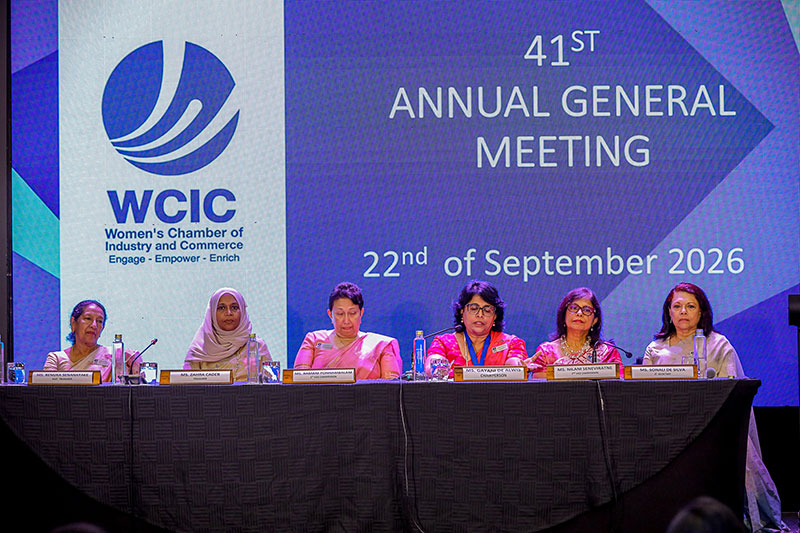
The Women’s Chamber of Industry and Commerce (WCIC) is sharpening its focus on helping women entrepreneurs move beyond business creation towards sustainable growth, as it expands its membership, partnerships and advocacy footprint.
WCIC Chairperson Gayani de Alwis, concluding her second tenure, highlighted the Chamber’s efforts had increasingly centered on creating pathways for women to translate entrepreneurial ambition into viable enterprises and, importantly, build those businesses for the longer term.
“Ultimately, our impact is not measured by the number of programmes we conducted, but by the women whose businesses grew, whose voices became stronger, whose horizons expanded and whose contribution to the economy became greater,” she said addressing the WCIC 41st Annual General Meeting (AGM) held on 22 September for which the Chief Guest was Canadian High Commissioner to Sri Lanka and the Maldives Isabelle Martin.
The focus has included a special initiative for female university students with an entrepreneurial mindset, regional chapter initiatives in the Northern Province, capacity-building programmes and the inaugural ‘Beyond Ramp Up’ workshop.
The Chairperson said these initiatives were designed to move women “from aspiration to enterprise, and from enterprise to sustainable growth”, signaling a broader focus on strengthening the progression of women entrepreneurs beyond the initial stages of business formation.
WCIC recorded a 20 percent increase in membership during the period with membership crossing 460 and expanded its ecosystem through a series of strategic partnerships.
Internally, WCIC moved to strengthen its governance framework, revising its Articles of Association to ensure regulatory compliance and introducing a Code of Conduct and Board self-assessment. Clearer organisational roles, job descriptions and performance targets were also introduced as part of efforts to strengthen accountability and professionalise its operations.
Reflecting on her tenure, the Chairperson said the period had been about building a stronger, more connected and professionally governed organisation, while converting its wider ambitions into tangible opportunities for women in business.

Showers or thundershowers will occur in most parts of the island after 1.00 p.m

CTU: Teacher shortage casts doubt on govt.’s education reforms

Norochcholai to remain offline for several days after blackout

President links businessman held with arms to politicians

CID probe sought into tusker’s death amid fears of elephant-killing syndicate

Bill to allow remote witness testimony in courts

‘Dates have the highest sugar content to fight Coronavirus’

Sunday Island 27 December – Headlines

#SundayIsland 17th December – Headlines

Sunday Island – 28th March

Sunday Island Headlines – 21 March

Sunday Island – 21st February – Headlines
-

 Latest News6 days ago
Nissanka’s return headlines Sri Lanka’s Test squad against Pakistan
-

 News5 days ago
Sri Lanka, India caught in US-Iran ship crisis
-

 Latest News6 days ago
Imran Khan’s PTI braces to fight federal takeover of Khyber Pakhtunkhwa
-

 Latest News5 days ago
Missiles intercepted near Riyadh after Saudi coalition hits Yemen fuel depot
-

 Latest News5 days ago
Kusal Mendis’ unbeaten 87 hands Sri Lanka consolation win
-

 News6 days ago
Mahinda and Shiranthi hospitalised
-

 News2 days ago
Asgiri Mahanayake calls for immediate release of Gnanasara Thera
-

 News6 days ago
Presidential pardons: Govt. studying Justice Thurairaja’s recommendations – Minister