
Opinion
‘ System change’: Yet another mirage!


As we are fast approaching the anniversary of the election of AKD as President, perhaps, it is an opportune moment to take stock of what happened since. It was an earth-shattering event in Sri Lankan politics when the leader of a party responsible for two insurrections leading to huge economic and infrastructure damage, on top of the horrendous human cost, was voted to the highest office, though not by the majority, However, three months later, his mandate was solidified when the voters gave him a two-thirds majority in parliament. Leaving aside the fact that he still speaks as if he is in the opposition and his supporters continue with often exaggerated vilification campaigns against opponents, as old habits die hard, concerns have been raised about emerging negative tendencies and ‘system change’ which was the bulwark of their pledges for election, seems increasingly to be a mirage!
The first, and the most significant, deviation from the promised ‘system change’ was continuing with the agreements made with the IMF by his predecessor Ranil Wickremesinghe (RW), which was sensible though a broken promise. We should be thankful to AKD for having had the strength to break that vital promise as the country would be in a disastrous situation had he not done so. Whatever his faults, there is no doubt that RW should be credited for having urgent negotiations with the IMF and implementing harsh but unpopular measures which steadied the economy that was in freefall. Those around AKD must be making sure that he does not hear the recordings of his vociferous denunciations of IMF which are played repeatedly by his critics. AKD’s supporters lose no time in crediting him whenever any improvements are shown in the economy! How was Ranil rewarded? By remanding him on flimsy grounds, may be because the attack on him based on the Batalanda report backfired! It looks as if the government is using remanding of opponents as a means of punishment. Perhaps, it is no surprise when Shani Abeysekara, of Ranjan Ramanayake tapes fame, heads the CID!
Voters should have realised that ‘system change’ was just a slogan, to win power, the moment AKD decided to bring back Ravi Seneviratne and Shani Abeysekara from retirement to install them in positions of power. Two retired police officers, with clouds hanging over them, being brought back without clearing their names, was simply an act of political tomfoolery! There is no doubt whatsoever that they were active participants of the Retired Police Collective ensuring the victory of the NPP and were rewarded for their active support. Perhaps, it is ‘system change’ because it far worse than the actions of AKD’s predecessors!
Those who value democracy are most concerned about what is happening in the parliament. Whilst belittling all the achievements since independence, the NPP painted the picture of a parliament dominated by a band of rogues, needed to be cleared out to preserve the dignity and sanctity of the hallowed house. Voters acquiesced with the NPP, but what happened? The very first act of the new parliament turned out to be the election of a rogue to the third highest position in the country!
Whilst giving the impression that its ranks are filled with intellectuals, the NPP government which came to power promising transparency, accountability and a new political culture, elected Dr Asoka Sapumal Ranwala as the speaker. However, his doctorate in biochemistry, supposed to have been awarded by Waseda, a private university in Japan, came in for questioning soon after his elevation to the high position. When challenged for proof, he claimed that he has misplaced the certificate! It is reported that when approached by the fact-checking organisation FactCrescendo Ranwala had admitted that he does not have even the claimed basic degree from Moratuwa University! Though he continued to maintain that he had a PhD, he was forced to step down, stating that he is doing so to avoid embarrassment to the government but would stage a comeback after finding the certificate. He has not been able to do so, even though the period of gestation of a baby has passed! He is not only a cheat but a hypocrite too, if he had anything to do with a private university. Afterall, he led the campaign that resulted in the closure of SAITM, which he and his co-protestors labelled a “fake degree-awarding institute.” AKD’s rhetoric, at the time, “We will not shield anyone who errs, regardless of the reason” rings hollow as Ranwala remains a MP still! This again highlights AKD’s inability to translate words into action!!
Sickened by the sight of unruly behaviour of parliamentarians, voters gave a massive mandate to the NPP in the hope of seeing a well conducted parliament, in Westminster style. Not that the British parliament is devoid entirely of bad behaviour but the Speaker steps in firmly, reprimanding even the Prime Minister at times! Did this much needed ‘system change’ happen? Far from it, judging by the scenes of what is happening in the parliament. Regrettably, there seems to be unruly behaviour from both sides but, unexpectedly, government parliamentarians seem to be doing their utmost to outdo the opposition! The Speaker seems helpless, or clueless, when MPs are shouting at each other. At times, it looks as if the Leader of the House is dictating terms to the Speaker. In instances like this the response from the Westminster Speaker would be “Honourable Minister, please note that I do need instructions from you”! This behaviour, in part, may be due to lack of experience as most MPs are novices but they are supposed to have had a training.
What is worrying are the statements made by some government MPs and Ministers as to the direction of travel, which shows increased domination of JVP attitudes. It is reported that all emoluments of government MPs are credited to party coffers, which makes dissent impossible, making them act as puppets. In a thriving democracy, dissent inside the ruling party is the norm. In fact, despite a massive majority, the position of the UK Prime Minister seems to be under threat following the recent resignation of his deputy and the sacking of the British ambassador to the USA, due to internal dissent and dissatisfaction. Some of these statements make one suspect that we are heading for one party rule, a most unwelcome ‘system change’. Of the many pointing in this direction, the statement by Minister Paulraj stands out like a sore thumb. She stated, “There is no lack of determination even to turn the parliament inside out, for us to have our way.” What else could they have implied? The ‘system change’ has turned out to be a mirage, if not a nightmare!
by Dr Upul Wijayawardhana

Opinion
Matrimony in crisis: Economic volatility, youth outflow, and changing fabric of Sri Lankan families – II

by Prof. M. W. Amarasiri de Silva
(Continued from yesterday)
Waves of youth migration
Parallel to economic distress, unprecedented waves of outward youth migration and brain drain have drastically altered the local marriage market. Hundreds of thousands of prime-working-age professionals, university graduates, and skilled workers have left the country for employment or higher education opportunities abroad. This mass departure has physically depleted the eligible partner pool within Sri Lanka. When young adults migrate individually, relationships are often delayed or dissolved, while those remaining domestically find reduced prospects for finding partners with comparable educational and socio-economic backgrounds.
The economic downturn has also reshaped household labour dynamic choices and long-term family structures. An increasing number of married and single women have entered the overseas labour market to send remittances home, resulting in long-term physical separation of couples and extended delays in childbearing. Combined with elevated female educational attainment and career participation, the opportunity cost of early marriage has risen sharply. As a consequence, demographic data demonstrates a marked shift where young Sri Lankans prioritise personal economic survival, skill development, and financial stability over immediate family formation.
The compound effects of delayed marriage, economic strain, and youth outward migration have pushed Sri Lanka’s total fertility rate well below the natural replacement level of 2.1 children per woman. National census updates and international demographic indicators show the fertility rate dropping toward 1.93 births per woman, with recent localized census estimates indicating even sharper declines in urban districts. This drop in fertility marks a historic transition for Sri Lanka, transforming its population structure from a steady growth model into a contracting youth demographic.
As a direct consequence of low birth rates and expanding life expectancy, Sri Lanka is experiencing one of the fastest aging demographic profiles in South Asia. The proportion of citizens over the age of 60 is rapidly expanding toward 20 percent of the total population, while the relative size of the under-15 population continues to shrink. This shifting ratio creates a growing elder dependency burden, placing mounting pressure on state pension mechanisms, social welfare networks, and public healthcare infrastructure that were historically structured to support a younger labor force.
Economically, the combined effect of diminished fertility and ongoing skilled labour migration is shrinking Sri Lanka’s domestic working-age population. Industries reliant on young entrant labour—including technology, agriculture, health services, and manufacturing—face structural workforce shortages. Over the long term, this demographic squeeze limits tax revenue generation, constrains domestic market consumption, and forces state planners to re-evaluate economic policy to maintain productivity despite a contracting native labor base.
To address rapid population aging, Sri Lanka must pursue comprehensive economic, legal, and social reforms that transition the country from treating aging solely as a welfare concern to integrating it into broader national economic strategy. A central priority involves reforming the social security architecture to ensure long-term financial security for senior citizens. Expanding pension coverage beyond civil servants to include informal sector workers, agricultural labourers, and self-employed individuals through contributory micro-pension schemes can reduce reliance on direct state subsidies while providing stable old-age income safety nets.
Need for reforms
Alongside financial security, structural overhauls in healthcare and formal elder care infrastructure are crucial. Sri Lanka’s healthcare system, historically built around acute care and maternal-child health, needs to pivot toward geriatric medicine, chronic disease management, and community-based care models. Establishing certified professional caregiving programs, supporting home-based care networks, and incentivising public-private partnerships for senior living and day-care facilities can relieve the mounting domestic burden on families. These measures also help address the growing shortfall of family caregivers caused by youth emigration.
From an economic perspective, policymakers can harness the experience of healthy older adults by fostering a “silver economy” and adapting labour market policies. Raising mandatory retirement ages across state and private sectors, offering flexible working arrangements, and creating targeted re-skilling programmes enable willing seniors to remain in the workforce longer. Simultaneously, long-term policy must focus on boosting female labour force participation—which remains low—and creating high-skilled domestic opportunities to retain working-age talent and cushion the fiscal pressure of a contracting labor supply.
Examining how other Asian nations adapt to demographic aging offers clear benchmarks for Sri Lanka, with Singapore and India providing two distinct structural approaches. Singapore demonstrates a high-income, state-directed system relying on mandatory self-funding and structured social safety nets, whereas India represents a lower-middle-income nation managing a vast informal labour force through a hybrid model of contributory schemes and targeted welfare pensions.
Singapore handles rapid population aging primarily through its Central Provident Fund (CPF), a mandatory, multi-tiered retirement scheme where workers and employers co-contribute throughout their careers. To ensure lifelong retirement income, the state automatically enrolls citizens into CPF LIFE, an annuity scheme providing monthly payouts for life. Healthcare and long-term care are integrated into this framework via dedicated sub-accounts, such as MediSave for medical treatments, MediShield Life for major medical expenses, and for long-term severe disability payouts. For lower-income seniors, the government supplements this self-funded model through targeted welfare transfers like the Silver Support Scheme and the Matched Retirement Savings Scheme. Complementing financial measures, Singapore actively invests in community-based senior centers, home caregiving grants, and legal measures that encourage older adults to remain in the workforce voluntarily.
India faces challenges closer to Sri Lanka’s structural realities, as over 80 percent of its workforce operates in the unorganized or informal sector without employer-provided benefits. To address this, the Indian government established the , a voluntary, micro-contributory scheme designed specifically for informal workers to secure a guaranteed monthly pension after age 60. For formal sector employees, the mandatory and Employees’ Provident Fund fulfill a similar function to Singapore’s CPF. For the destitute elderly and those living below the poverty line, non-contributory welfare programs like the Indira Gandhi National Old Age Pension Scheme deliver monthly cash transfers co-funded by central and state governments. Healthcare infrastructure is similarly subsidized through Ayushman Bharat, a national public health insurance initiative offering free tertiary hospital care to low-income households.
Actionable insights into policy response
Both models offer actionable insights for Sri Lanka’s policy response. Singapore’s framework illustrates how mandatory savings combined with national long-term care insurance can safeguard public budgets against skyrocketing healthcare costs. Meanwhile, India’s micro-pension and direct-benefit transfer mechanisms show how a developing state can extend basic social protection to agricultural and informal workers who fall outside formal pension structures. Adopting hybrid elements from both approaches—encouraging voluntary co-contributions while expanding basic non-contributory safety nets—can help Sri Lanka build a resilient support system for its aging population.
Adapting micro-pension framework presents a clear structural model for Sri Lanka, where nearly sixty percent of the domestic workforce operates in the informal economy across agriculture, fisheries, transportation, and small-scale trade. Currently, informal workers in Sri Lanka rely on fragmented social security programs administered by the and Agricultural and Agrarian Insurance Board. While these existing schemes—such as the Farmers’ and Fishermen’s Pension Schemes—were designed to offer voluntary retirement benefits, they suffer from irregular contributions, fiscal deficits, and low coverage due to fixed payment schedules that do not match the seasonal income of informal workers.
To successfully adapt the Indian micro-pension model, Sri Lanka would need to implement automatic co-contributions from the state to incentivize early enrollment among low-income workers. Under India’s APY, the central government co-contributes a portion of the subscriber’s annual contribution for a set period, significantly lowering the financial threshold for self-employed individuals to join. Applying a similar co-contribution mechanism in Sri Lanka would make micro-savings attractive to young informal workers, creating a self-sustaining pool of long-term capital while reducing the state’s eventual burden of providing direct welfare relief to destitute seniors.
Another vital feature to adopt is micro-payment flexibility backed by digital financial infrastructure. India’s program succeeds by linking micro-pension accounts directly to bank accounts with automated small deductions that can occur monthly, quarterly, or seasonally. Sri Lanka could leverage its high mobile phone penetration and digital banking systems to allow informal workers to make flexible, micro-amount deposits that align with fluctuating daily wages or harvest cycles. By removing rigid payment deadlines and enabling seamless digital contributions, compliance rates among daily wage earners and agricultural workers would increase significantly.
Need for health, disability insurance
Lastly, integrating basic health and disability insurance into the pension architecture is crucial for long-term retention. Informal workers frequently drop out of pension plans during personal health crises or periods of temporary disability because they must divert savings toward emergency medical care. Just as Sri Lanka’s public sector benefits from health schemes like the Agrahara insurance scheme administered by the , coupling informal micro-pensions with basic health and disability coverage would shield vulnerable households from sudden poverty. This holistic approach would transform informal pension enrollment from a luxury into an essential safety net for Sri Lanka’s working population.
Leveraging mobile banking and digital finance offers Sri Lanka a transformative pathway to scale micro-pension coverage across its vast informal sector. Traditional pension delivery models fail informal workers because physical branch visits, manual paperwork, and rigid payment intervals create friction for daily-wage earners. By utilizing the country’s high mobile penetration rate, the state can transition micro-pension enrollment to simple, USSD-based mobile menus and smartphone applications. This allows self-employed individuals, such as three wheel drivers, street vendors, and tea puckers and harvesters, to register using their National Identity Card (NIC) numbers and manage retirement savings directly from their phones without stepping into a bank.
Digital payment rails can solve the fundamental problem of income volatility by enabling micro-deductions. Through partnerships between the central bank, commercial banks, and telecommunication providers, informal workers can configure automated, small-scale contributions tied to digital transactions. National digital payment standards like make it seamless for small merchants and daily-wage earners to route small sums—such as 50 or 100 rupees—into a pension account whenever a customer pays them digitally. Integrating auto-deductions into mobile money platforms like eZ Cash and mCash allows workers to set flexible contribution schedules that mirror their seasonal or weekly earnings cycles.
Financial technology can also address low trust and retention through real-time transparency and behavioral nudges. In traditional paper-based schemes, contributors often lose track of their accumulated balance, leading to missed payments and high drop-out rates. Digital micro-pension platforms overcome this by sending automated SMS notifications whenever a deposit is credited, along with projected monthly payout calculators that demonstrate how small daily savings accumulate over time.
Gamified incentives, such as matching micro-bonuses funded by the state or development partners for consistent monthly contributions, can further reinforce positive saving habits among young informal workers.
Finally, integrating digital micro-pensions into Sri Lanka’s broader digital public infrastructure ensures systemic efficiency and fraud prevention. Linking mobile pension accounts to a centralized digital database—such as the national Unified Social Registry—prevents duplicate accounts, lowers administrative overhead for fund managers, and speeds up payout distributions when workers reach retirement age.
By embedding micro-pensions into everyday digital financial touchpoints, Sri Lanka can turn mobile phones into accessible wealth-building tools, converting informal sector workers into financially secure citizens in their old age.
Structural transformation of marriage market
The structural transformation of Sri Lanka’s marriage market is not merely a collection of isolated domestic choices, but a profound demographic shift with far-reaching consequences for the nation’s future. What appears on the surface as an exceptionally low divorce rate in official statistics masks a far more complex reality characterized by informal separations, financial hardship, and prolonged delays in family formation. As economic instability and the accelerated outflow of young talent continue to shrink the domestic partner pool and depress fertility rates, Sri Lanka stands at a critical juncture where the traditional institution of marriage can no longer be viewed in isolation from broader socio-economic policy.
Navigating this transition requires moving beyond passive observation toward proactive national planning. Adapting to an aging population, shrinking labor force, and shifting family dynamics will demand bold reforms, including modern social safety nets for informal workers, flexible micro-pensions, and updated legal and caregiving frameworks. Whether through the pages of Sunday newspaper classifieds or digital matchmaking platforms, the aspirations of young Sri Lankans reflect a desire for stability, security, and mutual progress. Safeguarding the social fabric of the island will ultimately depend on building an economic and institutional landscape where young adults can confidently plan their futures, raise families, and find long-term security at home.


By Lilani (Appadurai) Jayatilaka
Yesterday, we received the sad news that Professor Thiru Kandiah had passed on. In a letter that he had been crafting to my husband Tissa, but which remained unsent in his drafts folder until his daughter Shivanthi shared it with us today, he had referred to Dylan Thomas’ moving poem to his ageing father ‘Do not go gently into that good night’. Though Prof Kandiah acknowledged the innate desire to ‘rage, rage against the dying of the light’, he accepts that such an attitude to ageing and death, could be both a ‘blessing’ and a ‘curse’ and that ‘the more sensible course would most likely be to recognize it as simply inevitable and learn to live with it’. Perhaps that is true, but it is a truth that is hard to accept, especially when we know that the world is that much smaller, that much poorer with the passing of this gentle, intellectual giant.
I first met Prof Kandiah in my first year as a student of English at Peradeniya. At the time he was a relatively young lecturer and he seemed to fill the lecture room with his presence. He was never still; he never sat down. He strode from one end of the room to the other as he delivered his first lecture. That first lecture was on the Word Stock of English. Almost 50 years later, I can remember every word of that lecture along with the diagram he drew on the blackboard to illustrate the relationship between core words and borrowed or constructed words in the English language.
As someone whose special area of expertise was linguistics, he had, in my opinion, the driest of topics to handle. But Prof Kandiah was so engaged with the topics he had to teach, that he was able to make them interesting to us as well. And his concern for the welfare of his students did not end in the lecture room at the end of the day. Both he and Prof. Halpe took a lively interest in our welfare and in our performance as their students. We were invited several times to Prof. Kandiah’s home during the four years we were at Peradeniya, when both he and Mrs. Kandiah made us welcome and treated us to some delicious home-cooked meals. As we were away from home and subject to the vagaries of indifferent cooks at our halls of residence, these dinner invitations were greatly appreciated.
Prof Kandiah’s areas of interest extended well beyond the sphere of linguistics. As the lecturer in charge of the MusicSoc and DramSoc at Peradeniya, we were all roped into the activities of these two societies. When Edward Albee’s play, ‘Who’s Afraid of Virginia Woolf?’ was brought to Peradeniya from Colombo with (I believe) the McIntyre duo taking lead roles, we were ferried by Prof Kandiah across campus grounds to sell tickets for the play. I was President of the DramSoc that year and was in charge of seeing that the stage set was ready for the actors. A crucial prop for this play was a sofa which I had failed to procure in time for the performance. Panic stricken, I coerced my bemused aunt who lived in Kandy to part with hers, so that the play could run smoothly. Throughout this fiasco, Prof Kandiah remained calm and comforting, a rock amidst the chaos, never uttering a single word of blame, though I well deserved it.
But linguistics was his passion and he was so invested in teaching it, that he would continue to teach even when he was beset by migraines. We could see that his eyes were screwed up in pain, but he would carry on nevertheless. Apart from linguistics, he also taught us practical criticism on occasion, when he, in the manner of F.R Leavis, would dissect a poem word by word until he had extracted its essence and its every nuance.
My friends and I were inspired and excited by the intellectual stimulation provided by the English Department, and somehow, the very environs of Peradeniya seemed to enhance our understanding and appreciation of English literature. We were dazed and dazzled by all that Peradeniya had to offer: intellectual stimulation of the formal kind in lecture halls and of the less formal kind in debates and discussions late at night with close friends in the privacy of our halls of residence; plays and musical performances to be watched on stage or at the Wala, sitting on the damp steps of the open air theatre surrounded by flares while we watched a performance of ‘Maname’ or ‘Sinhabahu’; trekking half way uphill to the Anglican church for Sunday services or further uphill on Mahasivarathri for an all- night vigil of sorts at the Hindu Kovil; bathing in the nearby Mahaweli river – an action that was strictly forbidden by university authorities and thereby all the sweeter; watching movies at the American Centre in town; or taking the bus into town for a welcome respite from hall food at Lyons’ Café. The list is endless and its joys cannot be quantified.
In sampling all that Peradeniya had to offer, I had spread myself thin and Prof. Kandiah became concerned that I might be losing focus. He called me home to give me a gentle ‘talking to’ which had the desired effect. In the years since, my husband Tissa and I, along with some of my closest friends, have maintained a close relationship with Prof and Mrs. Kandiah. Whenever they visited Sri Lanka, they made it a point to meet us for a meal. Through the years, he has continued to hold our attention with his intellectual prowess, his facility with the language and his knowledge.
Nothing had changed. When he wrote to us, we could be sure that there would be one or two words that we had never come across before; when he spoke to us, we would listen spell-bound as he declaimed on various topics of interest. His letters were specially crafted missives -compassionate and warm, yet intellectually stimulating and thought provoking. The last time he visited Sri Lanka was to attend his brother- in -law’s memorial service, and though we chatted briefly after the service, we were not able to share a meal as was our usual wont. But on his previous visit, we watched as Prof Kandiah, older, slightly stooped and noticeably frailer than before, walked away holding Mrs. Kandiah’s hand for support. It is a tableau that haunts us to this day, for we could clearly see the ‘dying of the light’ in his physical deterioration and we could not but ‘rage’ at its inevitability.
by Sampath Perera
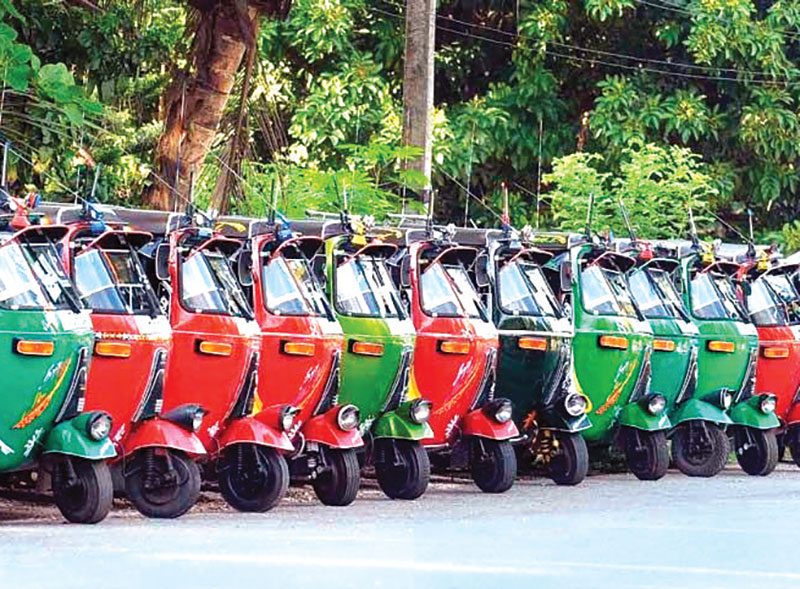
An ordinary journey through Colombo raises uncomfortable questions about road discipline, passenger safety and our tendency to judge motorists by the vehicles they drive.
It was a little past noon when I finished attending a court matter and remembered that I had to visit a nearby bank before returning to my other work. The bank was hardly a kilometer away, a distance I would normally have walked without giving it much thought. However, anyone who has walked through Colombo in formal court attire under the scorching midday sun would appreciate why I was reluctant to do so. Taking my own vehicle was not particularly appealing either, as finding a parking space near a bank during business hours can sometimes take longer than the transaction itself.
After considering my options, I decided to take a three-wheeler, a perfectly ordinary decision that unexpectedly left me reflecting on the way we judge those who drive them. Within minutes, I was seated in the rear, travelling through the usual Colombo traffic. It was convenient, reasonably priced and saved me the trouble of searching for parking or arriving at the bank drenched in sweat. As we approached a busy junction, however, a car suddenly cut across our path without any indication. Its driver appeared determined to squeeze into a narrow gap, apparently unconcerned about the vehicles already occupying the road. Our three-wheeler driver immediately applied his brakes, throwing me slightly forward in my seat. Fortunately, he reacted quickly enough to avoid a collision, while the car continued on its way as though nothing unusual had happened.
The incident itself was hardly extraordinary by Colombo’s standards, but it made me consider how differently we might have reacted had the situation been reversed. If a three-wheeler had suddenly cut across a car in the same manner, the driver would probably have been subjected to angry horns, harsh words and the familiar accusation that three-wheeler drivers have no respect for road rules. Yet when someone driving a comfortable, air-conditioned car behaves just as irresponsibly, we tend to treat it as another unpleasant encounter in traffic. It seems that, in our public discussions about road discipline, the seriousness of an offence sometimes depends not so much on what a driver does, but on the vehicle he happens to be driving.
This is not an attempt to portray three-wheeler drivers as innocent victims of unfair criticism. Anyone who regularly travels on Sri Lankan roads knows that some drivers behave recklessly, stopping without warning, making dangerous U-turns, disregarding traffic signals and squeezing through gaps that sensible motorists would avoid. Such conduct deserves criticism and, where appropriate, legal action. Nevertheless, it would be equally dishonest to pretend that these practices are confined to three-wheelers. A few minutes spent observing traffic at a busy Colombo junction would reveal expensive cars changing lanes without indicating, SUVs obstructing pedestrian crossings, motorcycles weaving dangerously between vehicles and buses stopping wherever passengers signal them to do so.
What is troubling is our tendency to turn the misconduct of an individual three-wheeler driver into an indictment of an entire profession. A badly parked three-wheeler becomes another example of everything wrong with the industry, while a luxury car obstructing a pavement is generally treated as the irresponsible conduct of its particular driver. Perhaps this difference in perception has become so familiar that we rarely question it. Yet the law makes no distinction between an illegally parked vehicle costing several million rupees and one purchased through a modest leasing arrangement. Both can obstruct traffic, inconvenience pedestrians and create dangerous situations for other road users.
There is also considerable irony in our relationship with three-wheelers. We complain about their presence on the roads, accuse them of contributing to congestion and criticise the behaviour of their drivers, but the moment we need to reach somewhere quickly, avoid a parking problem or transport an elderly relative to a nearby hospital, we often turn to the very vehicles we complain about. In many rural communities, where public transport remains inadequate, three-wheelers provide an essential connection between homes, hospitals, markets and bus routes. Their contribution to everyday mobility is difficult to dismiss, particularly for people who cannot afford private vehicles or have limited transport alternatives.
The driver who took me to the bank that afternoon was simply earning his living. For him, the three-wheeler was not a symbol of traffic disorder or a subject for public debate, but a means of supporting himself and possibly a family. He had provided a useful service and, when confronted with another motorist’s carelessness, demonstrated the kind of defensive driving that we should expect from everyone using our roads. By the time I paid the fare and stepped out near the bank, I found myself wondering whether our criticism of three-wheelers sometimes says as much about our own prejudices as it does about genuine concerns over road safety.
That question becomes particularly relevant when we consider one of the strongest arguments made against three-wheelers: passenger safety. There is no denying that a conventional three-wheeler offers considerably less protection in a collision than a modern passenger car equipped with airbags, seat belts and a reinforced passenger compartment. Its lightweight construction and limited structural protection expose occupants to risks that should never be underestimated. But acknowledging those limitations is quite different from suggesting that such vehicles have no legitimate place on our roads. If the absence of a protective passenger compartment is sufficient reason to question a vehicle’s acceptability, we must also consider motorcycles and bicycles, whose riders are even more exposed to the consequences of a collision.
A motorcyclist has little protection beyond a helmet and appropriate riding equipment, while a cyclist has neither airbags nor a surrounding metal structure to absorb the impact of an accident. Pedestrians are more vulnerable still, particularly on roads where pavements are obstructed or entirely absent. Yet nobody would seriously argue that walking or cycling should be discouraged simply because these activities involve greater physical exposure. The sensible response is to improve road conditions, regulate speeds, strengthen vehicle standards and ensure that motorists respect vulnerable road users. The World Health Organization has consistently emphasised this broader approach to road safety, recognising that pedestrians, cyclists and motorcyclists account for a substantial proportion of road traffic deaths worldwide.
The comparison does not mean that all vehicles are equally safe, nor should it be used to minimise the genuine risks associated with three-wheelers. Different vehicles offer different levels of protection, and their safety depends on design, maintenance, speed, road conditions and the circumstances of a collision. However, there is something fundamentally flawed in assuming that a vehicle becomes unacceptable merely because it cannot provide the protection available in a modern car. If that were the standard, we would have to reconsider the place of several widely used forms of transport. More importantly, we would risk overlooking the responsibility of drivers whose behaviour can turn an otherwise ordinary journey into a dangerous encounter.
There is an equally questionable assumption that travelling in a larger or more expensive vehicle somehow reflects greater responsibility on the road. A modern car may provide better protection to its occupants, but its safety features cannot compensate for the arrogance or carelessness of the person behind the steering wheel. An SUV equipped with advanced braking systems and multiple airbags can still be driven recklessly, and its greater weight may increase the danger to pedestrians, cyclists and smaller vehicles in certain collisions. Road safety cannot therefore be measured solely by how effectively a vehicle protects its occupants. It must also consider the risks that vehicle presents to everyone else sharing the road.
Perhaps what we need is a more balanced understanding of road safety, one that recognises the limitations of three-wheelers without turning their drivers into convenient villains. There is every reason to demand better vehicle standards, responsible driving and stronger enforcement, but those expectations must apply equally to motorists operating cars, buses, motorcycles and commercial vehicles. A reckless driver does not become less dangerous because he is seated inside an expensive car, just as a responsible three-wheeler driver should not be treated with suspicion merely because his vehicle has one wheel fewer.
The experience of that afternoon reminded me that our roads are shared public spaces, not a hierarchy determined by the price, size or appearance of the vehicles using them. The three-wheeler that took me to the bank served a practical purpose, while the driver of a more expensive vehicle created the only dangerous moment of the journey. It would be unreasonable to draw conclusions about all car drivers from that single incident, just as it would be unfair to judge an entire profession by the misconduct of a few three-wheeler drivers. If we genuinely want safer roads, perhaps we should begin by judging people according to how they drive rather than what they drive.
——————————————
Sampath Perera, LL.M. (UK), is an Attorney-at-Law and former Commissioner of the Office on Missing Persons (OMP). He has served as Legal Adviser to the Ministry of Justice and the Ministry of Higher Education.

Heavy showers about 100 mm are likely at some places in the Northern, North-central, Central, Eastern, North-western and Uva provinces

Molineux, Dunkley enter WPL 2027 auction with top base price of INR 50 lakh

Ranawaka accuses govt. of using JVP cadres and police to suppress political opponents

Six killed as speeding bulker crashes into vehicles, shop in Akurana

Prof. Peiris, summoned by CIABOC, appeals for Ven. Gnanasara’s release

Tusker Agbo found safe and in good health

‘Dates have the highest sugar content to fight Coronavirus’

Sunday Island 27 December – Headlines

#SundayIsland 17th December – Headlines

Sunday Island – 28th March

Sunday Island Headlines – 21 March

Sunday Island – 21st February – Headlines
-

 Latest News7 days ago
Nissanka’s return headlines Sri Lanka’s Test squad against Pakistan
-

 News6 days ago
Sri Lanka, India caught in US-Iran ship crisis
-

 Features2 days ago
Kotahena:A Small Enclave, An Extraordinary Legacy
-

 Latest News7 days ago
Imran Khan’s PTI braces to fight federal takeover of Khyber Pakhtunkhwa
-
 News3 days ago
Asgiri Mahanayake calls for immediate release of Gnanasara Thera
-

 Latest News6 days ago
Missiles intercepted near Riyadh after Saudi coalition hits Yemen fuel depot
-

 Latest News6 days ago
Kusal Mendis’ unbeaten 87 hands Sri Lanka consolation win
-

 Latest News7 days ago
Former Zimbabwe player and umpire Sarah Dambanevana dies aged 36