
Features
Sustainable economic development in Sri Lanka: Role of mass media in transforming public beliefs and attitudes


By Dr. A K M R Bandara
Head/Department of Agricultural Systems
Faculty of Agriculture
Rajarata University of Sri Lanka
Sri Lanka has been facing an economic crisis like never before. This crisis emerged with the COVID-19 pandemic mainly due to a drop in external earnings from tourism and foreign employment which are common to almost all countries in the region, including Bangladesh and India. However, those countries were able to recover due to the maintenance of external earnings reserves (buffer of dollars). Sri Lanka never gave much thought to reserving foreign earnings to face disasters, like COVID. The situation becomes acute with the incidence of repayment of interest and shares of foreign borrowings. Sri Lanka drew foreign loans substantially, after 2010, to develop highways, Mattala airport, and Nelum Pokuna which did not generate dollars to repay the loans. In this context, successive governments continued to borrow foreign loans to repay existing loans. Since the information on dollar inflows and outflows is not available to the public and the exchange rate is artificially controlled by the government, the dollar problem was not visible to the public until it has become a crisis.
There are lots of articles explaining the reasons for the economic problems, but no adequate information is available to resolve the problems. Factors affecting economic development have been discussed for over two centuries in the development literature in economics. Adam Smith, the father of economics, pointed out that low taxes, peace, and justices are the main factors that determine the economic development in 1776. However, evidence shows that economic development cannot be achieved by ensuring these three factors anymore, and it is more complicated when countries are struggling to achieve economic development that comprises of both quantitative and qualitative development. Quantitative development means an increase in quantity and value of the products and services of a country known as Gross Domestic Product (GDP) while qualitative development is the improvement of the quality of life of the people. When examining the development of many countries, including developed countries, economic development has been achieved mainly by changing the behaviour of the people. During the last 74 years, after independence, Sri Lanka has not given due attention to human aspects of economic development. Hence, the game of conflict instead of the game of cooperation, has grown in the country over the years and continues until now. The game of cooperation is necessary for economic development in which all individuals, politicians, and members of the society alike are searching for cooperative solutions for issues related to economic development.
Social transformation
In the case of social transformation, mass media can play a bigger role by increasing awareness. With the development of information and communication technology (ICT), passing information through media is very fast and effective. The media has already made a big impact on controlling corruption and changing political ideology from time to time through increasing awareness. Similarly, media can play a bigger role in economic development in the country. Today extensive awareness is going on highlighting who is wrong but not what should be done. Past is the past and it is not good to linger in the past. This article focuses on the role of mass media in economic development.
Performance (P) of a person depends on three factors: 1) knowledge (K), 2) skills (S) and 3) attitudes (A) known as KSA. Knowledge is to know things. It links with the brain. Skills are the ability to apply knowledge to do things and are linked with parts of the body because skills develop through doing things using hands, observing things through eyes, and hearing things through the ears. Attitudes are feelings, ideas, and thoughts and they link with the heart. There are two models explaining the relationship between performance and its determinants of knowledge, skills, and attitudes. One is the additive model (P= K+S+A) and another is the multiplicative model (P=K x S x A). The additive model is an old one and it says the performance of the person depends on three factors separately. For example, if the person has no skills, they will perform to some extent due to the other two factors but not to a great extent. Alternatively, the multiplicative model says that performance depends on three factors collectively. For example, if the person has no skills the performance is zero. In other words, performance and determinants work together and they are equally impotent to determine the performance of a person. This model has further improved giving more weight to the attitudes. Accordingly, the new performance model has the square of the attitudes (P = K x S X A2) illustrating that attitudes play a significant role person’s performance. Since economic development depends on the summation of individual performance, the highest priority should be given to the attitudinal changes in society. Mass media is the most effective tool in this regard. The following attitudinal changes are required for economic development.
Negative mindset
Society, especially public sector employees, has a negative mindset about privatization. This is mainly due to fear of losing jobs and benefits. It is necessary to highlight success stories in Sri Lanka and other countries through printed and electronic media. The best example is the privatization of the Department of Telecommunication in Sri Lanka. Before privatization people had to wait more than six months to get a connection even after payments. Similarly, repairing a breakdown took days and weeks. Now, the situation has completely changed. Also, employees are better off. Another negative attitude is setting up private entities. This is due to fear of competition. The principle is competition creates efficiency and efficiency leads to development. The best example is the banking sector. At the time of government monopoly with the presence of only the Bank of Ceylon and People’s Bank, customers were in the queue for a long time to deposit and withdraw money.
The situation completely changed with the establishment of the private banks.The society also has a negative attitude toward foreign direct investment. The most popular argument against foreign direct investments is the sale of national assets. Most countries, such as India, Malaysia, Thailand, and Singapore, have developed with foreign direct investments. Countries need foreign investments to develop their economies because domestic savings are inadequate for investments which generate returns, such as foreign earnings, employment, and technologies. Competition is now high for foreign investments as many countries are encouraging foreign direct investments by providing facilities such as low-rent land, and tax reliefs. India established free trade zones to attract foreign investments. The principal objective of foreign investment is obtaining foreign money. One of the reasons for the current foreign currency crisis is negative attitudes regarding foreign direct investments.
Need for attitudinal change
Changing the attitude of the employees in the government sector is urgently required for economic development. Both local and foreign investors complained about the long process of getting things done through government organizations. Studies found that Turkey needs 6 hours for start-ups; Thailand needs 7 days and Sri Lanka needs more than 6 months. Moreover, employee productivity is low in Sri Lanka. In the garment sector, three people require getting the work done by one person in Pakistan. It is required to inculcate among employees that taxpayers’ money is spent on their salaries. The situation is more crucial in Sri Lanka because over 80 percent of the tax comprises indirect tax paid by the public. Government sector employees are the servants of the public, not the masters or puppets of politicians. The public should respect those who provide better services, not the title of the position. In the recent past, the government introduced a luxury bus service to travel from the railway station to government offices to reduce traffic in Colombo city. It failed because of attitude problems. High-ranking officials wish to come to the office by vehicle and have somebody to take their bags to the office. The situation is the same or worst with politicians.
The expenditure pattern of the households also needs to be changed for economic development. In Sri Lanka, unnecessary expenditure is high compared to income whereby the domestic saving ratio is low. It is less than 25% of the DGP whereas in India the figure is 35%. Sri Lankans spend huge amounts of money on house construction and purchasing vehicles because they have social value. There is a slogan in India that is “be Indians, act Indians”. The life of the Indian people is simple. They mainly depend on things produced in India. Also, they do not spend money unnecessarily. University lecturers use motorcycles to travel short distances including travel to university. The use of bicycles is common in Japan though it produces vehicles in large quantities.
The government is planning to declare the year 2023 as the year of agriculture. The success of this programme hinges on a change in the attitudes of the participants of the agricultural value chain. At present, farmers do not plan production based on the market requirements while traders are reluctant to provide information to farmers on market requirements. Also, traders hide pricing information and they do not like to establish relationships with farmers. Hence, the agricultural value chain in Sri Lanka is fragmented and disorganised resulting in high transaction costs, severe price fluctuations, low farm income, high consumer price, poor quality, and high post-harvest losses. It is an accepted fact that a sustainable agricultural value chain is required for agricultural development. Donor-funded projects such as Agricultural Modernisation Project, Smallholder Agribusiness Partnership Project, and Climate Smart Agriculture are developing agricultural value chains, but success is in question due to the lack of business discipline. In business, the customer is the king. There is no business without customers. Customers need quality, convenient and safe food at an affordable price.
Price control
In Sri Lanka, the popular mechanism used to stabilise food prices is price control. It is now an outdated tool that creates artificial shortages in the market resulting from the inability to supply products. The government does not have buffer stocks and no adequate foreign currency to import any more to solve this issue. Hence, the measures should be made to increase production in the country rather than controlling the price. For instance, India introduced a three crops programme to control vegetable price hikes. Under this, the most popular short terms crops were selected. Another issue in the value chain is low prices at the harvest time causing hardship to the farmers who are mainly depending on farming income. The farmers think that the government should purchase the products at a reasonable price. This is also an old concept and is not given priority at present because of huge financial losses incurred by the Treasury. This issue can be solved by delayed selling from time to time rather than selling the entire stocks at harvest time. The government’s role is to provide financial and technical facilities to set up farm-level storage facilities. There is no country where guaranteed prices are stipulated for perishables and prices are determined by market-led production planning.
Attitudinal changes are required in the decision-making process. Evidenced-based decisions are lacking. A scientific decision-making process should be adopted. It includes five steps: 1) identification of the problem, 2) finding alternative solutions, 3) evaluation of each alternative 4) selection of the best alternative, and 5) implementation of the best alternative. Also, proactive decisions are required instead of reactive decisions which are taken after the problem happened and provide solutions to the effect of the problem rather than the root causes of the problem.
In Sri Lanka, it is necessary to raise awareness of four management functions: planning, organising, directing, and controlling. Planning includes the formulation of vision, mission, objectives, strategies, and activities. Organizing is the allocation of resources and staff to implement the plan. Directing means the provision of instructions necessary to undertake activities. Controlling includes monitoring the project activities in line with the plan. Most of the projects formulated, especially in agriculture, are limited to the planning function and monitoring is poor in many foreign funded projects. Many countries in the region have established, long-term continuous plans one after another that does not alter with the change of ruling party of the government. For example, India is implementing the 12th five-year plan after independence. Also, monitoring reports are submitted every year to the parliament. Educating all the stakeholders including the community is essential for the success of government projects such as home gardening. Past projects such as home gardening and tree planting fail due to poor management. The media should be alert in these areas.
Youth participation in agriculture
Youth participation in agriculture is poor and there is a need to motivate the youth to return to this vital sector. There are success stories here as well as abroad. The global trend now is the promotion of high-tech agriculture such as precision agriculture and digital agriculture. In these fields, youth entrepreneurs are urgently required.
All in all, the necessary condition for economic development is attitudinal changes in the society. The role of mass media is to raise the evidence-based awareness to facilitate the attitudinal changes. Priority should be given to making awareness of how developed countries such as Japan recovered from their crisis after the World War II by changing attitudes. Print media can provide opportunities to publish articles while electronic media can provide opportunities for discussions. At present, the media is engaged in such activities, but those efforts are not adequate to change the mindset of the Sri Lankan society.

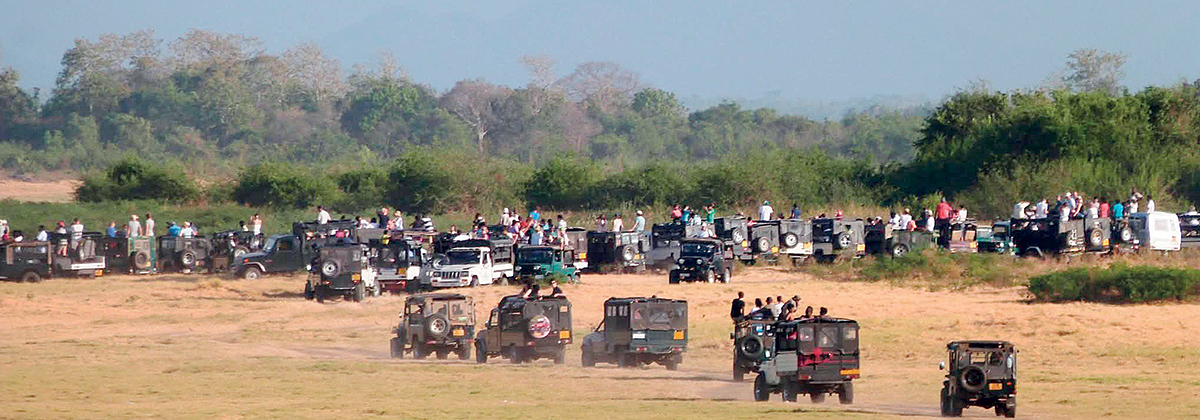
If elephants are truly to be given “freedom” in Udawalawe, the solution is not simply to open gates or redraw park boundaries. The map itself tells the real story — a story of shrinking habitats, broken corridors, and more than a decade of silent but relentless ecological destruction.
“Look at Udawalawe today and compare it with satellite maps from ten years ago,” says Sameera Weerathunga, one of Sri Lanka’s most consistent and vocal elephant conservation activists. “You don’t need complicated science. You can literally see what we have done to them.”
What we commonly describe as the human–elephant conflict (HEC) is, in reality, a land-use conflict driven by development policies that ignore ecological realities. Elephants are not invading villages; villages, farms, highways and megaprojects have steadily invaded elephant landscapes.
Udawalawe: From Landscape to Island
Udawalawe National Park was once part of a vast ecological network connecting the southern dry zone to the central highlands and eastern forests. Elephants moved freely between Udawalawe, Lunugamvehera, Bundala, Gal Oya and even parts of the Walawe river basin, following seasonal water and food availability.
Today, Udawalawe appears on the map as a shrinking green island surrounded by human settlements, monoculture plantations, reservoirs, electric fences and asphalt.
“For elephants, Udawalawe is like a prison surrounded by invisible walls,” Sameera explains. “We expect animals that evolved to roam hundreds of square nationakilometres to survive inside a box created by humans.”
Elephants are ecosystem engineers. They shape forests by dispersing seeds, opening pathways, and regulating vegetation. Their survival depends on movement — not containment. But in Udawalawa, movement is precisely what has been taken away.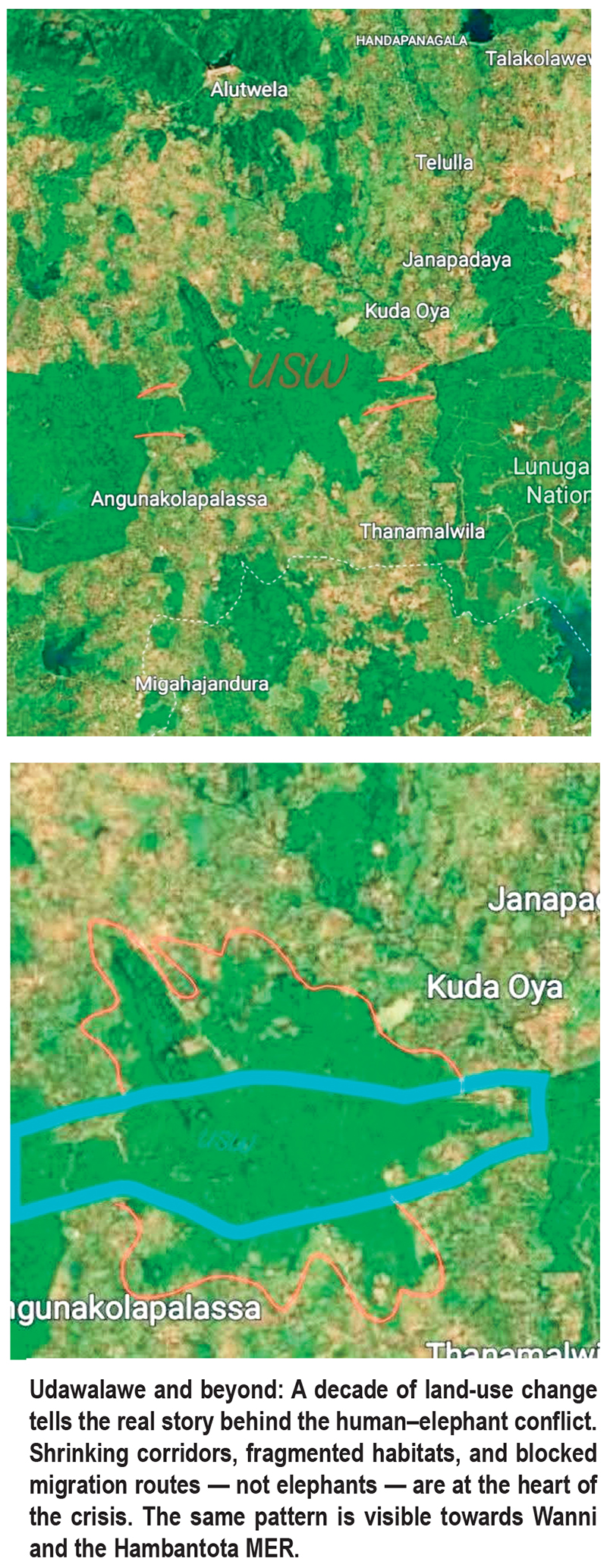
Over the past decade, ancient elephant corridors have been blocked or erased by:
Irrigation and agricultural expansion
Tourism resorts and safari infrastructure
New roads, highways and power lines
Human settlements inside former forest reserves

Sameera
“The destruction didn’t happen overnight,” Sameera says. “It happened project by project, fence by fence, without anyone looking at the cumulative impact.”
The Illusion of Protection
Sri Lanka prides itself on its protected area network. Yet most national parks function as ecological islands rather than connected systems.
“We think declaring land as a ‘national park’ is enough,” Sameera argues. “But protection without connectivity is just slow extinction.”
Udawalawe currently holds far more elephants than it can sustainably support. The result is habitat degradation inside the park, increased competition for resources, and escalating conflict along the boundaries.
“When elephants cannot move naturally, they turn to crops, tanks and villages,” Sameera says. “And then we blame the elephant for being a problem.”
The Other Side of the Map: Wanni and Hambantota
Sameera often points to the irony visible on the very same map. While elephants are squeezed into overcrowded parks in the south, large landscapes remain in the Wanni, parts of Hambantota and the eastern dry zone where elephant density is naturally lower and ecological space still exists.
“We keep talking about Udawalawe as if it’s the only place elephants exist,” he says. “But the real question is why we are not restoring and reconnecting landscapes elsewhere.”
The Hambantota MER (Managed Elephant Reserve), for instance, was originally designed as a landscape-level solution. The idea was not to trap elephants inside fences, but to manage land use so that people and elephants could coexist through zoning, seasonal access, and corridor protection.
“But what happened?” Sameera asks. “Instead of managing land, we managed elephants. We translocated them, fenced them, chased them, tranquilised them. And the conflict only got worse.”
The Failure of Translocation
For decades, Sri Lanka relied heavily on elephant translocation as a conflict management tool. Hundreds of elephants were captured from conflict zones and released into national parks like Udawalawa, Yala and Wilpattu.

Elephant deaths
The logic was simple: remove the elephant, remove the problem.
The reality was tragic.
“Most translocated elephants try to return home,” Sameera explains. “They walk hundreds of kilometres, crossing highways, railway lines and villages. Many die from exhaustion, accidents or gunshots. Others become even more aggressive.”
Scientific studies now confirm what conservationists warned from the beginning: translocation increases stress, mortality, and conflict. Displaced elephants often lose social structures, familiar landscapes, and access to traditional water sources.
“You cannot solve a spatial problem with a transport solution,” Sameera says bluntly.
In many cases, the same elephant is captured and moved multiple times — a process that only deepens trauma and behavioural change.
Freedom Is Not About Removing Fences
The popular slogan “give elephants freedom” has become emotionally powerful but scientifically misleading. Elephants do not need symbolic freedom; they need functional landscapes.
Real solutions lie in:
Restoring elephant corridors
Preventing development in key migratory routes
Creating buffer zones with elephant-friendly crops
Community-based land-use planning
Landscape-level conservation instead of park-based thinking
“We must stop treating national parks like wildlife prisons and villages like war zones,” Sameera insists. “The real battlefield is land policy.”
Electric fences, for instance, are often promoted as a solution. But fences merely shift conflict from one village to another.
“A fence does not create peace,” Sameera says. “It just moves the problem down the line.”
A Crisis Created by Humans
Sri Lanka loses more than 400 elephants and nearly 100 humans every year due to HEC — one of the highest rates globally.
Yet Sameera refuses to call it a wildlife problem.
“This is a human-created crisis,” he says. “Elephants are only responding to what we’ve done to their world.”
From expressways cutting through forests to solar farms replacing scrublands, development continues without ecological memory or long-term planning.
“We plan five-year political cycles,” Sameera notes. “Elephants plan in centuries.”
The tragedy is not just ecological. It is moral.
“We are destroying a species that is central to our culture, religion, tourism and identity,” Sameera says. “And then we act surprised when they fight back.”
The Question We Avoid Asking
If Udawalawe is overcrowded, if Yala is saturated, if Wilpattu is bursting — then the real question is not where to put elephants.
The real question is: Where have we left space for wildness in Sri Lanka?
Sameera believes the future lies not in more fences or more parks, but in reimagining land itself.
“Conservation cannot survive as an island inside a development ocean,” he says. “Either we redesign Sri Lanka to include elephants, or one day we’ll only see them in logos, statues and children’s books.”
And the map will show nothing but empty green patches — places where giants once walked, and humans chose. roads instead.
By Ifham Nizam

 SAARC or the South Asian Association for Regional Cooperation has been declared ‘dead’ by some sections in South Asia and the idea seems to be catching on. Over the years the evidence seems to have been building that this is so, but a matter that requires thorough probing is whether the media in South Asia, given the vital part it could play in fostering regional amity, has had a role too in bringing about SAARC’s apparent demise.
That South Asian governments have had a hand in the ‘SAARC debacle’ is plain to see. For example, it is beyond doubt that the India-Pakistan rivalry has invariably got in the way, particularly over the past 15 years or thereabouts, of the Indian and Pakistani governments sitting at the negotiating table and in a spirit of reconciliation resolving the vexatious issues growing out of the SAARC exercise. The inaction had a paralyzing effect on the organization.
Unfortunately the rest of South Asian governments too have not seen it to be in the collective interest of the region to explore ways of jump-starting the SAARC process and sustaining it. That is, a lack of statesmanship on the part of the SAARC Eight is clearly in evidence. Narrow national interests have been allowed to hijack and derail the cooperative process that ought to be at the heart of the SAARC initiative.
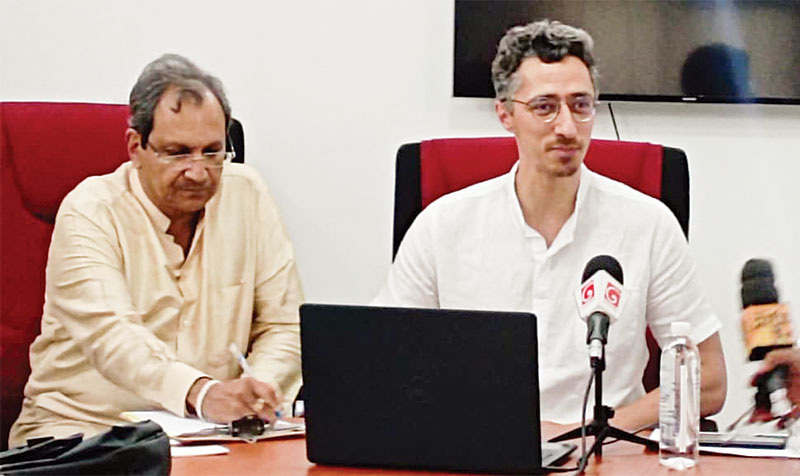
However, a dimension that has hitherto gone comparatively unaddressed is the largely negative role sections of the media in the SAARC region could play in debilitating regional cooperation and amity. We had some thought-provoking ‘takes’ on this question recently from Roman Gautam, the editor of ‘Himal Southasian’.
Gautam was delivering the third of talks on February 2nd in the RCSS Strategic Dialogue Series under the aegis of the Regional Centre for Strategic Studies, Colombo, at the latter’s conference hall. The forum was ably presided over by RCSS Executive Director and Ambassador (Retd.) Ravinatha Aryasinha who, among other things, ensured lively participation on the part of the attendees at the Q&A which followed the main presentation. The talk was titled, ‘Where does the media stand in connecting (or dividing) Southasia?’.
Gautam singled out those sections of the Indian media that are tamely subservient to Indian governments, including those that are professedly independent, for the glaring lack of, among other things, regionalism or collective amity within South Asia. These sections of the media, it was pointed out, pander easily to the narratives framed by the Indian centre on developments in the region and fall easy prey, as it were, to the nationalist forces that are supportive of the latter. Consequently, divisive forces within the region receive a boost which is hugely detrimental to regional cooperation.
Two cases in point, Gautam pointed out, were the recent political upheavals in Nepal and Bangladesh. In each of these cases stray opinions favorable to India voiced by a few participants in the relevant protests were clung on to by sections of the Indian media covering these trouble spots. In the case of Nepal, to consider one example, a young protester’s single comment to the effect that Nepal too needed a firm leader like Indian Prime Minister Narendra Modi was seized upon by the Indian media and fed to audiences at home in a sensational, exaggerated fashion. No effort was made by the Indian media to canvass more opinions on this matter or to extensively research the issue.
In the case of Bangladesh, widely held rumours that the Hindus in the country were being hunted and killed, pogrom fashion, and that the crisis was all about this was propagated by the relevant sections of the Indian media. This was a clear pandering to religious extremist sentiment in India. Once again, essentially hearsay stories were given prominence with hardly any effort at understanding what the crisis was really all about. There is no doubt that anti-Muslim sentiment in India would have been further fueled.
Gautam was of the view that, in the main, it is fear of victimization of the relevant sections of the media by the Indian centre and anxiety over financial reprisals and like punitive measures by the latter that prompted the media to frame their narratives in these terms. It is important to keep in mind these ‘structures’ within which the Indian media works, we were told. The issue in other words, is a question of the media completely subjugating themselves to the ruling powers.
Basically, the need for financial survival on the part of the Indian media, it was pointed out, prompted it to subscribe to the prejudices and partialities of the Indian centre. A failure to abide by the official line could spell financial ruin for the media.
A principal question that occurred to this columnist was whether the ‘Indian media’ referred to by Gautam referred to the totality of the Indian media or whether he had in mind some divisive, chauvinistic and narrow-based elements within it. If the latter is the case it would not be fair to generalize one’s comments to cover the entirety of the Indian media. Nevertheless, it is a matter for further research.
However, an overall point made by the speaker that as a result of the above referred to negative media practices South Asian regionalism has suffered badly needs to be taken. Certainly, as matters stand currently, there is a very real information gap about South Asian realities among South Asian publics and harmful media practices account considerably for such ignorance which gets in the way of South Asian cooperation and amity.
Moreover, divisive, chauvinistic media are widespread and active in South Asia. Sri Lanka has a fair share of this species of media and the latter are not doing the country any good, leave alone the region. All in all, the democratic spirit has gone well into decline all over the region.
The above is a huge problem that needs to be managed reflectively by democratic rulers and their allied publics in South Asia and the region’s more enlightened media could play a constructive role in taking up this challenge. The latter need to take the initiative to come together and deliberate on the questions at hand. To succeed in such efforts they do not need the backing of governments. What is of paramount importance is the vision and grit to go the extra mile.

By Ifham Nizam
As the sun softened over Colombo and the city’s familiar noise began to loosen its grip, the Beddagana Wetland Park prepared for its quieter hour — the hour when wetlands speak in their own language.
World Wetlands Day was marked a little early this year, but time felt irrelevant at Beddagana. Nature lovers, students, scientists and seekers gathered not for a ceremony, but for listening. Partnering with Park authorities, Dilmah Conservation opened the wetland as a living classroom, inviting more than a 100 participants to step gently into an ecosystem that survives — and protects — a capital city.
Wetlands, it became clear, are not places of stillness. They are places of conversation.
Beyond the surface
In daylight, Beddagana appears serene — open water stitched with reeds, dragonflies hovering above green mirrors.
Yet beneath the surface lies an intricate architecture of life. Wetlands are not defined by water alone, but by relationships: fungi breaking down matter, insects pollinating and feeding, amphibians calling across seasons, birds nesting and mammals moving quietly between shadows.
Participants learned this not through lectures alone, but through touch, sound and careful observation. Simple water testing kits revealed the chemistry of urban survival. Camera traps hinted at lives lived mostly unseen.
Demonstrations of mist netting and cage trapping unfolded with care, revealing how science approaches nature not as an intruder, but as a listener.
Again and again, the lesson returned: nothing here exists in isolation.
Learning to listen
Perhaps the most profound discovery of the day was sound.
Wetlands speak constantly, but human ears are rarely tuned to their frequency. Researchers guided participants through the wetland’s soundscape — teaching them to recognise the rhythms of frogs, the punctuation of insects, the layered calls of birds settling for night.
Then came the inaudible made audible. Bat detectors translated ultrasonic echolocation into sound, turning invisible flight into pulses and clicks. Faces lit up with surprise. The air, once assumed empty, was suddenly full.
It was a moment of humility — proof that much of nature’s story unfolds beyond human perception.
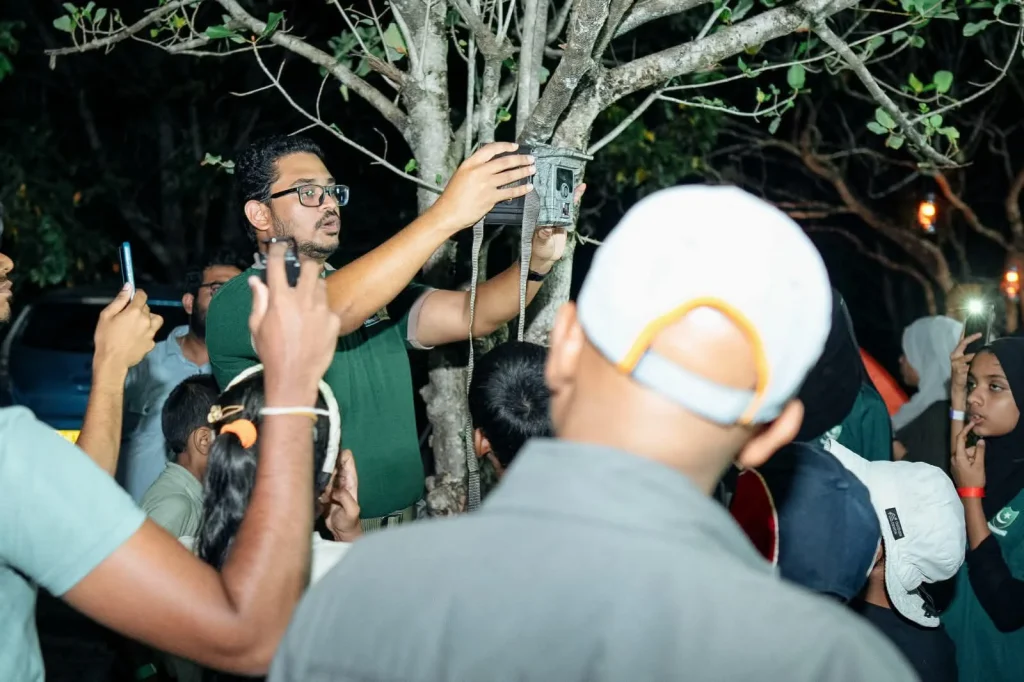
Sethil on camera trapping
The city’s quiet protectors
Environmental researcher Narmadha Dangampola offered an image that lingered long after her words ended. Wetlands, she said, are like kidneys.
“They filter, cleanse and regulate,” she explained. “They protect the body of the city.”
Her analogy felt especially fitting at Beddagana, where concrete edges meet wild water.
She shared a rare confirmation: the Collared Scops Owl, unseen here for eight years, has returned — a fragile signal that when habitats are protected, life remembers the way back.
Small lives, large meanings
Professor Shaminda Fernando turned attention to creatures rarely celebrated. Small mammals — shy, fast, easily overlooked — are among the wetland’s most honest messengers.
Using Sherman traps, he demonstrated how scientists read these animals for clues: changes in numbers, movements, health.
In fragmented urban landscapes, small mammals speak early, he said. They warn before silence arrives.
Their presence, he reminded participants, is not incidental. It is evidence of balance.
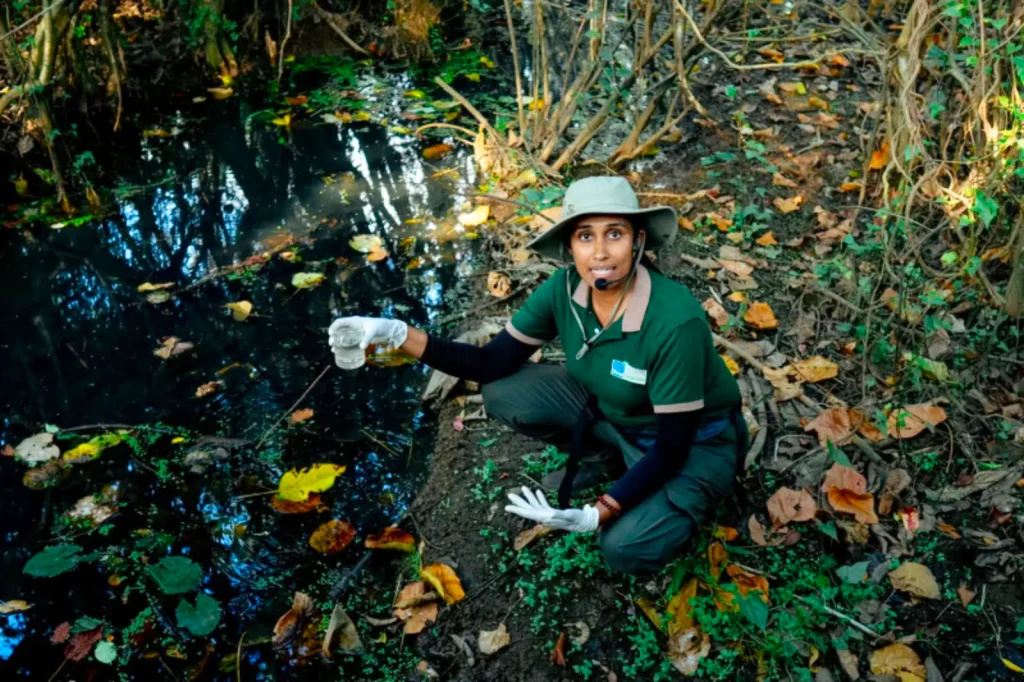
Narmadha on water testing pH level
Wings in the dark
As twilight thickened, Dr. Tharaka Kusuminda introduced mist netting — fine, almost invisible nets used in bat research.
He spoke firmly about ethics and care, reminding all present that knowledge must never come at the cost of harm.
Bats, he said, are guardians of the night: pollinators, seed dispersers, controllers of insects. Misunderstood, often feared, yet indispensable.
“Handle them wrongly,” he cautioned, “and we lose more than data. We lose trust — between science and life.”
The missing voice
One of the evening’s quiet revelations came from Sanoj Wijayasekara, who spoke not of what is known, but of what is absent.
In other parts of the region — in India and beyond — researchers have recorded female frogs calling during reproduction. In Sri Lanka, no such call has yet been documented.
The silence, he suggested, may not be biological. It may be human.
“Perhaps we have not listened long enough,” he reflected.
The wetland, suddenly, felt like an unfinished manuscript — its pages alive with sound, waiting for patience rather than haste.
The overlooked brilliance of moths
Night drew moths into the light, and with them, a lesson from Nuwan Chathuranga. Moths, he said, are underestimated archivists of environmental change. Their diversity reveals air quality, plant health, climate shifts.
As wings brushed the darkness, it became clear that beauty often arrives quietly, without invitation.

Sanoj on female frogs
Coexisting with the wild
Ashan Thudugala spoke of coexistence — a word often used, rarely practiced. Living alongside wildlife, he said, begins with understanding, not fear.
From there, Sethil Muhandiram widened the lens, speaking of Sri Lanka’s apex predator. Leopards, identified by their unique rosette patterns, are studied not to dominate, but to understand.
Science, he showed, is an act of respect.
Even in a wetland without leopards, the message held: knowledge is how coexistence survives.
When night takes over
Then came the walk: As the city dimmed, Beddagana brightened. Fireflies stitched light into darkness. Frogs called across water. Fish moved beneath reflections. Insects swarmed gently, insistently. Camera traps blinked. Acoustic monitors listened patiently.
Those walking felt it — the sense that the wetland was no longer being observed, but revealed.
For many, it was the first time nature did not feel distant.
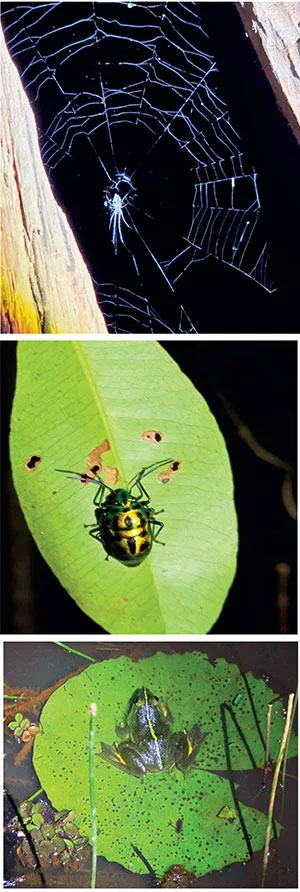
Faunal diversity at the Beddagana Wetland Park
A global distinction, a local duty
Beddagana stands at the heart of a larger truth. Because of this wetland and the wider network around it, Colombo is the first capital city in the world recognised as a Ramsar Wetland City.
It is an honour that carries obligation. Urban wetlands are fragile. They disappear quietly. Their loss is often noticed only when floods arrive, water turns toxic, or silence settles where sound once lived.
Commitment in action
For Dilmah Conservation, this night was not symbolic.
Speaking on behalf of the organisation, Rishan Sampath said conservation must move beyond intention into experience.
“People protect what they understand,” he said. “And they understand what they experience.”
The Beddagana initiative, he noted, is part of a larger effort to place science, education and community at the centre of conservation.
Listening forward
As participants left — students from Colombo, Moratuwa and Sabaragamuwa universities, school environmental groups, citizens newly attentive — the wetland remained.
It filtered water. It cooled air. It held life.
World Wetlands Day passed quietly. But at Beddagana, something remained louder than celebration — a reminder that in the heart of the city, nature is still speaking.
The question is no longer whether wetlands matter.
It is whether we are finally listening.

VVT UC asks US lawmakers to help achieve self-determination for Tamils

Sajith alleges MP Rohana Bandara’s life at risk

Nainativu fishermen lodge complaint with Deputy Indian HC over poaching in SL waters

Threats, hubris and flippancy

A Historic First: Sri Lanka’s capital market leaders bring investor forum to Saudi Arabia

From the Lecture Hall to the Global Market: How Sri Lankan students are mastering the “Gig Economy”

‘Dates have the highest sugar content to fight Coronavirus’

Sunday Island 27 December – Headlines

#SundayIsland 17th December – Headlines

Sunday Island – 28th March

Sunday Island Headlines – 21 March

Sunday Island – 21st February – Headlines
-

 Business6 days ago
Hayleys Mobility ushering in a new era of premium sustainable mobility
-

 Business3 days ago
SLIM-Kantar People’s Awards 2026 to recognise Sri Lanka’s most trusted brands and personalities
-

 Business6 days ago
Advice Lab unveils new 13,000+ sqft office, marking major expansion in financial services BPO to Australia
-
 Business6 days ago
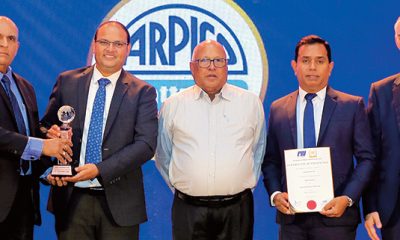
Arpico NextGen Mattress gains recognition for innovation
-

 Business5 days ago
Altair issues over 100+ title deeds post ownership change
-
 Editorial6 days ago
Govt. provoking TUs
-

 Business5 days ago
Sri Lanka opens first country pavilion at London exhibition
-

 Business4 days ago
All set for Global Synergy Awards 2026 at Waters Edge