
Features
State mechanisms need to fit in with new government’s ethos

by Jehan Perera
The government has two sets of problems coming from the past, one external to it and the other internal, but both interconnected. The external problems include the vulnerable state of the economy which is on the mend by any objective standard. But the government is liable to face growing public disenchantment unless the benefits of development are more widely distributed. However, the last government’s negotiations with international creditors and the agreement with the IMF leave little room for the new government to manoeuvre. The reduction in the debt that was negotiated was around 20 percent overall, which is significantly less than obtained historically from similarly positioned countries. In 2020, Argentina restructured $65 billion in foreign bonds, securing a 50 percent reduction in debt payments over the next decade.
The second set of problems that are internal to the government comes from the fact that those in positions of political authority are mostly new to governance. It will take time for them to become accustomed to the complexities of decision making in complex situations as in Sri Lanka. Due to the self-interestedness and corrupt practices of those who previously held those same positions, the country reached the lowest point three years ago, which resulted in the landslide swing to those entirely new to wielding governmental power.
The problem for the new government is that it needs to face the challenge of rebooting the economy with a team that is new to governance. The unfortunate reality is that the corruption and priority given to parochial interests by the governmental decision makers of the past was accompanied by support and similar compromises by those in the state administration. This has meant that the new government leaders have felt it necessary to appoint a set of new administrators to be in charge of the government machinery. Some of them may take longer than others to learn on the job, with the result that the government machinery is not working as effectively as it could in the short term.
CLEAN LANKA
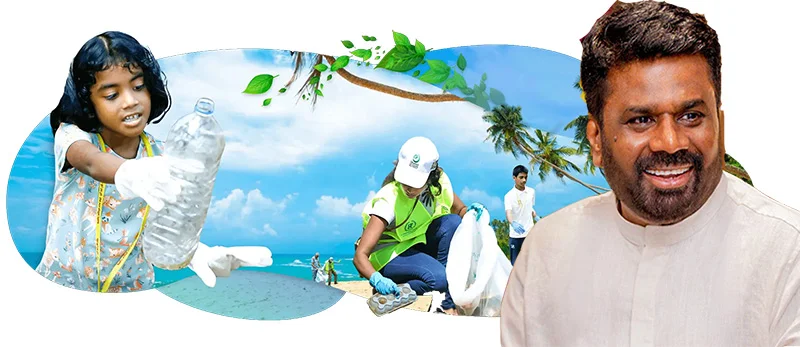
The problems that recently accompanied the Presidential Task Force for a Clean Sri Lanka and received adverse publicity may be attributed to taking on a mechanism that had its origins in an earlier initiative to deal primarily with environment related problems. According to this model the public sector is the “government or governmental institutions that provide policy directions, regulations and public services”. They are to work in partnership with the private sector which is “Business and private organisations that bring in resources, expertise and technology. They also contribute to the funding, innovation and efficiency of the partnership”. This model gave emphasis to public-private partnerships in which civil society would be the target to be “directly impacted by the partnership outcomes”.
The early initiatives of the Clean Lanka task force did not have the positive impact that was envisaged as it was non-consultative and attempted to enforce its views of the public-private partnership on target groups who felt victimised by the decisions made. The owners and drivers of private buses and trishaws who were the first targets have protested the decisions made. The environmental pollution and dangers to traffic that they were judged to be responsible for, was to them the outcome of their efforts to beautify and upgrade their modes of livelihood and which they had invested money in. The government has now agreed to a compromise where the proposed reforms have been given a time frame of three months to be implemented.
One of the initiatives of the government to deal constructively with this issue post-facto has been to invite civil society organisations to discuss the concept of the Clean Lanka task force and obtain their feedback. The government’s NGO Secretariat acted as the intermediary, inviting a select group of civil society organisations to a dialogue with the task force. This was a positive development as civil society groups have not been invited to participate in many of the government’s new initiatives. This has created an impression that the new government has been marginalising them and relying instead on the government machinery and private sector. This negative impression has been strengthened by the sudden emergence of a set of government regulations that would erode their independence.
MODIFY INTERVENTIONS
Civil society organisations are part of the system of democratic governance, particularly in filling gaps left by the public and private sectors such as in the case of marginalised groups, be they ethnic or religious minority groups, women and those from the LGBTIQ community. They also act as part of the system of checks and balances through the monitoring of abuse of power and human rights violations. The space for CSO/NGOs is constantly under threat worldwide. Their actions are often not appreciated by those in power who find civic groups to be inconvenient and troublesome to them.
CSOs in Sri Lanka have faced multiple attempts to restrict their independence for a variety of reasons. During the period of the war, some of them were accused of supporting the LTTE or undermining the government’s war effort. During the immediate post-war period they were accused of trying to revive the spirit of rebellion in the Tamil people and making the government vulnerable to international sanctions by supporting human rights initiatives. At the present time, there are claims that NGOs pose a threat to international law by engaging in criminal money laundering. A new set of NGO regulations have suddenly emerged to subject them to government control.
Discussions with government leaders, however, presents a more nuanced picture of reality. The government position on CSOs has not been formally conveyed but it is reported that President Anura Kumara Dissanayake has expressed his desire for an NGO-friendly government position. These positive sentiments and intentions will take some time to manifest themselves as the new government leaders and administrators become more familiar with the issues and apply their values and principles to administer the country. In the meantime, interventions coming from the past may need to be altered and modified like the directions of the task force on a clean Sri Lanka to fit in with the values and principles of the new government.

 It was a few years back that a former President of Sri Lanka took it on himself to pronounce SAARC ‘dead’. Since then there have been other sections of Sri Lankan opinion that have joined the critics of SAARC and taken the solemn stance that SAARC has indeed died what may be called a natural death.
Their fatalism is understandable. SAARC has failed to meet at heads of government or state level for the past several years to take the SAARC process notably forward. Regional cooperation has more or less been only an appealing idea. No substantive concrete projects have taken off to make the idea a hard reality. ‘Inner paralysis’ seems to be SAARC’s lot. Hence the fatalism in these circles.
However, being one of the worst cash-strapped regions of the world and a teemingly populated one with people virtually left to their devices, what choices do the ‘SAARC Eight’ have other than to try their best to band together and continue with their cooperation efforts, however small they may be?
There is no escaping the mounting debt trap for many of these countries and bankrupt Sri Lanka is a glaring example, but ‘throwing in the towel’ and abandoning themselves entirely to the diktats of the strongest economies and their agencies will prove a ‘living death’ for many countries in the SAARC fold.
The gains may be meagre but giving-up on SAARC cooperation in full would prove self-defeating for the organization and South Asia. Right now, the collective intention ought to be to salvage what the region could from the tenuous cooperative efforts. Moreover, such initiatives could go some distance to generate a degree of goodwill among the Eight and help in sustaining a dialogue process.
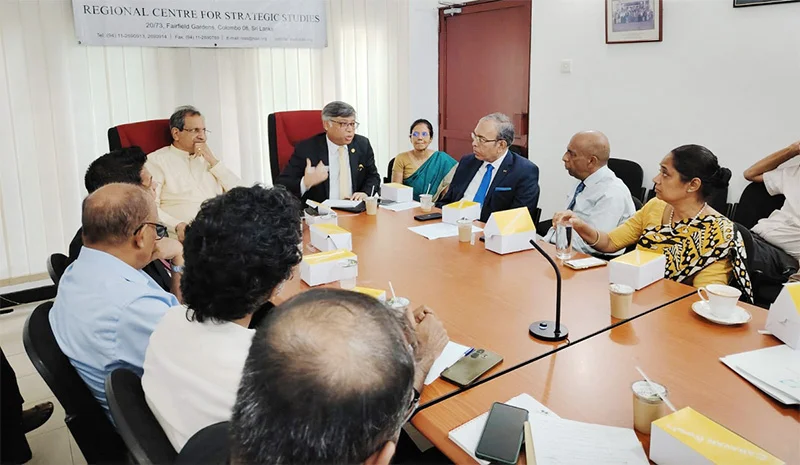
Given this backdrop it proved ‘a stich in time’ for the Regional Centre for Strategic Studies (RCSS), Colombo, to recently host the SAARC Secretary General Ambassador Md. Golam Sarwar to a round table discussion on the unifying potential of SAARC and its future possibilities, besides other related issue areas.
Held on June 24th and moderated by RCSS Executive Director and former ambassador Ravinatha Aryasinha, the forum brought together a vibrant, wide ranging audience comprising academicians, diplomats, senior public servants, civil society activists and many others. Following the presentation by Ambassador Golam Sarwar titled, ‘Reigniting SAARC: Achievements, Challenges and the Way Ahead’, a lively Q&A followed.
The above forum could be described as an act of lighting the proverbial ‘candle’ rather than ‘cursing the darkness.’ It surely is a ‘darkness’ that could be seen as daunting considering that the region’s pivotal powers, India and Pakistan, are failing to act in a spirit of accord but are engaged in bitter finger-pointing on a number of questions of vital importance to SAARC.
On the other hand, what is the rest of the region doing to bring the above sides together? It is disappointing that to date the rest of SAARC has failed to launch a major diplomatic drive to bring peace between the feuding regional heavyweights. It needs to act without delay and establish its earnestness and this effort would need to prove SAARC’s staying power in the unfolding months and even years.
In assessing SAARC’s seeming failure local opinion in particular has failed to factor in what could be described as weak leadership. Since Sheikh Mujibur Rahman of Bangladesh, the founding father of SAARC, the region has failed to produce a visionary leader who could advance the SAARC cause with charisma and drive.
Among other reasons, weak leadership accounts considerably for the faltering and stuttering status, as it were, of SAARC. Badly needed are leaders who could go the extra mile, think less of narrow national interests and work diligently towards the collective well being of the region but SAARC’s millions of ordinary people have been made to wait in vain for leaders of such stature. Instead, they have been burdened with politicians who seem to be relishing the apparently moribund state of SAARC.
Looking back, it could be said that it was the dynamic leadership factor that led to the launching of the Non-Aligned Movement and for its sustenance for a few decades. True, it could be seen in some quarters that NAM is no more, but as in the case of SAARC, the former too has been unfortunate to be burdened over the years with politicians who lack the vision and drive to unflaggingly advance the fortunes of the South. NAM and SAARC lack the dynamism and vision of leaders of the stature of Jawaharlal Nehru, for example, to give them the required guidance and intellectual depth.
The reasons are complex for there not being among us currently political leaders with the vision and the steadfast commitment to advance the legitimate interests of the South. However, it could be stated with conviction that the majority of Southern leaders have too easily caved in to the demands of the global North and its financial agencies.
These leaders have failed to see, for instance, that the largely market economy oriented Northern governments would not view with favour a centrist economic model that attaches priority to the interests of the dis-empowered publics of the South. This realization ought to have dawned on the current government in Sri Lanka, for instance, some while ago but it has no choice but to abide by IMF dictates since economic survival at present is unthinkable without the latter’s succour.
Accordingly for SAARC this should be the time for some soul-searching. Priority needs to be attached to ending the feuding between India and Pakistan since at present the material fortunes of the region hinge largely on these regional giants giving peaceful relations among them a try. This is no easy challenge to meet but some daring, visionary diplomacy needs to take hold among the rest of SAARC.
There is some sense in SAARC bringing the peoples of the region together through programs that address their best collective interests. A meeting of minds among SAARC nations could enable SAARC and its agencies to build a region-wide people’s movement for progressive political and economic change that could in turn lead to the region’s political leaders sensitizing themselves more to the neglected needs of their publics.
However, the time is ‘now’ for the initiation of these progressive changes and the voice of SAARC well wishers would need to drown out those of their critics.
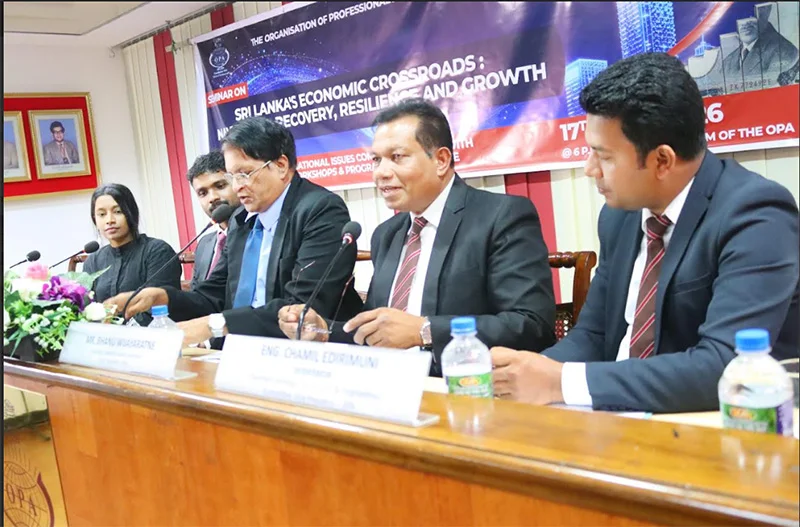
A seminar, “Sri Lanka’s Economic Crossroads: Navigating Recovery, Resilience and Growth” was recently held by the Organisation of Professional Associations of Sri Lanka (OPA) at the OPA Auditorium, bringing together economists, OPA members, and professionals from diverse fields for an insightful discussion on Sri Lanka’s economic recovery and future growth prospects.
The event was held under the patronage of Jayantha Gallehewa, President of the OPA, and was jointly organised by the National Issues Committee (NIC) and the Seminars, Workshops and Programmes Committee of the OPA. The event reaffirmed the organisation’s commitment to advancing professional excellence, fostering insightful intellectual engagement, facilitating interdisciplinary knowledge exchange and creating a constructive platform for informed dialogue on issues of national importance.
The panel of speakers comprised Dr. Harsha Aturupane, Lead Economist and Programme Leader for Human Development at the World Bank for Sri Lanka and the Maldives; Dr. Achinthya Koswatta, Senior Lecturer in Economics at the Open University of Sri Lanka, and Anushan Kapilan, Lead Economist at Verité Research.
In his welcome address, the President of the OPA emphasised that Sri Lanka was at a critical juncture in its economic recovery journey where sustained reforms, effective implementation, and collective national commitment are essential to achieving long-term stability, resilience and inclusive growth. He noted that the country had experienced one of the most severe economic crises in its history with the economy contracting by 7.8 percent in 2022 and a further 11.5 percent in 2023, resulting in significant economic and social challenges.
Delivering his introductory remarks Bhanu Wijeyaratne, Vice President of the OPA and Chairman of the National Issues Committee, underscored the need to move beyond short-term economic stabilisation towards a comprehensive agenda of structural transformation. He observed that the economic crisis had revealed deep-rooted weaknesses within the economy, including persistent fiscal pressures, rising public debt, foreign exchange limitations, and insufficient diversification of the export base. He stressed that addressing these challenges through strategic reforms, institutional strengthening and long-term economic planning would be essential to establishing a more resilient and competitive economy.
While acknowledging recent positive developments, including improved inflation management, tourism recovery and signs of economic stabilisation, Wijeyaratne stressed the need to advance reforms aimed at strengthening fiscal discipline, enhancing productivity, improving competitiveness, developing human capital and reinforcing governance and institutional effectiveness.
He further highlighted the important role of professionals, businesses, academia and other stakeholders in contributing to evidence-based dialogue and supporting Sri Lanka’s journey towards a resilient, inclusive and sustainable economic future.
Delivering the keynote presentation, Dr. Harsha Aturupane provided a comprehensive assessment of Sri Lanka’s economic prospects within the broader context of global economic transformation. He argued that Sri Lanka functioned as a small open economy whose performance is significantly influenced by developments in the global marketplace. External factors could not be controlled, and the country must strengthen its domestic capacity and resilience to respond effectively to international economic shifts, he noted.
Tracing the evolution of global economic systems, Dr. Aturupane highlighted the transition from ideological divisions between state-controlled and market-oriented economies towards increasingly pragmatic approaches focused on growth, competitiveness and development. He noted that Sri Lanka’s own economic journey reflects a similar evolution, with contemporary policy debates now centred on practical solutions for sustainable economic progress.
The presentation also examined the transformative impact of globalisation. Dr. Aturupane observed that global economic integration had enabled several East Asian economies, including South Korea, Singapore, Taiwan and Hong Kong, to achieve remarkable economic advancement through export-led growth strategies. Sri Lanka similarly benefited from this process through the expansion of its apparel industry and increased integration into global value chains.
Turning to Sri Lanka’s recovery programme, Dr. Aturupane emphasised that the ongoing stabilisation process should be viewed as a national programme supported by the International Monetary Fund rather than solely as an IMF initiative. He observed that strong worker remittances, improved tourism earnings, enhanced government revenue mobilisation and prudent import management have contributed significantly to economic stabilisation.
Despite this progress, he cautioned that rebuilding foreign exchange reserves and meeting future debt obligations remain major challenges. He underscored the need to strengthen export performance, attract investment and generate sustainable foreign exchange earnings to ensure long-term economic resilience.
The discussion also focused on monetary stability, inflation management and exchange-rate policy. Dr. Aturupane stressed that maintaining price stability was fundamental to sustainable growth and household welfare, while sound monetary policy remains essential for preserving economic confidence.
Looking beyond stabilisation, he argued that Sri Lanka must transition towards a broader economic transformation agenda. Sustainable growth, he noted, will depend on expanding productive capacity through investment, technological advancement, innovation, skills development and structural reforms.
Among the key constraints identified was the high cost of energy, which continues to affect competitiveness and investment attractiveness. Dr. Aturupane emphasised the importance of improving efficiency and affordability within the energy sector to enhance Sri Lanka’s business environment.
He further highlighted the social dimensions of the crisis, noting the rise in poverty and economic vulnerability among households. Strengthening social protection systems and ensuring inclusive growth, he argued, must remain central components of the national development agenda.
Another critical challenge identified was Sri Lanka’s demographic transition. With an ageing population, outward migration and evolving labour market dynamics, the country is increasingly confronting labour shortages in several sectors. Dr. Aturupane suggested that greater automation, increased labour-force participation and strategic workforce planning would be necessary to address these emerging realities.
Concluding his presentation, he emphasised the need to improve governance, strengthen institutions, enhance competitiveness and create an enabling environment for private sector investment. Sri Lanka’s future success, he noted, will depend on its ability to move decisively beyond crisis management towards a development model founded on resilience, innovation, productivity and inclusive growth.
Dr. Achinthya Koswatta reiterated the importance of policy consistency and predictability in fostering investment and industrial development. She observed that frequent policy changes create uncertainty and discourage long-term investment decisions, whereas stable and coherent policy frameworks build confidence and support sustainable economic transformation.
Meanwhile, Anushan Kapilan highlighted the substantial progress achieved in restoring macroeconomic stability following the recent crisis. He noted significant improvements in fiscal performance, including increased government revenue, reduced reliance on debt financing and a historically low fiscal deficit.
He further observed that public debt levels are declining faster than anticipated, economic growth has exceeded expectations and inflation has been brought under control more rapidly than forecast. Nevertheless, he cautioned that the recovery remains uneven, particularly within the industrial sector and that many households have yet to experience a meaningful improvement in living standards.
The seminar was expertly coordinated by Eng. Chamil Edirimuni, Vice President of the OPA and Chairman of the Seminars, Workshops and Programmes Committee, while the technical moderation and interactive discussion session were facilitated by Bhanu Wijeyaratne, Vice President of the OPA and Chairman of the National Issues Committee.
The event was attended by Tisara De Silva, President-Elect of the OPA, Eng. Ravi Rupasinghe, General Secretary, Past Presidents, members of the Executive Council, representatives of the General Forum and professionals representing a wide range of disciplines.
The seminar concluded with a vibrant exchange of ideas and perspectives, reaffirming the importance of evidence-based policy dialogue, institutional collaboration and collective national commitment in advancing Sri Lanka’s economic recovery, resilience and sustainable growth.

 Yes, for UK-based presenter and artiste Samantha Kay, home is where the heart – and the roots – are. And her roots run deep in Sri Lanka.
In an exclusive interview with The Island, Samantha says “I’m proud to be Sri Lankan. My mum is from Kandy and my dad is from Colombo, so Sri Lanka has always held a very special place in my heart.
“Whenever I visit Sri Lanka, I love spending time on the beautiful south coast, especially Hikkaduwa and Mirissa. It’s somewhere I always feel connected to my roots and completely at peace.”
Now living in Bournemouth, on the south coast of England, where, she says, she is lucky to be close to some of the UK’s most beautiful beaches, including the iconic Sandbanks, Samantha has built a career that refuses to fit into one box.
She is a radio presenter, podcast host, singer-songwriter, personal trainer and life coach.
“I genuinely love the variety because every role allows me to connect with people and, hopefully, make a positive difference in someone’s day.”
Of course, music has taken her far.
One of her proudest achievements, she says, was releasing a song with 90s music icon Angie Brown, which reached No. 9 in the UK Club Charts.
She also reached the final stages of The X Factor and performed at Wembley Stadium in front of thousands.
Beyond music, Samantha competed in bikini bodybuilding across the UK, winning several titles. “It taught me discipline, resilience and self-belief,” she recalls.
Today, her focus is on radio, podcasting and coaching women. Her podcast encourages people to live life on their own terms rather than feeling pressured to follow society’s expectations.
Says Samantha: “Whether someone is single, changing careers, travelling solo or simply trying to find their purpose, I want them to know that it’s never too late to create a life that feels authentic. If you’ve ever felt like you don’t fit into the box, maybe you were never meant to.”
Samantha Kay also spent a year in Dubai, performing at five-star hotels, including FIVE, and coaching at the iconic outdoor gym on Palm Jumeirah.
“I taught strength and conditioning classes, and hosted wellness retreats, combining my passion for music, health and inspiring others.”
However, with family matters calling her back to the UK, she made the choice to return. “Family comes first,” she says.
Looking ahead, Samantha plans to grow her radio and podcast work, release more music, and expand her wellness retreats.
“My biggest passion is helping people, especially women, build confidence and believe in themselves,” she says.
“Wherever my career takes me, I hope to continue inspiring others to live with courage, kindness and authenticity, while never forgetting my Sri Lankan roots.”

President chairs discussion on 2027 Budget Proposals for the Ministry of Industry and Entrepreneurship Development

Prime Minister meets the Amir of the State of Qatar and conveys condolences on the passing of the Father Emir

Current El Niño Status in Sri Lanka

A few showers may occur in the Western, Sabaragamuwa and North-western provinces and in Kandy, Nuwara-Eliya, Galle and Matara districts.

Argentina face fine for Falklands banner in semi-final win

US launches fresh strikes on Iran as Trump warns Tehran it ‘better behave’

‘Dates have the highest sugar content to fight Coronavirus’

Sunday Island 27 December – Headlines

#SundayIsland 17th December – Headlines

Sunday Island – 28th March

Sunday Island Headlines – 21 March

Sunday Island – 21st February – Headlines
-
 News7 days ago
Herath warns prospective migrant workers not to get fleeced by racketeers
-
 Features5 days ago
Prison riots and politics: NPP’s biggest challenge and Sri Lanka’s biggest opportunity
-

 Editorial6 days ago
What’s the world coming to?
-
 Foreign News7 days ago
Tensions erupt in Indian state after 11-year-old raped and murdered
-
 Features7 days ago
Devanesan Annan – in Memoriam
-
Editorial7 days ago
Punishment in hellholes
-
 Features2 days ago
Dirty Money
-

 Editorial5 days ago
Much ado about crime: Fish or cut bait