
Business
Sri Lanka’s economy on Y-o-Y growth expansion of 5.3 percent – CBSL Governor

By Hiran H.Senewiratne
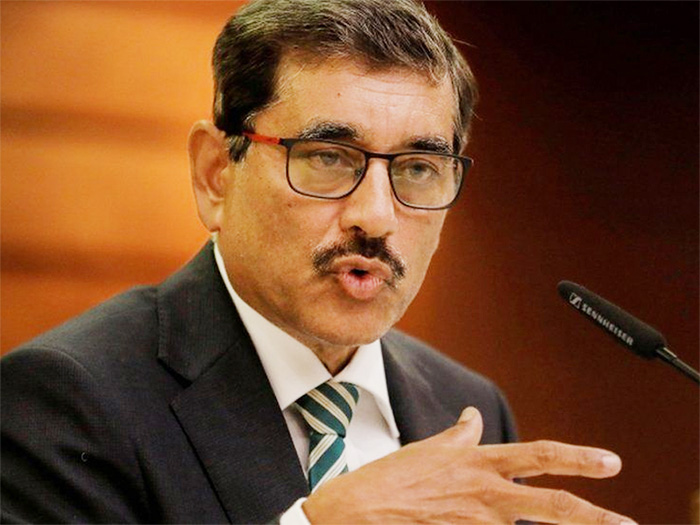
The Sri Lankan economy expanded for the third consecutive quarter in the first quarter 2024, with a year-on- year real growth of 5.3 percent, as per the estimates, Central Bank Governor Dr Nandalal Weerasinghe said.
‘The rebound in domestic economic activity is expected to sustain, buoyed by the transmission of relaxed monetary policy to broader market interest rates, enhanced supply conditions, the gradual rebound in external demand conditions, revival of tourism and the dissipation of uncertainties surrounding debt restructuring, Dr Weerasinghe told the press briefing following CBSL’s monthly monetary policy review meeting. The event was held at Central Bank head office in Colombo.
Dr. Weerasinghe added: ‘In consideration of the current and expected macroeconomic developments highlighted above, and with due regard to the domestic and global uncertainties, the CBSL decided to reduce the Standing Deposit Facility Rate (SDFR) and the Standing Lending Facility Rate (SLFR) of the Central Bank by 25 basis points to 8.25 per cent and 9.25 per cent, respectively.
‘CBSL underscores the need to signal its desire to continue easing monetary conditions to sustain revival of economic activity, in the absence of significant inflationary pressures.
‘The Monetary Policy Board will continue to monitor inflation developments and those of other macroeconomic variables and take policy actions as necessary in the period ahead.
‘In line with the eased monetary policy stance of the Central Bank, market interest rates continued to adjust downwards. However, the adjustments, particularly of lending interest rates other than on prime lending, remained weaker than the adjustments to deposit interest rates.
‘Further, following a contraction recorded in April 2024, credit extended to the private sector by Licensed Commercial Banks (LCBs) expanded in May and June 2024. A sustained rebound in credit growth requires market lending interest rates to decline further in line with the prevailing accommodative monetary policy stance.
‘While the external current account is likely to have recorded a surplus in the first half of the year, the cumulative merchandise trade deficit widened during this period compared to the same period in 2023. Earnings from tourism and workers’ remittances continued to be promising.
‘Gross Official Reserves (GOR) stood at US dollars 5.6 billion (including the swap with the People’s Bank of China) as of end June 2024, compared to US dollars 4.4 billion at end 2023.
‘The Sri Lanka rupee witnessed intermittent volatility against the US dollar in recent months. Overall, the Sri Lanka rupee appreciated by over 6.5 per cent against the US dollar thus far during 2024.
‘The Central Bank has cut the rate at which it is lending “printed money” to banks by 25 basis points to 9.25 percent and the rate at which excess money is taken to 8.25 percent, in a July monetary policy decision.
‘The Board arrived at this decision following a careful assessment of the current and expected macroeconomic developments and possible risks and uncertainties on the domestic and global fronts with a view to maintaining inflation at the targeted level of 5 per cent over the medium term, while enabling the economy to reach its full capacity.
‘In arriving at this decision, the Board considered the need to signal the continuation of the eased monetary policy stance, thereby inducing a further reduction in market lending rates to support economic activity, amidst a benign inflation outlook.
‘The Board noted that, based on the available information, inflation is likely to remain below the inflation target of 5 per cent by a sizable margin for the next several months before aligning with the targeted level over the medium term.
‘Since September 2022 in particular, Sri Lanka’s Central Bank has laid a strong foundation for people and businesses to engage in economic activity by keeping inflation around 2-3 percent, and exchange rate stable by largely avoiding printing money to enforce policy rates incompatible with the balance of payments.
‘Sri Lanka has to repay some sovereign debt in 2024 if a bond exchange proceeds as planned and the Central Bank itself has to settle loans to India and the International Monetary Fund requiring deflationary policy to be followed.
‘Analysts have warned that countries under IMF programs which use mathematics to decide policy rates (data driven monetary policy) ignoring laws of nature, under so-called flexible inflation targeting, tend to trigger confidence shocks, external crises, followed by stabilization programs and social unrest at home.
‘Social unrest broke out in both Kenya and Bangladesh during IMF programs, following depreciating currencies. Kenya had to hike rates steeply to end confidence shocks to the currency. Bangladesh is now following a so-called ‘crawling peg’.
‘Analysts say that a Central Bank that has reserve-related-liabilities to settle (or collect forex reserves under an IMF program) cannot cut rates based on a historical inflation statistic – especially as private credit recovers.
‘In June, the Central Bank injected 7-day money to the banking system up to Rs. 50 billion as low as 8.93 percent despite the overnight rate being at 9.50 percent, losing the ability to collect reserves in the month.
‘Headline inflation, as measured by the year-on-year change in the Colombo Consumer Price Index (CCPI, 2021=100), was recorded at 1.7 per cent in June 2024. Such considerably below-target headline inflation was underpinned by the downward revisions to the electricity tariff and fuel and LP gas prices in addition to relatively weak demand conditions.
‘Meanwhile, core inflation, which reflects underlying demand in the economy, was recorded at 4.4 per cent (CCPI- based, year-on-year) in June 2024 compared to 3.5 per cent in May 2024, although a sustained acceleration is not anticipated.
‘Realized quarterly average headline inflation during the Q2 2024 was below the inflation target by more than the margin of 2.0 percentage points stipulated in the Monetary Policy Framework Agreement (MPFA). The latest projections suggest that headline inflation is likely to be notably below the target in the forthcoming months due to the combined impact of downward adjustments to electricity tariffs and domestic fuel prices and the favourable statistical base.’


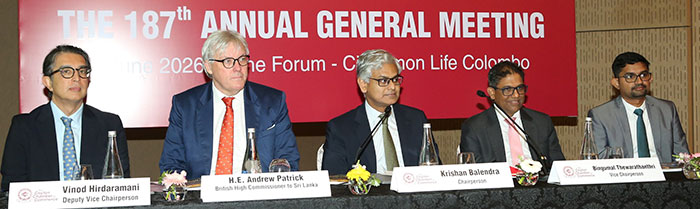
The Ceylon Chamber of Commerce announced the re-election of Chairperson Krishan Balendra and the election of its Board for the Year 2026/27 at the Chamber’s 187 th Annual General Meeting on June 25. High Commissioner of Britain to Sri Lanka, Andrew Patrick, attended as Chief Guest.
The 2026/27 office-bearers are Chairperson Krishan Balendra, – Chairperson John Keells Holdings PLC, Vice Chairperson Bingumal Thewarathanthri – CEO, Standard Chartered Bank Sri Lanka, and Deputy Vice-Chairperson Vinod Hirdaramani – Chairman, Hirdaramani Group.
Jayanthi Dharmasena – Managing Director, Hayleys Agriculture Holdings Ltd., Kasturi Chellaraja Wilson – Chief Operating Officer, Head of APAC – 5Hour International Corporation Singapore, Shibani Thambiayah – Managing Director, Renuka Hotels PLC,Supun Weerasinghe – Director/Group CEO – Dialog Axiata PLC, and Shiran Fernando – Secretary-General and CEO will serve as Board Members. Rohana Dissanayake – Group Chairman and Managing Director of David Pieris Motor Company Pvt. Ltd. will also join the Board, replacing Bernhard Stefan – Managing Director – Nestlé Lanka PLC, who relocated overseas.
In his remarks, Balendra noted that over the past year, the Chamber adopted a more solutions-oriented approach to advocacy, focusing not only on identifying challenges but also on developing constructive recommendations in collaboration with government, industry stakeholders, and development partners, with this approach yielding stronger results. “Through our engagement in the Budget 2026 process, eighteen recommendations proposed by the Chamber were incorporated into the national budget, covering areas such as trade facilitation, investment promotion, digitalisation, infrastructure, and improving the ease of doing business.
This builds upon the strong momentum established in previous years and demonstrates the value of evidence-based, constructive engagement.
The Chamber also contributed to addressing emerging global trade challenges, including tariff-related issues affecting Sri Lankan exports. By representing private sector perspectives in Presidential Committees, we supported efforts to safeguard export competitiveness and strengthen trade resilience.”
Beyond advocacy, it significantly expanded its engagement footprint, strengthening bilateral partnerships across more than twenty countries, and supporting more than 1,800 SMEs through training, advisory services, and market access initiatives.
He added that over the next year, the Ceylon Chamber is committed to deepening engagement with members, strengthening global partnerships, enhancing support for SMEs, and accelerating efforts to promote exports and attract investment, and is committed to working with the Government and stakeholders to ensure a resilient and prosperous Sri Lanka.

In the hill capital of Kandy, a husband-and-wife duo has won the admiration of music lovers with their shared passion for singing and their dedication to the art.
Vijitha Kingsley Bandara and Umesha Kalhari Navaratne have become familiar voices among audiences in Kandy, entertaining crowds with their musical talents while building a reputation as a versatile singing couple.
Kingsley began his musical journey at the age of 17, performing at outdoor musical shows before gaining opportunities to showcase his talent at several hotels in the Kandy area. His performances for local and foreign tourists further enhanced his reputation as a singer. He later took his musical talents overseas, entertaining audiences in several countries.
For the past 12 years, Kingsley has been engaged in singing at establishments operated by the Devon Group and The Grand Kandyan Hotel in Kandy, following an opportunity extended by Group Chairman Gamini Weeraratne.
Supporting him both in life and music, Umesha has also established herself as a singer, performing at Devon establishments. She also runs a home-based cake-making venture.
The couple, who continue to receive appreciation from music enthusiasts, said they are ready to accept invitations to perform at musical events across the country. They can be contacted on 071-1519130.
Text and Pic by SK Samaranayake

Recognising the rapid emergence of the gig economy in Sri Lanka, the Commercial Bank of Ceylon has introduced ‘ComBank GIG+’ – a specialised banking solution designed for freelancers, digital entrepreneurs, social media influencers, and individuals and businesses earning in foreign currency through overseas engagements to receive their foreign earnings, including PayPal-linked withdrawals, through a structured banking account.
ComBank GIG+ reflects a decisive shift in the country’s employment landscape, where a growing number of professionals are leveraging global digital platforms and remote work opportunities to build independent income streams. From freelance service providers operating on platforms such as Fiverr, Upwork and Freelancer.com, to content creators monetising audiences across YouTube, TikTok, Meta and X, this segment represents a dynamic and increasingly influential contributor to foreign exchange inflows.
ComBank GIG+ is tailored to meet the specific needs of these digital earners, offering account options in Sri Lanka Rupees as well as major foreign currencies including USD, EUR, GBP and AUD. The account is available to Sri Lankan citizens aged 18 and above residing in the country, as well as duly registered business entities, subject to verification of foreign currency income derived through recognised digital and remote work channels.
Commenting on the introduction of ComBank GIG+, Hasrath Munasinghe, Chief Operating Officer of Commercial Bank said: “The rise of independent digital earners represents a structural shift in how value is created and exported from Sri Lanka. With ComBank GIG+, we are establishing a banking framework that not only recognises this segment, but also integrates it more meaningfully into the formal financial system. This enables individuals and businesses operating beyond traditional employment models to build a verifiable financial track record, access formal financial services, scale their operations, and contribute more visibly to the country’s economic growth.”
The launch of ComBank GIG+ is particularly timely following Sri Lanka’s recent enablement of PayPal linked withdrawals, which has simplified the process of bringing overseas digital earnings into the country.
In addition to facilitating PayPal-linked withdrawals and foreign currency inflows, the Bank said the ComBank GIG+ account offers a range of value-added benefits including first-year fee waivers on credit cards and digital banking services, preferential foreign exchange rates for qualifying conversions into Sri Lanka Rupees, and the opportunity to establish a structured banking relationship that may support future access to financing and other financial solutions. These features are designed to enhance financial efficiency while supporting the day-to-day banking needs of digitally active customers.
By aligning its product innovation with evolving global work patterns, Commercial Bank continues to strengthen its position as a forward-looking, technology-driven institution. The introduction of ComBank GIG+ underscores the Bank’s commitment to supporting new economic segments, enhancing financial inclusion, and enabling Sri Lankan talent to participate more effectively in the global digital economy.

Zafar, Feroza lead Pakistan to consolation win

Jangoo 233, Chase 194 put West Indies in commanding position

Showers will occur at times in the Western, Sabaragamuwa and North-western provinces and in Galle, Matara, Kandy and Nuwara-Eliya districts

Venezuelans dig for earthquake survivors as death toll rises to 1,430

Chemmani mass graves: Govt to seek international forensic help

ADB approves $57.4 million package to boost Lanka’s rooftop solar drive

‘Dates have the highest sugar content to fight Coronavirus’

Sunday Island 27 December – Headlines

#SundayIsland 17th December – Headlines

Sunday Island – 28th March

Sunday Island Headlines – 21 March

Sunday Island – 21st February – Headlines
-

 Features6 days ago
Sri Lanka developing independent hydrographic capabilities
-

 Opinion5 days ago
Ranasinghe Premadasa: The man who would not take ‘No’ for an answer
-

 News21 hours ago
Another 1,132 Sri Lankan Personnel to be deployed for United Nations Peacekeeping Missions
-

 Latest News7 days ago
Sooryavanshi thumps fastest List A fifty as India A win tri-series
-

 Opinion4 days ago
Sri Lanka’s national security: Justice, reconciliation, and forward-looking vigilance
-

 News5 days ago
US Assistant Secretary of State for South and Central Asian Affairs meets President
-

 Opinion3 days ago
A triumph for Pakistan’s skilled diplomacy at Iran-US talks
-

 Business6 days ago
University of West London opens Sri Lanka’s first full UK university branch campus