
Business
Sri Lankan ambassador to Viet Nam in warm discussion with leading Southeast Asian EV manufacturer


The Sri Lankan embassy in Viet Nam had a meeting with the top-most management of the iconic automobile manufacturer, Vinfast, at the latter’s corporate head office in Ha Noi to discuss and explore commercial and investment opportunities, thus benefiting both Sri Lanka and Vinfast.
Vinfast is under parent company, Vingroup, one of the largest listed corporates in South-East Asia. Ambassador Dr. A. Saj U. Mendis along with the Minister Commercial, Ms. Kishani Wickramasinghe, met with Vingroup chief of International and Government Affairs cum Vinfast Deputy CEO, Ms. Bui Kim Thuy, along with the senior management of Vinfast. The meeting lasted over an hour and discussed a myriad economic, commercial and trade opportunities.
Vinfast is one of the very few auto manufacturers specialized in manufacturing electric vehicles (EVs) as well as other conventional vehicles. Being one of the largest auto manufacturers not only in the region but in the world, when Vinfast was listed on the US stock exchange, Nasdaq, in August, 2023, the price of shares soared to make Vinfast the second most valuable auto company in the world just behind that of Tesla, yet another EV manufacturer.
Market capitalization of Vinfast in August 2023 was higher than the combined market cap. of both General Motors and Ford of the US as it exceeded USD 110 billion or over 25% of the total GDP of Viet Nam. During the recent past, Vinfast, which is highly aggressive in expanding and penetrating new markets, is in the process of investing USD 4 billion in the state of North Carolina in the US on a state-of-the-art manufacturing facility and USD 500 million in the Chennai in India as well as has investment propositions to commit USD 1.2 billion in Indonesia respectively.
Dr. Mendis and Deputy CEO of Vinfast at the Vinfast showroom exchanging mementos
Ambassador Mendis commended the achievements and attainments of Vinfast of Vingroup stating that today Vinfast has basically become a household name mostly in Asia as well as in other countries. Vinfast produces around 300,000 vehicles per year and has the potential to produce one million vehicles. Dr. Mendis stated to Deputy CEO, Ms. Thuy, to consider Sri Lanka favorably, to have commercial operations such as outsourcing, manufacturing or assembly plant, thus facilitating and ensuring the smooth functioning of the global supply chains as well as complementing the manufacturing facilities of Vinfast.
Further, ambassador Mendis listed out the compelling and appealing factors and attributes of Sri Lanka in order to be considered as an investment destination as well as to be engaged on commercial activity as pertinent. For all record purposes, Vinfast has one of the most advanced state-of-the-art manufacturing facilities in the entire region. Dr. Mendis impressed upon and accentuated to Deputy CEO, Ms. Thuy, that given the number of FTAs and trade agreements Sri Lanka has as well as the strategic location with easy access to Central & South Asia and Middle-East, among other incentives, Sri Lanka would be an ideal and quintessential location for commercial and economic activity for Vinfast.
(Sri Lankan embassy in Ha Noi )


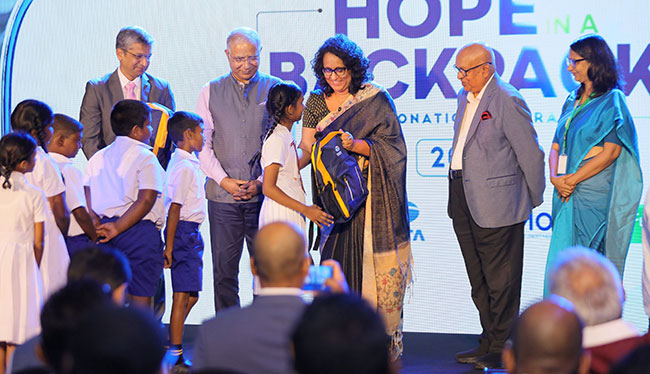
The Tata Group, in partnership with ChildFund and DIMO, has successfully implemented a humanitarian education support initiative for disaster-affected schoolchildren in Sri Lanka, reaffirming its commitment to helping communities recover from the impacts of Cyclone Ditwah and the subsequent floods.
Following a formal request for support from Sri Lanka, an on-ground assessment was conducted in December 2025. Recognizing the urgent need, several Tata companies joined forces to implement the response program.
As part of this initiative, the ‘Hope in a Backpack’ programme, which provides disaster-affected children with essential educational supplies, was launched by the Tata Group at Taj Samudra, Colombo, in the presence of the Chief Guest, Hon. Prime Minister Dr. Harini Amarasuriya; the Guest of Honour, Hon. Indian High Commissioner Santhosh Jha; Ranjith Pandithage, Chairman of DIMO; Chacko Thomas, Group Chief Sustainability Officer, Tata Sons; and Aditi Ghosh, Country Director, ChildFund.
This initiative is part of DIMO’s Social and Community Pillar, under the project theme ‘Lassana Hetak,’ which focuses on giving the future generation a helping hand towards a better future.
This collective effort was further strengthened by volunteers from Tata and DIMO, who actively mobilized on the ground to pack, distribute, and support affected communities. During the proceedings, specially invited schoolchildren received the backpacks with essential supplies as well.
Commenting on the partnership, Ranjith Pandithage, Chairman of DIMO, said: “DIMO is proud to collaborate on this meaningful initiative alongside the Tata Group and ChildFund as the local implementation and logistics partner. Our relationship with Tata spans more than six decades and has been built on a shared commitment to ethical business practices, trust, and creating lasting value for the communities we serve. These values have shaped our partnership over the years, extending beyond business to initiatives that make a meaningful difference in people’s lives.”
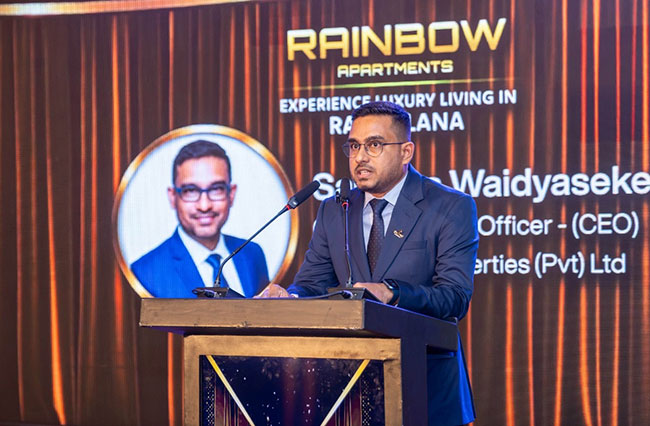
NovaNest Properties (Pvt) Ltd has officially launched Rainbow Apartments, a new residential development in Ratmalana. The announcement was made at an official launch event held at the Shangri-La Hotel, Colombo, marking the company’s latest addition to Sri Lanka’s growing apartment market.
The development is designed to cater to homebuyers seeking modern urban living, as well as investors looking for long-term value. Rainbow Apartments is located in Ratmalana, an area of increasing residential interest, and benefits from the suburb’s established social infrastructure, proximity to major transportation links, and accessibility to Colombo.
The project reflects NovaNest Properties’ commitment to delivering quality residential developments that combine contemporary design with practical living. Intended to satisfy the evolving lifestyle demands of today’s homeowners, Rainbow Apartments features thoughtfully designed living spaces supported by modern amenities. These include two infinity pools, a gym, fully functional workspaces, a mini theatre, stylish cafés, a mini-mart, and a children’s daycare. Additionally, it features a full time medical centre backed by Nawaloka Hospitals PLC Colombo, with a 24-hour ambulance service.
Commenting on the launch, the Chief Executive Officer of NovaNest Properties (Pvt) Ltd, Samitha Waidyasekera, said, “Today’s buyers are looking beyond square footage. In addition to providing long-term value, they want homes that are close to the places where they work, learn, and spend their time. With that shift in mind, Rainbow Apartments was created to bring together a strategic location, thoughtful design, and quality construction in a way that will continue to meet buyers’ needs for years to come. Through our promise of ‘Luxury Beyond Expectations,’ we are committed to delivering an elevated lifestyle experience that combines comfort, convenience, and modern living.
To open sustainable energy projects to all investors
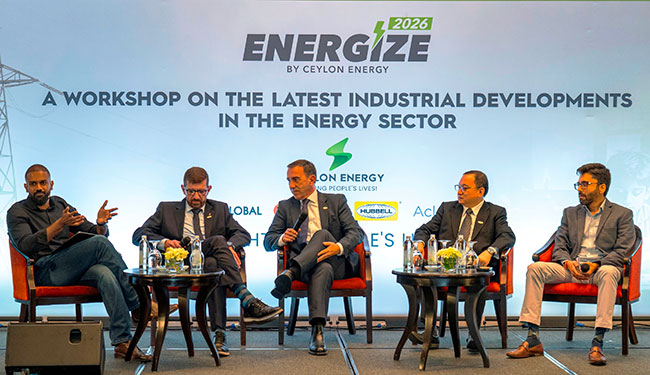
Ceylon Energy hosted Energize 2026, a global forum featuring experts from Hubbell, CTC Global, and Aclara Technologies, to discuss advanced transmission, smart grids, and digital energy infrastructure. The event’s centerpiece was the launch of Apollo Energy (Delaware USA) – a new investment platform that connects individual, corporate, and institutional investors with curated, high-yield renewable energy and infrastructure projects in Sri Lanka and the region. Founder Madu Fernando emphasized the platform aligns with the company’s vision of “Lighting People’s Lives” by democratizing access to sustainable energy investments, unlocking new funding, and fostering innovation. The initiative complements Ceylon Energy’s broader mission to drive industry collaboration, technology adoption, and a resilient energy ecosystem
The workshop featured resource personnel representing Ceylon Energy’s strategic global alliances, including Hubbell Power Systems, CTC Global, and Aclara Technologies. The experts shared their knowledge on advanced transmission and distribution technologies, smart grid solutions, digital infrastructure, and innovations that are shaping energy systems across the world. The event attracted a diverse audience comprising engineers, utility professionals, investors, financial institutions, business leaders, and other stakeholders from across the energy sector. A key highlight of Energize 2026 was the insightful panel discussion titled “Shaping the Future of Energy,” which brought together renowned global industry experts to discuss the opportunities and challenges in building resilient and technology-driven energy systems.

Lithuania warns Lankans against falling into job offer scams

NPP government here to stay, says Lal Kantha

Dengue cases surpass 72,000 as death toll rises to 49

Tales of Mystery and Suspense 10 Casino for Sale

WPC signs MoU with NGO to implement an Early Childhood Education (ECE) Programme

Suspect arrested over shooting at police after grabbing weapon from them, has security background

‘Dates have the highest sugar content to fight Coronavirus’

Sunday Island 27 December – Headlines

#SundayIsland 17th December – Headlines

Sunday Island – 28th March

Sunday Island Headlines – 21 March

Sunday Island – 21st February – Headlines
-
 News7 days ago
Herath warns prospective migrant workers not to get fleeced by racketeers
-

 Features5 days ago
Prison riots and politics: NPP’s biggest challenge and Sri Lanka’s biggest opportunity
-

 Editorial6 days ago
What’s the world coming to?
-

 Foreign News7 days ago
Tensions erupt in Indian state after 11-year-old raped and murdered
-
 Features2 days ago
Dirty Money
-

 Editorial5 days ago
Much ado about crime: Fish or cut bait
-

 Features5 days ago
More on Saudi Arabia: ARAMCO and beyond
-

 Latest News3 days ago
Oil prices hit 1-month high as US-Iran attacks dim Strait of Hormuz outlook