
News
Sri Lanka voters hand Rajapaksa strength to face India and China

Washington tweets its
concern of the strategic island’s indebtedness to Beijing
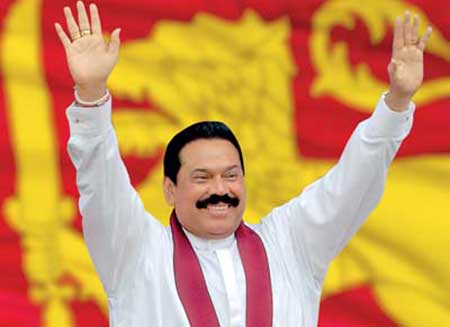
Prime Minister Mahinda Rajapaksa and his brother have a difficult economic path ahead of them but can count on financial favors as China, India, the U.S. and Japan vie for influence.
MARWAAN MACAN-MARKAR,
Asia regional correspondent , Nikkei Asian Review
BANGKOK — Sri Lankan voters have already detected a whiff of what the electoral landslide won by the country’s most influential political clan earlier this week means to the international community, or at least what it means to India, the U.S. and Japan.
Indian Prime Minister Narendra Modi set the tone by going on a charm blitz. He called and tweeted at his counterpart, caretaker Prime Minister Mahinda Rajapaksa, part of that political clan, even before the final results were in, giving the Sri Lanka Podujana Peramuna, a Rajapaksa political vehicle, 146 seats in the 225-member legislature.
“We will work together to further advance all areas of bilateral cooperation and to take our special ties to ever new heights,” Modi tweeted on Thursday, one day after the general elections.
Hours later, the U.S. embassy in Colombo, the island’s commercial capital, reached out, also on Twitter. “As the new parliament convenes,” the tweet says, “we hope the government will renew its commitments to building an inclusive economic recovery, upholding human rights and the rule of law, and protecting the country’s sovereignty.”
That “sovereignty” nudge was a reminder of the massive amount of loans Sri Lanka has taken from China for infrastructure projects, one of which two years ago prompted The New York Times to write this headline: “How China Got Sri Lanka To Cough Up A Port.” That was a dig at the $1.5 billion southern port in Hambantota, built with Chinese loans, that the debt-strapped Sri Lankan government gave to the Chinese on a 99-year lease as part of a $1.1 billion debt swap.
The Sri Lankan public was not privy, however, to the mood inside the Chinese embassy on Friday, following the pro-China Rajapaksas’ triumph. They are “so happy,” was the sentiment making the rounds within some Colombo-based diplomatic circles.
Foreign policy insiders in the country regard these rhetorical cues as a hint of the “diplomatic balancing act” that looms for the new government in Sri Lanka, increasingly wooed by China, India, the U.S. and Japan, all covetous of the island’s strategic location in the Indian Ocean.
Yet, the foreign policy insiders are sanguine. The decisive electoral mandate won by the Sri Lanka Podujana Peramuna, or SLPP, will afford the Rajapaksas enough political stability to chart a firmer diplomatic course.
“One thing out of the way with the general elections is we will not have partisan quarrels over foreign policy,” said a veteran Sri Lankan diplomat, referring to the previous coalition government, one marked by disunity when it came to foreign relations with China, India and the U.S. “The people’s mandate gives the government a stable domestic platform to deal with foreign powers.”
The elections cemented the Rajapaksas’ political comeback after a five-year lapse. In November, Gotabaya Rajapaksa, Mahinda’s younger brother, won a sweeping mandate in the presidential election. The brothers had risen to dominate the country for a decade during Mahinda’s two terms as president, which came to an end in January 2015.
It was during Mahinda’s presidency that Sri Lanka tilted
toward China, ending decades of influence that India had enjoyed. Beijing poured in military assets that enabled the Rajapaksas to end Sri Lanka’s 30-year civil war and followed it up with billions of dollars worth of infrastructure loans to help revive the war-shattered economy.
The general elections also serve as a reminder: Foreign-funded infrastructure projects and foreign assistance have become political fodder and will pose an early foreign policy challenge for the Rajapaksa brothers’ new administration.
On the eve of the elections, a Colombo port trade union with ties to the Rajapaksa camp launched a protest to stop the development of a container terminal that India, Japan and Sri Lanka agreed to build last year.
Likewise, speakers on SLPP platforms during the campaign opposed Sri Lanka signing a deal for a $480 million grant from the U.S. government under its so-called Millennium Challenge Corporation, which is aimed at improving logistics and transportation on the island. Anti-U.S. sentiment was also stoked by Washington’s Indo-Pacific strategy, which mentions Sri Lanka and a need to counter China’s presence in the nation.
According to Palitha Kohona, a former Sri Lankan foreign secretary, it will be difficult to ignore the national mood laid bare during the elections. “There is pressure on the government not to hand over the terminal to Japan and India … and the political mood is entirely against the MCC,” Kohona said. “It is also a reaction that you cannot conduct foreign policy by giving out bits and pieces of our real estate.”
Seasoned geopolitical observers reckon that New Delhi, Tokyo and Washington recognize the edge China will enjoy under a Rajapaksa administration. “India, Japan and the U.S. have long been concerned that Sri Lanka may go down Pakistan’s path: become another country in South Asia that is heavily indebted to China,” said Aparna Pande, director for the Initiative on the Future of India and South Asia at the Hudson Institute, a Washington-based think-tank.
“[But] what Delhi-Tokyo-Washington will need to understand is that Colombo has access to a constant tap of dollars from Beijing,” Pande added, “and that they will need to be willing to disburse more money if they want to play the game.”
Well-placed sources within Sri Lanka’s financial sector point to the country’s need for a financial lifeline as the $88 billion economy teeters on the brink of a worsening crisis. The island’s international reserves have shrunk to $6.5 billion, and growth is forecast to contract by 1.3% this year, a further drop from the 2.5% in 2019, the worst in 18 years.
Gotabaya has already made desperate appeals to India and China for relief from mounting external debt payments that will average over $4 billion a year until 2024. China has already stepped forward with a $500 million loan. India has pledged $450 million.
“We need every dollar we can lay our hands on,” said the head of a Colombo-based financial sector company. “The Rajapaksas cannot antagonize our allies — they need foreign friends, not foreign enemies, to tap funds.”
Japan, which holds 10% of Sri Lanka’s debt, a share matched by China, will matter in this equation. It appears not to have been lost in Tokyo’s tweet to congratulate the new Rajapaksa administration.
“Japan, as a long-standing friend of Sri Lanka, will continue to support Sri Lanka’s effort towards further development as a hub of the Indian Ocean region,” it said.

News
“Investments in Professional Education Are Investments in Institutional Strength and National Progress” – PM


Prime Minister Dr. Harini Amarasuriya stated that strengthening Sri Lanka’s professional education framework and aligning it with internationally recognised standards is essential to building a skilled, ethical, and globally competitive workforce.
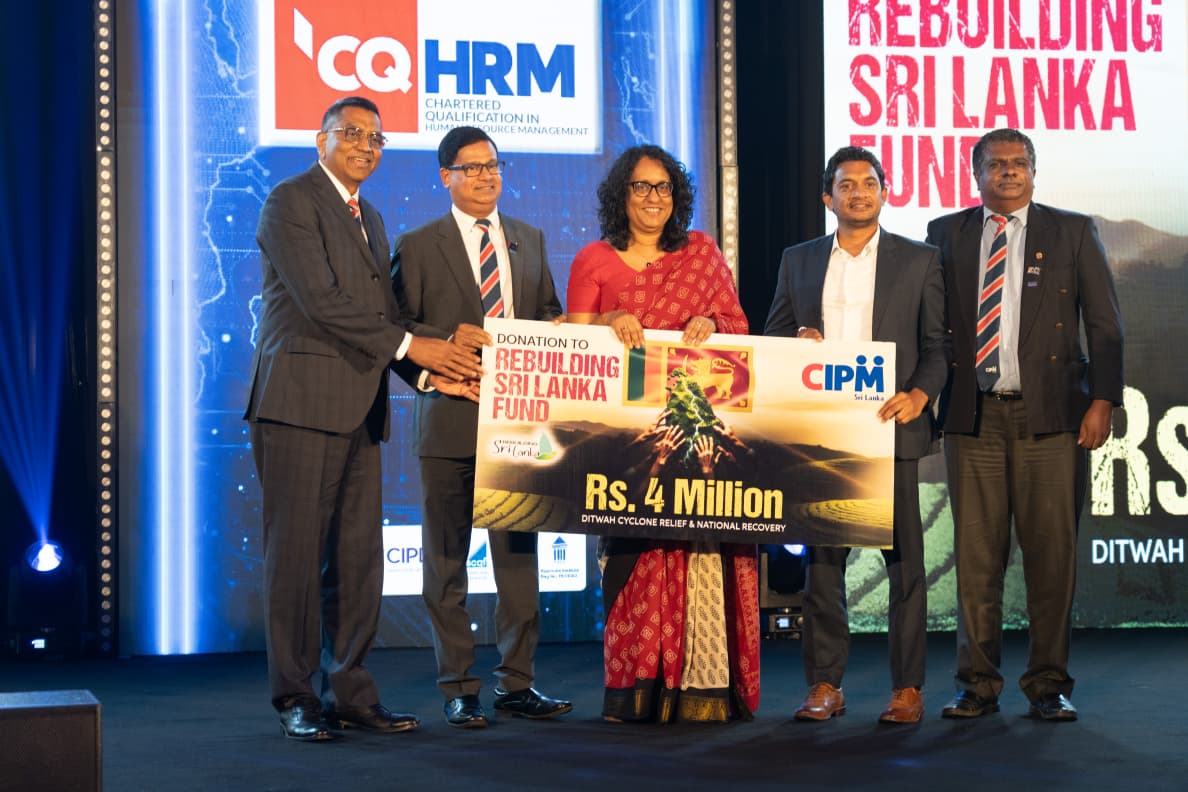
The Prime Minister made these remarks while addressing the official launch of the QS-accredited Chartered Qualification in Human Resource Management (CQHRM) at SCQF Level 11 (New Syllabus), organised by the Chartered Institute of Personnel Management (CIPM) Sri Lanka under the theme New Heights of Recognition. The event was held on Wednesday, 18 February at the Cinnamon Life, Colombo.
Emphasising the importance of expanding professional and vocational education pathways, the Prime Minister stated:
“This is of crucial importance to us in broadening our educational pathways and opportunities. We need to increase access to education that is globally recognised and that offers multiple pathways in professional and vocational fields. This aligns closely with the reform process we have initiated in the education sector and with our commitment to lifelong learning where individuals can work and learn at the same time, and where education is not limited to a particular age group but continues throughout life.”
Highlighting Sri Lanka’s national priorities, the Prime Minister further observed:
“At a time when Sri Lanka is focused on economic recovery, institutional reform and sustainable growth, the need for competent and ethical human resource leadership is clear. A competitive economy depends not only on investment and infrastructure but also on skilled professionals who can lead institutions effectively.”
The Prime Minister noted that the QS accreditation of the CQHRM qualification strengthens international recognition of Sri Lankan human resource professionals, enhances professional progression pathways, and reinforces confidence in the country’s professional education system. She also underscored the role of human resource leadership in advancing equity and inclusion within workplaces, including fair recruitment practices, safe working environments, leadership development for women, and inclusive policies for persons with disabilities and neurodivergent individuals.
Addressing the future of work, the Prime Minister stressed the importance of preparing for rapid technological transformation, including the growing impact of artificial intelligence on industries and workforce management, encouraging institutions to proactively adapt to emerging demands.
The event was attended by Deputy Minister of Industry and Entrepreneurship Development, Chathuranga Abeysinghe, along with other distinguished guests.
[Prime Minister’s Media Division]
Latest News
Advisory for Severe Lightning issued to the Western and Sabaragamuwa provinces and Nuwara-Eliya, Galle and Matara districts
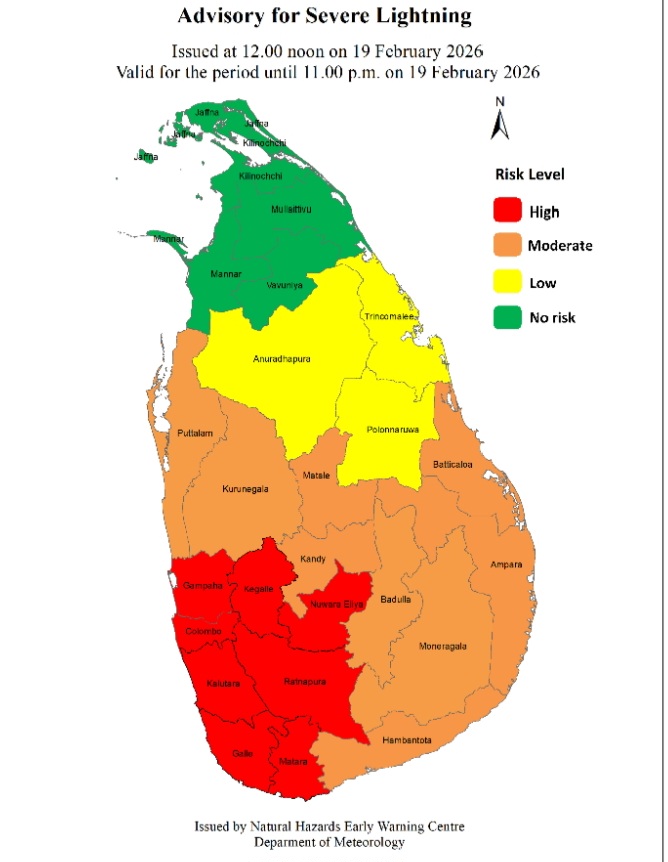
Advisory for Severe Lightning
Issued by the Natural Hazards Early Warning Centre at 12.00 noon 19 February 2026 valid for the period until 11.00 p.m. 19 February 2026
The public are warned that thundershowers accompanied with severe lightning are likely to occur at some places in in the Western and Sabaragamuwa provinces and in Nuwara-Eliya, Galle and Matara districts after 2.00 p.m.
There may be temporary localized strong winds during thundershowers.
General public is kindly requested to take adequate precautions to minimize damages caused by lightning activity.
ACTION REQUIRED:
The Department of Meteorology advises that people should:
Seek shelter, preferably indoors and never under trees.
Avoid open areas such as paddy fields, tea plantations and open water bodies during thunderstorms.
Avoid using wired telephones and connected electric appliances during thunderstorms.
Avoid using open vehicles, such as bicycles, tractors and boats etc.
Beware of fallen trees and power lines.
For emergency assistance contact the local disaster management authorities.
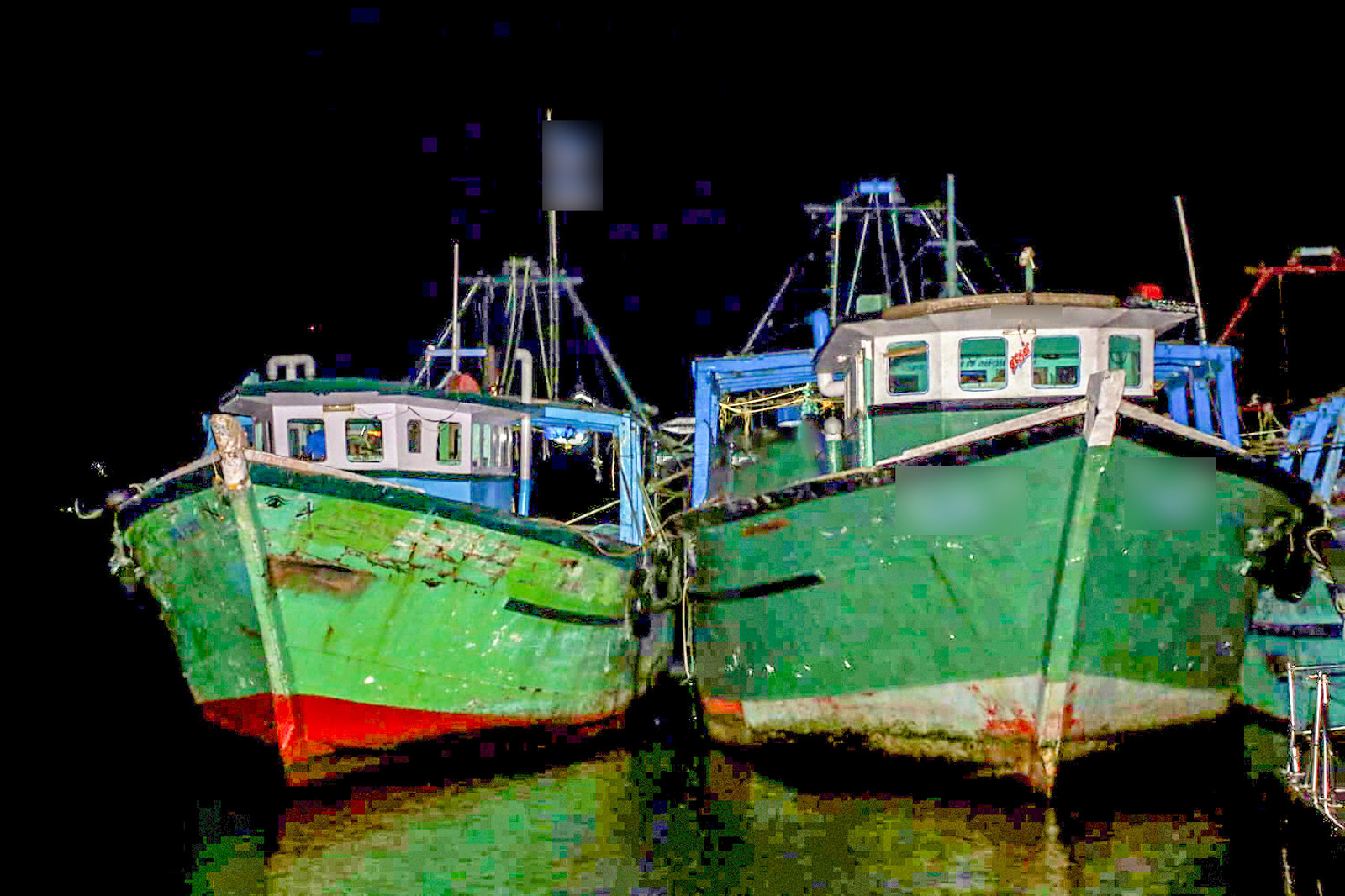
During operations conducted in the dark hours of 18 Feb 26, the Sri Lanka Navy and Coast Guard seized 04 Indian fishing boats and apprehended 22 Indian fishermen, while they were poaching in Sri Lankan waters north of Mannar and off the Delft Island, Jaffna.
Recognizing the detrimental effects of poaching on marine resources and the livelihoods of local fishing communities, the Sri Lanka Navy and Coast Guard continue to conduct regular operations as proactive measures to deter such activities. These efforts underscore the collective robust approach and steadfast commitment to safeguarding the nation’s marine ecosystems while ensuring the economic security and wellbeing of its citizens.
The 02 fishing boats along with the 10 fishermen held in Mannar were handed over to the Fisheries Inspector of Mannar and the remaining 02 fishing boats intercepted off the Delft Island, together with 12 Indian fishermen were handed over to the Fisheries Inspector of Myliddy for onward legal proceedings.

“Investments in Professional Education Are Investments in Institutional Strength and National Progress” – PM

Zimbabwe stun Sri Lanka to enter Super Eight unbeaten

Ex-UK Prince Andrew arrested on suspicion of misconduct in public office

Advisory for Severe Lightning issued to the Western and Sabaragamuwa provinces and Nuwara-Eliya, Galle and Matara districts

Navy and Coast Guard seize 04 Indian fishing vessels poaching in Sri Lankan waters

Hope’s 75, Forde and Joseph’s wickets help West Indies go into playoffs unconquered

‘Dates have the highest sugar content to fight Coronavirus’

Sunday Island 27 December – Headlines

#SundayIsland 17th December – Headlines

Sunday Island – 28th March

Sunday Island Headlines – 21 March

Sunday Island – 21st February – Headlines
-
 Life style5 days ago
Marriot new GM Suranga
-

 Business4 days ago
Ministry of Brands to launch Sri Lanka’s first off-price retail destination
-

 Features5 days ago
Monks’ march, in America and Sri Lanka
-

 Features5 days ago
The Rise of Takaichi
-
 Features5 days ago
Wetlands of Sri Lanka:
-
 News5 days ago
Thailand to recruit 10,000 Lankans under new labour pact
-
 News5 days ago
Massive Sangha confab to address alleged injustices against monks
-

 News3 days ago
IMF MD here