
Sports
Sri Lanka Athletics to seek private sector support to send team for World Junior Championships

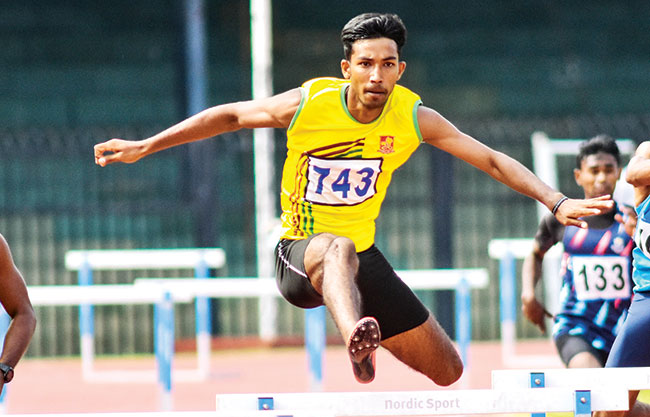
Junior Nationals Athletics Championships rescheduled to June 7-10
by Reemus Fernando
Sri Lanka Athletics will seek support from the private sector to meet the massive costs involved in sending all athletes reaching qualifying standards for the World Junior Championships which will be held from August 1-6 in Cali, Colombia.The track and field governing body, which met this week to reschedule the Junior National Championship which was postponed due to the curfew imposed on May 9, also discussed ways of finding funds to send all athletes who reach qualifying standards for the World Junior Championships.
Sri Lanka Athletics has been sending all athletes reaching qualifying standards for the World Junior events in recent years. But the massive cost of airfare in the midst of the prevaling economic crisis has made it difficult for the sport’s governing body to bear the full cost involved in sending a strong team.So far nine athletes have reached qualifying standards for the biennial event and there is opportunity for other athletes to reach entry standards for the event when the postponed Junior National Athletics Championship is held from June 7 to 10 at the Sugathadasa Stadium.
“There is a massive cost involved in sending athletes for the Cali event. With the increased airfare it will cost around 1.5 million rupees per athlete. If we opt to send only the top two athletes and those who can find funds by their own it will not be fair by the others who reach qualifying standards. Because of that we will seek private sector support to send the full team,” a senior official of Sri Lanka Athletics told The Island on Friday.
Earlier there were plans to send a pruned down team but a couple of athletes have obtained private sponsorships for their travel compelling athletics officials to find sponsorships for others as well.Of the nine athletes who have reached qualifying standards so far, four are from three schools in Colombo. At least one athlete from outstations and an athlete from a school in Colombo have received the support of sponsors to meet their expenses during the meet.
“We will request leading private sector firms to support junior athletes. We will also seek the support of friendly sports federations like Sri Lanka Cricket to support us at this difficult moment,” said the official.
Tharushi Karunaratne (800m, 400m), Jayeshi Uththara (400m) and Amesha Hettiarachchi (400m hurdles) in the girls’ category and Sithum Jayasundara (400m), Dhanuka Dharshana (400m hurdles), Kaveesha Bandara (110m hurdles), Pasindu Malshan (triple jump), Hirusha Hashen (long jump) and Rumesh Tharanga (javelin throw) in the boys’ category are the athletes who have reached qualifying standards for the Cali event. Incidentally, Tharushi Karunaratne and Sithum Jayasundara will be taking part in their second consecutive World Junior Championships after having represented the country at the last edition in Nairobi. Sri Lanka did well to reach the final in the mix relay in Nairobi where they were ranked fifth with a time of 3:26.39 secs.
Junior National Championships from June 7 to 10
The Junior National Athletics Championship which was postponed after the morning session on May 9 will commence from where it stopped on June 7. According to athletics officials the events which could not be completed on May 9 will be held on June 7 and there will not be any changes to the schedule of the next three days.



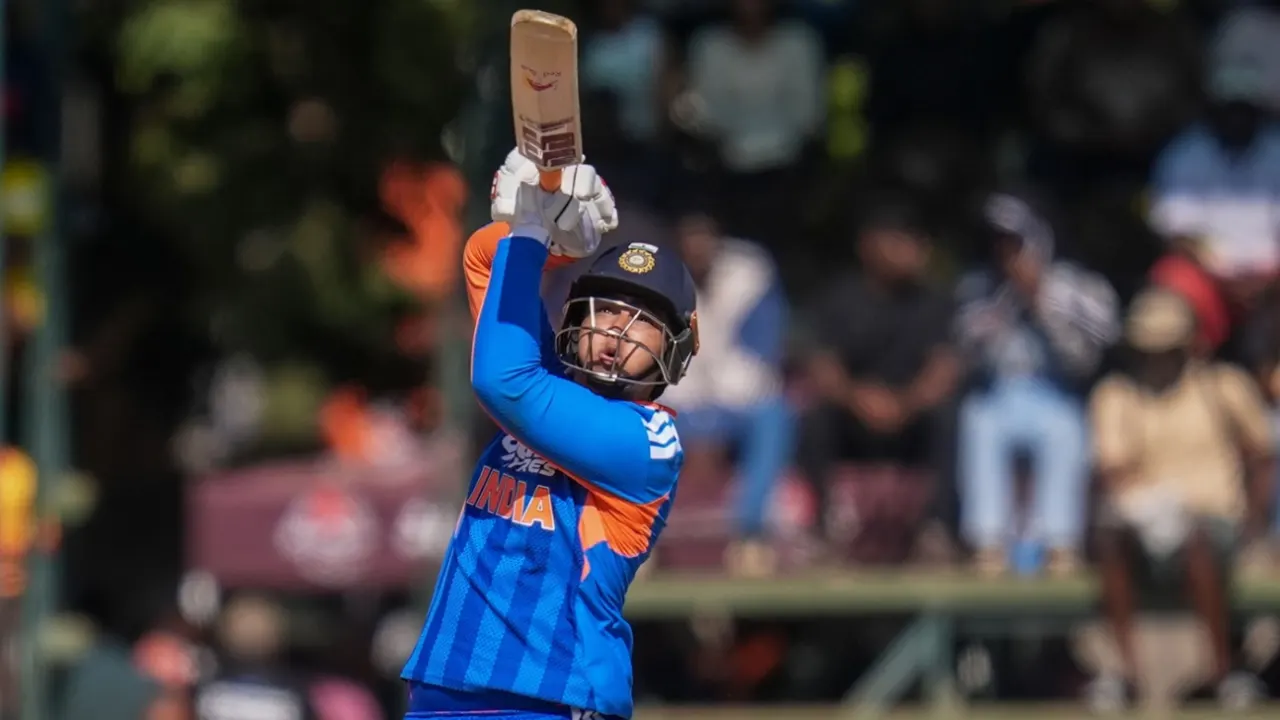
After six abandoned matches, five of them without a toss, because of incessant rain – Shreyas Iyer called it a “torrential downpour” – in Nisshin, we might finally get some cricket again at the men’s Asian Games.
The timing couldn’t have been better because the four remaining games will decide the positions on the podium. Pakistan and Bangladesh still don’t have a gold in this edition (as of Wednesday morning); Sri Lanka have just one; India have seven but that’s well behind the 28 they finished with in 2023.
India are the defending champions, and it will take a gargantuan effort from the second string Sri Lanka side to throw them off their path. Even the full-strength Sri Lanka T20I side has not been able to score 150 of late, or win a match since June, and have only one win from their last ten attempts. The Sri Lanka squad that hasn’t played even a moment of cricket since landing in Japan has a captain – Sahan Arachchige – with just one T20I to his name, which came back in the 2023 Asian Games, when they lost to Afghanistan. The more recognisable names are Niroshan Dickwella and Ashen Bandara, who haven’t featured in a T20I since 2021 and 2023 respectively. There are six other players in that squad of 15 who have played fewer than ten T20Is each, and another four who are uncapped.
India, unlike most other Full Member sides, have sent their big guns to Japan.
There’s also an ODI series going on at home, and the ODI World Cup is just a year away. But they chose to send the likes of Jasprit Bumrah, Shreyas Iyer and Ishan Kishan, among others, to Japan instead, which shows their commitment to the gold-medal cause.
Rain or shine, Sri Lanka will have to sweat it out on Thursday to try and get the better of India.
India have been plagued by injuries of late and one of the names on that list was that of Washington Sundar, who returned to action in the Japan T20I last week. He didn’t get to bat, but bowled two overs and took two wickets in his first game in two months. India would want to give him more game time before he heads back home for the West Indies T20Is that start on October 6. Washington has otherwise had an impressive year across formats with an unbeaten 52 in an ODI to give India their first win of their UK tour after he took a four-for in the Test against Afghanistan, in which he also scored 52*.
Niroshan Dickwella last played a T20I in 2021 and he is back in the scheme of things despite an underwhelming Lanka Premier League a couple of months ago, where he scored only 110 runs in six innings at a strike rate of 142.85 while averaging 18.33. He has, however, been among the runs of late, and scored a brisk 80 off 115 balls in the first Test against India. If he gets to bat on Tuesday, this could be a great chance for Dickwella to show why he was once an all-format regular for Sri Lanka.
India had rested Bumrah for the one-off T20I against Japan and played Arshdeep Singh and Yash Thakur as the quicks, and Ravi Bishnoi, Axar Patel and Washington as the lead spinners. India will now have to decide whom to leave out for Bumrah. The other question will be whether to give Vaibhav Sooryavanshi a game, although neither Abhishek Sharma nor Sanju Samson have any reason to be dropped.
India (possible): Abhishek Sharma, Sanju Samson (wk), Ishan Kishan, Shreyas Iyer (capt), Tilak Varma, Axar Patel, Shivam Dube, Washington Sundar, Ravi Bishnoi, Yash Thakur/Arshdeep Singh, Jasprit Bumrah
Sri Lanka will be expected to hand out a few debut caps and give game time to some of the more inexperienced players.
Sri Lanka (possible): Niroshan Dickwella (wk), Lasith Croospulle, Sahan Arachchige (capt), Nuwanidu Fernando, Ashen Bandara, Chamika Karunaratne, Tharindu Ratnayake, Wanuja Sahan, Vijayakanth Viyaskanth, Nuwan Thushara, Binura Fernando
[Cricinfo]
by Reemus Fernando
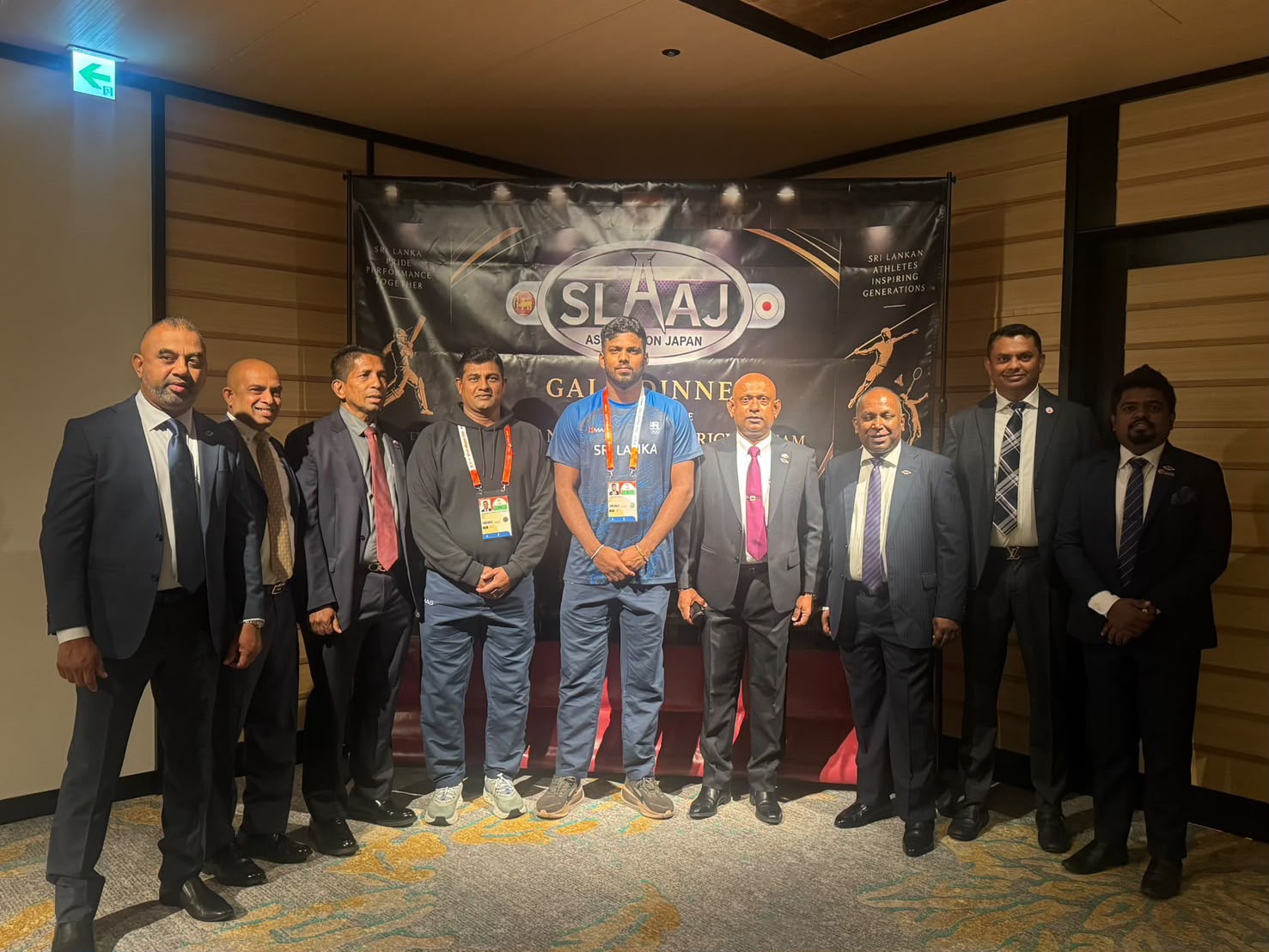
The Sri Lanka Automobile Association in Japan (SLAAJ) has awarded a brand-new Honda Vezel to gold medallist Rumesh Tharanga at a felicitation ceremony for the Sri Lankan team that competed at the Asian Games in Nagoya, Japan.
The gift was announced at the ceremony, held on the eve of the team’s departure from Nagoya.
”We decided to reward every Sri Lankan athlete who wins a gold medal with a brand-new vehicle. We invited all the Sri Lankan athletes taking part in the Games to the felicitation, and at the time of the event, only Tharanga had won gold,”
Nishantha Meegalla, Vice President of the Nagoya Prefecture of the Sri Lanka Business Council of Japan, told ‘The Island’.
Tharanga, the world’s top-ranked javelin thrower this season, won Sri Lanka’s first-ever javelin medal at the Asian Games on Monday, sealing the historic victory with a throw of 88.55 metres.

by Rex Clementine
Every cricket fan remembers that Angelo Mathews was Sri Lanka’s captain when Australia were whitewashed 3-0 in the Test series of 2016. Most will also remember Graham Ford, the master tactician, was Head Coach. But hardly anyone remembers the curator.
Perhaps they are not expected to. Curators rarely make headlines. Yet the truth remains that Godfrey Dabare produced the surfaces tailor made for Rangana Herath to weave his magic and the rest, as they say, is history.
Godfrey breathed his last on Tuesday morning after a brief illness. He was 62.
He had no degree in science or agriculture, qualifications that have become almost mandatory for chief curators these days. His university was the cricket field. His knowledge came from countless hours spent under the sun, studying soil, grass, weather and wickets, learning the craft the old fashioned way.
It is a little known fact that Godfrey spent three months in Galle preparing the venue ahead of its inaugural Test in 1998. He did a similar job in Dambulla before it became an international venue in 2001. He was a loyal lieutenant of former board chief Thilanga Sumathipala and both, Galle and Dambulla, were Thilanga’s treasured projects.
I first met Godfrey in 2000 when he was managing Chilaw Marians, then a club playing Division Three cricket. Within two years, the Marians had climbed into First Class cricket and soon became a thorn in the flesh of many fashionable Colombo clubs.
Did Godfrey occasionally use his influence as national curator to prepare pitches that suited his club? Of course he did. He was no paragon of virtue. But neither was he the villain some tried to paint him as.
He would often complain that he would unearth a rare gem from the beaches of Marawila or Wennappuwa, nurture him and give him a platform, only for one of the posh Colombo clubs to come along and pinch the player. Godfrey took those raids personally. And he was determined to teach them a lesson.
Above everything else, he cared deeply about his players.
Without his tireless work, Chilaw Marians would hardly have survived nearly three decades of First Class cricket. Now that he is gone, you cannot help but fear for the future of the club he built with such devotion, a club that has produced many fine cricketers, the latest being fast bowler Asitha Fernando.
Godfrey also had a soft spot for the press.
When England toured Sri Lanka in 2021, Sri Lanka Cricket kept journalists out of the grounds because of COVID restrictions. The press were not prepared to take it lying down, so several reporters climbed Galle Fort and covered the Tests from there.
That did not go down particularly well with SLC. The issue eventually reached Parliament, where there was rare cross party agreement that journalists should be allowed into the venue.
Relations between the cricket establishment and the press were frosty, to put it mildly. What those running the show did not know was that Godfrey was quietly sending food and drinks from inside the ground to the journalists perched on Galle Fort.
That was Godfrey.
His finest hour, however, came during the Asia Cup in 2023.
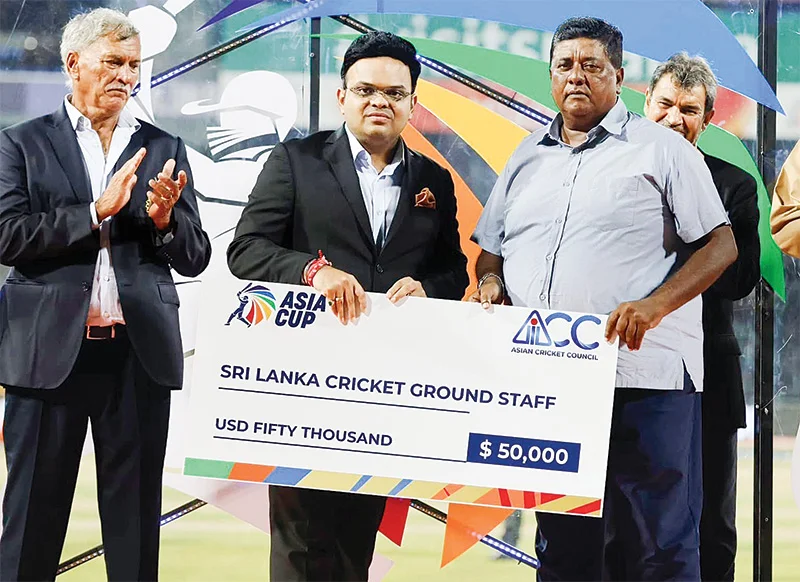
The tournament had been battered by bad weather and the ground staff worked around the clock, often in miserable conditions, to keep it moving. At the end of the tournament, the Asian Cricket Council recognised their extraordinary efforts by awarding the ground staff US$50,000. Godfrey received the cheque from ACC President Jay Shah.
Soon, murmurs began doing the rounds in Colombo. Would all that money actually reach the men who had sweated for it? There were plenty who had their doubts given the questions surrounding SLC’s financial management.
Godfrey made sure there could be no such suspicion.
Every groundsman received an equal share. Godfrey documented the payments, complete with bank and contact details of the recipients, and then, twisting the knife just a little, shared the information with the press.
He was an honest man, although often a misunderstood one.
There was another episode that summed up both Godfrey’s character and the world he occasionally had to navigate.
During a game at the R. Premadasa Stadium, the visiting team’s dressing room door had been smashed with brute force. Nobody quite knew what had happened.
When journalists rang Godfrey, he gave us chapter and verse. Bangladesh star Shakib Al Hasan, furious over an umpiring decision, had taken a bat to the dressing room door. Godfrey said he had CCTV footage and eyewitnesses to back up the claim.
The press went to town.
Shakib was summoned by the Match Referee and a suspension appeared to be looming.
Then, suddenly, Godfrey’s phone went silent.
The following day Shakib escaped with a slap on the wrist. There was apparently insufficient evidence.
A few weeks later, while journalists were watching Sri Lanka train at the R. Premadasa Stadium, Godfrey wandered over, put an arm around me and said: “Sorry, Rex. Bangladesh Cricket Board wanted the matter settled amicably. They agreed to pay for the damage. Board President (go figure who it was), called me and told me to delete the CCTV recording.”
That was Godfrey too.
Loyal to his friends. Loyal to his bosses. Sometimes caught between the two.
Sri Lankan cricket has lost one of those colourful characters who operated away from the television cameras but whose fingerprints were all over the game. Players came and went, administrators fought their battles and coaches collected the applause, but Godfrey was there in the background, preparing the stage on which they performed.
He will be missed.
His remains lie at his residence in Kurukulawa, Ragama. The burial will take place on Thursday in his hometown of Chilaw.

Waste management and recycling to receive priority in the 2027 Budget – PM

Rain stays away as India and Sri Lanka look for fair contest to enter final

Gold winner Tharanga gets brand-new Honda Vezel from SLAAJ

Showers above 50 mm are likely at some places inthe Uva, Eastern and Central provinces and in Polonnaruwa and Mullaittivu districts after 1.00 p.m.

Civil society activist accuses govt. of favouring Ven. Gnanasara

More cops than cones

‘Dates have the highest sugar content to fight Coronavirus’

Sunday Island 27 December – Headlines

#SundayIsland 17th December – Headlines

Sunday Island – 28th March

Sunday Island Headlines – 21 March

Sunday Island – 21st February – Headlines
-
 Latest News7 days ago
Showers above 100 mm are likely at some places in the Western, Sabaragamuwa, Central and North-western provinces and in Galle and Matara Districts
-

 Editorial7 days ago
Crimes punished and unpunished
-

 Features6 days ago
Beyond traditional jobs: Why Sri Lanka needs to facilitate the gig economy
-

 Editorial5 days ago
Birth of a bad law
-

 News3 days ago
Police remove Thileepan statue in Jaffna
-
 Latest News6 days ago
Kusal, Wellalage star as Sri Lanka defend 322 in Headingley thriller
-

 News5 days ago
TIN mandatory for key transactions from Nov. 1
-

 News7 days ago
IMF: Sri Lanka on course for 2027 market return