
Features
Sri Lanka and Global Climate Emergency: Lessons of Cyclone Ditwah

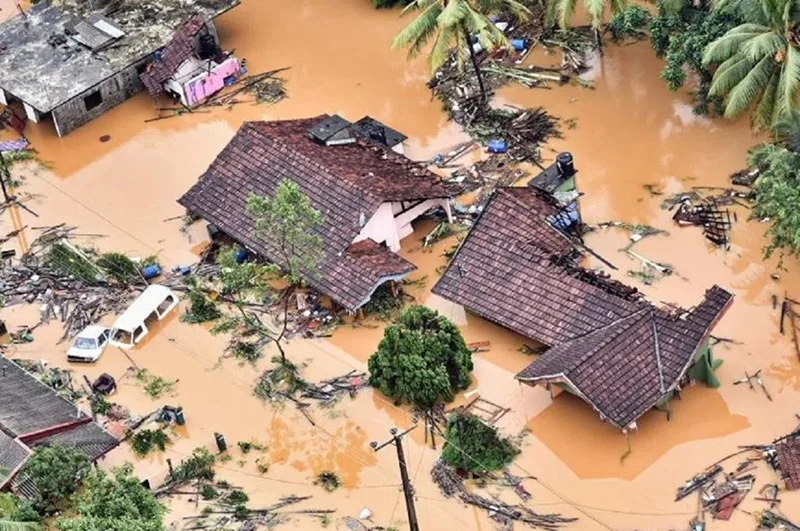
Tropical Cyclone Ditwah, which made landfall in Sri Lanka on 28 November 2025, is considered the country’s worst natural disaster since the deadly 2004 tsunami. It intensified the northeast monsoon, bringing torrential rainfall, massive flooding, and 215 severe landslides across seven districts. The cyclone left a trail of destruction, killing nearly 500 people, displacing over a million, destroying homes, roads, and railway lines, and disabling critical infrastructure including 4,000 transmission towers. Total economic losses are estimated at USD 6–7 billion—exceeding the country’s foreign reserves.
The Sri Lankan Armed Forces have led the relief efforts, aided by international partners including India and Pakistan. A Sri Lanka Air Force helicopter crashed in Wennappuwa, killing the pilot and injuring four others, while five Sri Lanka Navy personnel died in Chundikkulam in the north while widening waterways to mitigate flooding. The bravery and sacrifice of the Sri Lankan Armed Forces during this disaster—as in past disasters—continue to be held in high esteem by grateful Sri Lankans.
The Sri Lankan government, however, is facing intense criticism for its handling of Cyclone Ditwah, including failure to heed early warnings available since November 12, a slow and poorly coordinated response, and inadequate communication with the public. Systemic issues—underinvestment in disaster management, failure to activate protocols, bureaucratic neglect, and a lack of coordination among state institutions—are also blamed for avoidable deaths and destruction.
The causes of climate disasters such as Cyclone Ditwah go far beyond disaster preparedness. Faulty policymaking, mismanagement, and decades of unregulated economic development have eroded the island’s natural defenses. As climate scientist Dr. Thasun Amarasinghe notes:
“Sri Lankan wetlands—the nation’s most effective natural flood-control mechanism—have been bulldosed, filled, encroached upon, and sold. Many of these developments were approved despite warnings from environmental scientists, hydrologists, and even state institutions.”
Sri Lanka’s current vulnerabilities also stem from historical deforestation and plantation agriculture associated with colonial-era export development. Forest cover declined from 82% in 1881 to 70% in 1900, and to 54–50% by 1948, when British rule ended. It fell further to 44% in 1954 and to 16.5% by 2019.
Deforestation contributes an estimated 10–12% of global greenhouse gas emissions. Beyond removing a vital carbon sink, it damages water resources, increases runoff and erosion, and heightens flood and landslide risk. Soil-depleting monocrop agriculture further undermines traditional multi-crop systems that regenerate soil fertility, organic matter, and biodiversity.
In Sri Lanka’s Central Highlands, which were battered by Cyclone Ditwah, deforestation and unregulated construction had destabilised mountain slopes. Although high-risk zones prone to floods and landslides had long been identified, residents were not relocated, and construction and urbanisation continued unchecked.
Sri Lanka was the first country in Asia to adopt neoliberal economic policies. With the “Open Economy” reforms of 1977, a capitalist ideology equating human well-being with quantitative growth and material consumption became widespread. Development efforts were rushed, poorly supervised, and frequently approved without proper environmental assessment.
Privatisation and corporate deregulation weakened state oversight. The recent economic crisis and shrinking budgets further eroded environmental and social protections, including the maintenance of drainage networks, reservoirs, and early-warning systems. These forces have converged to make Sri Lanka a victim of a dual climate threat: gradual environmental collapse and sudden-onset disasters.
Sri Lanka: A Climate Victim
Sri Lanka’s carbon emissions remain relatively small but are rising. The impact of climate change on the island, however, is immense. Annual mean air temperature has increased significantly in recent decades (by 0.016 °C annually between 1961 and 1990). Sea-level rise has caused severe coastal erosion—0.30–0.35 meters per year—affecting nearly 55% of the shoreline. The 2004 tsunami demonstrated the extreme vulnerability of low-lying coastal plains to rising seas.
The Cyclone Ditwah catastrophe was neither wholly new nor surprising. In 2015, the Geneva-based Internal Displacement Monitoring Centre (IDMC) identified Sri Lanka as the South Asian country with the highest relative risk of disaster-related displacement: “For every million inhabitants, 15,000 are at risk of being displaced every year.”
IDMC also noted that in 2017 the country experienced seven disaster events—mainly floods and landslides—resulting in 135,000 new displacements and that Sri Lanka “is also at risk for slow-onset impacts such as soil degradation, saltwater intrusion, water scarcity, and crop failure”.
Sri Lanka ranked sixth among countries most affected by extreme weather events in 2018 (Germanwatch) and second in 2019 (Global Climate Risk Index). Given these warnings, Cyclone Ditwah should not have been a surprise. Scientists have repeatedly cautioned that warmer oceans fuel stronger cyclones and warmer air holds more moisture, leading to extreme rainfall. As the Ceylon Today editorial of December 1, 2025 also observed:
“…our monsoons are no longer predictable. Cyclones form faster, hit harder, and linger longer. Rainfall becomes erratic, intense, and destructive. This is not a coincidence; it is a pattern.”
Without urgent action, even more extreme weather events will threaten Sri Lanka’s habitability and physical survival.
A Global Crisis
Extreme weather events—droughts, wildfires, cyclones, and floods—are becoming the global norm. Up to 1.2 billion people could become “climate refugees” by 2050. Global warming is disrupting weather patterns, destabilising ecosystems, and posing severe risks to life on Earth. Indonesia and Thailand were struck by the rare and devastating Tropical Cyclone Senyar in late November 2025, occurring simultaneously with Cyclone Ditwah’s landfall in Sri Lanka.
More than 75% of global greenhouse gas emissions—and nearly 90% of carbon emissions—come from burning coal, oil, and gas, which supply about 80% of the world’s energy. Countries in the Global South, like Sri Lanka, which contribute least to greenhouse gas emissions, are among the most vulnerable to climate devastation. Yet wealthy nations and multilateral institutions, including the World Bank, continue to subsidise fossil fuel exploration and production. Global climate policymaking—including COP 30 in Belém, Brazil, in 2025—has been criticised as ineffectual and dominated by fossil fuel interests.
If the climate is not stabilised, long-term planetary forces beyond human control may be unleashed. Technology and markets are not inherently the problem; rather, the issue lies in the intentions guiding them. The techno-market worldview, which promotes the belief that well-being increases through limitless growth and consumption, has contributed to severe economic inequality and more frequent extreme weather events. The climate crisis, in turn, reflects a profound mismatch between the exponential expansion of a profit-driven global economy and the far slower evolution of human consciousness needed to uphold morality, compassion, generosity and wisdom.
Sri Lanka’s 2025–26 budget, adopted on November 14, 2025—just as Cyclone Ditwah loomed—promised subsidised land and electricity for companies establishing AI data centers in the country.
President Anura Kumara Dissanayake told Parliament: “Don’t come questioning us on why we are giving land this cheap; we have to make these sacrifices.”
Yet Sri Lanka is a highly water-stressed nation, and a growing body of international research shows that AI data centers consume massive amounts of water and electricity, contributing significantly to greenhouse gas emissions.
The failure of the narrow, competitive techno-market approach underscores the need for an ecological and collective framework capable of addressing the deeper roots of this existential crisis—both for Sri Lanka and the world.
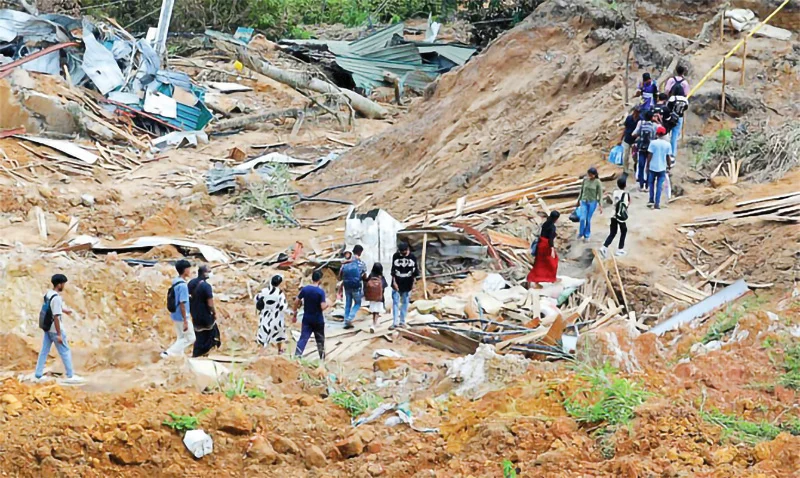
A landslide in Sri Lanka (AFP picture)
Ecological and Human Protection
Ecological consciousness demands
recognition that humanity is part of the Earth, not separate from it. Policies to address climate change must be grounded in this understanding, rather than in worldviews that prize infinite growth and technological dominance. Nature has primacy over human-created systems: the natural world does not depend on humanity, while humanity cannot survive without soil, water, air, sunlight, and the Earth’s essential life-support systems.
Although a climate victim today, Sri Lanka is also home to an ancient ecological civilization dating back to the arrival of the Buddhist monk Mahinda Thera in the 3rd century BCE. Upon meeting King Devanampiyatissa, who was out hunting in Mihintale, Mahinda Thera delivered one of the earliest recorded teachings on ecological interdependence and the duty of rulers to protect nature:
“O great King, the birds of the air and the beasts of the forest have as much right to live and move about in any part of this land as thou. The land belongs to the people and all living beings; thou art only its guardian.”
A stone inscription at Mihintale records that the king forbade the killing of animals and the destruction of trees. The Mihintale Wildlife Sanctuary is believed to be the world’s first.
Sri Lanka’s ancient dry-zone irrigation system—maintained over more than a millennium—stands as a marvel of sustainable development. Its network of interconnected reservoirs, canals, and sluices captured monsoon waters, irrigated fields, controlled floods, and even served as a defensive barrier. Floods occurred, but historical records show no disasters comparable in scale, severity, or frequency to those of today. Ancient rulers, including the legendary reservoir-builder King Parākramabāhu, and generations of rice farmers managed their environment with remarkable discipline and ecological wisdom.
The primacy of nature became especially evident when widespread power outages and the collapse of communication networks during Cyclone Ditwah forced people to rely on one another for survival. The disaster ignited spontaneous acts of compassion and solidarity across all communities—men and women, rich and poor, Buddhists, Christians, Muslims, and Hindus. Local and international efforts mobilized to rescue, shelter, feed, and emotionally support those affected. These actions demonstrated a profound human instinct for care and cooperation, often filling vacuums left by formal emergency systems.
Yet spontaneous solidarity alone is insufficient. Sri Lanka urgently needs policies on sustainable development, environmental protection, and climate resilience. These include strict, science-based regulation of construction; protection of forests and wetlands; proper maintenance of reservoirs; and climate-resilient infrastructure. Schools should teach environmental literacy that builds unity and solidarity, rather than controversial and divisive curriculum changes like the planned removal of history and introduction of contested modules on gender and sexuality.
If the IMF and international creditors—especially BlackRock, Sri Lanka’s largest sovereign bondholder, valued at USD 13 trillion—are genuinely concerned about the country’s suffering, could they not cancel at least some of Sri Lanka’s sovereign debt and support its rebuilding efforts? Addressing the climate emergency and the broader existential crisis facing Sri Lanka and the world ultimately requires an evolution in human consciousness guided by morality, compassion, generosity and wisdom. (Courtesy: IPS NEWS)
Dr Asoka Bandarage is the author of Colonialism in Sri Lanka: The Political Economy of the Kandyan Highlands, 1833-1886 (Mouton) Women, Population and Global Crisis: A Politico-Economic Analysis (Zed Books), The Separatist Conflict in Sri Lanka: Terrorism, Ethnicity, Political Economy, ( Routledge), Sustainability and Well-Being: The Middle Path to Environment, Society and the Economy (Palgrave MacMillan) Crisis in Sri Lanka and the World: Colonial and Neoliberal Origins, Ecological and Collective Alternatives (De Gruyter) and numerous other publications. She serves on the Advisory Boards of the Interfaith Moral Action on Climate and Critical Asian Studies.



 by Kaushalya Perera
Time has, by and large, stood still in the business of academic staff recruitment to state universities. Qualifications have proliferated and evolved to be more interdisciplinary, but our selection processes and evaluation criteria are unchanged since at least the late 1990s. But before I delve into the problems, I will describe the existing processes and schemes of recruitment. The discussion is limited to UGC-governed state universities (and does not include recruitment to medical and engineering sectors) though the problems may be relevant to other higher education institutions (HEIs).
How recruitment happens currently in SL state universities
Academic ranks in Sri Lankan state universities can be divided into three tiers (subdivisions are not discussed).
* Lecturer (Probationary)
– recruited with a four-year undergraduate degree. A tiny step higher is the Lecturer (Unconfirmed), recruited with a postgraduate degree but no teaching experience.
* A Senior Lecturer can be recruited with certain postgraduate qualifications and some number of years of teaching and research.
* Above this is the professor (of four types), which can be left out of this discussion since only one of those (Chair Professor) is by application.
State universities cannot hire permanent academic staff as and when they wish. Prior to advertising a vacancy, approval to recruit is obtained through a mind-numbing and time-consuming process (months!) ending at the Department of Management Services. The call for applications must list all ranks up to Senior Lecturer. All eligible candidates for Probationary to Senior Lecturer are interviewed, e.g., if a Department wants someone with a doctoral degree, they must still advertise for and interview candidates for all ranks, not only candidates with a doctoral degree. In the evaluation criteria, the first degree is more important than the doctoral degree (more on this strange phenomenon later). All of this is only possible when universities are not under a ‘hiring freeze’, which governments declare regularly and generally lasts several years.
Problem type 1
– Archaic processes and evaluation criteria
Twenty-five years ago, as a probationary lecturer with a first degree, I was a typical hire. We would be recruited, work some years and obtain postgraduate degrees (ideally using the privilege of paid study leave to attend a reputed university in the first world). State universities are primarily undergraduate teaching spaces, and when doctoral degrees were scarce, hiring probationary lecturers may have been a practical solution. The path to a higher degree was through the academic job. Now, due to availability of candidates with postgraduate qualifications and the problems of retaining academics who find foreign postgraduate opportunities, preference for candidates applying with a postgraduate qualification is growing. The evaluation scheme, however, prioritises the first degree over the candidate’s postgraduate education. Were I to apply to a Faculty of Education, despite a PhD on language teaching and research in education, I may not even be interviewed since my undergraduate degree is not in education. The ‘first degree first’ phenomenon shows that universities essentially ignore the intellectual development of a person beyond their early twenties. It also ignores the breadth of disciplines and their overlap with other fields.
This can be helped (not solved) by a simple fix, which can also reduce brain drain: give precedence to the doctoral degree in the required field, regardless of the candidate’s first degree, effected by a UGC circular. The suggestion is not fool-proof. It is a first step, and offered with the understanding that any selection process, however well the evaluation criteria are articulated, will be beset by multiple issues, including that of bias. Like other Sri Lankan institutions, universities, too, have tribal tendencies, surfacing in the form of a preference for one’s own alumni. Nevertheless, there are other problems that are, arguably, more pressing as I discuss next. In relation to the evaluation criteria, a problem is the narrow interpretation of any regulation, e.g., deciding the degree’s suitability based on the title rather than considering courses in the transcript. Despite rhetoric promoting internationalising and inter-disciplinarity, decision-making administrative and academic bodies have very literal expectations of candidates’ qualifications, e.g., a candidate with knowledge of digital literacy should show this through the title of the degree!
Problem type 2 – The mess of badly regulated higher education
A direct consequence of the contemporary expansion of higher education is a large number of applicants with myriad qualifications. The diversity of degree programmes cited makes the responsibility of selecting a suitable candidate for the job a challenging but very important one. After all, the job is for life – it is very difficult to fire a permanent employer in the state sector.
Widely varying undergraduate degree programmes.
At present, Sri Lankan undergraduates bring qualifications (at times more than one) from multiple types of higher education institutions: a degree from a UGC-affiliated state university, a state university external to the UGC, a state institution that is not a university, a foreign university, or a private HEI aka ‘private university’. It could be a degree received by attending on-site, in Sri Lanka or abroad. It could be from a private HEI’s affiliated foreign university or an external degree from a state university or an online only degree from a private HEI that is ‘UGC-approved’ or ‘Ministry of Education approved’, i.e., never studied in a university setting. Needless to say, the diversity (and their differences in quality) are dizzying. Unfortunately, under the evaluation scheme all degrees ‘recognised’ by the UGC are assigned the same marks. The same goes for the candidates’ merits or distinctions, first classes, etc., regardless of how difficult or easy the degree programme may be and even when capabilities, exposure, input, etc are obviously different.
Similar issues are faced when we consider postgraduate qualifications, though to a lesser degree. In my discipline(s), at least, a postgraduate degree obtained on-site from a first-world university is preferable to one from a local university (which usually have weekend or evening classes similar to part-time study) or online from a foreign university. Elitist this may be, but even the best local postgraduate degrees cannot provide the experience and intellectual growth gained by being in a university that gives you access to six million books and teaching and supervision by internationally-recognised scholars. Unfortunately, in the evaluation schemes for recruitment, the worst postgraduate qualification you know of will receive the same marks as one from NUS, Harvard or Leiden.
The problem is clear but what about a solution?
Recruitment to state universities needs to change to meet contemporary needs. We need evaluation criteria that allows us to get rid of the dross as well as a more sophisticated institutional understanding of using them. Recruitment is key if we want our institutions (and our country) to progress. I reiterate here the recommendations proposed in ‘Considerations for Higher Education Reform’ circulated previously by Kuppi Collective:
* Change bond regulations to be more just, in order to retain better qualified academics.
* Update the schemes of recruitment to reflect present-day realities of inter-disciplinary and multi-disciplinary training in order to recruit suitably qualified candidates.
* Ensure recruitment processes are made transparent by university administrations.
Kaushalya Perera is a senior lecturer at the University of Colombo.
(Kuppi is a politics and pedagogy happening on the margins of the lecture hall that parodies, subverts, and simultaneously reaffirms social hierarchies.)

 This week, too, the spotlight is on an outfit that has gained popularity, mainly through social media.
Last week we had MISTER Band in our scene, and on 10th February, Yellow Beatz – both social media favourites.
Talento is a seven-piece band that plays all types of music, from the ‘60s to the modern tracks of today.
The band has reached many heights, since its inception in 2012, and has gained recognition as a leading wedding and dance band in the scene here.
The members that makeup the outfit have a solid musical background, which comes through years of hard work and dedication
Their portfolio of music contains a mix of both western and eastern songs and are carefully selected, they say, to match the requirements of the intended audience, occasion, or event.
Although the baila is a specialty, which is inherent to this group, that originates from Moratuwa, their repertoire is made up of a vast collection of love, classic, oldies and modern-day hits.
The musicians, who make up Talento, are:
Prabuddha Geetharuchi:

Geilee Fonseka: Dynamic and charismatic vocalist

Prabuddha Geetharuchi: The main man behind the band Talento
(Vocalist/ Frontman). He is an avid music enthusiast and was mentored by a lot of famous musicians, and trainers, since he was a child. Growing up with them influenced him to take on western songs, as well as other music styles. A Peterite, he is the main man behind the band Talento and is a versatile singer/entertainer who never fails to get the crowd going.
Geilee Fonseka (Vocals):
A dynamic and charismatic vocalist whose vibrant stage presence, and powerful voice, bring a fresh spark to every performance. Young, energetic, and musically refined, she is an artiste who effortlessly blends passion with precision – captivating audiences from the very first note. Blessed with an immense vocal range, Geilee is a truly versatile singer, confidently delivering Western and Eastern music across multiple languages and genres.
Chandana Perera (Drummer):
His expertise and exceptional skills have earned him recognition as one of the finest acoustic drummers in Sri Lanka. With over 40 tours under his belt, Chandana has demonstrated his dedication and passion for music, embodying the essential role of a drummer as the heartbeat of any band.
Harsha Soysa:
(Bassist/Vocalist). He a chorister of the western choir of St. Sebastian’s College, Moratuwa, who began his musical education under famous voice trainers, as well as bass guitar trainers in Sri Lanka. He has also performed at events overseas. He acts as the second singer of the band
Udara Jayakody:
(Keyboardist). He is also a qualified pianist, adding technical flavour to Talento’s music. His singing and harmonising skills are an extra asset to the band. From his childhood he has been a part of a number of orchestras as a pianist. He has also previously performed with several famous western bands.
Aruna Madushanka:
(Saxophonist). His proficiciency in playing various instruments, including the saxophone, soprano saxophone, and western flute, showcases his versatility as a musician, and his musical repertoire is further enhanced by his remarkable singing ability.
Prashan Pramuditha:
(Lead guitar). He has the ability to play different styles, both oriental and western music, and he also creates unique tones and patterns with the guitar..

The JJ Twins, the Sri Lankan musical duo, performing in the Maldives, and known for blending R&B, Hip Hop, and Sri Lankan rhythms, thereby creating a unique sound, have come out with a brand-new single ‘Me Mawathe.’
In fact, it’s a very special milestone for the twin brothers, Julian and Jason Prins, as ‘Me Mawathe’ is their first ever Sinhala song!
‘Me Mawathe’ showcases a fresh new sound, while staying true to the signature harmony and emotion that their fans love.
This heartfelt track captures the beauty of love, journey, and connection, brought to life through powerful vocals and captivating melodies.
It marks an exciting new chapter for the JJ Twins as they expand their musical journey and connect with audiences in a whole new way.
Their recent album, ‘CONCLUDED,’ explores themes of love, heartbreak, and healing, and include hits like ‘Can’t Get You Off My Mind’ and ‘You Left Me Here to Die’ which showcase their emotional intensity.
Readers could stay connected and follow JJ Twins on social media for exclusive updates, behind-the-scenes moments, and upcoming releases:
Instagram: http://instagram.com/jjtwinsofficial
TikTok: http://tiktok.com/@jjtwinsmusic
Facebook: http://facebook.com/jjtwinssingers
YouTube: http://youtube.com/jjtwins

Trump says Iran war projected to last 4 to 5 weeks, could go ‘far longer’

Qatar downs two Iranian fighter jets as conflict widens

Jammu and Kashmir’s long road to India cricketing glory

Rembrandt painting worth millions rediscovered after 65 years

Zimbabwe, West Indies delayed from returning home following West Asia airspace closure

Dry weather will prevail in most parts of the island

‘Dates have the highest sugar content to fight Coronavirus’

Sunday Island 27 December – Headlines

#SundayIsland 17th December – Headlines

Sunday Island – 28th March

Sunday Island Headlines – 21 March

Sunday Island – 21st February – Headlines
-

 Opinion4 days ago
Jamming and re-setting the world: What is the role of Donald Trump?
-
 Features4 days ago
An innocent bystander or a passive onlooker?
-
 Features5 days ago
Ratmalana Airport: The Truth, The Whole Truth, And Nothing But The Truth
-
 Features6 days ago
Building on Sand: The Indian market trap
-
 Opinion6 days ago
Future must be won
-

 Business6 days ago
Dialog partners with Xiaomi to introduce Redmi Note 15 5G Series in Sri Lanka
-
 Business5 days ago
IRCSL transforms Sri Lanka’s insurance industry with first-ever Centralized Insurance Data Repository
-

 Opinion1 day ago
Sri Lanka – world’s worst facilities for cricket fans