
News
Spinning conspiracy theories or launching political manifestos when DISASTER management is the need of the hour

By Chandre Dharmawardana
There is always a certain amount of truth in all conspiracy theories, putting the blame on the CIA, RAW, the Tiger Diaspora, ISIS, Chinese-Debt Trap, NGOs, etc. But it is NEVER the whole truth. Even looking for the truth becomes secondary when mitigating disaster should become the priority.
The suggestion that the upheaval in Sri Lanka is a part of the rise of drone warfare is just another twist in the current slew of conspiracy theories. The US military machine gaining more and more control of the Electro-Magnetic spectrum is part of the cyber-warfare that started some decades ago. Military satellites that fly over every country, deployed by the US, provide the infrastructure for military deployment of weapons, be they drones or intercontinental missiles.
Military observers expected greater use of drone warfare in Ukraine, but saw very little. Even in Afghanistan where the terrain is difficult, although strategists talked of a drone war to heavily tilt the war to the US, it did not happen.
Similarly, in the battle against ISIS, while some drone hits were used to “remove” a few ISIS leaders, Osama, etc., extensive application of drones did not materialise. Drones have failed to significantly penetrate North Korea. The whole point is, shielding from electromagnetic radiation can be done by simply covering yourself with metal foil (c.f., “Faraday cage”, a technology going back to Michael Faraday of the 19th century).
The US was booted out by Cuban rebels, the Viet Cong, in Iran, and by the primitive Taliban. The US proxy wars in many other places (e. g., Somalia) have stalled in spite of vastly superior technology.
So, most conspiracy theories,are strongly hyped up tabloid stuff without backup evidence from any of the conflict zones or military fronts.
In Sri Lanka, the social unrest started with farmers protesting when they foresaw failed harvests when the government told them to go organic and use traditional methods that avoid agro-chemical inputs. The upper-class proponents of organic farming who had fondly grown tomatoes in their hobby backyards did not know that every kilo of chemical fertiliser has to be replaced by huge amounts (metric tonnes) of organic manure to get viable harvests.
That Sri Lanka is an agrarian society is its strength and its weakness. Successive rulers (except perhaps the Senanayakes) had merely paid lip service to this but gone on to undermine the farmers. The left movements with their accent on urban trade unions and “industrialisation” have been largely detrimental to farmers. Organisations, like MONLAR, support the fertiliser fiasco and idolize Luddites.
The nationalists (be they Sinhala or Tamil) have also been detrimental to farmers in directing them to medieval agricultural practices, claiming that the moderns have allegedly “poisoned mother earth with agrochemicals”. It was Gunadasa Amarasekera who wrote a forward to Channa Jayasumana’s slanderous book named “Wakugadu Hatana”.
So, the “Jathika” movements and their politicians blindly misled the farmers. The consequent protest by farmers was genuine and not spawned by the “CIA” or other agents. The protest by farmers was strengthened by the revolt of the middle-class urban dwellers who couldn’t even cook their meals as the supply of cooking gas dwindled out, or exploded in monkeyed gas cylinders. The usually dormant middle class also came out to protest.
The protest was hijacked and coordinated into a concerted event, using whatsApp and Facebook messages. The slogan “Gota Go Home” was coordinated to appear in all agitations, including in Western Capitals. It is easy to ascertain that the protests in Western capitals were partly coordinated by JVP-linked groups.
While the JVP is ostensibly a leftist Marxist party, it is also alleged to be funded by US-linked political interests; the JVP was a significant component of the US-backed Yahapalanaya government. So, identifying the JVP and some other leftist fronts as mere Western instruments is a common type of conspiracy theory. More realistically, the JVP is an opportunistic political organisation taking funds from anyone without much public backing, but well organised for agitation and propaganda.
The theories on class war and historical materialism have now proved false by post-World-War-I and WWII histories. But they still provide simplified political messages that resonate with some youth groups and an older generation of Marxists still driven by 1950s nostalgia.
The protesters in ‘GotaGoGama’ at Galle Face are supported by meal packets provided by a number of private companies. It has become a surreal “big-match-style” carnival for the middle-class and elite Colombo youth who can pride themselves of being “militant”.
However, all this is now irrelevant. The task of destroying Sri Lanka was during 2012-2022, mostly due to mismanagement by uneducated politicians rather than due to foreign machinations (that were certainly there) or due to corruption (which was certainly there).
From 2009-2011, the Sri Lankan economy grew very fast due to the money poured into infrastructure development (roads, fly-overs, bridges, railways, electric grids, resource structures), and in rehabilitating and de-mining the North and East. But this construction was largely supported by borrowed money. From 2012 onwards the economy dipped downwards. So, most of the forex earnings went to pay loans, buy fuel (energy) and food.
Even in 2009 (and also before and after) I have written many articles and given many seminars, etc., in Sri Lanka emphasising that the money spent for food and fuel can be readily saved by simple locally available technological steps that involve the agricultural sector and the energy sector. [https://dh-web.org/place.names/posts/dev-tech-2009.ppt]
However, politicians preferred turn-key vanity projects that guaranteed earning opportunities for themselves without realising that they are forfeiting the whole country.
Now that the ship has sunk, the politicians have gone to the IMF, the international Shylock. A mere pittance of a loan will come, after agreeing to put “matters right” by “cost cutting”. However, on listening to the speeches by various economists (e.g., Dr. Harsha de Silva of the Opposition) or political leaders (e.g., Anura Kumara Dissanayake) we see that the political leaders do not understand that there is a catastrophe. They are talking of long-term projects like “rapid industrialization”, “cutting corruption”, “jailing the culprits”, etc., that we have heard from them in previous times.
But what about impending riots when famine strikes, garbage accumulates, water pumps stop, hospitals close, etc.,? Where are their disaster plans?
If you are bankrupt, you cannot get loans any more. Mere charity will leave you as a perpetual pauper. So, is Sri Lanka to identify its sellable assets and sell them to international buyers who have the Forex to manage them? The Tea plantations and other agricultural assets, the loss-making SriLankan Airlines and the Ceylon Electricity Board, etc., are they all under the gun? Is this the inevitable fate of small nations that fail to retain self-sufficiency in food and energy supplies? This is made more painful because Sri Lanka was one clear case where such self-sufficiency was possible
Even the UK has sold some of its priced industries, and allowed London to be the centre of questionable money laundering to avert economic collapse that loomed ahead. In Sri Lanka, the collapse has come. Is “the family jewellery” on the auction block?
The politicians planning an interim government or wanting to go it alone have to reveal their plans for facing disaster.

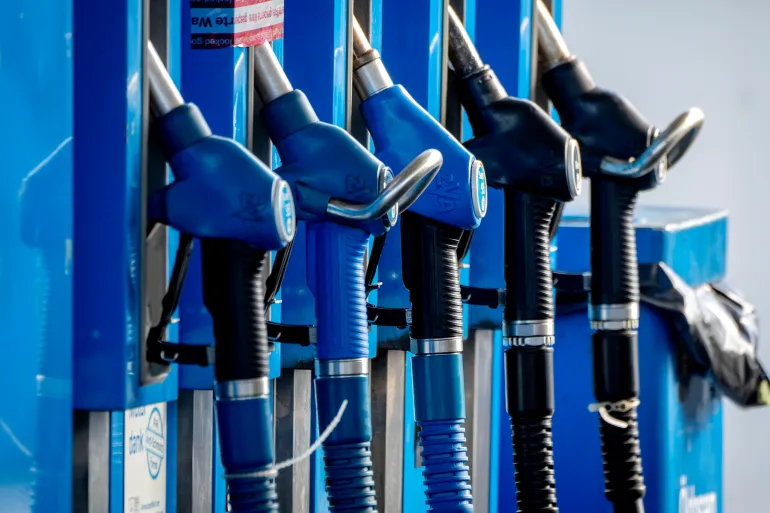
The Ceylon Petroleum Corporation (Ceypetco) has announced a revision of fuel prices, effective from midnight today (21).
Accordingly,
Auto Diesel – Rs. 382 (increased by Rs. 79)
Super Diesel – Rs. 443 (increased by Rs. 90)
Petrol 92 Octane – Rs. 398 (increased by Rs. 81)
Kerosene – Rs. 255. (increased by Rs. 60)
Petrol 95 Octane – Rs. 455 (increased by Rs. 90)

Latest News
Advisory for Severe Lightning issued for Galle, Matara, Kaluthara and Rathnapura districts

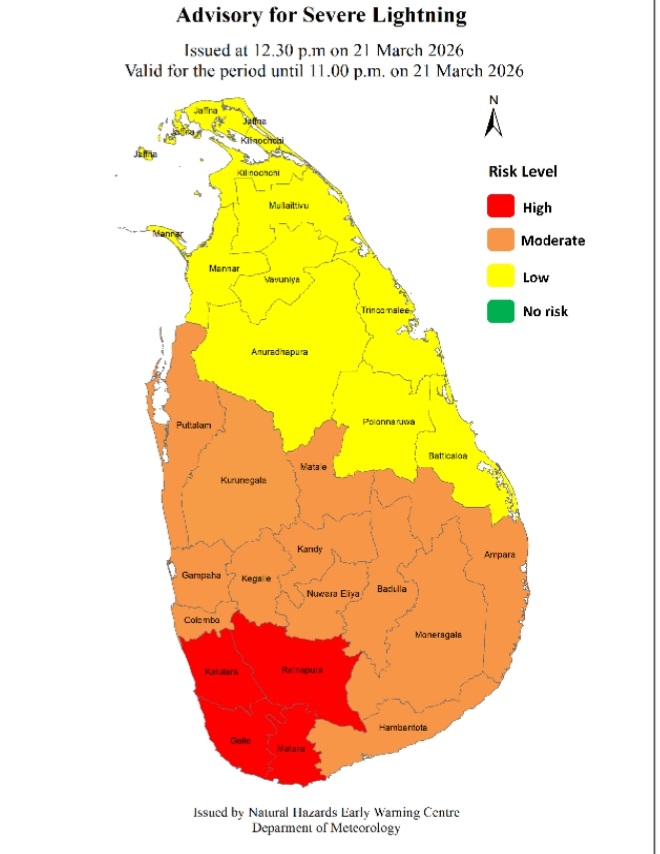
Advisory for Severe Lightning Issued by the Natural Hazards Early Warning Centre Issued at 12.30 p.m. 21 March 2026, valid for the period until 11.00 p.m. 21 March 2026
Thundershowers accompanied with severe lightning are likely to occur at some places in the Galle, Matara, Kaluthara and Rathnapura districts after 1.00 p.m.
There may be temporary localized strong winds during thundershowers. General public is kindly requested to take adequate precautions to minimize damages caused by lightning activity.
ACTION REQUIRED:
The Department of Meteorology advises that people should:
Seek shelter, preferably indoors and never under trees.
Avoid open areas such as paddy fields, tea plantations and open water bodies during thunderstorms.
Avoid using wired telephones and connected electric appliances during thunderstorms.
Avoid using open vehicles, such as bicycles, tractors and boats etc.
Beware of fallen trees and power lines.
For emergency assistance contact the local disaster management authorities.
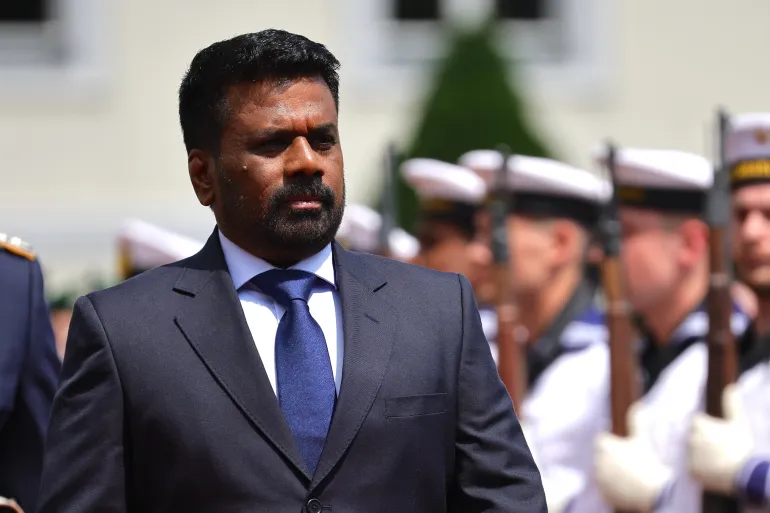
Sri Lanka’s president says his government turned down a request from the United States to land two US combat aircraft at a civilian airport earlier this month.
President Anura Kumara Dissanayake told Sri Lanka’s parliament on Friday that Washington had requested permission for the aircraft to land at Mattala Rajapaksa International Airport in southern Sri Lanka from March 4 to 8.
The request was made on February 26, two days before the US and Israel launched their military offensive against Iran.
“They wanted to bring two warplanes armed with eight antiship missiles from a base in Djibouti”, Dissanayake told lawmakers. “We turned down the request to maintain Sri Lanka’s neutrality”, he added to applause.
The US-Israeli war on Iran has sparked widespread concern globally, as Iranian missile and drone attacks across the wider Middle East have sent energy prices soaring and fuelled fears of a widening conflict.
US President Donald Trump has also been pressuring Washington’s allies to show more support for the war, slamming NATO countries as “cowards” for refusing to help secure the Strait of Hormuz.
Iran has essentially shuttered the critical Gulf waterway amid the war, forcing leaders around the world to scramble to try to offset the effects on their economies and energy supplies.
Amid the turmoil, many countries have refused to get directly involved in the war while calling for urgent de-escalation.
On Friday, Switzerland announced that it would halt any weapons exports to the US that could be used in military operations against Iran, citing its longstanding policy of neutrality.
“The export of war materiel to countries involved in the international armed conflict with Iran cannot be authorised for the duration of the conflict”, the Swiss government said.
Sri Lanka’s president also cited his country’s neutrality in the decision to deny the US request to land the two aircraft at Matalla airport earlier this month.
Dissanayake said he had received another request that same day, on February 26, from Iran to seek permission for three naval vessels to make a goodwill visit to Sri Lanka.
“With two requests before us, the decision was clear,” he said, noting that the government denied both to avoid taking sides as signs of escalating conflict emerged.
“Had we said ‘yes’ to Iran, we would have had to say ‘yes’ to the US, as well”, Dissanayake added.
In early March, Sri Lanka’s navy rescued 32 Iranian crew off IRIS Dena after it was torpedoed by a US submarine off the country’s coast, killing at least 84 people.
Days later, Sri Lanka evacuated more than 200 crew members from a second Iranian vessel, IRIS Bushehr, after the ship requested assistance from Colombo.
[Aljazeera]

CEYPETCO Fuel prices increased from midnight today (21)

Advisory for Severe Lightning issued for Galle, Matara, Kaluthara and Rathnapura districts

Sri Lanka says it denied US request to land two aircraft at Mattala airport

Eid celebrations dimmed by war and displacement across Middle East

Showers may occur at several places in the Western, Sabaragamuwa, Northwestern and Uva provinces and in Galle, Matara, Kandy and Nuwara-Eliya districts after 1.00 pm.

Iranian strikes on bases used by US caused $800m in damage, new analysis shows

‘Dates have the highest sugar content to fight Coronavirus’

Sunday Island 27 December – Headlines

#SundayIsland 17th December – Headlines

Sunday Island – 28th March

Sunday Island Headlines – 21 March

Sunday Island – 21st February – Headlines
-

 Business6 days ago
Browns EV launches fast-charging BAW E7 Pro at Rs. 5.8 million
-

 Life style7 days ago
From culture to empowerment: Indonesia’s vision for Sri Lanka
-

 News4 days ago
CIABOC questions Ex-President GR on house for CJ’s maid
-

 Life style7 days ago
Ranjith Fernando celebrates cricketing journey with Hob Nails to Spikes
-

 News5 days ago
Sri Lankan marine scientist Asha de Vos honoured at UNGA opening
-

 Features6 days ago
Achievements of the Hunduwa!
-

 Latest News7 days ago
QR code system will be implemented for fuel with effect from 06.00 a.m. today (15th)
-

 News5 days ago
Australian HC debunks misleading travel risk claims for Sri Lanka