


A magnitude 7.5 earthquake struck northern Japan on Monday. Tsunami advisories have been lifted for the Pacific coastline in northern Japan. But officials have issued an alert for a potential megaquake in northern Japan.
Strong tremors felt across the region
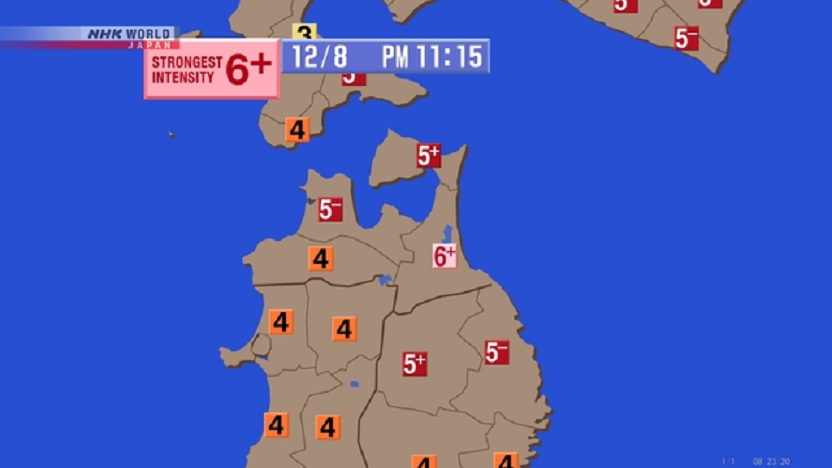
The earthquake struck off the eastern coast of Aomori Prefecture at 11:15 p.m. on Monday.
The Japan Meteorological Agency has downgraded the magnitude of the quake centered off the Pacific coast in Aomori Prefecture to 7.5 from 7.6.
The depth has also been adjusted to 54 kilometers, from an initial estimate of 50 kilometers.
Tremors with an intensity of upper 6 on the Japanese intensity scale of 0 to 7 were observed in the city of Hachinohe in Aomori Prefecture.
As of 1:00 a.m., six people in Aomori have been injured by either falling down or getting hit by falling objects at their homes.
Tsunami advisories lifted
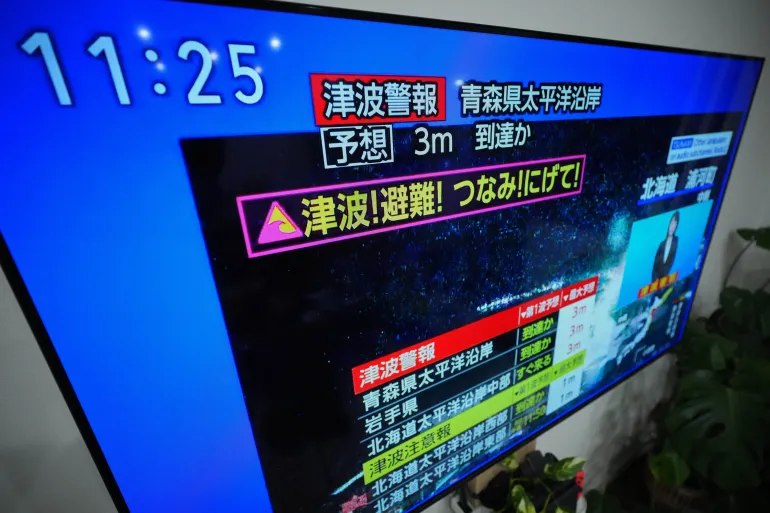
Authorities had issued a tsunami warning for Iwate Prefecture and parts of Hokkaido and Aomori.
At Kuji Port in Iwate, a tsunami measuring 70 centimeters was observed. In Hokkaido, a 50-centimeter tsunami was seen in Urakawa Town and a 40-centimeter tsunami was observed at Mutsuogawara Port.
The Japan Meteorological Agency says: it is the first time the agency has issued a tsunami warning since July, when a powerful quake off Kamchatka, Russia, prompted it to issue one for Japan’s Pacific coastal areas.
Over 3 hours later, authorities downgraded the tsunami warning to advisories. And they lifted all tsunami advisories for the Pacific coastline of northern Japan at 6:20 a.m. on Tuesday.
‘Long-period ground motions’ recorded
According to authorities, long-period ground motions were recorded during the Monday earthquake.
The motions are slow, large-amplitude seismic waves with frequencies of 2 seconds or longer that occur during a large earthquake. Such motions are known to have a significant impact on high-rise buildings.
Strong long-period motions, classified class-3, the second highest in the 4-level scale were observed in the village of Rokkasho in Aomori Prefecture. Such class-3 waves are strong enough to make it difficult for people in a high-rise building to stand up.
‘An alert for a potential mega quake’ issued
Officials at Japan’s Meteorological Agency have issued an alert for a potential mega quake following Monday’s quake.
A mega quake could trigger tsunami along Japan’s Pacific coast from Hokkaido to Chiba Prefecture.
Officials are urging people to check evacuation routes, prepare emergency kits, secure home furniture and confirm backup food, water and portable toilets.
People along the Pacific coast in those areas should remain on the alert during the next week, even though an evacuation recommendation will not be issued.
The alert is the first since this category of warning was started in 2022.
Morikubo Tsukasa, Cabinet Office official for disaster preparedness, has held a news conference over a potential mega quake.
Morikubo: Based on the statistics of earthquakes that have occurred around the world so far, there is a possibility that a large-scale earthquake with a magnitude of 8 or higher could occur as a follow-up earthquake along the Japan Trench and the Chishima Trench off Hokkaido. It is unclear whether a large-scale earthquake will occur. But everyone should heed the call to take precaution to protect their own lives.
Residents ordered to evacuate
After tsunami warnings were issued, some municipalities in Hokkaido, and the Tohoku region issued evacuation orders to residents.
Traffic disrupted on Monday
East Japan Railway Company says that as of Tuesday, outbound trains on the Tohoku Shinkansen have been suspended between Fukushima and Shin-Aomori stations due to the earthquake. The company says three trains stopped in this section.
The company says that it is checking for any damage to railway tracks and that it remains unclear when services will resume.
The Morioka branch of East Japan Railway says that as of midnight on Tuesday, services on the Tohoku Main Line were suspended in Iwate Prefecture.
It says two trains made emergency stops. It remains unclear when services will resume. There are no reports of injuries.
As for Hokkaido, the operator of its busiest airport, New Chitose Airport near Sapporo, says that as of 11:40 p.m. on Monday, it was checking whether there are any abnormalities on two runways.
Highways have been affected. East Nippon Expressway Company says that as of 11:45 p.m. on Monday, traffic was completely stopped between the Shiraoi and Shinchitose Airport Interchanges and between the Tomakomai Higashi and Numanohata Nishi Interchanges.
Major traffic disorder unlikely on Tuesday
East Japan Railway Company says there has been no impact on its bullet train and regular train services after authorities issued the alert for potential megaquake following magnitude-7 or over quakes related to Monday’s quake. The operator, however, warns that delays or cancellations are still possible if damage to infrastructure is confirmed.
All Nippon Airways and Japan Airlines say they plan to operate as usual starting Tuesday.
According to Cabinet Office guidelines, no restrictions will be placed on railways, airports and roads, even after such an alert is issued. The authorities are supposed to provide the public with information about locations they consider being vulnerable to a possible major quake, as well as evacuation sites.
In August 2024, authorities issued a Nankai Trough megaquake advisory after a powerful earthquake struck in southern Japan. The operator of the Tokaido Shinkansen was forced to slow down its bullet trains in some sections over the ensuing one-week period.
Power Companies: No abnormalities at nuclear plants
Tokyo Electric Power Company says it has confirmed that there are no abnormalities at the Fukushima Daiichi and Daini nuclear plants.
The company says it halted the release of treated and diluted water from the Fukushima Daiichi nuclear power plant at 11:42 pm on Monday, as per predetermined procedures.
The facility suffered a triple meltdown during the March 2011 earthquake and tsunami. The water used to cool molten fuel has been mixing with rain and groundwater.
That has been treated to remove most radioactive substances, except tritium. It’s then diluted, reducing levels of tritium to well below the World Health Organization’s guidance for drinking water, before it is released into the ocean.
TEPCO also ordered some employees at the facility to evacuate. There have been no reports so far of injuries at the nuclear power plant.
Tohoku Electric Power Company says no abnormalities have been detected at the Higashidori nuclear power plant in Aomori Prefecture and the Onagawa plant in Miyagi Prefecture.
Hokkaido Electric Power Company says no problems have been found at the Tomari nuclear power plant in the prefecture.
Government bracing for damages
The Japanese government set up a task force at the crisis management center in the prime minister’s office at 11:16 p.m. on Monday in response to the earthquake.
Prime Minister Takaichi Sanae entered the prime minister’s office shortly after 11:50 p.m.
She instructed the government to immediately provide information on any tsunami and evacuation orders to the people in an appropriate manner, take thorough measures to prevent harm, such as evacuating residents, and get a grasp of the extent of damage as soon as possible.
Takaichi: The central government will work closely with local governments and make the utmost effort to carry out measures, such as emergency response, including rescue for the affected people.
Chief Cabinet Secretary Kihara Minoru held a news conference on Tuesday. Kihara said the government continues to assess the extent of the damage.
He added that the government is devoting all its efforts to disaster prevention measures, with rescue and relief efforts as its top priority, led by the police, fire departments, Self-Defense Forces, and Japan Coast Guard.
Expert view on the quake
Sakai Shinichi, professor at the Earthquake Research Institute of the University of Tokyo, says: If this was a shallow earthquake centered in the sea, there is a high possibility that a tsunami has already occurred. People should stay away from the coast. It is important to evacuate and to take measures to stay warm.
Sakai says: The epicenter may be north of the epicenter area of the 2011 Great East Japan Earthquake. This time, the earthquake is believed to have occurred at the plate boundary, so I think it was a slightly larger earthquake. The magnitude could be revised in the future.
[NHK]