
Foreign News
Spacecraft blasts off to hunt alien life on a distant moon

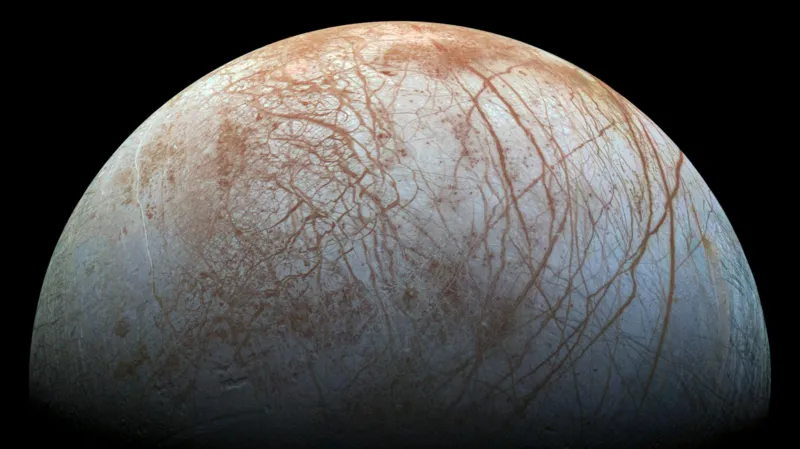
A spacecraft that will hunt for signs of alien life on one of Jupiter’s icy moons has blasted off from Cape Canaveral, Florida.
Nasa launched the spacecraft at 12:06 local time (16:06 GMT) after hurricane Milton forced the mission to postpone plans last week.
Europa Clipper will now travel 1.8 billion miles to reach Europa, a deeply mysterious moon orbiting Jupiter.
It will not arrive until 2030 but what it finds could change what we know about life in our solar system.
Trapped under the moon’s surface could be a vast ocean with double the amount of water on Earth.
The spacecraft is chasing a European mission that left last year, but using a cosmic piggyback, it will overtake and arrive first.
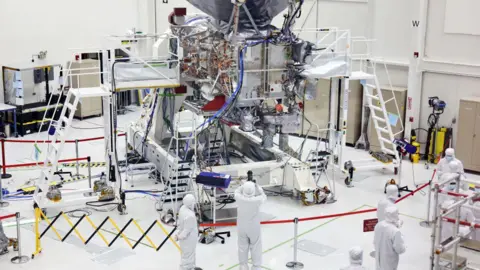
Years in the making, the Europa Clipper launch was delayed at the last minute after hurricane Milton blasted Florida this week.
The spacecraft was rushed indoors for shelter, but after checking the launchpad at Cape Canaveral for damage, engineers gave the go-ahead for lift-off at 12:06 local time (16:06 GMT).
“If we discover life so far away from the Sun, it would imply a separate origin of life to the Earth,” says Mark Fox-Powell, a planetary microbiologist at the Open University. “That is hugely significant, because if that happens twice in our solar system, it could mean life is really common,” he says.
Located 628 million kilometres from Earth, Europa is just a bit bigger than our moon, but that is where the similarity ends.
If it was in our skies, it would shine five times brighter because the water ice would reflect much more sunlight.
Its icy crust is up to 25km thick, and sloshing beneath, there could be a vast saltwater ocean. There may also be chemicals that are the ingredients for simple life.
Scientists first realised Europa might support life in the 1970s when, peering through a telescope in Arizona, they saw water ice.
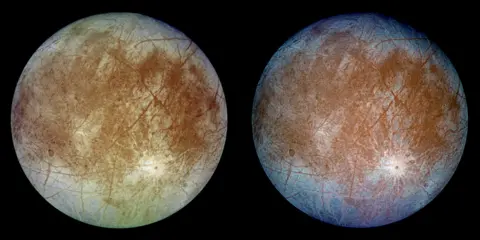
Voyager 1 and 2 spacecrafts captured the first close-up images, and then in 1995 Nasa’s Galileo spacecraft flew past Europa taking some deeply puzzling pictures. They showed a surface riddled with dark, reddish-brown cracks, fractures that may contain salts and sulfur compounds that could support life.
The Hubble space telescope has since taken pictures of what might be plumes of water ejected 100 miles (160 kilometers) above the moon’s surface
But none of those missions got close enough to Europa for long enough to really understand it.
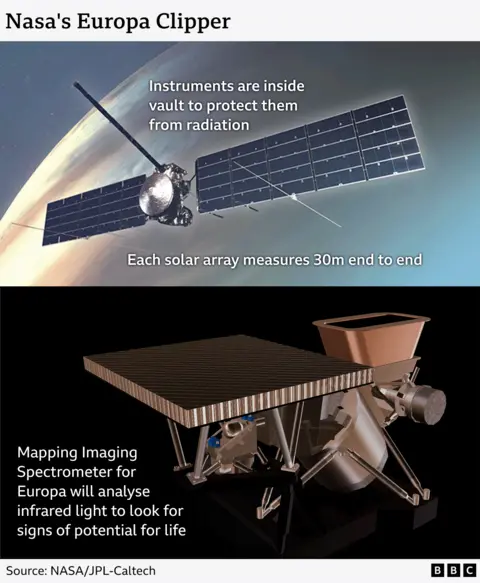
Now scientists hope that instruments on Nasa’s Clipper spacecraft will map almost the entire moon, as well as collect dust particles and fly through the water plumes.
Britney Schmidt, professor of earth and atmospheric sciences at Cornell university in the US, helped to design a laser onboard that will see through the ice.
“I’m most excited about understanding Europa’s plumbing. Where’s the water? Europa has the ice version of Earth’s subduction zones, magma chambers and tectonics – we’re going to try to see into those regions and map them,” she says.
Her instrument, which is called Reason, was tested in Antarctica.
But unlike on Earth, all the instruments on Clipper will be exposed to huge amounts of radiation which Prof Schmidt says is a “major concern.”
The spacecraft should fly past Europa about 50 times, and each time, it will be blasted with radiation equivalent to one million X-rays.
“Much of the electronics are in a vault that’s heavily shielded to keep out radiation,” Prof Schmidt explains.
The spaceship is the largest ever built to visit a planet and has a long journey ahead. Travelling 1.8 billion miles, it will orbit both the Earth and Mars to propel itself further towards Jupiter in what is called the sling-shot effect.
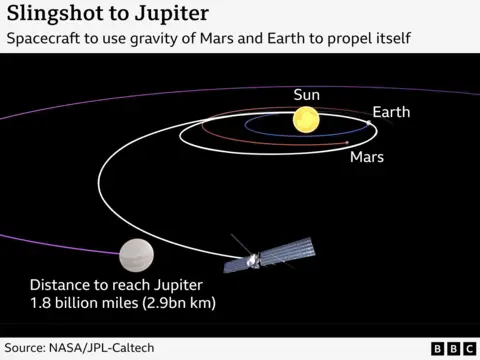
It cannot carry enough fuel to motor itself all the way alone, so it will piggyback off the momentum of Earth and Mars’s gravitational pull.
It will overtake JUICE, the European Space Agency’s spaceship that will also visit Europa on its way to another of Jupiter’s moons called Ganeymede.
Once Clipper approaches Europa in 2030 it will switch on its engines again to carefully manoeuvre itself into the right orbit.
Space scientists are very cautious when talking about the chances of discovering life – there is no expectation that they will find human-like creatures or animals.
“We are searching for the potential for habitability and you need four things – liquid water, a heat source, and organic material. Finally those three ingredients need to be stable over a long enough period of time that something can happen,” explains Michelle Dougherty, professor of space physics at Imperial College in London.
And they hope that if they can understand the ice surface better, they will know where to land a craft on a future mission.
An international team of scientists with Nasa, the Jet Propulsion Lab and the Johns Hopkins Applied Physics Lab will oversee the odyssey.
At a time when there is a space launch virtually every week, this mission promises something different, suggests Professor Fox-Powell.
“There’s no profit being made. This is about exploration and curiosity, and pushing back the boundaries of our knowledge of our place in the universe,” he says.
[BBC]


A court in Malta has acquitted businessman Yorgen Fenech of masterminding the murder of prominent anti-corruption journalist Daphne Caruana Galizia.
Fenech, 44, was acquitted on Wednesday at the end of a jury trial. He had been tried on charges of complicity to murder and for the lesser charge of criminal association to commit murder.
If found guilty, Fenech could have faced life in prison.
Caruana Galizia’s family were seen weeping in the packed courtroom in Valletta after the businessman was cleared of both counts by an 8-1 margin following eight hours of deliberation by the jury.
“Nine years after Daphne’s brutal assassination, the institutional failures that enabled her murder remain unaddressed and unreformed,” the slain reporter’s family said in a statement.
“Lasting justice means no person should ever face the same risks again. Our country failed to protect Daphne’s life. It owes it to her to prevent other lives being lost.”
Fenech’s family members were seen celebrating the jury’s decision.
The killing of Caruana Galizia in October 2017 shocked Europe’s journalist community and set off a political firestorm in Malta, focusing international attention on its police and judiciary.
Dubbed a “one-woman WikiLeaks”, Caruana Galizia had exposed corruption at the highest level in the Mediterranean island country, shining a spotlight on links between Malta’s business and political elites. She was 53 when she was killed.
Prosecutors argued that Fenech had wanted Caruana Galizia killed because she was about to reveal information about him.
Fenech has denied the accusations. His defence instead pointed fingers at his one-time friend Keith Schembri, the former chief of staff of then-Prime Minister Joseph Muscat and a target of Caruana Galizia’s blogs.
Muscat, who was never linked to the murder, stepped down in January 2020 due to the political fallout from the assassination.
Police told the court that Schembri had never been a suspect. He has denied any role in the murder.
An independent inquiry in 2021 found that officials in Malta had failed to protect Caruana Galizia from threats to her life before her death.
[Aljazeera]

A head teacher’s quick decision to evacuate his school saved 900 pupils from deadly flash floods along the Nepal-Tibet border
Rajendra Dawadi tells the BBC he was tipped off about incoming flood waters and moved students to higher ground with just minutes to spare. One pupil says she and her friends survived by just 10 seconds and watched as a nearby bazaar was swept away
Wednesday’s disaster has killed at least 794 people and more than 2,500 people are missing in Nepal, local officials say
In Tibet, the official death toll is 16, with 546 reported to be missing, according to Chinese state media –
[BBC]

A ferry carrying around 260 people has capsized off the coast of northern Cyprus with a search underway for survivors, according to local media.
The catamaran-style boat was travelling from the port of Kyrenia, also known as Girne, and started sinking a few kilometres off the coast of the island state on Sunday.
There were no immediate reports of casualties.
[Aljazeera]

Prime Minister of Sri Lanka holds a bilateral meeting with Minister for Education and Skills Development of Bhutan

Prime Minister Meets His Majesty the King of Bhutan

Kusal Mendis, Binura Fernando ruled out of T20I series in England

SLPP MP Namal Rajapaksa arrested by CIABOC

Devapathiraja clinch U15 Division I title with 33-run win over Royal

Mandhana’s record ton powers India into semi-finals

‘Dates have the highest sugar content to fight Coronavirus’

Sunday Island 27 December – Headlines

#SundayIsland 17th December – Headlines

Sunday Island – 28th March

Sunday Island Headlines – 21 March

Sunday Island – 21st February – Headlines
-

 Features6 days ago
“Wrap Me Up in My Blazer”— A Gentlemanly Bradby Reminiscence
-

 Features5 days ago
When Sri Lankan stories find their own voice
-

 Features6 days ago
JVP/NPP government as seen from outside by Lionel Bopage now domiciled in Australia
-

 News5 days ago
BASL takes exception to Justice Ganepola being denied a place in SC
-

 Editorial7 days ago
Govt. trying to dupe UN Rapporteur?
-

 Features6 days ago
Prof. Savitri Goonesekere: What has she done?
-

 News2 days ago
Denied of promotion to SC despite vacancies, justice Gurusinghe retires
-

 Latest News2 days ago
Grade 5 scholarship exam results released