
News
South Asian nations must collaborate on climate fund

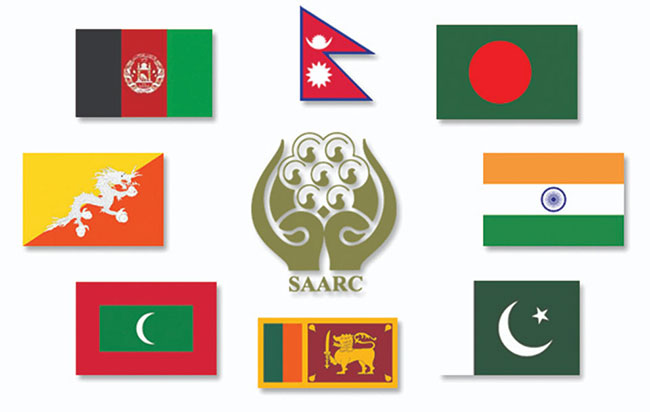
‘SA region needs to double down on pursuing sustainable development goals’
South Asian countries have been asked to establish a South Asia Association for Regional Cooperation Climate Fund, which could pay for adaptation and mitigation initiatives with a strong focus on innovations, joint R&D, technology transfer, knowledge exchange, and capacity building.
A report published by The Hindustan Times (HT) says the regional cooperation in South Asia has been an exercise in hope but suboptimal in its outcome. The climate crisis can alter it. Home to about one-fourth of the global population, the region is responsible for 4% of historical global greenhouse gas (GHG) emissions. The annual per capita GHG emissions were 2.6 tonnes of CO2 equivalent in 2019, the lowest of any region globally, while the Gross Domestic Product per capita (purchasing power parity) was $5,814 in 2020, the second lowest globally, just ahead of Africa.
The HT report says: “South Asia faces several climate challenges. However, the similarity of the challenges and the complementary strengths of the nations, along with their shared geography, socioeconomic characteristics, and cultures, present opportunities for collaboration among the South Asian countries. For example, the Himalayan countries of Afghanistan, Bhutan, India, Nepal, and Pakistan have large, unutilised hydropower resources. Collaboration on technologies and finances, and the development of a common South Asian power market can lead to increased energy security while reducing power costs and GHG emissions. India’s lead on solar power can help other countries develop this renewable resource as a cheap and principal energy source.”
There are existing initiatives that have lessons for all countries: Adaptation strategies of Bangladesh (including its Delta Plan 2100), India’s focus on enhanced energy efficiency, sustainable management of forests by Bhutan, fisheries management by Bangladesh and India, micro-hydropower in Nepal, ecotourism in Maldives and Sri Lanka, and climate-smart agriculture in Bangladesh, India and Pakistan. In addition, India has a rich experience in attempting to develop sustainable and economically productive cities, with programmes such as the Smart Cities Mission, Atal Mission for Rejuvenation and Urban Transformation, Swachh Bharat Mission, Housing for All, Start-Up Mission, Street Vendors Act 2014 and India Cooling Action Plan.
Based on the climate crisis challenges and current initiatives, five key areas emerge for regional cooperation: Sustainable urbanisation (inclusive sustainable municipal services, green transport, pollution abatement and prevention); climate-smart agriculture (water and resource efficiency, minimising food wastage, transport logistics and cold chains, and food processing); disaster resilience (joint and coordinated early warning systems for hydro-meteorological events, shared response mechanisms to disasters including chemical and oil spills in coastal areas, and forest fires); renewable and clean energy (solar and wind energy, power storage technologies, joint development of hydropower projects, regional energy market, and increasing energy efficiency across industries, farms, institutions, offices and homes); and downscaled climate modelling to predict short- to long-term impacts and implement people-oriented adaptation plans.
The private sector will have a substantial role in climate adaptation and mitigation. Thus, relaxation of foreign direct investment rules will help, especially for green technologies, digital firms, fourth industrial revolution technologies, waste management and treatment, disaster resilience enhancing processes, and technologies including in infrastructure sectors such as climate-resilient roads and water transport. Countries could establish a South Asia Association for Regional Cooperation Climate Fund, which could pay for adaptation and mitigation initiatives with a strong focus on innovations, joint R&D, technology transfer, knowledge exchange, and capacity building. The fund could also raise money from private foundations and individuals, corporate social responsibility initiatives, and bilateral and multilateral agencies.
In addition, South Asia needs to double down on pursuing sustainable development goals. Lastly, India could leverage its development assistance to other South Asian countries by joining hands with international development agencies to jointly design, fund, and implement climate resilience programmes.


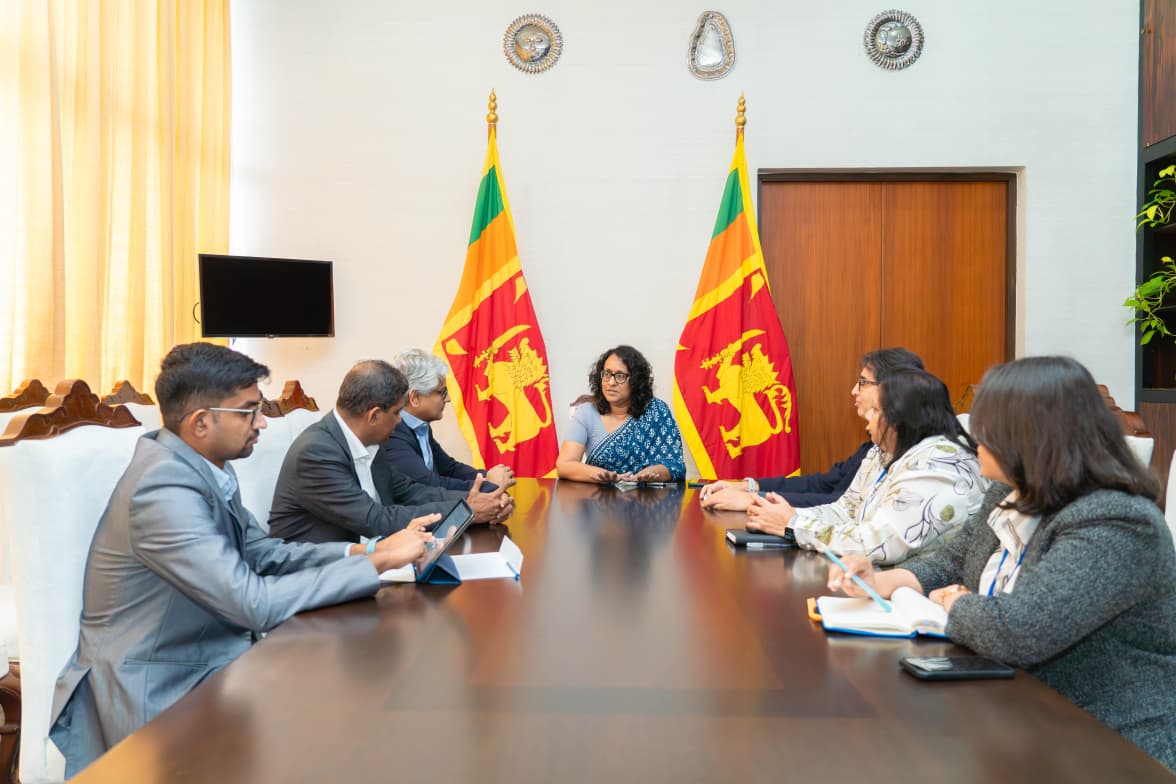
Representatives from the ’The Ceylon Chamber of Commerce’ met with Prime Minister Dr. Harini Amarasuriya on Wednesday [24th of June] at the Parliament premises.
During the meeting, discussions focused on the Sri Lanka Economic and Investment Summit 2026 (SLEIS 2026), which is scheduled to be held on 12 and 13 October 2026. Attention was also given to digitalization initiatives, the introduction of digital technologies in schools under new education reforms, and the transformative role of Artificial Intelligence (AI) in Sri Lanka’s education sector.
Representatives of the Chamber noted that the summit would serve as an important platform for encouraging both local and foreign investment, while also contributing to the shaping of the country’s future economic policies.
The meeting was attended by Krishan Balendra, Chairman of The Ceylon Chamber of Commerce; Vinod Hirdaramani, Deputy Vice Chairman; Shiran Fernando, Secretary General and Chief Executive Officer; Aliki Perera, Deputy Secretary General and Chief Operating Officer; and Anagi Rodrigo-Weerasekera, Chief Economist and Head of Economic Intelligence, along with several other representatives.
[Prime Minister’s Media Division]
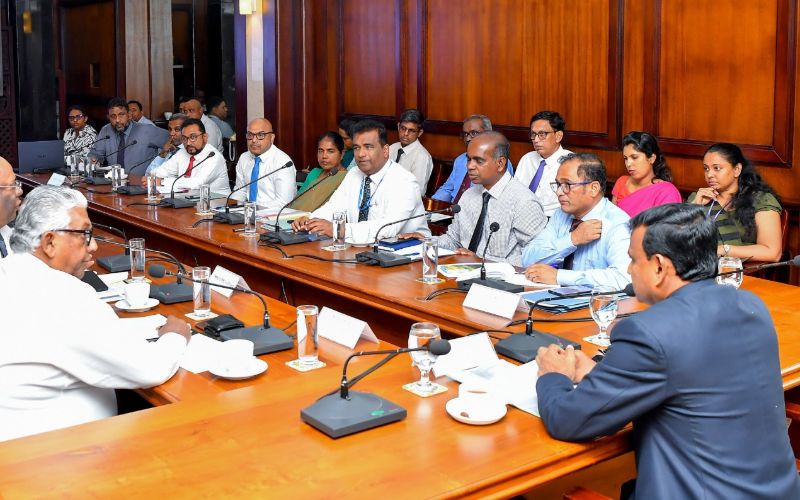
A discussion to review the progress of the housing project under which 4,700 houses are being constructed for the Malayagam community with Indian assistance was held this afternoon (24) at the Presidential Secretariat under the chairmanship of the Chief of Staff to the President, Prabath Chandrakeerthi.
Under this housing programme, 2,026 houses are to be provided to families identified by the National Building Research Institute (NBRI) as being at disaster risk. The remaining houses are expected to be allocated to eligible workers residing in the plantation sector.
Accordingly, the houses will be provided to Malayagam community families living on estates belonging to 22 Regional Plantation Companies, as well as estates under the State Plantations Corporation, Janawasama and Elkaduwa Plantations.
For the construction of each house, the Government of India has allocated Rs. 2.8 million, while the Government of Sri Lanka has contributed Rs. 400,000.
During the discussion, Chandrakeerthi instructed officials to ensure that the housing project is completed before the end of this year. He further directed that land identified for the construction of houses be released without delay and that the National Building Research Institute provide the necessary reports to identify suitable land for the project.
The housing project is being implemented jointly by the Ministry of Plantation and Community Infrastructure, the National Housing Development Authority, the State Engineering Corporation and the Plantation Human Development Trust.
Among those present were Additional Secretary (Development) of the Ministry of Plantation and Community Infrastructure, K. S. Wijayakeerthi; Director General (Engineering), N. D. N. Pushpakumara; Director General (Planning), W. A. K. S. Damayanthi; the Secretary General of the Planters’ Association; and officials from the National Housing Development Authority, the State Engineering Corporation, relevant institutions and plantation companies.
(PMD)

It has been reported that Attorney at Law Rakitha Rajapakshe, the son of former Minister of Justice Wijeyadasa Rajapakshe, has been arrested by the Commission to Investigate Allegations of Bribery or Corruption (CIABOC) over alleged links with the underworld.

Venezuela earthquakes: At least 164 dead, 971 injured as toll rises

Representatives from the Ceylon Chamber of Commerce meet PM

Progress of Housing Project for Malayagam Community families funded by India reviewed

South Africa stun South Korea to reach World Cup knockouts for the first time

Tremors of 7.5, 7.2 kill 32, injure hundreds in Venezuela

Former Minister Wijeyadasa Rajapakshe’s son arrested by CIABOC

‘Dates have the highest sugar content to fight Coronavirus’

Sunday Island 27 December – Headlines

#SundayIsland 17th December – Headlines

Sunday Island – 28th March

Sunday Island Headlines – 21 March

Sunday Island – 21st February – Headlines
-

 News7 days ago
Creditor receives USD 2.5 mn as Lankan public bears loss from theft of Treasury funds
-

 News6 days ago
Creditor not yet paid
-
 News6 days ago
Consumers bearing 22% tax burden despite 18% VAT claim: Dr. Harsha de Silva
-

 Features5 days ago
Nanda Pethiyagoda Wanasundara as three generations of family saw her
-

 Features4 days ago
Sri Lanka developing independent hydrographic capabilities
-

 Opinion7 days ago
SriLankan Airbus struck by lightning
-

 Editorial5 days ago
Fuel crisis: Beyond price debate
-

 Latest News4 days ago
Sooryavanshi thumps fastest List A fifty as India A win tri-series