
Foreign News
South Africa’s ANC on course to lose majority


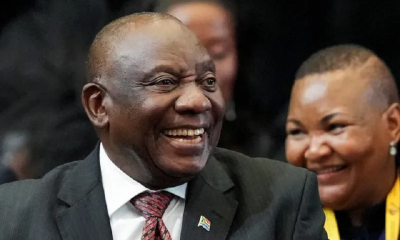
South Africa’s ruling party, the African National Congress (ANC), is on course to lose its majority in parliament for the first time since it came to power 30 years ago, partial results from Wednesday’s parliamentary election suggest.
With results from more than 50% of voting districts counted so far, the ANC is leading with 42%, followed by the Democratic Alliance (DA) with 23%.
The uMkhonto weSizwe Party (MK Party) of former President Jacob Zuma has received nearly 11% of the vote and the Economic Freedom Fighters party, nearly 10%.
Final results are expected over the weekend.
The online system streaming the election results crashed on Friday morning, leaving poll screens showing zero results.
South Africa’s electoral commission has apologised for the issue and said it was working to restore the service.
“The results system is still operational and local offices continue to capture results,” it added.
Many voters blame the ANC for the high levels of corruption, crime and unemployment in the country.
The respected Council for Scientific and Industrial Research (CSIR) and the News24 website have projected that the party’s final vote will be around 42%, a big drop from the 57% it obtained in the 2019 election.
This would force it go into a coalition with one or more of the other parties in order to form a majority in parliament.
The DA has liberal economic policies, while both the EFF and MK favour more state intervention and nationalisation, so the choice of partner would make a huge difference to South Africa’s future direction.
It is unclear whether President Cyril Ramaphosa will remain in power, as he could come under pressure from the ANC to resign if the party gets less than 45% of the final vote, said Prof William Gumede, chairman of the non-profit Democracy Works Foundation.
“The ANC could turn him into a scapegoat, and a faction within the party could push for him to be replaced by his deputy, Paul Mashatile. The EFF and MK are also likely to demand his resignation before agreeing to any coalition with the ANC,” Prof Gumede told the BBC.
South Africans do not directly vote for a president. Instead they vote for members of parliament who will then go on to elect the president.
(BBC)










Iran’s intelligence minister Esmail Khatib has been killed, the country’s president has confirmed.
Masoud Pezeshkian said the “cowardly assassination” had left Iran “in deep mourning”, after Israel said on Wednesday it had killed Khatib in an air strike.
It comes a day after Israel announced it had killed Iran’s top security official, Ali Larijani, and head of the paramilitary Basij force, Gholamreza Soleimani, in strikes.
Since the assassination of Supreme Leader Ayatollah Ali Khamenei on the first day of the war on 28 February, multiple senior Iranian officials and commanders have been killed in efforts by Israel and the US to weaken the regime’s leadership.
In a post on X, Pezeshkian extended his condolences to the Iranian people over the officials’ deaths, adding he was “certain their path will continue more steadfastly than before”.
Speaking to the BBC, a woman from Tehran said the “killing of Khatib might help the people since he was among the leadership”.
“It might be that when people come out after a call to protest, the likelihood of them being killed is lower now,” she said. “Even though they all have replacements, these were the main figures.”
Earlier on Wednesday, Israel’s defence minister Israel Katz announced that Khatib had been “eliminated” in an Israeli strike on Tehran.
“Prime Minister Benjamin Netanyahu and I have authorised the IDF to eliminate any senior Iranian official for whom the intelligence and operational circle has been closed, without the need for additional approval,” he said.
[BBC]

Ten people have been killed after a fire broke out in the trauma centre of a government hospital in the eastern Indian state of Odisha.
All the victims were patients, while 11 hospital staff are being treated for burns suffered while trying to rescue patients, state Chief Minister Mohan Charan Majhi said.
The fire – suspected to have been caused by an electrical short circuit – started in the trauma care ICU of SCB Medical College and Hospital in Cuttack city around 02:30 local time on Monday (21:00 GMT Sunday).
Hospital fires are often reported in India, with many blamed on electrical faults. Last October, six critically ill patients were killed in an ICU fire in Rajasthan state.
In 2024, a blaze in the neonatal ICU of a medical college in northern Jhansi city killed at least 10 new born babies. In 2021, a fire in the ICU of Vijay Vallabh hospital in the western city of Virar killed 13 patients receiving treatment for Covid-19. Another fire in 2021 at a newborn care unit in Bhandara district in western state Maharashtra killed 10 infants.
In Odisha, the blaze was brought under control after fire service personnel rushed to the hospital. Patients were moved to other departments inside the same hospital, officials said.
SCB Medical College and Hospital is one of the largest government-run medical facilities in Odisha.
Speaking to reporters after visiting the hospital, Majhi said the fire affected the trauma care ICU as well as an adjoining ICU and wards.
Majhi said medical staff and security personnel “risked their lives” during the rescue operation and some of them were injured, adding that the government had directed officials to ensure proper treatment for those hurt in the incident.
The state government has announced financial compensation for the families of the victims. Majhi said he has ordered a judicial inquiry into the incident and said strict action would be taken against anyone found responsible.
Short circuits are among the most common causes of hospital fires in India. Hospitals are particularly vulnerable to fires because they contain a lot of electrical equipment, oxygen systems and patients who often cannot be moved quickly during emergencies.
[BBC]

The Ecuadorean government has deployed more than 75,000 police officers and soldiers to four of the country’s most violence-wracked provinces, the interior minister says.
The authorities have also declared a night-time curfew in these areas as part of a “new phase” in their “war” on criminal gangs.
Since coming to office in November 2023, President Daniel Noboa has tried to quell drug-related violence but nevertheless Ecuador registered a record murder rate in 2025.
Noboa has also joined a US-led alliance of 17 countries aimed at fighting criminal cartels in the Western Hemisphere.
“We’re at war,” Ecuadorean Interior Minister John Reimberg told residents of the provinces of El Oro, Guayas, Los Ríos and Santo Domingo de los Tsáchilas.
“Don’t take any risks, don’t go out, stay at home,” he added.
Ecuador’s geographical location – sandwiched between Colombia and Peru, the world’s largest producers of cocaine – has turned it into a key transit country for the illicit drug.
Around 70% of the cocaine produced in Colombia and Peru is estimated to be shipped through Ecuador.
Noboa’s government has been working with the administration of US President Donald Trump to quell the flow of cocaine from Ecuador to the US.
Last week, the FBI opened its first office in the Andean country, a move which came shortly after the two countries launched joint counter-narcotic operations.
Noboa was one of the Latin American leaders to attend an international meeting hosted by Trump in Mar-a-Lago, which the US authorities dubbed the “Shield of the Americas” summit.
At the summit, Trump likened criminal gangs to a “cancer” and urged his Latin American counterparts to use military force to root them out.
“We don’t want it spreading,” Trump added.
Following the meeting, Noboa posted a photo on social media of himself standing next to Trump with the words: “For too long, the mafias thought that America was their territory. That they could cross borders, move drugs, guns and [spread] violence without consequences. Their time has run out.”
Since coming to office, Noboa has tried to combat criminal organisations in his country with an iron fist and has declared several states of emergency but nevertheless the murder rate rose by over 30% between 2024 and 2025.
[BBC]

Our objective is to ensure that the Commission to Investigate Allegations of Bribery or Corruption operates as an independent institution, free from any external influence – PM

Showers above 50 mm can be expected at some places in the Central, Sabaragamuwa and Uva provinces and in Ampara district.

Oil nears $110 a barrel after gas field strike

Iran’s intelligence minister Esmail Khatib killed in air strike

Heat Index at ‘Caution Level’ in the Western, Sabaragamuwa, North-central, Southern and North-western provinces and in Monaragala, Mannar, Vavuniya and Mullaitivu districts

Pay hike demand: CEB workers climb down from 40 % to 15–20%

‘Dates have the highest sugar content to fight Coronavirus’

Sunday Island 27 December – Headlines

#SundayIsland 17th December – Headlines

Sunday Island – 28th March

Sunday Island Headlines – 21 March

Sunday Island – 21st February – Headlines
-

 Business3 days ago
Browns EV launches fast-charging BAW E7 Pro at Rs. 5.8 million
-

 Life style4 days ago
From culture to empowerment: Indonesia’s vision for Sri Lanka
-

 Opinion6 days ago
M. D. Banda: Memories of Appachchi – II
-

 Business5 days ago
Sri Lanka Institute of Information Technology raises the bar for academic excellence
-

 Latest News4 days ago
QR code system will be implemented for fuel with effect from 06.00 a.m. today (15th)
-

 News2 days ago
Australian HC debunks misleading travel risk claims for Sri Lanka
-

 News5 days ago
Crypto loopholes funnel Lankan funds abroad
-

 News1 day ago
CIABOC questions Ex-President GR on house for CJ’s maid