
Latest News
South Africa, New Zealand gear up for run-fest as even contest beckons

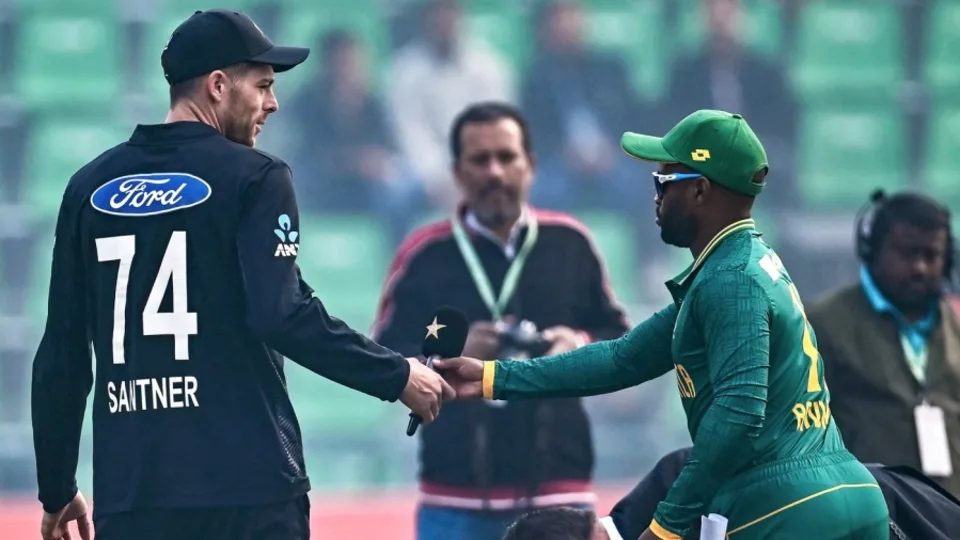
South Africa and New Zealand, the two best sides to have never won a World Cup, meet in a knockout match. Both have had their hands on this trophy all the way back when it was called the ICC Knockout and possibly meant something else in terms of its significance in the global game. So make no mistake: winning this will not take away the desire for the big one but it will help to tide things over until 2027, when South Africa co-host the event with neighbours Zimbabwe and Namibia.
Quietly, South Africa know they are actually building for that but the pressure to return home with something other than disappointment is ever-present. This is another chance to change that. New Zealand, after coming so close to the trophy at the 2019 World Cup, also carry scars but somehow seem less burdened by them. Perhaps a smaller population, with fewer socio-economic fractures that can be plastered over with sporting success helps them; maybe they’re just good at stoicism. Those are things to ponder later in the week when one of these two teams will play a final against a yet-to-be-decided opposition at a yet-to-be-decided venue. For now, they’ve both probably got the knockout they wanted.
Facing each other, rather than India or Australia, appears to give them both a better chance of progressing to the final. And doing it in Pakistan, though both teams travelled from Dubai at different times on Monday, likely suits them more. Conditions are good for run-scoring and both have line-ups capable of posting big scores which suggests fans will be in for a run-fest. Their attacks are similarly matched to the point where both were hit by injury-enforced absences amongst the quicks. Some of the more interesting narratives could be around which of the tall men – Marco Jansen and Kyle Jamieson – can extract the most with their height or which of the attacking bowlers, Kagiso Rabada or Matt Henry, has the most success.
A difference could come in the spin resources, where South Africa have chosen to operate with only one specialist in Keshav Maharaj but New Zealand have both captain Mitchell Santner and offspinner Michael Bracewell in their best XI. Maharaj had previously indicated he sees a spinners role as a more defensive one at this event so their economy rates are the numbers to watch here.
Overall, this match promises an even contest without the hype that comes with playing a big three nation even though there is plenty of history. New Zealand dumped South Africa out of both the 2011 and 2015 World Cups and though the likes of us will talk about it, it’s worth remembering that the last of those was ten years ago and much cricket has been played since.
Then, particularly for South Africa, the results seemed seismic. Now, ICC events happen annually and teams are dusting themselves off and starting again with much greater frequency. Does that mean it matters less if you lose at a crucial stage or even if you win? Ask one of these two, who have both spent the best part of the last three decades trying to win a major trophy and they’re likely to say no. Only one of them will have the chance to do it this time.
No one has quite said it yet but could this be the last time 35-year-old David Miller plays in an ODI tournament for South Africa? And if so, what kind of say will he have on it? He has limited opportunity in the tournament so far. He came to bat in the 43rd over against Afghanistan only to smash the winning runs against England, but has had almost-decisive knocks in both South Africa’s previous white-ball knockout games. At the 2023 ODI World Cup, Miller’s century gave South Africa something to defend in the semi-final after they were reduced to 24 for 4; at the 2024 T20 World Cup, he was looking good on 21 off 17 balls before being spectacularly caught on the boundary which could have taken South Africa within touching distance of the trophy. Miller has shown he enjoys the big occasion and has also indicated he is taking things year by year, so chances to play in knockouts are likely becoming fewer. After all his efforts, he will want to play a role in South Africa winning one
Kane Williamson has back-to-back ODI centuries against South Africa, albeit they were scored six years apart. He made 106* against them in Birmingham in June 2019 and 133* against them at this venue in the tri-series that preceded this tournament, though that was not against a full-strength South African side. Overall, Williamson averages 57.35 against South Africa, his best against any opposition other than Zimbabwe. Though New Zealand have a line-up of creative and crafty hitters, Williamson’s role in New Zealand’s side continues to be of utmost importance as evidenced by his 81 against India in Dubai, where he kept New Zealand in the fight in what was ultimately a losing cause.
Like many of the more experienced players at this event, at 34, Williamson may not get another opportunity to win an ODI trophy and will want to make the most of this one.
Openers Temba Bavuma and Tony de Zorzi have both recovered from the illness that kept them out of the England game and are expected to be available for selection, but de Zorzi is expected to make way for Aiden Markram, who passed his fitness test on Tuesday. George Linde has been called up as a travelling reserve. The bowling make-up – two allrounders, one specialist spinner and two quicks – is expected to be unchanged.
New Zealand’s only question will be which one of Will Young, Rachin Ravindra, Devon Conway or Daryl Mitchell they will leave out. Conway sat out the India match for Mitchell, who played against Pakistan but not Bangladesh. Young and Ravindra both have centuries to their names at this competition which suggests the decision is between Mitchell and Conway, who has scores of 30 and 10 from his outings in the tournament.
South Africa (possible): Temba Bavuma (capt), Ryan Rickelton, Rassie van der Dussen, Aiden Markram, Heinrich Klaasen (wk), David Miller, Wiaan Mulder, Marco Jansen, Keshav Maharaj, Kagiso Rabada, Lungi Ngidi
New Zealand: Will Young, Rachin Ravindra/Devon Conway, Kane Williamson, Daryl Mitchell, Tom Latham (wk), Glenn Phillips, Michael Bracewell, Mitchell Santner (capt), Matt Henry, Kyle Jamieson, Will O’Rourke
[Cricinfo]

Latest News
Landslide Early Warnings issued to the Districts of Kandy, Kegalle, Matale and Ratnapura

The Hational Building Research Institute (NBRI) has issued landslide early warnings to the Districts of Kandy, Kegalle, Matale and Ratnapura valid from 2200 hrs on 03rd October upto 2200 hrs on 04th October 2026.
Accordingly,
LEVEL II (AMBER) landslide early warnings have been issued to the Divisional Secretaries Divisions and surrounding areas of Udu Dumbara and Minipe 8n the Kandy district, Dehiowita in the Kegalle district, and Ambanganga Korale and Matale in the Matale district.
LEVEL I (YELLOW) landslide early warnings have been issued to the Divisional Secretaries Divisions and surrounding areas of Rambukkana in the Kegalle district, Rattota in the Matale district, and Eheliyagoda in the Ratnapura district.
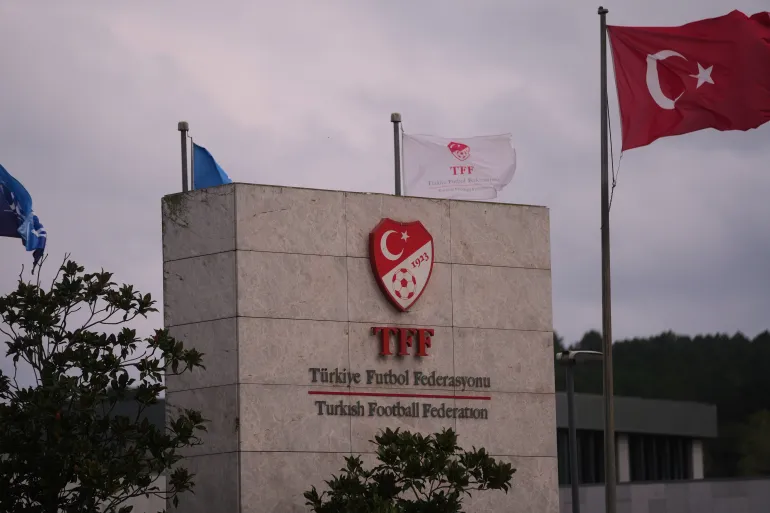
The head of Turkiye’s football refereeing body and four other officials have been placed in pretrial detention by a court as part of a corruption investigation, the state news agency Anadolu reports.
Ferhat Gundogdu, head of the Central Referees Committee, and six others appeared before a judge over allegations of manipulation of the referee administration process, Anadolu said on Saturday.
They appeared on Friday before a judge at Istanbul’s Caglayan courthouse on several charges, including forgery of official documents, breach of trust and illegal acquisition of personal data, the report said.
The judge remanded five people in custody and granted the other two conditional release, Anadolu said.
It was the latest scandal to shake football in Turkiye, coming exactly a year after the Turkish Football Federation (TFF) suspended 149 referees on charges of illegal betting.
On Thursday night, police from the illegal betting and sports crime unit also detained Yasin Kol, a referee from Turkiye’s top-flight Super Lig, as well as an assistant referee, media reports said.
Justice Minister Akin Gurlek said prosecutors are examining claims about “interference in the processes of referee classification, assignments, scoring and appointments as well as the exams on rules”.
During raids on Tuesday, police searched the VAR room at TFF’s headquarters in Istanbul. Observers said the investigation was likely linked to last year’s betting scandal and would have implications for the federation.
“It does seem to be a continuation of 2025, and it looks like it will continue further,” sports journalist Ayhan Sensoy told the AFP news agency.
Sensoy, who wrote a 2024 book on the issue called The Gambling Pit, said it was unlikely that federation bosses “have any chance of staying in office”.
So far, the TFF has not directly addressed the arrests as its top officials are due to fly home on Saturday after attending Friday night’s Belgium-Turkiye UEFA Nations League clash in Liege, which Turkiye lost 3-0.
[Aljazeera]
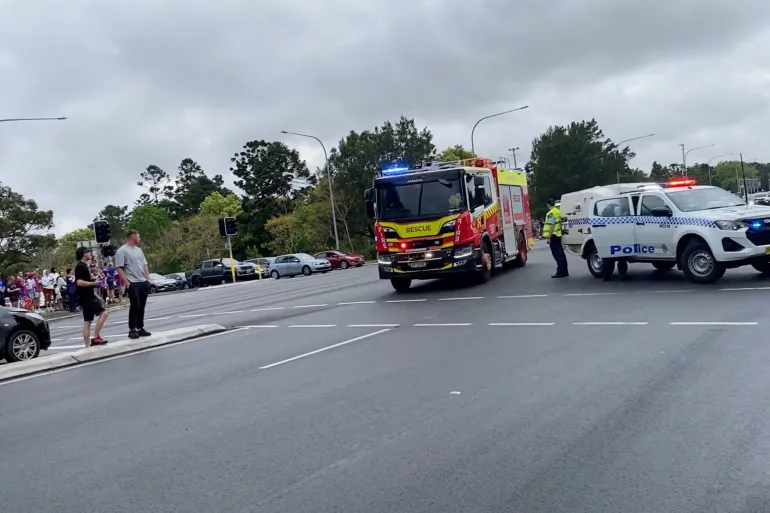
A car has crashed into a crowd of rugby league supporters in the eastern Australian city of Newcastle, injuring 10 people, including three children.
New South Wales police said on Saturday that two of the injured – a five-year-old girl and a 67-year-old man – were in a critical condition and the other eight were in stable condition in hospital.
Police said they had arrested the 18-year-old man driving the vehicle and were investigating what happened. They said the crash was not believed to be related to “terrorism”.
The crowd had gathered to farewell the local rugby league side, the Newcastle Knights, ahead of their grand final against the Sydney Roosters on Sunday.
Newcastle Lord Mayor Gavin Morris said the driver, a rugby league fan, had lost control of his vehicle and had been taken into custody.
“He was revving the car, he was excited, he was a supporter, he was there for the joy of the moment,” Morris told the national broadcaster ABC.
“Somehow he lost control of the car … and he’s gone into the crowd,” he added.
Prime Minister Anthony Albanese said: “My thoughts are with everyone injured or involved in the horrible incident this morning in Newcastle.”
“Rugby league brings people together, and this should have been a weekend of excitement and pride for Newcastle fans,” he wrote in a social media post.
[Aljazeera]

Showers or thundershowers will occur at several places in the most part of the island after 1.00 p.m

GS1 Lanka drives Sri Lanka’s shift to 2D barcodes

Geneva takes up Sallay’s case and govt. ignores opportunity to answer accusations

Section of wartime KKS High Security Zone vacated to facilitate economic development in the area

Lawyer lodges complaint against Govt. Printer, Media Ministry Secy.

Sri Lankan troops in joint anti-terrorist exercise in Russia

‘Dates have the highest sugar content to fight Coronavirus’

Sunday Island 27 December – Headlines

#SundayIsland 17th December – Headlines

Sunday Island – 28th March

Sunday Island Headlines – 21 March

Sunday Island – 21st February – Headlines
-

 Latest News5 days ago
Gold winner Tharanga gets brand-new Honda Vezel from SLAAJ
-

 Features5 days ago
Why Sri Lanka needs an Inclusive Civic Nationalism – urgently
-

 News4 days ago
US-assisted ‘Ice’ detection: NPC to examine IGP’s move to transfer drug-busting team
-

 Features6 days ago
Thailand’s biggest new global star …
-
 News6 days ago
First cases taken up by SC after enactment of 22A dismissed
-

 News5 days ago
Civil society activist accuses govt. of favouring Ven. Gnanasara
-

 Editorial6 days ago
Aftershocks of 22A
-

 Editorial3 days ago
Colombo Port drug bust: The plot thickens