
Features
Some incomprehensible lapses in Easter Attack Commission Report

By Kalyananda Tiranagama
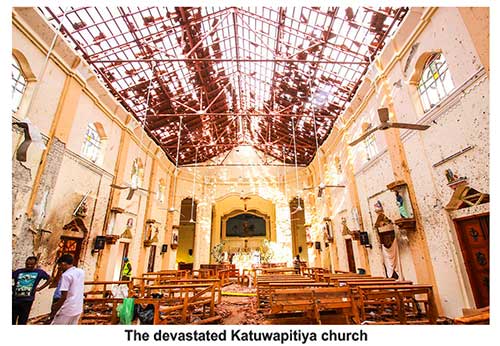
The Presidential Commission of Inquiry on Easter Sunday Attack (PCoI) had the difficult and challenging task of going through a vast amount of evidence, both oral and documentary, of several hundred witnesses, identifying the persons and organizations involved in the attack and the circumstances that brought about the situation culminating in the attack, and the political leaders and state officials whose dereliction of duty and responsibility resulting in the failure to take necessary action to prevent the attack in time and making necessary recommendations for taking legal action against them and for preventing recurrence of such situations.
In its Final Report submitted to the government, the PCoI had made a large number of relevant, important, useful and implementable recommendations, some of which the government has already taken steps to implement such as arresting some of the persons and proscribing some organizations mentioned therein. The Commission has done a commendable job by presenting this report.
While the Commission was conducting its inquiries summoning witnesses and recording their evidence at length giving wide publicity through the media, the people of the country expected that the Commission would identify all the culprits responsible for the attack, not only those who carried out the terrorist acts, but all those who were involved in or contributed to it directly or indirectly in various ways by facilitating, aiding and abetting, providing financial, material or moral support, within the country and from outside, to the terrorist group that carried out the attack; the links they had with communalist Muslim political parties and their leaders; and the foreign involvements in the attack. The people also expected it to identify the political leaders and public officials accountable for this attack by their failure to take necessary action to prevent it even after having received information in advance and deal with them according to law.
However, when a person with some legal background reads this report with an analytical mind, one finds that there are several incomprehensible lapses, omissions and lacunae in it. The purpose of this article is to point out some of the lapses that one would come across while going through this report.
Persons directly connected to terrorist attacks
In its Final Report the Commission has identified 14 persons as persons directly connected with the terrorist acts that took place on Easter Sunday. Out of them 11 persons are dead:
Zaharan and Ilham Ibrahim – suicide bombers in Shangrila attack;
Inshaf Ibrahim – Cinnamon Grand bomber; Mubarak – Kingsbury bomber;
Jameel – Dehiwala Tropical Inn bomber; Muath – Kochchikade bomber;
Hasthun – Katuwapitiya bomber;
Azad – Batticaloa Zion Church bomber;
Rilwan, Shaini and Niyas – died in Saindumarudu explosion.
Only three persons remain in custody to be prosecuted:”
(i)
Mohammed Ibrahim Mohammed Naufer – who has lectured on IS ideology and its activities in all the training camps conducted by Zaharan group;
(ii) (ii) Hayathu Mohammadu Ahamadu Milhan – who has acted as the weapons trainer in about 12 training camps conducted by Zaharan, played a key role in establishing the training camp at Wanathavilluwa and preparing explososives and procuring chemicals for the manufacture of bombs and taken part in the killing of two Police officers at Vavunativu in November 2018.
(iii) (iii) Mohomed Ibrahim Sadeeq Abdulla – an active member of Jamaath Islamia Students Movement (SLJISM), who had gone to Syria via Turkey in 2014 and undergone arms training; and participated in two training camps conducted by Zaharan and conducted some more camps in 2017 and 2018 on his own.
Persons and Organisations that contributed to terrorist acts
The PCoI has identified
the following as organizations and persons that contributed to the terrorist attacks by aiding and abetting actions which caused racial and religious disturbances or by giving support to such acts within the country and created public unrest and disturbed social order:
(i) Sri Lanka Jamaat-e-Islami (SLJI)
SLJI is an organization working on the same ideology as Muslim Brotherhood, a terrorist organization banned in Egypt, and having close connections with persons and organizations having the same ideology in Egypt, Saudi Arabia, Kuwait, Qatar, India and Pakistan. The final goal of the SLJI is establishment of an Islam state in Sri Lanka. The official publication of SLJI, Al Hassanat has over the years carried articles glorifying jihad. In February 1990 it has published an article stating that the establishment of an Islamic state cannot be done without waging jihad. In November 1999 it has carried an editorial criticizing the worshipping of statues and praising those who break them. In February 2001 it has published an article extolling people who sacrifice their lives for Islam and stating that they will be given 72 virgins in heaven. In June 2008 it has stated quoting Egyptian terrorist Al Qardawi that a suicide attack is a great act of jihad. It has established Arabic Schools in Madampe, Mawanella and Kalkudah. At the Arabic School in Madampe students were taught about the establishment of an Islamic state and it was compulsory to learn to fight with weapons – P. 227 – 228.
(ii) Sri Lanka Jamaat-e-Islami Students Movement (SLJISM)
SLJISM is the students’ wing of the SLJI. Many of the participants in training programmes conducted by Zaharan and several of the suspects in custody over the Easter Sunday attacks are members of the SLJI. About 15 members of the SLJISM are in custody over the Easter attack, some of them have gone to Syria for arms training and Mufees, the person who provided the land at Wanathavilluwa where explosives and weapons found was a member of SLJISM. – P. 238
The COI has recommended proscription of SLJI and SLJISM.
Persons:
(i) Ahamed Talib Lukman Thalib (father);
(ii) (ii) Lukman Thalib Ahamed (son) – 2 persons of Sri Lankan origin domiciled in Australia –who have facilitated several members of SLJISM to proceed to Syria via Turkey for arms training;
(iii) (iii) one Rimsan, a Sri Lankan connected to Al Qaida. The COI has recommended in the on-going criminal investigations to examine their role, if any, in the Easter Sunday attacks.
(iv) Rasheed Hajjul Akbar – the leader of SLJI from 1994 till August 2018. He was a member of the Shura Council of the SLJI. Hajjul Akbar is one of the main ideologists of Islamic extremism in Sri Lanka, promoting religious hatred and intolerance, application of Sharia law and establishing an Islamic state in Sri Lanka. Under his leadership, the official journal of SLJI Al Hassanat has published articles promoting extremism and terrorism. He had been arrested by the CCD on August 25, 2019 and released on September 27, 2019. His younger brother is Moulavi Rasheed Mohamed Ibrahim. Moulavi Ibrahim and his two sons Sadeek Abdulla and Shahid Abdulla are in custody for damaging Buddha statues in Mawanella in December 2018. The COI has recommended the AG to consider instituting criminal action against Rasheed Hajjul Akbar for conspiring to establish an Islamic state in Sri Lanka.
(v) Dr. Muhamad Zufyan Muhamad Zafras – working at the National Hospital, Colombo who has helped Zaharan’s brother Rilwan to get admitted to Colombo National Hospital for treatment as a person injured in a gas cylinder blast, hiding the fact that he was injured in a blast while experimenting with explosives. The COI has recommended the AG to consider instituting criminal action against Dr. Zafras under S. 5 of the PTA for withholding information.
Accountability of Authorities for Failure to Prevent Attacks
Political Authorities
As for the political authorities in government accountable for the failure to prevent the terrorist attacks, the PCoI has found only President Maithripala Sirisena accountable: President Maithripala Sirisena – failed in his duties and responsibilities, transcending beyond mere civil negligence – P 263. There is criminal liability on his part for the acts or omissions mentioned therein and the COI recommends the Attorney General instituting criminal action under the Penal Code against him. -P 265
Senior Public Officers
The COI has recommended the AG to consider instituting criminal action under any suitable Penal Code provision against three senior public officers:
(i)
Secretary Defence Hemasiri Fernando – P. 284;
(ii)
DIG Sisira Mendis, Chief of National Intelligence – P. 285;
(iii)
SDIG Nilantha Jayawardane, Director, State Intelligence Service – P, 288.
Law Enforcement Officers
Out of the Law Enforcement Officers held accountable by the PCoI for their failure to take necessary steps to prevent the attacks in their respective areas, recommendation has been made only against the Inspector General of Police Pujitha Jayasundara for the AG to consider instituting criminal action under any suitable Penal Code provision. – P. 308
In respect of 6 other Police Officers recommendation has been made for the AG to consider instituting criminal action under any suitable Penal Code provision or S. 82 of the Police Ordinance. The following Police Officers belong to this category:
(i)
SDIG Nandana Munasinghe – Western Province – P. 312;
(ii)
SP Sanjeewa Bandara – Superintendant of Police, Colombo North – P. 314;
(iii)
SSP Negombo – Chandana Athukorala – P. 315;
(iv)
SP B. E. I. Prasanna, Western Province Intelligence Division – P. 315;
(v)
Chief Inspector Sarath Kumarasinghe, Acting OIC, Fort Police Station – P.320;
(vi)
Chief Inspector Sagara Wilegoda Liyanage, OIC, Fort
The AG has the option of instituting criminal action under any suitable Penal Code provision or under S. 82 of the Police Ordinance. If the AG decides to institute action under S. 82 of the Police Ordinance, they will not be indicted and there will be no criminal proceedings against them. They will be charged in the Magistrate’s Court for breach of duty under S. 82 of the Police Ordinance:
–
S. 82 :– Every Police officer (a) guilty of any violation of duty or wilful breach or neglect of any regulations and lawful orders of other competent authority – shall be liable to a penalty not exceeding three month’s pay, or to imprisonment with or without hard labour, for period not exceeding three months, or both.
Against three other Police Officers only disciplinary inquiry has been recommended:
(i)
DIG Deshbandu Tennekone, Colombo North;
(ii)
Negombo ASP Sisila Kumara;
(iii)
Chaminda Nawaratne, OIC, Katana
Accountability of Prime Minister Ranil Wickremasinghe and the Cabinet of Ministers
As for the responsibility and failures of the Prime Minister Ranil Wickremasinghe no such recommendation, as made against the President, has been made.
It appears from the following observations of the PCoI that it has shown a very lenient attitude towards the failures of the Prime Minister. The report states: ‘The reasons for the Prime Minister Ranil Wickremasinghe’s inability to attend meetings of the National Security Council when fixed at short notice due to other commitments – acceptable; Though he did not explain why he did not stay on for some of full meetings, this taken in isolation is insufficient to make any adverse findings against him – P. 268; There are other instances reflecting lenient approach on his part to national security issues: No positive action taken to prevent Wahabi violence against traditional Sufi Muslim community though he was aware of it; Did not accept army intelligence presentations about the rising Islam extremism in the country, particularly in the East – P. 270; He opposed the issue of banning nikab and burkha raised by the Army Commander at the National Security Council without consulting Muslim parties – P. 271; Govt. did not ban IS organization in Sri Lanka as there were no reports stating IS propaganda taking place in Sri Lanka, only reports of individuals spreading IS ideology; It was corroborated by several witnesses that the Govt was reluctant to take strong action against rising Islamic extremism due to its dependence on support of Muslim political parties.’
However, the Report states: ‘The lax approach of the Prime Minister towards Islam extremism was one of the primary reasons for the failure on the part of the government to take proactive steps towards Islam extremism. This facilitated the build-up of Islam extremism to the point of Easter Sunday attacks.’ – P. 277
– If it is so, why no action is recommended against Prime Minister Ranil?
– It has totally ignored the fact that, though Maithripala Sirisena was the President, the Prime Minister Ranil Wickremasinghe had the effective control of the entire government in his hands under the 19th Amendment, controlling the Cabinet and the Parliament.
– Sagala Ratnayake, a close confidante of the Prime Minister in the UNP, was the Minister of Law and Order in charge of the Police.
The Accountability of the Cabinet of Ministers
The PCoI has not given its mind as to whether the Cabinet of Ministers has contributed in any manner to the terrorist attack by its failure to discharge its Constitutional responsibility. When it examined the accountability of the President and the Prime Minister, one finds it difficult to understand why it did not examine the accountability of the governemtn headed by the Cabinet of Ministers, especially in view of the relevant provisions in Article 42 of the Constitution and the evidence placed before it.
Article 42 (1) There shall be a Cabinet of Ministers charged with the direction and control of the government of the Republic;
(2) The Cabinet of Ministers shall be collectively responsible and answerable to Parliament;
(3) The President shall be a member the Cabinet of Ministers and shall be the Head of the Cabinet of Ministers.
IGP Pujitha Jayasundara sent the communication received from Senior DIG Nilantha Jayawardana, Head of the State Intelligence Services and from Sisira Mendis, the Chief of National Intelligence containing detailed information warning about a threat of possible terrorist attack by ISIS terrorists in Sri Lanka received from Indian Intelligence sources with a note stating ‘FNA’ on 09. 04. 2019 itself to four Senior Police Officers: i. SDIG Western Province – Nandana Munasinghe; ii. SDIG Crimes, Organized Crimes and STF – M. Latheef; iii. SDIG Special Protection Range – Priyalal Dasanayake; iv. Director – Counter Terrorism Investigation Division – Waruna Jayasundara – P. 303.
Special Protection Range is the Ministerial Security Division (MSD) which provides security to Ministers of the Cabinet. It was reported in the media that SDIG Priyalal Dasanayake, giving evidence before the Commission, stated that he had conveyed the information received of the threat of possible terrorist attack to all the officers of the Ministerial Security Division on April 9, 2019 itself.
Of the four Senior Officers who received the said communication from the IGP, the PCoI has recommended to the AG to consider instituting criminal action under any suitable Penal Code provision or S. 82 of the Police Ordinance against SDIG Western Province – Nandana Munasinghe;. – P. 312. As for the conduct of SDIG Crimes, Organized Crimes and Commander STF – M. Latheef, the Report contains the following comment: ‘When the COI queried the steps taken with regard to it (the IGP’s communication) the response was that he got in touch with the Indian High Commission and provided security to it. However, it is surprising as to why he did not instruct his intelligence units to work on the intelligence received.’ – P. 309. No recommendation made against him.
However, the final report does not mention anything about the steps taken by SDIG Priyalal Dasanayake on the information conveyed to him. It does not show whether COI made any query as to whether the officers of the Ministerial Security Division conveyed the information received by them to the Ministers to whom they provide security and the reaction of the Ministers concerned. This is highly relevant and a serious lacuna in the report. One cannot expect or believe that none of the officers of the Ministerial Security Division conveyed this information received by them to any of the Ministers. At least we know that Minister Harin Fernando’s father had got this information from a Police officer, and that he conveyed it to his son preventing him from going to church on that fateful day.
The entire Cabinet of Ministers cannot evade responsibility for their failure in their Constitutional duty. Though they may not be legally accountable, their conduct is highly irresponsible, immoral and blameworthy.
However, the Cabinet Sub-Committee appointed by the present government to study the Report of the COI and identify recommendations for implementation has also expressed its view that the entire government then in power was accountable for the failure to prevent the Easter Attack.
(To be concluded tomorrow)




Participating at the All Party Conference that then President Jayewardene convened in January 1984 in the aftermath of the watershed violence of 1983, Dr. Colvin R de Silva characteristically perorated that the structure of the Sri Lankan state is incongruent with the country’s sociopolitical reality. He said it more as Historian than as a Lawyer or the architect of the 1972 Constitution.
This gap between state structure and political reality was somewhat bridged by the 13th Amendment that came three years later, with all due credit to President Jayewardene no matter how begrudgingly he may have done it and even if it was under Indian duress as JRJ’s critics have been alleging ever since.
In this backdrop, it is fair to say that the NPP’s constitutional proposals, even if they may not have been drafted with this specific intent, could contribute to further bridging the structural-reality gap and potentially transform Sri Lanka into an ethno-equal state and an ethno-equal nation. The rub, however, is in the ability of the government, as well as its intention, to fulfill in practice what is otherwise a very laudable purpose. The experience so far with the Provincial Council elections and the absence of any manifest effort by the NPP government towards implementing any of its main constitutional proposals do not allow room for too much optimism.
As I cite below, the NPP’s Manifesto fulsomely promises to hold all provincial and local government elections within one year after coming into office. Now with all the ministerial and prime-ministerial explanations in parliament as to what and what pre-steps this overworked government is apparently constrained to take, the PC system would consider itself lucky if the next provincial elections end up being held at the same time as the next parliamentary elections. That is the reality. It could be much better and that too by a government that promised to be much better.
The NPP’s Constitutional Purpose
Section 4 of the NPP Manifesto, A Thriving Nation, A Beautiful Life, is entitled A Dignified Life – A Strong Country, and includes nine subsections, viz. 1) A new constitution – A united Sri Lankan nation; 2) An efficient public service – A skill based professionalism; 3) Rule of law – A judicial system with equal access; 4) Public security assuring – People friendly service; 5) A humanitarian prison – A lawful confinement; 6) A drug-free country – A healthier citizen life; 7) A dignified diplomacy – A sovereign state; 8) High level of national security – Secured state; and 9) A Sri Lankan Nation – The Universal Citizen. These subheadings and sections are indicative of the NPP’s vision for the Sri Lankan State, a Sri Lankan Nation, and the equality of all its citizens.
The Section specific to the constitution (Section 4.1) includes the NPP’s promise to usher in “a new constitution” for “a united Sri Lankan nation.” The process for introducing the new constitution is described thus: “A new constitution will be drafted and passed through a referendum with the necessary changes, if there any, after going through a public discourse.” In addition, Section 4.9 – A Sri Lankan Nation – The Universal Citizen, elaborates on the premise and the purpose of a new NPP Constitution which are outlined as follows:
“Introduce a new constitution that strengthens democracy and ensures equality of all citizens. This initiative will build on the constitutional reform process started in 2015 which remains incomplete. The proposed constitutional reforms will guarantee equality and democracy and the devolution of political and administrative power to every local government, district and province so that all people can be involved in governance within one country. Provincial councils and local government elections, which are currently postponed indefinitely, will be held within a year to provide an opportunity for the people to join the governance.”
Fifteen “activities” are included as making up the constitution making process: 1) Recognizing and enacting the rights mentioned in the International Covenant on Civil and Political Rights as basic rights; 2) Broadening the constitutional law about the rights of children, women, and people with disabilities according to international conventions; 3) Safeguarding the voting rights of immigrants within and outside of the country; 4) Abolishing the executive presidency and appointing a president, without executive powers, by the parliament; 5) Introducing a new parliamentary electoral system; 6) Limiting official presidential residences to one; 7) Abolishing the pensions and special privileges given to retired presidents and their families; 8) Appointing 25 ministers and corresponding deputy ministers to 25 logically determined ministries and abolishing State Ministerial posts; 9) An advisory council consisting of specialists on the subject will be appointed to each ministry; 10) Introducing a code of ethics, including not allowing members of parliament (MPs) and ministers to appoint their immediate family members to their personal staff; 11) Abolishing allowances made to MPs for participating in parliamentary sessions; 12) Abolishing the pension offered to MPs after 05 years; 13) Preventing MPs or their close family members from directly or indirectly engaging in businesses or contracts with the government; 14) Removing the tax-free vehicle permits for MPs; and 15) Giving only one vehicle for Ministers /Deputy Ministers to be used during their period of office.
Interestingly, while the aborted 2015 constitutional reform process that the NPP was a part of is acknowledged, there are no references in the proposals – to the 1972 Constitution or the 1978 Constitution, and missing in the proposals are some of the signature terms that were/are both the badges and burdens of the two constitutions viz., the republic; unitary state; socialist (1972) and democratic socialist (1978); and special status for Buddhism. On the other hand, the proposals (Activity #1 & #2) include the commitment to enshrine and enforce rights and freedoms of Sri Lankans in accordance with international covenants and conventions. This inclusion is refreshingly open in contrast to the 1972 and 1978 constitutions which were rather averse to embracing anything ‘foreign’ due to the misplaced fear of diluting the island’s sovereignty, which is more theoretical than concrete.
Sovereignty and territorial integrity are duly emphasized in Section 4.7 of the proposals: A Dignified Diplomacy – A sovereign State, and in Subsection 4.8: Sovereignty and Territorial Integrity. Section 4.9: A Sri Lankan Nation – The Universal Citizen, underscores national reconciliation, equality of citizens in religion and language, and the vigorous operationalization of the Provincial Council system even though the 13th Amendment is not mentioned in the proposals. There is, however, specific reference to the 16th Amendment and the promise to implement the National Language Policy that is enshrined in 16A. Sri Lanka’s ethnic diversity is acknowledged and various measures are identified for achieving national reconciliation and a free and equal society.
Among these measures are: establishing an Inter-Religious Council consisting of all religious leaders and religious scholars to resolve inter-religious issues; releasing all political prisoners and ensuring their free socialization; abolition of all oppressive acts including the Prevention of Terrorism Act (PTA); regularization of civil administration in a way that the civil rights of the people in all parts of the country including the North and East are guaranteed; providing educational and employment opportunities to all ethnicities based on merit without political influence; providing relief to war widows, internally displaced persons, people with disabilities and people with trauma in need of relief and shelter; settlement of existing land related issues by a National Commission on Lands and Settlements; and ending resettlement programmes that operate with the aim of changing population composition; and addressing the wages, land, housing, education, and health issues of the Malaiayaka Tamils based on the NPP’s Hatton Declaration of 2023.
This is an impressive list by any comparison and it will be all the more impressive if the NPP government were to seriously and capably set about achieving most or all of them.
The Constitutional Process
While the Manifesto indicates that “a new constitution will be drafted and passed through a referendum with the necessary changes, if there are any, after going through a public discourse,” it is not clear if the NPP intends to comprehensively amend the current (1978) constitution, or repeal and replace it based on a referendum. Similar to its 1972 predecessor, the 1978 Constitution provides for repealing and replacing itself but requires the people’s endorsement in a referendum. Although the referendum requirement is limited to specific provisions of the constitution, an interpretive judicial culture has since evolved widening the referendum net to capture other provisions that are not stipulated in Article 83 of the constitution.
Opposing and, in my view, more persuasive voices have been heard from experts like Dr. Nihal Jayawickrema, and long before that from Dr. Colvin R.de Silva during the controversy over 13A referendum requirements, that a referendum requirement should be limited to changing only the provisions that are specifically to the provisions mentioned in Article 83. By this interpretation, a referendum is required to extend the term of a president or of parliament, but not for abolishing the system of elected executive presidency itself.
At the same time, a synthesizing view has also evolved that if the constitution were to be changed in a substantial manner, let alone repeal and replace it even without changing any of the Article 83 provisions, it would be prudent to have a referendum and be done with it. The latter is also the NPP’s position but seemingly taken from a more positive and democratic standpoint than a narrow interpretive standpoint. But there are questions as to how and when the NPP government will have a constitution package ready and when will it likely call for a referendum. It is not necessary to detail the amending processes in an election manifesto, but with nearly two years in office it is time for the government to indicate what is going to be its new constitution and how is it going to be achieved.
Another technicality is that when it drafted the manifesto promising constitutional changes subject to a referendum, the NPP may not have been expecting a two-thirds majority in parliament. So, what was its thinking about meeting the initial amendment requirement of a two-thirds majority in parliament without having sufficient numbers in the government. It would have had to find common ground with opposition parties in parliament. That is the very purpose of the two-thirds majority in parliament – to achieve interparty consensus as opposed to using a steamroller single-party majority.
The question to the government is why is it not being consultative with at least some, if not all, of the parties in opposition. As well, inasmuch as the Manifesto refers to a continuation of the 2015 constitutional reform process, why is the government not consulting with those individuals and organizations who were significantly involved in that earlier process. Some of them were directly associated with the NPP. But none of them is in the scene now, while the current Minister of Justice was politically unheard and unseen at that time.
The double burden of Justice and Constitutional Affairs is too much for even the most experienced and equipped political leader. It is too much to saddle a first time MP and Minister with such heavy responsibilities. As well, there is much talk about the government inviting non-NPP experts to play lead roles in institutions and agencies involved in running the economy. Why not extend this approach to implementing the NPP’s constitutional reform process?
To hark back briefly to the making of the 1972 Constitution, neither Colvin R de Silva nor the United Front were banking on winning a two-thirds majority in the 1970 elections. Instead, they were relying on Colvin’s legal theory that the new constitution will be a total rupture from the Soulbury Constitution and that its making will follow its own path based on an electoral mandate from the people.
“Not merely despite the Queen, but in defiance of the Queen and her Crown,” was Dr. Colvin’s platform pitch. The two-thirds majority that the United Front turned out to be a curse in disguise. While the NPP is now saddled with a two-thirds majority it doesn’t have Colvin’s legal theory to ignore the amending procedures of the 1978 Constitution. JR Jayewardene faithfully followed the amending procedure of the 1972 Constitution, but created a more rigid constitution than its far more flexible predecessor.
Ushering new constitutions are easily done on the morrow of independence or a revolution. Midlife constitutional changes are extremely difficult in any country and there are only a handful of countries that have successfully achieved this feat. The successful making of the 1972 and 1977 constitutions in Sri Lanka were almost entirely due to the power and competence of their two architects, Colvin R de Silva whose power was entirely intellectual and professional, and JR Jayewardene who in addition had absolute political power after the UNP’s landslide victory in 1977.
Sri Lankan politics has not been able to replicate their circumstances ever since, and the circumstances of the NPP are no different, its two-thirds majority notwithstanding. If the government is serious about drafting a new constitution, conducting public consultation, and holding a referendum, it should have started the process the day after it was sworn into office. It could start the process right away even now. The task deserves a separate ministry and supporting expertise. It cannot be the part time job of a first time Minister of Justice.
All that said, many of the NPP’s reform proposals can be implemented without introducing a new constitution. Few have already been introduced and many more can be introduced by simple legislation or through amendments without a referendum. For the super majority the government has in parliament, its legislative record has not been sufficiently impressive. The government has given priority to implementing proposals that it considers to be more resonant with the voters at large.
They include, the taking away the manifestly undue perks and privileges of former presidents, and the proposals to end the more offensive perks and privileges of parliamentarians. The reform of parliament itself is to be achieved by implementing a new electoral system; by limiting cabinet size to 25 and appointing an advisory council for each ministry; and introducing a code of ethics for MPs. These measures will also go down well with the public, but they can all be implemented through simple legislation without having to change the constitution through a referendum.
The most glaring omission is the continuing foot dragging over the repeal of the Prevention of Terrorism Act (PTA). There are already new victims of this continuation. What is the point in indefinitely detaining people like Retired Major Gen. Suresh Sallay under the PTA? It only vitiates however plausible a case the government might have against Gen. Sallay. More importantly, it flies in the face of the NPP’s promise to abolish the PTA, and its promise of custodial and prison reforms under Section 4.5 of the Manifesto: A humanitarian prison – A lawful confinement. The PTA only keeps the door open for police abuse and overreach.
The most recognizable and much talked about proposal is for “Abolishing the executive presidency and appointing a president, without executive powers, by the parliament.” If only the NPP government can deliver on this promise during its current first term, it can justifiably claim to have fulfilled its constitutional promise almost in entirety. No one will likely ask for anything more from the NPP, constitutionally speaking. But that seems unlikely to happen and this gets clearer as each day goes by. The talk inside the NPP and outside would seem to suggest that President Dissanayake will seek a second term as an elected Executive President and renege on what was made out to be a historic promise. It will become another daydream, so to speak.
by Rajan Philips

Soon after Pyongyang unveiled a new facility to produce nuclear bomb fuel, with Kim Jong Un reaffirming plans to expand the country’s nuclear forces “at an exponential rate”, President Xi Jinping crossed the border after seven years to visit his neighbouring state. Before his arrival, Xi published a carefully crafted message, couched in the deeply rooted lexicon of diplomacy and carrying layered meanings for a North Korean audience, in which he argued against hegemonic politics and the erosion of international rules. It was not merely a gesture of goodwill but a calculated act of strategic signaling, written in the language of stability while echoing the rhetoric of geopolitical rivalry that increasingly shapes the international order.
The visit itself, staged with extraordinary ceremony across Pyongyang’s grand civic spaces, was presented as an affirmation of friendship between socialist neighbours. Yet beneath the choreographed spectacle lies a more complicated reality. China is no longer speaking to North Korea as a problem to be solved, but as a condition to be managed within a fragmented international system. Xi’s carefully chosen phrases — “shared destiny”, “mutual assistance” and “unbreakable friendship” — were not decorative flourishes. They were assertions of permanence in a relationship that has survived war, sanctions and decades of strategic ambiguity.
At Kim Il Sung Square, where formations of soldiers, students and citizens performed beneath fluttering flags, the language of unity concealed an underlying imbalance. China’s diplomatic doctrine, repeatedly articulated in Xi’s writings, presents both states as “fellow travellers on the socialist road”; yet the material reality is more hierarchical. Beijing is not merely a partner to Pyongyang. It is the centre of gravity around which much of the North Korean system revolves economically, diplomatically and, increasingly, strategically. This is not openly acknowledged, but it is reflected in trade patterns, energy dependence and the tightly managed permeability of the border regions.
Xi’s article, published ahead of the visit and carried by North Korean and Chinese state media alike, reveals the intellectual framework behind this engagement. It speaks of “top-level strategic guidance”, a phrase that in Chinese political language denotes the primacy of leader-to-leader diplomacy over institutional negotiation. It also reiterates opposition to “hegemonism and power politics”, a formulation that simultaneously criticizes Western strategic dominance while offering ideological reassurance to Pyongyang. The brilliance of the wording lies in its dual purpose. It reassures North Korea while signaling to the United States without ever mentioning it directly.
Less visible, but widely recognized among regional specialists, is the dense network of economic activity that sustains the frontier between China and North Korea. Officially, trade remains constrained by sanctions and regulatory controls. Unofficially, the border operates through a mixture of state-approved commerce, local barter arrangements and carefully managed informal exchanges. Chinese provinces adjoining the frontier depend on this controlled permeability, particularly in sectors such as food supplies, textiles and consumer goods. In return, North Korea provides labour, access concessions and selected resource exports. This is not a “shadow economy” but a tolerated grey area maintained by both governments because it preserves stability without allowing the relationship to descend into crisis.
It is within this grey area that stories of “secret networks” frequently emerge. Yet the reality is often more bureaucratic than clandestine. Trade is driven less by rogue actors than by overlapping permissions, discretionary enforcement and shifting instructions from the centre. The notion of a handful of powerful profiteers orchestrating cross-border commerce oversimplifies a system in which benefits are dispersed through layers of administrative authority, provincial intermediaries and sanctioned enterprises. The defining feature is not secrecy but carefully managed ambiguity.
Xi’s emphasis on “jointly upholding the international system with the United Nations at its core” becomes particularly revealing when viewed alongside these frontier realities. On the surface, it is a reaffirmation of multilateral order. In practice, it reflects China’s preference for a world in which legitimacy flows through established institutions, even while bilateral relationships such as that with North Korea operate according to a different set of political calculations. This dual-track approach enables Beijing to retain strategic flexibility without formally dismantling the international framework from which it continues to benefit.
The visit also took place against a wider shift in global diplomacy. The Financial Times has noted the growing number of world leaders traveling to Beijing rather than Xi traveling abroad. Some interpret this as evidence of a China-centred diplomatic sphere. Whether viewed as modern statecraft or, more controversially, as a distant echo of tributary-era symbolism, one fact remains evident. Xi Jinping has built a diplomatic model in which China is less a participant in international gatherings and more a focal point through which bilateral relationships are channeled.
Within this arrangement, North Korea occupies a uniquely delicate position. It is at once a liability, a buffer and a strategic asset. Its nuclear programme complicates China’s relations with much of the international community, yet its existence also serves as a geopolitical barrier on the Korean peninsula. Xi’s language avoids direct reference to nuclear weapons, concentrating instead on “regional stability” and a “peaceful environment”. That omission is deliberate. Silence, in this context, is not avoidance but the management of contradiction.
One of the most closely watched questions following Xi’s visit is whether North Korea’s rapid nuclear expansion will become less visible, or simply retreat further from public view. Xi later stated that he and Kim had reached an “important consensus” and agreed to safeguard regional and global peace, a formulation that may signal a preference for restraint in presentation rather than any fundamental change in Pyongyang’s strategic ambitions.
Under Xi, Chinese foreign policy has increasingly prioritized stability over transformation and management over resolution. Nowhere is this more evident than on the Korean peninsula, where the objective is not denuclearization through coercion but the containment of escalation within predictable limits. In this sense, North Korea is not being pushed towards change.
Rather, it is being held within a carefully maintained balance that serves broader regional interests.
The wider geopolitical setting, including Russia’s deepening alignment with Pyongyang and the fluctuating approach of the United States towards Asia, further complicates this balance. Xi’s diplomatic language — with its emphasis on multi-polarity, opposition to “power politics” and the creation of a “community with a shared future for mankind” — is intended to place China at the centre of an alternative vision of international affairs. Yet that vision is not merely ideological. It is expressed through trade agreements, infrastructure investment and selective political partnerships.
What emerges from the Pyongyang visit is not a straightforward story of alliance, but one of carefully calibrated interdependence. North Korea retains leverage through its strategic unpredictability, while China retains influence through economic indispensability. The border between them is not merely geographical. It is a political and economic mechanism composed of regulated flows of goods, labour and messaging. It is this managed interdependence that allows both governments to preserve autonomy while avoiding collapse or confrontation.
Xi Jinping’s rise in global politics, therefore, cannot be understood solely through military strength or economic weight. It rests upon the construction of a diplomatic order in which China functions simultaneously as host, mediator and stabilising force. Foreign leaders travel to Beijing not as supplicants, but as negotiators entering a system where outcomes are increasingly shaped through bilateral and asymmetrical relationships. Within that framework, North Korea remains both an exception and a participant, its nuclear status complicating but not excluding its place within China’s strategic sphere.
Xi’s visit to Pyongyang reflects a world in transition, where the old certainties of alignment and isolation no longer fully apply. In their place is emerging a more complicated pattern of selective cooperation, managed tensions and carefully cultivated historical memory. Xi’s diplomacy does not resolve contradictions. It arranges them. And within that ability to arrange competing interests lies much of his contemporary influence. Whether that model ultimately proves durable or fragile remains one of the defining geopolitical questions of our age.
by Nilantha Ilangamuwa

Justice Ministry secretary and attorney-general at 33, Nihal Jayawickrama was the architect of the justice system’s most radical overhaul. Over a leisurely lunch at Tintagel we talk about the speed of justice, an independent public prosecutor, and the 1972 constitution.
“Tintagel” was Nihal Jayawickrama’s reply when I asked him where we should lunch. I smiled. The former secretary to the Justice Ministry, appointed at the tender age of 33, and now 88, hasn’t lost his mojo.
No restaurant — even Bawa’s studio, now become the Gallery Café — can claim anywhere near Tintagel’s pedigree. It was the home of the three Bandaranaike prime ministers. If the waiters’ intelligence is on point, it will be home to one of them again soon. Yes, Tintagel’s lease is up. Lunch while you can.
I’ve reserved one of two verandah tables, a few meters away from where S.W.R.D. Bandaranaike, the former prime minister, was assassinated by Talduwe Somarama, “a foolish man in robes”. Thinking Jayawickrama is a few minutes late, I wander to the sitting room. But he is waiting for me. I’m surprised that, at 88, he has come alone.
We make our way to the verandah and sit down. I break the ice, asking Jayawickrama when he first came to Tintagel.
Jayawickrama pauses to think, then with twinkling, mischievous eyes, says it was 70 years ago, in 1956. He had come to Tintagel to invite Bandaranaike to speak to the Royal College literary association. Jayawickrama said there was no security, save for maybe a sole policeman at the gate. He had walked to the verandah, and sat on one of the many chairs where the public would sit in the mornings, waiting for the prime minister to talk to them.
Bandaranaike’s response to the invitation had been clever rather than candid. He said it would be a great honour to address the Royal College literary association, and that he would be so happy to drop by. But the prime minister had only one problem: he’d have to go to the one at his own school, S. Thomas’, first. But they hadn’t invited him. Thus nothing ever came of the invitation.
We move on to more important business, lunch. Jayawickrama eschews the wine, we settle on thambili, almost always the best value drink on a Colombo resto menu. A veggie, he orders his usual, the parmesan gnocchi. I’d have ordered the pumpkin gnocchi, for many years my Paradise Road staple, but sadly they dropped it years ago. Good. For having taken up the pen, the purse won’t permit me anyway. Really wishing for Caribbean ox tail, I reluctantly settle for the osso bucco.
I’m too impatient for subtlety, so launch right into one of my burning questions: how did Jayawickrama become both secretary to the Ministry of Justice and attorney-general at such a young age. The answer is found in Balangoda, where Sirima Bandaranaike’s brother contested the 1965 election. He faced a few court cases, but the SLFP was strapped for cash. So, the party asked Jayawickrama to represent him. Jayawickrama went on to represent other members of the Ratwatte family, and then eventually, Mrs. Bandaranaike started consulting him too. He also served as her election agent and ended up drafting her prime ministerial acceptance speech in 1960.
A few days after her victory, Mrs. B called him and asked if he could be the permanent secretary to the justice ministry. Jayawickama said he was a lawyer, not a public servant. She responded:
“No no no no, you had been complaining for a long time that absolutely nothing had been done about law reform. I am telling you now come and do whatever you want to do — all the reforms you have been talking about. You have a free hand; we have got a two-third majority so the legislation can be passed. So come and do that.”
The Justice Ministry secretary’s monthly take-home at the time was around 1,800 rupees, which more than covered the 500-rupee rent onof his Park Road flat. Today, the secretary’s entire salary wouldn’t even pay for half the rent of such a flat.
Jayawickrama’s work was cut-out for him. The tale sounds familiar. The civil procedure and criminal procedure codes — the backbone of court work — were from 1880. Two distinguished commissions, chaired by Justices Noel Gratian and C. Nagalingam respectively, had already figured out what needed to be done. They produced “excellent reports” but “no government had done it”, Jayawickrama said rather ruefully.
When the attorney-general died, an acting attorney-general was identified. But he had to finish some cases he was presiding over. As the country needed to have an attorney-general, Bandaranaike appointed Jayawickrama to the office on his 33rd birthday. His contemporaries were the most junior state counsel. It was not a friendly atmosphere. Luckily for him, he had friends who warned him of the files which contained traps and snares.
He set up a research division in the Justice Ministry for law reform, consisting of five or six bright young things. The division included Dhara Wijetilleke, who became the planning ministry secretary, Suri Ratnapala, who became a distinguished constitutional law professor, and Priyani Wijesekara who became the Parliament’s secretary-general.
Unclogging justice
This team was the moving force behind the Administration of Justice Law of 1973, which overhauled the justice and courts system.
Among the many changes brought by the act was a recommendation from the Gratiaen Commission of 1952. The attorney-general’s role was almost bifurcated by creating the office for a director of public prosecutions.
The key reason Jayawickrama pushed this initiative through was to de-clog and speed-up the justice system by eliminating “non-summary proceedings”, where the police would present evidence to a magistrate to decide which court would hear a case. The public prosecutions director would instead direct the police’s inquiry and decide whether to file a case in the magistrate’s court, or at a higher court.
The team also introduced pre-trial conferences for non-criminal cases and mandated day-to-day hearings for trials, with postponement only granted in the event of family bereavement.
These initiatives faced massive protest from the Bar, as they “would change their lifestyles” and affect them financially. Not all his reforms succeeded. When he tried to regulate lawyers’ fees, the cabinet paper leaked and a lawyer representing the prime minister barged into Temple Trees, left his briefs on the breakfast table, said “you appear for yourself”, and went off. Mrs. Bandaranaike told Jayawickrama to withdraw the cabinet paper.
The Bar also refused to participate in the legal aid scheme. Jayawickrama’s response was to say that he would create a brigade of “barefoot lawyers” like barefoot doctors. Years later he said the proposal wasn’t a serious one, the remark was made in terrorem, meant to frighten the bar into becoming more generous with legal aid.

Five Indian air force staff killed as transport plane crashes in Assam

New York Knicks win NBA championship for first time in over 50 years

Shanaka, Mishara fifties set up series-levelling win for Sri Lanka

India v Pakistan: The noise the World Cup had been waiting for

Vinicus Jr recues draw for Brazil against Morocco

Kidnapped Nigerian retired general dies in captivity

‘Dates have the highest sugar content to fight Coronavirus’

Sunday Island 27 December – Headlines

#SundayIsland 17th December – Headlines

Sunday Island – 28th March

Sunday Island Headlines – 21 March

Sunday Island – 21st February – Headlines
-

 Editorial6 days ago
Probe Sallay’s complaint
-
 News2 days ago
CIABOC summons Yoshitha over his participation in British Navy training programme
-
 News4 days ago
Local firms move millions of dollars overseas for phantom imports: Govt.
-
 Midweek Review4 days ago
July 09: An inexcusable overall security failure and exceptional contingency plan
-

 Opinion5 days ago
Could Sri Lanka once again face an economic crisis similar to 2022?
-

 News4 days ago
AI raises concerns over arrest of Sallay and rapper under PTA
-
 News5 days ago
Sallay refuses to end hunger strike unless probe is taken out of CID led by Shani
-
 Latest News5 days ago
Iran and Israel say they will pause strikes but warn of retaliation if ceasefire breached again