
Midweek Review
Solving the Human-Elephant Conflict

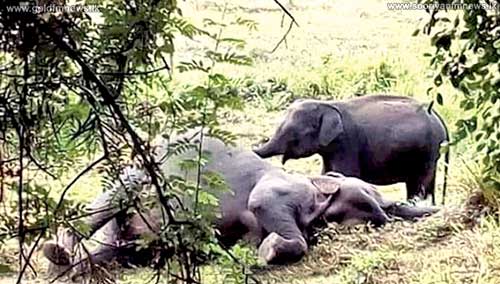
By Rajitha Ratwatte
I am told that our new President is going to make another attempt to handle the burning issue of the human-elephant conflict (HEC). I have nothing but good wishes for his attempts and to those well qualified academics who have been appointed to a committee to handle the task. Engaging the groves of academe in the task is well and good, but please remember that practical experience in handling elephants is essential.
The following are extracts from my book; they deal with HEC as I see it and the hard problem of how we are going to reduce the wild elephant population of our country. It is undisputable that the Pearl has too many wild elephants and since reducing humans is not really possible; the elephant numbers have to come down.
Fortunately, we have a proven method, that needs some improvement for sure but is a real alternative to culling entire herds which is the method followed in the African countries. Happy reading dear readers!
“The human-elephant conflict in a country with a growing population and a level of politically patronized corruption that does not allow the implementation of conservation laws. A Chena cultivator stakes his future and the future of his entire family on a crop that gets raided by a marauding elephant a few days before harvest. The entire crop is ruined, and the farmer faces destitution. Can the farmer be blamed for trying his best to keep the elephants out? This leads to horrendous wounds on both sides and slow lingering death from gangrene or poison, for the elephants.
“The fact that the cultivation is inside a buffer zone of a national park or in some cases actually inside the demarcated zone for a national park can be blamed on local vote grabbing political patronage …. but what else is new!
In such a situation we have a real alternative to culling. We in this land that has been thrice blessed, have an ancient art that has been passed down for thousands of years. We know how to domesticate elephants and these elephants can support up to two families each. The people who look after elephants learn a trade, they are not unskilled workers and they have a life of dignity. If they take any pride in their craft the elephant too lives free of gunshot wounds, semi starvation and trauma and lack of sleep.
“Why are the politicians and the greenies blocking this? It can’t be lack of knowledge. Some of the leading politicians of this country come from families that have had elephants. Surely, even though their skills and aptitudes turned them towards one of the more questionable professions in this world, they have some memories? Anyone who has had the privilege of earning the trust of an elephant will never ever forget that. If they have never experienced it how can they speak with authority and make decisions if they don’t know the subject?”
Next is an extract from some actual trapping of elephants that I was privileged to watch and participate in:
“This herd lived in a tiny pocket of jungle surrounded by rice fields. The land had been cleared without getting the elephants out and therefore the animals had to compete with humans for food and water. The only way the elephants could live was to raid the cultivation and during the rice harvesting season it was an absolute nightmare. First, we went to the area and set up camp. There was no sleep in the night! All you heard was the shouting of men, the exploding of firecrackers and gunshots and the screams of angry elephants. It was like the soundtrack for Dante’s description of hell. Everyday there were reports of human and elephant casualties and some of the methods used by farmers to defend their crops were unbelievable. May I hasten to add that when one saw the conditions under which those farmers lived and realised that one raid from a herd of elephants meant the total loss of a crop for that season, a farmer was perfectly justified in defending his corp. My opinion is that it should have been the politicians’ who settled farmers on those lands in order to garner votes that should have been poisoned and shot!
“Poisoned fruit, trap guns that maimed horribly, pouring acid and boiling oil onto the backs of elephants from watch huts on top of trees and using six-inch nails driven into planks that when lodged in an elephant’s foot caused gangrene, were only some of the methods used. All this because the elephant was a “protected” animal and most of the guns that belonged to farmers had been confiscated by the authorities with the advent of war. To any sane man it was obvious that actually culling those elephants would have been much more merciful that subjecting them to what was and is still happening. We, in our country actually had an alternative. We knew how to trap, and train elephants and these elephants would provide a vocation and a means of livelihood for two families per elephant but there was politics and the “greenies” to consider. This was the only occasion that something would be considered on these lines and since it had a rather sticky ending, I fear those elephants are condemned to die slowly. It still pains me to think of what was done to us and how the project ended but I will not bore the reader with another anecdote of politics from the third world. This is supposed to be a book dedicated with love to elephants and I will describe the methods used by the traditional elephant trappers of Ceylon.
“The trappers arrived (not in loincloths) with their trusty ropes and we accompanied them on their initial recce of the territory. We were fortunate enough to encounter the herd of elephants resting in a small forest area and immediately the Pannikyars’ were transformed. “Civilised” attire vanished and loincloths appeared like magic. The oldest among them a gnarled veteran of indiscriminate age, said he would go in among the herd and come back to us with a report of how many animals were there and if there were any animals that were suitable for capture. We had permission to capture a few cow elephants to form the nucleus of a team of Monitor elephants that would be used in future plans to translocate pocketed animals. We needed half grown cows around 4-5-foot-tall as these were the best for training. The old man disappeared, and we sat in the shade, in the growing heat, waiting for a report. We all had one ear cocked for an elephantine scream, followed by a nasty thud and the resulting mayhem. Just as we were beginning to get worried the old man materialised, seemingly from the foot of the tree and he had good news, there were suitable animals and we could set our traps.
“We had a further advantage because this herd of wild elephants was actually trapped inside this pocket of forest because (can you believe it!) There was a musical concert going on in the adjoining village and the elephants’ only exit route was blocked by a noisy screaming bunch of music fans.
“The trap itself is basically a noose made of specially cured Sambhar hide. One end of which is tied securely to a stout tree and the noose end is connected to a weighted pulley which hangs from a branch of the same tree and buried in a shallow trench the size of the foot of the animal you wish to capture; remember the formula is 2xcircumferance of the fore-foot gives you the height at the shoulder). All this is then cleverly camouflaged and covered with thin twigs and earth. This ensures that when the elephant’s foot goes in the twigs give way, this then releases a crude spring mechanism that lifts the noose up the leg of the animal and tightens the noose. The elephant is then effectively tied to the tree and unable to free itself. The rope is so strong that even though elephants are known to have knelt down and bitten it with their immensely powerful jaws, it has held up.
“I followed the old man because I knew that he was the master. Everyone used the elephant paths to locate their traps in because when a herd is moving the majority of animals use the well-beaten path and consequently your chances of success increase. While assisting the old man, we got talking and he told me, “There is a lovely young princess (a high caste calf) and she even has tushes (very rare among female elephants in our country) shall we set a trap for her?” I couldn’t believe my ears. To get a female with tushes from whom it was possible to breed that most valuable of animals a tusker, was a fantastic bonus and I said, “Let’s do it,” thinking to myself that I would somehow arrange for permission because it was vital to save those genes from the terrible fate they were destined to. I was also a little skeptical as to how this man was going to set a trap for a specific animal although I didn’t dare ask.
“The old man selected a stout teak tree that grew in the middle of the elephant path. It had a fairly low branch about four feet of the ground on one side and no low branches on the other side. The path went around this tree and there was thick thorn bush on either side of the path at this point. Sulaiman selected a point under the low branch and began to set his trap. I couldn’t contain my curiosity anymore and was about to ask him why he had selected that spot when he began to explain. I think he was reasoning out to himself more than telling me. I was just a fortunate bystander. “The mother leads the herd and she will come first”. “The calf (or the child as he called it) will be close at heel and the adult will pick the easy path and not go under the low branch. The calf trying to keep at heel and getting jostled by the rest of the herd will take the route under the short branch as it is no obstruction to her and then she will be ours.” This is how this now dead master of his art put it. That is exactly how “Kiri” came into our lives!
“Rani and Khadira (two tame elephants) had been brought to the camp to assist in moving the captured animals as we still did not accept the use of tranquilizers. It was the age-old belief that a couple of good monitor elephants did the job with the least trauma to the new captives. Rani adopted Kiri immediately and although she didn’t have a calf at the time she actually came into milk and was feeding Kiri with mother’s milk (not really necessary at Kiri’s age) during her training and initiation into our lives.”
Below is an account of the training:
“We picked a coconut estate that belonged to my uncle, in a fairly remote area with good access to a river and plenty of room for stabling elephants to introduce Kiri to living with humans. We found Kiri in a terrible state. She was riddled with ticks and full of internal parasites. This little elephant calf had also been shot at and there was buckshot all over her body. She was so weak that when she lay down, she needed help to get up again and when she got any food, she ate so fast that it was obvious that she had been brought up on a diet of food snatched from angry cultivators. Kiri would probably have died if she had remained in the wild under those conditions. Even though we had Kiri forcibly removed from us by the politicians of the day, it was nice to know that we had rescued even one of that ill-fated herd of elephants.
“The first thing to do was to simply sit with Kiri and talk to her some of the “pannikayar” sang to her and get her to realise that all humans didn’t hate her. Of course, we also fed her with all kinds of tasty morsels, the treacle from the “kithul” flower and the “juggery”, which is the solidified form of this same product, were the most popular. Having Rani was also very helpful because she was able to communicate, and no doubt explain a few things to Kiri once her initial terror wore off. Rani, as mentioned earlier, was imminently sensible and although all elephants long for the wild—it is so obvious when working with elephants in the vicinity of wild herds—they do form a very good relationship with humans and more often than not adapt and settle down very well. The way I look at it is how we humans (originally hunter gatherers) have adapted to the “rat race”. It is essential to have good (sensible) monitor elephants when training wild ones as this makes a huge difference to the end product. I feel that ‘sensible’ monitor elephants explain the situation to their charges in the correct way and shape a correct attitude by the trainee. Rani however went silly over her charge. She, practical, sensible, down to earth Rani started lactating and decided that the calf was hers. Kiri was quick to realise that she could manipulate Rani and took advantage of every opportunity.
“Kiri hated bath time. Very strange in elephants because they usually relish bathing. This could only have been attributed to the fact that the pocketed herd that Kiri was part of, had to share their water source with humans and bathing was always fraught with danger. Usually, if you let an elephant off in a river it would “dive” straight in and lie down and roll around and it would be very difficult to get the elephant out again. With Kiri it was different. She would stand in the water petrified and try to find a way of getting out as soon as possible. However, to keep an elephant fit and healthy it is necessary to have them lie in water and we also used to give them a good scrub when they did lie down. This was the way to keep parasites off their bodies. Kiri wouldn’t lie down, and we had to make her do it. What ensued was the equivalent of a rugby union ruck, followed by a rolling maul and a total collapse. We had to physically tackle Kiri and get her down on her side, of course she resisted strongly and would accompany her struggles with loud bellows and Rani in spite of all her good sense would get up and come running to help with loud cries of her own.
Bath time would attract the whole village and we even had a request from the local school principal to have bath time after 1.30 PM as this was the time his school sessions were over for the day and he was having terrible trouble with truancy during the last period … Rani was so well trained and we were so sure of her that in spite of the noise and her physical presence she never actually intervened and, therefore, she was no threat. However, Khadira had to be used for the actual training because there was little room for sentimentality when training a good working elephant.
“Initially, Kiri was tied to Khadira by a rope attached to both elephant’ shoulders. This meant that Kiri was compelled to do everything Khadira did and she also learned to associate the commands that Khadira obeyed with the relevant action. They would go off on long walks in the countryside and Kiri did try her charms on her venerable teacher but the “old man” would have none of it. She tried everything, wriggling under the bull’s stomach and trying to entangle the guide rope on his legs and maybe trip him up. Kiri soon learnt that it was a waste of time to try to go the other way when Khadira was obeying an order and standing still really meant STANDING STILL. If the bull wanted to, he could easily have jerked the little calf off her feet and some have been known to strike them with their trunks and even kill them. Khadira was the best of the best. Wonderfully patient and so obedient! He just stood there with just the correct resistance on the rope and his trunk tucked into his mouth so that even if he was tempted… he could resist. Soon this attitude filtered down to the trainee and all unnecessary activities ceased and we had an obedient controlled young elephant so much so that after only a week or two we had Kiri walking all over the town and holding her own on the roads with buses horning at her and of course people falling in love with her. Kiri must have been fed by one in two people who saw her, and they would have little offerings of bananas and other fruit waiting for her when she went on her walks. The hill country villages of Ceylon love their elephants and some even worships them as elephants are associated with the Hindu god Ganesh.
“Kiri and Khadira got so used to each other that on the first occasion that Kiri was taken to have a look at what working was all about she went hitched to Khadira in the usual way and at the place of work she was unhitched and Khadira wheeled off to the right to get to work. The little trainee didn’t realise that she had been unhitched, for it was Khadira’s end of the rope that had been removed and she wheeled in perfect time keeping an even pressure on the guide rope! Of course, we all fell about laughing and Kiri looked rather hurt.
Politics intervened, and our project was deemed another elitist venture and we were accused of murdering some elephants in a cruel manner. One day the long arm of the law came to our estate and ordered us to load Kiri onto a lorry for transport to a life of drudgery in an “elephant orphanage”. Kiri wouldn’t go, and it was I, with a breaking heart and Rani, who had to guide her onto the lorry and she bellowed and cried as the lorry was driving away. Rani’s cries that day were so terrible, and I never want to hear an elephant cry like that ever again. There was nothing I could do, so I hugged her trunk and I wept unashamedly until I found Rani comforting me with the gentle rumbling call that a cow elephant makes to her calf to tell it that “things will be alright because mother knows best”. It took the wisdom of this matriarch of elephants to point out to a humble human that life is cruel and sometimes we have no control of what is to happen to us”.
fromoutsidethepearl@gmail.com



Coordinated suicide attacks targeted three churches—St. Anthony’s in Colombo, St. Sebastian’s at Katuwapitiya and Zion Church in Batticaloa—along with popular tourist hotels Shangri-La, Kingsbury, and Cinnamon Grand. No less a person than His Eminence Archbishop of Colombo Rt. Rev. Malcolm Cardinal Ranjith is on record as having said that the carnage could have been averted if the Yahapalana government shared the available Indian intelligence warning with him. Yahapalana Minister Harin Fernando publicly admitted that his family was aware of the impending attack and the warning issued to senior police officers in charge of VVIP/VIP security is evidence that all those who represented Parliament at the time knew of the mass murder plot. Against the backdrop of Indian intelligence warning and our collective failure to act on it, it would be pertinent to ask the Indians whether they knew the Easter Sunday operation was to facilitate Gotabaya Rajapaksa’s victory at the 2019 presidential poll. Perhaps, a key to the Easter Sunday conspiracy is enigma Sara Jasmin (Tamil girl from Batticaloa converted to Islam) whose husband Atchchi Muhammadu Hasthun carried out the attack on St. Sebastian’s Church, Katuwapitiya
By Shamindra Ferdinando
Pivithuru Hela Urumaya (PHU) leader Udaya Gammanpila’s Pasku Praharaye Mahamolakaru Soya Yema (Searching for the mastermind behind the Easter Sunday attacks) inquired into the 2019 April 21 Easter Sunday carnage. The former Minister and Attorney-at-Law quite confidently argued that the mastermind of the only major post-war attack was Zahran Hashim, one of the two suicide bombers who targeted Shangri-la, Colombo.
Gammanpila launched his painstaking work recently at the Sambuddhathva Jayanthi Mandiraya at Thummulla, with the participation of former Presidents Gotabaya Rajapaksa, who had been accused of being the beneficiary of the Easter Sunday carnage at the November 2019 presidential election, and Maithripala Sirisena faulted by the Presidential Commission of Inquiry (PCoI) that probed the heinous crime. Rajapaksa and Sirisena sat next to each other, in the first row, and were among those who received copies of the controversial book.
PCoI, appointed by Sirisena in September, 2019, in the run-up to the presidential election, in its report submitted to President Gotabaya Rajapaksa, in February, 2020, declared that Sirisena’s failure as the President to act on ‘actionable intelligence’ exceeded mere civil negligence. Having declared criminal liability on the part of Sirisena, the PCoI recommended that the Attorney General consider criminal proceedings against former President Sirisena under any suitable provision in the Penal Code.
PCoI’s Chairman Supreme Court Judge Janak de Silva handed over the final report to President Rajapaksa on February 1, 2021 at the Presidential Secretariat. Gotabaya Rajapaksa received the first and second interim reports on 20 December and on 2 March, 2020, respectively.
The Commission consists of the following commissioners: Justice Janak De Silva (Judge of the Supreme Court and Chairman of the Commission), Justice Nissanka Bandula Karunarathna (Judge of the Court of Appeal), Justice Nihal Sunil Rajapakse (Retired Judge of the Court of Appeal), Bandula Kumara Atapattu (Retired Judge of the High Court) and Ms W.M.M.R. Adikari (Retired Ministry Secretary).
H.M.P. Buwaneka Herath functioned as the Secretary to the PCoI.
It would be pertinent to mention that the Archbishop of Colombo Malcolm Cardinal Ranjith, declined an opportunity offered by President Rajapaksa to nominate a person for the PCoI. The Church leader asserted such a move would be misconstrued by various interested parties. Both the former President and Archbishop of Colombo confirmed that development soon after the presidential election.
Having declared its faith in the PCoI and received assurance of the new government’s intention to implement its recommendations, the Church was taken aback when the government announced the appointment of a six-member committee, chaired by Minister Chamal Rajapaksa, to examine the PCoI and recommend how to proceed. That Committee included Ministers Johnston Fernando, Udaya Gammanpila, Ramesh Pathirana, Prasanna Ranatunga and Rohitha Abeygunawardena.
The Church cannot deny that their position in respect of the Yahapalana government’s pathetic failure to thwart the Easter Sunday carnage greatly influenced the electorate, and the SLPP presidential candidate Gotabaya Rajapaksa directly benefited. Alleging that the Archbishop of Colombo played politics with the Easter Sunday carnage, SJB parliamentarian Harin Fernando, in June 2020, didn’t mince his words when he accused the Church of influencing a decisive 5% of voters to back Gotabaya Rajapaksa. At the time that accusation was made about nine months before the PCoI handed over its report, President Rajapaksa and the Archbishop of Colombo enjoyed a close relationship.
The Church raised the failure on the part of the government to implement the PCoI’s recommendations six months after President Rajapaksa received the final report.
The National Catholic Committee for Justice to Eastern Sunday Attack Victims, in a lengthy letter dated 12 July 2021, demanded the government deal with the following persons for their failure to thwart the attacks. The Committee warned that unless the President addressed their concerns alternative measures would be taken. The government ignored the warning. Instead, the SLPP adopted delaying tactics much to their disappointment and the irate Church finally declared unconditional support for the US-India backed regime change project.
Sirisena and others
On the basis of the 19th Chapter, titled ‘Accountability’ of the final report, the Committee drew President Rajapaksa’s attention to the following persons as listed by the PCoI: (1) President Maithripala Sirisena (2) PM Ranil Wickremesinghe (3) Defence Secretary Hemasiri Fernando (4) Chief of National Intelligence Sisira Mendis (5) Director State Intelligence Service Nilantha Jayawardena.
The 20th Chapter, titled ‘Failures on the part of law enforcement authorities’ in the Final report (First Volume), identified the following culprits ,namely IGP Pujith Jayasundera, SDIG Nandana Munasinghe (WP), Deshabandu Tennakoon (DIG, Colombo, North), SP Sanjeewa Bandara (Colombo North), SSP Chandana Atukorale, B.E.I. Prasanna (SP, Director, Western province, Intelligence), ASP Sisira Kumara, Chief Inspector R.M. Sarath Kumarasinghe (Acting OIC, Fort), Chief Inspector Sagara Wilegoda Liyanage (OIC, Fort)., Chaminda Nawaratne (OIC, Katana), State Counsel Malik Azeez and Deputy Solicitor General Azad Navaavi.
The PCoI named former Minister and leader of All Ceylon Makkal Congress Rishad Bathiudeen, his brother Riyaj, Dr Muhamad Zulyan Muhamad Zafras and Ahamad Lukman Thalib as persons who facilitated the Easter Sunday conspiracy, while former Minister M.L.A.M. Hisbullah was faulted for spreading extremism in Kattankudy.
Major General (retd) Suresh Sallay, who is now in remand custody, under the CID, for a period of 90 days, in terms of the prevention of Terrorism Act (PTA) ,was not among those named by the PCoI. Sallay, who served as the head of the Directorate of Military Intelligence (DMI/from 2012 to 2016) was taken into custody on 25 February and named as the third suspect in the high profile investigation. (Interested parties propagated that Sallay was apprehended on the basis of UK’s Channel 4 claim that the officer got in touch with would-be Easter Sunday bombers, including Zahran Hashim, with the help of Sivanesathurai Chandrakanthan, alias Pilleyan. However, Pilleyan who had been arrested in early April 2025 under PTA was recently remanded by the Mount Lavinia Magistrate’s Court, pending the Attorney General’s recommendations in connection with investigations into the disappearance of a Vice Chancellor in the Eastern Province in 2006. There was absolutely no reference to the Easter Sunday case)
The Church also emphasised the need to investigate the then Attorney General Dappula de Livera’s declaration of a ‘grand conspiracy’ behind the Easter Sunday carnage. The Church sought answers from President Rajapaksa as to the nature of the grand conspiracy claimed by the then AG on the eve of his retirement.
Sallay was taken into custody six years after the PCoI handed over its recommendations to President Rajapaksa and the appointment of a six-member parliamentary committee that examined the recommendations. The author of Pasku Praharaye Mahamolakaru Soya Yema, Gammanpila, the only lawyer in the six-member PCoI, should be able to reveal the circumstances that committee came into being.
Against the backdrop of the PCoI making specific recommendations in respect of the disgraced politicians, civilian officials and law enforcement authorities over accountability and security failures, the SLPP owed an explanation regarding the appointment of a six-member committee of SLPPers. Actually, the SLPP owed an explanation to Sallay whose arrest under the PTA eight years after Easter Sunday carnage has to be discussed taking into consideration the failure to implement the recommendations.
Let me briefly mention PCoI’s recommendations pertaining to two senior police officers. PCoI recommended that the AG consider criminal proceedings against SDIG Nandana Munasinghe under any suitable provision in the Penal Code or Section 82 of the Police Ordinance (Final report, Vol 1, page 312). The PCoI recommended a disciplinary inquiry in respect of DIG Deshabandu Tennakoon. The SLPP simply sat on the PCoI recommendations.
Following the overthrow of President Rajapaksa by a well-organised Aragalaya mob in July 2022, the SLPP and President Ranil Wickremesinghe paved the way for Deshabandu Tennakoon to become the Acting IGP in November 2023. Wickremesinghe went out of his way to secure the Constitutional Council’s approval to confirm the controversial police officer Tennakoon’s status as the IGP.
Some have misconstrued the Supreme Court ruling, given in January 2023, as action taken by the State against those named in the PCoI report. It was not the case. The SC bench, comprising seven judges, ordered Sirisena to pay Rs 100 mn into a compensation fund in response to 12 fundamental rights cases filed by families of the Easter Sunday victims, Catholic clergy and the Bar Association of Sri Lanka. The SC also ordered ex-IGP Pujith Jayasundara and former SIS head Nilantha Jayawardene to pay Rs. 75m rupees each, former Defence Secretary Hemasiri Fernando Rs. 50 million and former CNI Sisira Mendis Rs. 10 million from their personal money. All of them have been named in the PCoI report. As previously mentioned, Maj. Gen. Sallay, who headed the SIS at the time of the SC ruling that created the largest ever single compensation fund, was not among those faulted by the sitting and former justices.
Initial assertion
The Archbishop of Colombo, in mid-May 2019, declared the Easter Sunday carnage was caused by local youth at the behest of a foreign group. The leader of the Catholic Church said so in response to a query raised by the writer regarding a controversial statement made by TNA MP M. A. Sumanthiran. The Archbishop was joined by Most Ven Ittapane Dhammalankara Nayaka Thera of Kotte Sri Kalyani Samagri Dharma Maha Sangha Sabha of Siyam Maha Nikaya. They responded to media queries at the Bishop’s House, Borella.
The Archbishop contradicted Sumanthiran’s claim that the failure on the part of successive governments to address the grievances of minorities over the past several decades led to the 2019 Easter Sunday massacre.
Sumanthiran made the unsubstantiated claim at an event organised to celebrate the first anniversary of the Sinhala political weekly ‘Annidda,’ edited by Attorney-at-Law K.W. Janaranjana at the BMICH.
The Archbishop alleged that a foreign group used misguided loyal youth to mount the Easter Sunday attacks (‘Cardinal rejects TNA’s interpretation’, with strap line ‘foreign group used misguided local youth’, The Island, May 15, 2019 edition).
Interested parties interpreted the Easter Sunday carnage in line with their thinking. The writer was present at a special media briefing called by President Sirisena on 30 April, 2019 at the President’s House where the then Northern Province Governor Dr. Suren Raghavan called for direct talks with those responsible for the Easter Sunday massacre. One-time Director of the President’s Media Division (PMD) Dr. Raghavan emphasised that direct dialogue was necessary in the absence of an acceptable mechanism to deal with such a situation. Don’t forget Sisisena had no qualms in leaving the country a few days before the attacks and was away in Singapore when extremists struck. Sirisena arrived in Singapore from India.
The NP Governor made the declaration though none of the journalists present sought his views on the post-Easter Sunday developments.
During that briefing, in response to another query raised by the writer, Army Commander Lt. Gen. Mahesh Senanayake disclosed that the CNI refrained from sharing intelligence alerts received by the CNI with the DMI. Brigadier Chula Kodituwakku, who served as Director, DMI, had been present at Sirisena’s briefing and was the first to brief the media with regard to the extremist build-up leading to the Easter Sunday attacks.
The collapse of the Yahapalana arrangement caused a security nightmare. Frequent feuds between Yahapalana partners, the UNP and the SLFP, facilitated the extremists’ project. The top UNP leadership feared to step in, even after Justice Minister Dr. Wijeyadasa Rajapaksha issued a warning in Parliament, in late 2016, regarding extremist activities and some Muslim families securing refuge in countries dominated by ISIS. Instead of taking tangible measures to address the growing threat, a section of the UNP parliamentary group pounced on the Minister.
The UNP felt that police/military action against extremists may undermine their voter base. The UNP remained passive even after extremists made an abortive bid to kill Thasleem, Coordinating Secretary to Minister Kabir Hashim, on 8 March 2019. Thasleem earned the wrath of the extremists as he accompanied the CID team that raided the extremists’ facility at Wanathawilluwa. The 16 January 2019 raid indicated the deadly intentions of the extremists but PM Wickremesinghe was unmoved, while President Sirisena appeared clueless as to what was going on.
Let me reproduce the PCoI assessment of PM Wickremesinghe in the run-up to the Easter Sunday massacre. “Upon consideration of evidence, it is the view of the PCoI that the lax approach of Mr. Wickremesinghe towards Islamic extremists as the Prime Minister was one of the primary reasons for the failure on the part of the then government to take proactive steps towards tackling growing extremism. This facilitated the build-up of Islam extremists to the point of the Easter Sunday attack.” (Final report, Vol 1, pages 276 and 277).
The National Catholic Committee for Justice to Easter Sunday Attack Victims, in its letter dated 12 July, 2021, addressed to President Rajapaksa, questioned the failure on the part of the PCoI to make any specific recommendations as regards Wickremesinghe. Accusing Wickremesinghe of a serious act of irresponsibility and neglect of duty, the Church emphasised that there should have been further investigations regarding the UNP leader’s conduct.
SLPP’s shocking failure
The SLPP never made a serious bid to examine all available information as part of an overall effort to counter accusations. If widely propagated lie that the Easter Sunday massacre had been engineered by Sallay to help Gotabaya Rajapaksa win the 2019 presidential poll is accepted, then not only Sirisena and Wickremesinghe but all law enforcement officers and others mentioned in the PCoI must have contributed to that despicable strategy. It would be interesting to see how the conspirators convinced a group of Muslims to sacrifice their lives to help Sinhala Buddhist hardliner Gotabaya Rajapaksa to become the President.
Amidst claims, counter claims and unsubstantiated propaganda all forgotten that a senior member of the JVP/NPP government, in February 2021, when he was in the Opposition directly claimed Indian involvement. The accusation seems unfair as all know that India alerted Sri Lanka on 4 April , 2019, regarding the conspiracy. However, Asanga Abeygoonasekera, in his latest work ‘Winds of Change’ questioned the conduct of the top Indian defence delegation that was in Colombo exactly two weeks before the Easter Sunday carnage. Abeygoonasekera, who had been a member of the Sri Lanka delegation, expressed suspicions over the visiting delegation’s failure to make reference to the warning given on 4 April 2019 regarding the plot.
The SLPP never had or developed a strategy to counter stepped up attacks. The party was overwhelmed by a spate of accusations meant to undermine them, both in and outside Parliament. The JVP/NPP, in spite of accommodating Mohamed Yusuf Ibrahim, father of two Easter Sunday suicide bombers Ilham Ahmed Ibrahim (Shangila-la) and Imsath Ahmed Ibrahim (Cinnamon Grand), in its 2015 National List was never really targeted by the SLPP. The SLPP never effectively raised the possibility of the wealthy spice trader funding the JVP to receive a National List slot.
The Catholic Church, too, was strangely silent on this particular issue. The issue is whether Mohamed Yusuf Ibrahim had been aware of the conspiracy that involved his sons. Another fact that cannot be ignored is Attorney-at-Law Hejaaz Hizbullah who had been arrested in April 2020 in connection with the Easter Sunday carnage but granted bail in February 2022 had been the Ibrahim family lawyer.
Hejaaz Hizbullah’s arrest received international attention and various interested parties raised the issue.
The father of the two brothers, who detonated suicide bombs, was granted bail in May 2022.
Eric Solheim, who had been involved in the Norwegian-led disastrous peace process here, commented on the Easter Sunday attacks. In spite of the international media naming the suicide bombers responsible for the worst such atrocity Solheim tweeted: “When we watch the horrific pictures from Sri Lanka, it is important to remember that Muslims and Christians are small minorities. Muslims historically were moderate and peaceful. They have been victims of violence in Sri Lanka, not orchestrating it.”
That ill-conceived tweet exposed the mindset of a man who unashamedly pursued a despicable agenda that threatened the country’s unitary status with the connivance of the UNP. Had they succeeded, the LTTE would have emerged as the dominant political-military power in the Northern and Eastern Provinces and a direct threat to the rest of the country.

At present, the world stands in the midst of a transitional and turbulent phase, characterised by heightened uncertainty and systemic flux, reflecting an ongoing transformation of the modern global order. The existing global order, rooted in the US hegemony, shows unmistakable signs of decay, while a new and uncertain global system struggles to be born. In such moments of profound transformation, as Antonio Gramsci observed, morbid symptoms proliferate across the body politic. From a geopolitical perspective, the intensifying coordinated aggression of the United States and Israel against Iran is not merely a regional crisis, but an acceleration of a deeper structural transformation in the international order. In this context, the conduct of Donald Trump appears less as an aberration and more as a morbid symptom of a declining US-led global order. As Amitav Acharya argues in The Once and Future World Order (2025), the emerging global order may well move beyond Western dominance. However, the pathway to that future is proving anything but orderly, shaped instead by disruption, unilateralism, and the unsettling symptoms of a system in transition.
Origins of the Conflict
To begin with, the origins and objectives of the parties to the present armed confrontation require unpacking. In a sense, the current Persian Gulf crisis reflects a convergence of long-standing geopolitical rivalries and evolving security dynamics in the Middle East. The roots of tension between the West and the Middle East can be traced back to earlier historical encounters, from the Persian Wars of classical antiquity to the Crusades of the medieval period. A new phase in the region’s political trajectory commenced in 1948 with the establishment of Israel—widely perceived as a Western enclave within the Arab world—and the concurrent displacement of approximately 700,000 Palestinians from their homeland. Since then, Israel has steadily consolidated and expanded its territory, a process that has remained a persistent source of regional instability. The Iranian Revolution introduced a further layer of complexity, fundamentally reshaping regional alignments and ideological contestations. In recent years, tensions between Israel and the United States on one side and Iran on the other have steadily intensified. The current phase of the conflict, however, was directly triggered by coordinated U.S.–Israeli airstrikes on both civilian and military targets on 28 February 2026, which, as noted in a 2 April 2026 statement by 100 international law experts from leading U.S. universities, constituted a clear violation of the UN Charter and International Humanitarian Law (IHL).
Objectives and Strategic Aims
Israel’s strategic objective appears to be directed toward the systematic and total destruction of Iran’s military, nuclear, and economic capabilities, driven by the perception that Iran remains the principal obstacle to its security and its pursuit of regional primacy. Israel was aware that Iran did not possess a nuclear weapon at the time; however, its nuclear programme remained a subject of international contention, with competing assessments regarding its ultimate intent and potential for weaponisation.
The United States, for its part, appears to be pursuing more targeted political and strategic objectives, including eventual transformation of Iran’s current political regime. Washington has long regarded the Iranian leadership as fundamentally antagonistic to U.S. interests in the Middle East. In this context, the United States may seek to enhance its strategic leverage over Iran, including in relation to its substantial oil and gas resources, a point underscored in recent statements by Donald Trump. It must be noted, however, successive U.S. administrations since 1979 have avoided direct large-scale military confrontation with Iran, preferring instead a combination of sanctions, diplomatic pressure, and indirect military engagement.
The positions of other Arab states in the Persian Gulf are shaped by a combination of security calculations, sectarian considerations, and broader geopolitical alignments. While several Gulf Cooperation Council (GCC) members, notably Saudi Arabia and United Arab Emirates, have expressed tacit support for measures that counter Iranian regional influence, their involvement remains calibrated to avoid direct military confrontation. Their position is informed by the belief that Iran provides backing to militant non-state actors, including Hezbollahs in the West Bank and the Houthis in Southern Yemen, which they view as destabilising forces in the region. These states are balancing competing priorities: the desire to curb Iran’s power projection, maintain strong security and economic ties with the United States, and preserve domestic stability. At the same time, countries such as Oman and Qatar have adopted more neutral or mediating stances, emphasizing diplomatic engagement and conflict de-escalation.
Militarily, Iran is not positioned to match the combined military capabilities of U.S.–Israeli forces. Nevertheless, it retains significant asymmetric leverage, particularly through its capacity to influence global energy flows. Control over critical maritime chokepoints, most notably the Strait of Hormuz, provides Tehran with a potent strategic instrument to disrupt global oil supply. Iranian leadership appears to view this leverage as a key pressure point, designed to compel global economic actors to push Washington and Tel Aviv toward a cessation of hostilities and a negotiated settlement. In this context, attacks on oil and gas infrastructure, shipping routes, and supply lines constitute central components of Iran’s survival strategy. As long as the conflict persists and energy flows through the Strait of Hormuz remain disrupted, the resulting instability is likely to generate severe repercussions across the global economy, increasing pressure on the United States to halt military operations against Iran.
Now entering its fifth week, the conflict continues to flare intensely, characterised by sustained and intensive aerial operations. Joint U.S.–Israeli strikes have reportedly destroyed substantial elements of Iran’s air and naval capabilities, as well as critical military and economic infrastructure. Nevertheless, Iran has retained the capacity to conduct guided missile strikes within Israel and against selected U.S. economic, diplomatic, and military assets across the Middle East, including reported long-range attacks on the U.S. facility at Diego Garcia in the Indian Ocean, approximately 4,000 kilometers from Iranian territory. Initial U.S. and Israeli strategic calculations—anticipating that a decisive initial strike and the targeted killing of Iranian Supreme Leader Ali Khamenei would precipitate regime collapse and popular uprising—have not materialized. On the contrary, the destruction of civilian facilities has strengthened anti-American sentiment and reinforced domestic support for the Iranian leadership. While Iran faced initial setbacks on the battlefield, it has achieved notable success in the international media front, effectively shaping global perceptions and advancing its propaganda objectives. By the fifth week, Tehran’s asymmetric strategy has yielded tangible results, including the downing of two U.S. military aircraft, F15E Strike Eagle fighter jet and A10 Thunderbolt II (“Warthog”) ground-attack aircraft , signaling the resilience and operational efficacy of Iran’s military power.
The Military Industrial Complexes and ProIsrael Lobby
Why did the United States initiate military action against Iran at this particular juncture? Joe Kent, who resigned in protest over the war, stated that available intelligence did not indicate an imminent Iranian capability to produce a nuclear weapon or pose an immediate threat to the United States. This assessment raises important questions about the stated objective of dismantling Iran’s nuclear programme, suggesting that it may have served to obscure broader strategic and economic considerations underpinning the intervention. To understand the timing and rationale of the U.S. intervention in the Persian Gulf, it is therefore necessary to examine the influence of two powerful domestic pressure groups: the military–industrial complex and the pro-Israel lobby.
The influence of the U.S. military–industrial complex on American foreign policy is most clearly manifested through the institutionalized “revolving door” between defense corporations and senior positions within the U.S. administration. Over the past two decades, key figures such as Lloyd Austin (Secretary of Defence, 2021–2025), a former board member of Raytheon Technologies, Mark Esper (Secretary of Defence 2019–2020), who previously served as a senior executive at the same firm, and Patrick Shanahan (2019) from Boeing exemplify the direct movement of personnel from industry into the highest levels of strategic decision-making. This circulation is complemented by influential policy actors such as Michèle Flournoy (Under Secretary of Defence Under President Obama) and Antony Blinken (Secretary of State 2021 to 2025, Deputy Secretary of State 2015 to 2017), whose engagement with consultancies like WestExec Advisors further blurs the boundary between public policy and private defense interests. This pattern appears to persist under the present Trump administration, where the interplay between defense industry interests and strategic policymaking continues to shape procurement priorities and threat perceptions. Consequently, the military–industrial complex operates not merely as an external pressure group but as an internalized component of the policy process, shaping U.S. foreign policy in ways that align strategic objectives with the structural and commercial interests of the defense sector. Armed conflicts may also generate substantial commercial opportunities, as increased military spending often translates into expanded profits for defense contractors.
The influence of the pro-Israel lobby on U.S. foreign policy is best understood as a dense network of advocacy organisations, donors, policy institutes, and political actors that shape both elite consensus and decision-making within successive administrations. At the center of this network is the American Israel Public Affairs Committee, widely regarded as one of the most effective lobbying organisations in Washington, which works alongside a broader constellation of groups and donors to sustain bipartisan support for Israel. This influence is reinforced through the presence of senior policymakers and advisors with strong ideological or institutional affinities toward Israel, including Donald Trump and Benjamin Netanyahu, whose close political alignment has translated into consistent diplomatic and strategic backing. Policy decisions—ranging from the recognition of Jerusalem as Israel’s capital to continued military assistance—reflect not only geopolitical calculations but also the domestic political salience of pro-Israel advocacy within the United States. Consequently, the pro-Israel lobby operates not merely as an external pressure group but as an embedded force within the policy ecosystem, shaping U.S. foreign policy in ways that sustain a strong and often unconditional commitment to Israeli security and strategic interests. A fuller explanation of U.S. policy toward Iran emerges when the influence of both the military–industrial complex and the pro-Israel lobby is considered together. These two forces, while distinct in composition and motivation, converge in reinforcing a strategic outlook that prioritises the identification of Iran as a central threat and legitimizes the use of coercive military instruments.
Global Economic Fallout
After five weeks of sustained conflict, the trajectory of the war suggests that Iran’s strategy of resilience and asymmetric resistance is yielding tangible effects. While the United States, alongside Israel, has inflicted significant damage on Iran’s economic and military infrastructure, it has not succeeded in eroding Tehran’s capacity—or resolve—to continue the conflict through unconventional means. At the same time, Washington appears to be encountering increasing difficulty in bringing the war to a decisive conclusion, even as signs of strain emerge in its relations with key European allies. Most importantly, the repercussions of the conflict are no longer confined to the battlefield: the unfolding crisis has generated a widening economic shock that is reverberating across global markets and supply chains. It is this broader international economic impact of the war that now warrants closer examination.
The Persian Gulf conflict is rapidly sending shockwaves through the global economy. At the forefront is the energy sector: even partial disruptions to oil and gas exports from the region are driving prices sharply higher, placing severe pressure on energy-importing economies in Europe and Asia and fueling inflation worldwide. Maritime trade is also under strain, as heightened risk prompts longer shipping routes, increased freight rates, and rising war-risk premiums. These disruptions ripple through global supply chains, pushing up the cost of goods far beyond the energy sector.
Insurance costs for shipping and aviation are soaring as large zones are designated high-risk or even excluded from coverage, further elevating transport costs and pricing out smaller operators. Together, these pressures constitute a systemic economic shock: industrial production costs rise, supply chains fragment, and trade volumes contract, stressing manufacturing, logistics, and consumption simultaneously.
The cumulative effect is already slowing global growth. Major economies such as the EU, China, and India face slower expansion, while import-dependent states risk recession. Trade-driven sectors are contracting, reinforcing a scenario of high inflation and stagnating growth. Air travel is also impacted, with restricted airspace, higher fuel prices, and elevated insurance premiums driving up ticket costs and lengthening travel routes. Rising energy prices, logistics bottlenecks, and increased production costs are pushing up food prices and cost-of-living pressures, potentially forcing central banks into tighter monetary policy and slowing growth further.
Finally, global manufacturing—from chemicals and plastics to agriculture—is experiencing ripple effects as supply chain disruptions intensify shortages and price increases. The conflict in the Persian Gulf is thus not only a regional security crisis but also a catalyst for broad, interconnected economic disruptions that are reverberating across markets, trade networks, and everyday life worldwide.
(To be continued)

The hands faithfully ploughing the soil,
And looking to harvest the golden corn,
Are slowing down with hesitation and doubt,
For they are now being told by the top,
That what nations direly need most,
Are not so much Bread but Guns,
Or better still stealth bombers and drones;
All in the WMD stockpiles awaiting use,
Making thinking people realize with a start:
‘Mutually Assured Destruction’ or MAD,
Is now no longer an arid theory in big books,
But is upon us all here and now.
By Lynn Ockersz

Salt and Patidar power RCB past Mumbai Indians

Prasidh, Buttler set up comfortable win for Gujarat Titans

Heat Index at Caution level’ in the Northern, North-central, North-western, Western and Southern provinces and in Trincomalee district.

Showers above 75 mm are likely at some places in the Western, Sabaragamuwa, Central, Southern and North-western provinces.

Sun directly overhead Pesalai, Mankulam and Nedunkerny about 12:11 noon

PNS TAIMUR & ASLAT arrive in Colombo

‘Dates have the highest sugar content to fight Coronavirus’

Sunday Island 27 December – Headlines

#SundayIsland 17th December – Headlines

Sunday Island – 28th March

Sunday Island Headlines – 21 March

Sunday Island – 21st February – Headlines
-

 News6 days ago
Lankan-origin actress Subashini found dead in India
-

 News1 day ago
CEB orders temporary shutdown of large rooftop solar systems
-

 News4 days ago
AG: Coal procurement full of irregularities
-

 Business3 days ago
Israeli attack on Lebanon triggers local stock market volatility
-

 Business4 days ago
Hayleys Mobility introduces Premium OMODA C9 PHEV
-

 Business3 days ago
HNB Assurance marks 25 years with strategic transformation to ‘HNB Life’
-

 News6 days ago
UN Regional Director launches SL’s first Country Gender Equality Profile during official visit
-

 News6 days ago
Dialog Launches ‘GanuDenu QR’, Making Cashless Transfers Free for All with eZ Cash and Dialog Finance