
Sports
So brightly fades the skipper

by Rex Clementine
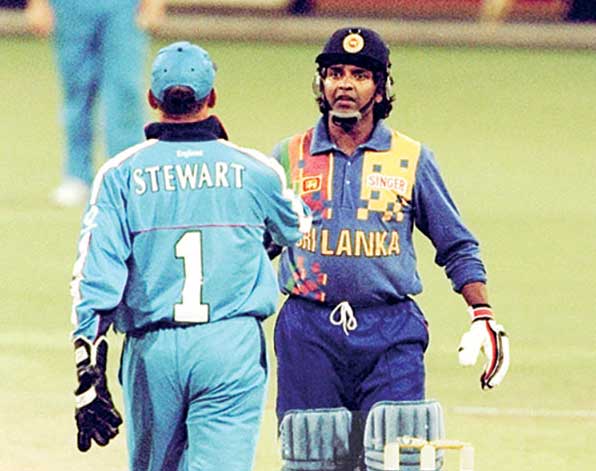
In Australia, they run cricket like a business. In Sri Lanka there was a man who ran cricket like a family. Arjuna Ranatunga is his name and on a day like this, 19 years ago, he retired from the game with his swansong being at the ground that has been home for him for many decades – SSC.
It was an end of an era. Arjuna captained 56 of the 93 Tests he played. He ran the sport with an iron fist.
There was one golden rule in cricket. Never cross Arjuna’s path. He only knew two ways; my way or the highway.
Those whom he thought had a future had to comply and he would back them come hell or high water. Take the case of Sanath Jayasuriya. He was the original ‘bits and pieces cricketer’ having managed just one half-century in his first 50 innings. But the faith and perseverance that Arjuna had shown was such that once he found his feet in the internatioanl arena, he unleashed hell ending the careers of many a cricketer from Manoj Prabhakar to Kabir Ali. They never played cricket again. Arjuna had created a monster.
Not all players he backed were successful. Pramodaya Wickremesinghe for example. He played in more games than the wickets he took! But for Arjuna those players who made the team into a family mattered, more than match winners. Even those who were average cricketers played for Sri Lanka; Eric Upashantha and Suresh Perera to name a few. The only reason they played was they were in the good books of the captain.
Pity those who didn’t fall in line with Arjuna’s thinking. They hardly got a look in. It mattered to him that everyone who took the field with him was on the same wavelength. If he’d asked them to go through a brick wall, they would do it.
Of course, Arjuna could bat. Test runs he has over 4000. Some 1000 more he walked to finish with over 5000 runs.
His battles with leading fast bowlers of his generation were a treat to watch. He was comfortable with pace. Rather than taking them apart, he relied on using the pace to his advantage; nudging boundaries through third man or fine-leg with those late cuts and flicks. Alan Donald or Waqar Younis, the quickest of his generation never bothered him. Wasim Akram with his swing did. Usually, when the opponent was better than him, Arjuna had another way to win the contest; to get under his skin.
Against spin; sweep was his staple diet. Easily, he was the best sweeper of his generation. Of course there was Waruna Waragoda. But he committed a blunder. He had crossed Arjuna’s path, during a mercantile game involving HNB and Union Assurance. And he never played for Sri Lanka.
Arjuna had this knack to identify good potential. He picked Mahela Jayawardene soon after school at the age of 20. Sanath Jayasuriya isn’t the only monster he created.
Arjuna is the only player to feature in a nation’s first Test and its 100th. In between he had missed a dozen Tests. He had his share of injuries but a fair share of fights with the establishment too for which he was axed. In the end, he finished on 93 Tests.
The Board’s CEO was his elder brother and his father was right-hand man of President Chandika Kumaratunga. Had he wished, he could have gone onto play 100 Test matches, becoming the first Sri Lankan to do so. Instead, he opted to go on his terms having played two stunning knocks just before retiring.
In his last tour, in Rawalpindi, Waqar left him with a broken thumb. With the side in peril, with a Test match to be won, Arjuna walked in having taken a pain killer injection and saw Sri Lanka over the line in what was one of the most exciting Test matches ever. He was tough like Allan Border, cunning like Diego Maradona and skillful like Michael Jordan.
Then in his penultimate Test at Asgiriya against Proteas when the team had collapsed to 133 for six chasing 177, he produced another masterclass scoring 88 runs. The old fox had not lost his guile.
He was too good a player to have not scored more than four Test hundreds. But then, in his generation only Aravinda had won more matches than him.
Not everyone agreed with Arjuna’s thinking. But he commands huge respect. Even today, if he tells his team mates to be at his house for a meal on Friday at 7pm, Asanka Gurusinha would make sure he flies all the way from Melbourne to be there on time.






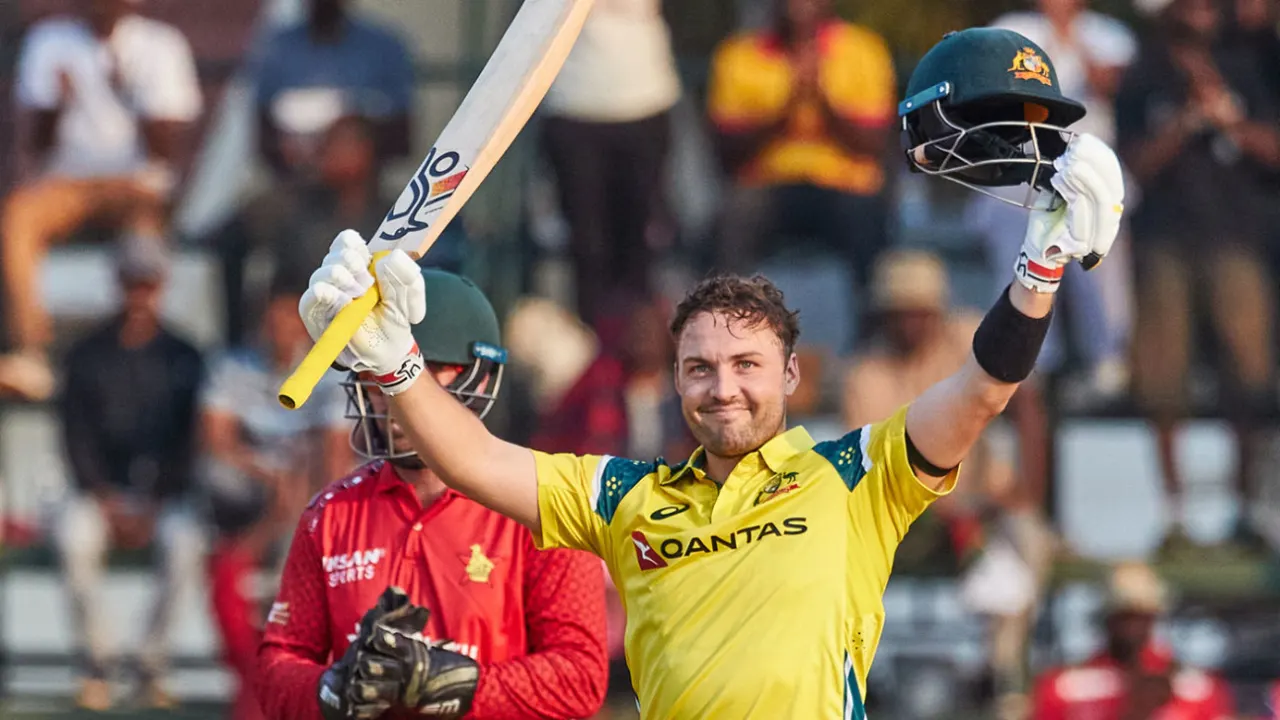
Australia concluded their first Zimbabwe tour after 12 years with a clean sweep of the hosts, who were unable to deliver a consolation win to a festive Harare crowd, as Nathan Ellis held his nerve alongside No. 11 Spencer Johnson in a match-winning tenth-wicket stand of 27. Zimbabwe do not have any internationals at home for the rest of the 2026 and, after posting their second-highest total batting first against Australia, saw the match slip from their grasp in the dramatic closing stages.
Pressure changed sides throughout the last quarter of the contest. Australia were cruising on 162 for 3 in the 26th over, when Brad Evans removed Alex Carey for the third of his four wickets and set the cat among the pigeons as wickets fell regularly. Josh Inglis was holding the chase together with his second ODI hundred but when he fell 45 were still needed. Then Ellis, who had earlier taken 3 for 50, put together a superbly-measured 36 not out to secure a thrilling win.
Their chase was built largely on the efforts of Inglis, who was the third Australian to reach a hundred in the series, after Matt Renshaw in the opening match and Travis Head in game two. In contrast, Zimbabwe did not have a century-marker, though Sikandar Raza and Craig Ervine scored two fifties each, including in this match and were the leading run scorers across the three matches.
Zimbabwe also had two of the three top bowlers and will know that it was in moments, not personnel terms, that they lost to Australia. In this match, there were four major ones. The first came when Innocent Kaia, batting well on 55, had to retire hurt with what looked like a hamstring injury to interrupt an 80-run fourth wicket stand with Ervine and stall Zimbabwe. The second was when Ervine, on 59, tried to accelerate with 10 overs left to go and holed out to long-on to spark a collapse of 4 for 22 which left Zimbabwe short of the 300 that was in their sights.
Then, in the field, Inglis, on 48, cut Ernest Masuku in the air to backward point and Wessly Madhevere leapt to his right but could not hold on. The drop proved costly even though Madhevere took a stunner to dismiss Carey. Madhevere’s biggest mistake was still to come. In the penultimate over when Ellis launched Masuku to deep midwicket, Madhevere got under the ball and spilled the chance.
With nine runs needed off the last six balls, Raza then gave Madhevere the ball, even though Graeme Cremer had an over in hand having caused problems in his first ODI in 2018. The first ball went for six and left Madhevere inconsolable at the end.
Inglis was in early after Evans struck twice in his first two overs. He had Head caught at deep backward square when he flicked off his pads and then found Mitchell Marsh’s inside edge to leave Australia were 25 for 2 in the fourth over. Inglis announced himself with a swivel pull that went for four and was brutal through the point area. He greeted Cremer’s return by sending his first ball – a full toss – through mid-on for four. But Cremer came back well and bowled Cooper Connolly with a classic leg break to announce his return in some style.
Inglis and Carey put on 85 for the fourth-wicket to keep Australia in control and Inglis’ big challenge came when Australia started to wobble. They were on 203 for 5 after 35 overs, 69 runs away from victory, and in the space of two overs Raza had Ollie Peake out lbw and Cremer got Xavier Bartlett with a googly. Then, Blessing Muzarabani was brought back to keep Australia under pressure and bounced Ellis, who fended him skywards but the chance fell out of Brendan Taylor’s reach. Muzarabani finished the series wicketless.
Inglis reached his century with a strong sweep against Cremer off his 94th ball and victory was still 55 runs away. When Raza bowled Inglis in the 42nd over, Zimbabwe were ahead in the contest but the management of their attack towards the end will raise questions. Muzarabani was bowled out after 44 overs and Evans with two overs to go. Cremer, despite his experience, was overlooked for his final over.
That won’t be the only area Zimbabwe will leave with questions. Their batting line-up underwhelmed in parts, especially after they chose to put runs on the board in the final match. They started off reasonably well and were on 34 without loss after six overs before their opening pair gave way.
Ben Curran’s poor returns in white-ball cricket continued when he gloved Johnson down leg and was caught behind for 7. His partner Brian Bennett didn’t fare much better. After showing promise with classy flicks off the pads and crunching pulls off short balls, Bennett skied a Ellis delivery to Head at midwicket to depart for 30. Bennett has not crossed 40 in his last eight ODI innings, despite getting several starts. Zimbabwe were 57 for 2 at the end of the powerplay.
Taylor took his time to get to a 16-ball nine before he was bowled by an Adam Zampa flipper and his form will also be a concern. Kaia, whose first runs had come off a thick inside edge, offered a chance on 27 when he was out of his crease early as Renshaw fired in a delivery down leg. Inglis fumbled and recovered but could not stump Kaia, who put the early jitters aside to play some classy strokes. He drove Renshaw through mid-on and pulled Johnson flat and hard to bisect the fielders in the deep. His fifty came just after the innings’ halfway mark, off 59 balls, and marked the first time he had crossed the milestone in 12 innings, since January 2023.
Kaia and Ervine got Zimbabwe into a good position and when Kaia retired on 148 for 3, it was up to Raza and Ervine to accelerate. They brought up the Zimbabwean 200 with 10 overs to go but the final flourish never came. Ervine was eager to up the ante but could not clear Renshaw at long-on and Madhevere sent an Ellis slower ball to cover to give Australia two wickets in two overs.
Evans showed glimpses of his finishing skills with back to back fours off Johnson but then top-edged a short ball to give Johnson a second wicket and Cremer was out lbw to a pinpoint Ellis yorker. Raza reached fifty soon after that and farmed strike for the final five overs to end unbeaten on 81 which gave Zimbabwe a competitive total, but agonisingly not quite enough.
Scores:
Australia 272 for 9 in 49.5 overs (Josh Inglis 103; Brad Evans 4-47, Graeme Cremer 2-53, Sikandar Raza 2-42) beat Zimbabwe 271 for 8 in 50 overs (Innocent Kaia 55 retired hurt,Craig Ervine 59, Sikandar Raza 81*; Spencer Johnson 2-50, Nathan Ellis 3-50, Adam Zampa 2-53) by one wicket
[Cricinfo]

Kenya’s Agnes Ngetich took a second off the women-only half-marathon world record on Sunday when she won the World Athletics Road Running Championships in Copenhagen, stopping the clock at one hour, five minutes, and 15 seconds.
Ngetich, who also broke the women-only 10km (6.2-mile) world record last year, pushed to the front from the outset on a sunny morning in the Danish capital and led until the end, finishing 50 seconds ahead of compatriot Veronica Loleo, who came in second.
The previous record was set by Peres Jepchirchir, another Kenyan, when she won the World Half Marathon title in Poland in 2020.
The overall women’s half-marathon world record is held by Ethiopia’s Letesenbet Gidey, who clocked 1:02:52 in 2021 at the mixed-gender Valencia Half Marathon in Spain.
Sunday’s win was the latest major title this year for the 25-year-old Ngetich, who also won the team half marathon in Copenhagen and the World Cross Country Championships in Florida in the US in January.
(Aljazeera)

Trophy row unlikely to repeat in Japan

Powerful explosions at Syrian army site near Aleppo injure at least four

Government committed to ensuring the rights of children with disabilities and providing equal opportunities – PM

Ellis and Inglis break Zimbabwe hearts to secure one-wicket thriller

Kenya’s Ngetich breaks women-only half-marathon world record by a second

Showers about 100 mm are likely at times in the Western, Sabaragamuwa and North-western provinces and in Galle, Matara, Kandy and Nuwara-Eliya Districts

‘Dates have the highest sugar content to fight Coronavirus’

Sunday Island 27 December – Headlines

#SundayIsland 17th December – Headlines

Sunday Island – 28th March

Sunday Island Headlines – 21 March

Sunday Island – 21st February – Headlines
-

 News4 days ago
US embassy won’t comment on IGP’s probe into joint drug raid
-

 News3 days ago
Bid for Basil’s extradition nears final stage: Police
-

 Features6 days ago
The emptying university: why are academics leaving?
-

 Business4 days ago
All-new Bolero MaXX unveiled in Sri Lanka
-

 News2 days ago
Shanakiyan urges urgent action over reported death sentence for Lankan in Saudi Arabia
-
 Opinion6 days ago
Who committed genocide and created mass graves in Sri Lanka?
-

 Opinion4 days ago
A journalist who wrote across the divide
-

 Weather6 days ago
Showers above 100 mm expected at times in the Western, Sabaragamuwa, Central, Uva and Southern provinces, and in Ampara and Batticaloa districts