
News
SLVA: Worst flooding since setting up Veterinary Medicine and Animal Science Faculty at Peradeniya raises concerns over food security


The recent flooding at the University of Peradeniya caused by Cyclone Ditwah has exposed what the Sri Lanka Veterinary Association (SLVA) describes as a deep-seated national crisis, highlighting the vulnerability of the country’s veterinary education system and raising concerns over food security, public health and economic resilience.
While several faculties at the university were affected by the unprecedented rise of the adjacent Mahaweli River, the Faculty of Veterinary Medicine and Animal Science sustained the severest damage. As Sri Lanka’s only fully-fledged veterinary faculty, the disruption has implications that extend far beyond the campus, with nationwide consequences for animal health services and disease control.
According to the SLVA, academic buildings, laboratories, animal housing units, diagnostic facilities, libraries, teaching hospitals and specialised equipment were either submerged or destroyed. Decades of research data were also lost. Senior academics have described the incident as the worst flooding experienced by the Faculty since its establishment more than 50 years ago.
Preliminary estimates place the financial losses at several billion rupees. More critically, the disaster has disrupted teaching schedules, halted essential research programmes, compromised clinical training and displaced both students and staff. The association warns that these setbacks threaten the continuity and quality of veterinary education at a time when national demand for trained professionals is already acute.
Concerns over the Faculty’s location within the flood plains of the Mahaweli River are not new. Professionals have long cautioned about the risks, but the recent floods exceeded all historical records at Peradeniya, marking the first event of this magnitude since the Faculty’s inception. With climate change increasing the frequency and intensity of extreme weather events, the SLVA says the likelihood of recurrence can no longer be dismissed.
Sri Lanka currently relies on a single institution to train veterinary surgeons, a dependency that has resulted in a significant workforce shortfall. The country requires an estimated 200 veterinarians annually, but the current output is around 100, leaving a deficit of nearly 50 per cent. This shortage affects livestock productivity, disease surveillance, food safety and public health, as well as the growth of key sectors such as dairy, poultry, meat, aquaculture and companion animal services.
In light of the proven vulnerability of the Peradeniya site and growing national needs, the SLVA has renewed calls for the strategic relocation of the Faculty to a safer, climate-resilient location. A modern, integrated veterinary faculty, the association argues, would strengthen Sri Lanka’s capacity to protect food security, enhance public health preparedness and build resilience against future climate-related disruptions.
The SLVA has urged policymakers to treat veterinary education as a matter of national strategic importance, warning that delayed action could undermine the country’s health systems and economic stability.


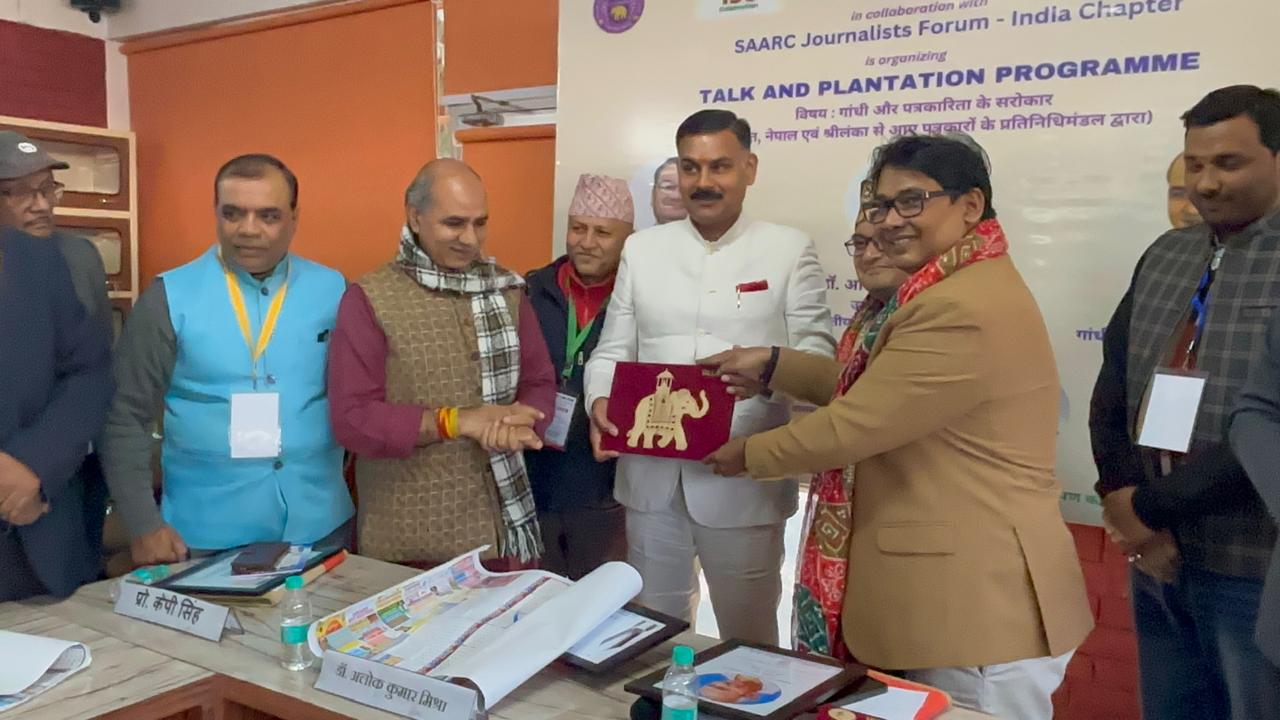
Members of the South Asian Journalists Forum have gathered at the University of New Delhi for a two day conference themed ‘Peace and Co-operation’.
Journalists from Bangladesh, Nepal, Sri Lanka and India are attending the conference hosted by the University of Delhi in collaboration with the India Chapter of SJF, and will deliberate on how the media can act as a catalyst for regional stability and mutual coexsistence.
A tree plantation campaign was also held at the Ghandi Bhawan premises of the University to mark the event and symbolize growing regional ties.
The Sri Lanka delegation is led by President of SJF’s Sri Lanka Chapter Rahul Samantha Hettiarachchi.

The Governor of the of Gujarat, Acharya Devvrat, along with the Deputy Chief Minister of Gujarat, Harsh Sanghvi, met with Prime Minister Dr. Harini Amarasuriya on Thursdy [February 05] at the Parliamentary Complex to discuss the arrangements related to the exposition of the Devnimori Sacred Relics of Lord Buddha, which have been brought to Sri Lanka under the patronage of Indian Prime Minister Narendra Modi and the Government of India.
These sacred relics of Lord Buddha were discovered during archaeological excavations conducted in the 1960s at the historic Devnimori site in Gujarat, the home state of Indian Prime Minister Narendra Modi. Until now, these relics had never been taken outside India. As a result of discussions held between President Anura Kumara Dissanayake and Indian Prime Minister Narendra Modi during his recent visit to Sri Lanka, the people of Sri Lanka have been granted this rare opportunity to venerate these sacred relics.
The exposition of the relics is being held for a period of seven days, from February 05 to February 11, at the Gangaramaya Temple in Hunupitiya, Colombo. Discussions were held between both parties regarding the arrangements related to this event.
The discussion was attended by Samar Nanda, Joint Secretary of the Indian Ministry of Culture; Dr. Satyanjal Pandey, Acting High Commissioner of India in Sri Lanka; Abhijit Halder, Director General of the International Buddhist Confederation; along with several others.
[Prime Minister’s Media Division]

The Indian Naval Ship (INS) GHARIAL made a port call in Colombo for operational turnarounds on 04 Feb 26. The Sri Lanka Navy welcomed the visiting ship in compliance with naval traditions.
Commanded by Commander Gaurav Tewari, INS GHARIAL is a vessel with a length of 124.8 meters.
During this visit, ten (10) Bailey Bridges, brought by ship, through the coordination of the High Commission of India in Sri Lanka, will be handed over to the Disaster Management Center. These bridges will provide temporary transportation links while bridges damaged across the island by adverse weather conditions are repaired.
The crew’s itinerary features scheduled goodwill activities with the Sri Lanka Navy, alongside visits to several tourist attractions across the island.

Sooryavanshi 175 makes India six-time Under-19 world champions

Mighty India meet multicultural USA in polarised World Cup

At least 31 killed, dozens wounded in Islamabad mosque blast

The SSC finally steps out of the sunshine and into the floodlights

SAARC journalists meet in New Delhi

Governor of Gujarat met with Sri Lanka PM to discuss exposition of Devnimori Relics

‘Dates have the highest sugar content to fight Coronavirus’

Sunday Island 27 December – Headlines

#SundayIsland 17th December – Headlines

Sunday Island – 28th March

Sunday Island Headlines – 21 March

Sunday Island – 21st February – Headlines
-

 Business7 days ago
Hayleys Mobility ushering in a new era of premium sustainable mobility
-

 Business4 days ago
SLIM-Kantar People’s Awards 2026 to recognise Sri Lanka’s most trusted brands and personalities
-
 Business7 days ago
Advice Lab unveils new 13,000+ sqft office, marking major expansion in financial services BPO to Australia
-
 Business7 days ago
Arpico NextGen Mattress gains recognition for innovation
-

 Business6 days ago
Altair issues over 100+ title deeds post ownership change
-

 Editorial7 days ago
Govt. provoking TUs
-

 Business6 days ago
Sri Lanka opens first country pavilion at London exhibition
-

 Business5 days ago
All set for Global Synergy Awards 2026 at Waters Edge