
News
SL’s debt crisis has aggravated due to fear of taxing the super-rich says LSSP leader


The fear of taxing the super rich has worsened Sri Lanka’s debt crisis, says SLPP MP Prof. Tissa Vitarana, leader of the Lanka Sama Samaja Party (LSSP).
Speaking in Parliament during the recent Vote on Account debate, Prof. Vitarana said he was glad that speakers from both sides of the House appeared, at least now, to accept that the country was faced with a severe economic crisis. This did not seem to be the case when promises were being made during the recent General Election campaign. But now when the money has to be found to fulfill the promises made, both sides of the House came out with the same solution, more and more loans, i.e. both local and foreign borrowing, the MP said.
“This is inadvisable as it would deepen the debt crisis facing the country and the people”, he cautioned.
Now, and in the November Budget, Prof. Vitarana called for a different approach to obtain the money the country requires. Wasteful expenditure, both local and foreign, should be minimized. In order to cut Sri Lanka’s foreign debt, instead of increasing it, strict import restriction together with increased export earnings is essential to achieve a positive trade balance. But the latter would take time as it requires proper planning, full mobilization of all the required resources and firm committed action based on science and technology by the government.
As the former Minister of Science and Technology, having established 263 Vidatha resource centres at divisional level across the country and helped to produce over 12,300 micro, small and medium entrepreneurs (17 exporters and 64 suppliers to the food chains and 57 to hotels – refer IPS report), Prof. Vitarana said that he would have liked to make a contribution when the country is facing a difficult time. However, it would appear that there are more capable people available.
“I wish them all success in the national interest. In the interim, less reliable short-term funding solutions, like tourism and repatriated incomes are being promoted, but alas they too have fallen and will take time to revive in the context of the deepening global crisis of capitalism aggravated by Covid-19”, he noted.
Internally, as the Treasury is averse to deficit financing, taking money from the Central Bank, for fear of inflation etc., other ways have to be found to increase government revenue. Rather than taking more loans and getting deeper into debt, Prof. Vitarana suggested that the government should raise the required money by increasing the tax on the super-rich. This was the way out of the debt crisis for the country and the government and the next logical step now that the government has returned to the correct policy of developing the national economy by reducing, and where possible banning, the import of foreign goods.
This was done when Dr. N. M. Perera was the Finance Minister in the SLFP/LSSP/CP Coalition Government led by Mrs. Sirimavo Bandaranaike after it came to power in 1970, the MP recalled.
In Sri Lanka, the upper limit of direct taxation on individuals, mainly the super-rich is one of the lowest in the world, a mere 18%, while the average in Europe is around 45%. In some Scandinavian countries that provide their citizens with a welfare state, the money required is obtained through a higher direct tax with an upper limit of about 60%, which targets the super-rich, he said.
When faced with the severe triple crisis (debt, oil and food) Dr. N. M. Perera as the then Finance Minister in 1970 enabled the country, when faced with a severe global food scarcity, to avoid the deaths of thousands due to starvation, unlike in most other Third World countries, by raising the upper limit of direct taxation to 75%. The funds generated enabled him to provide a measure of rice free and all essentials at low prices through the excellent cooperative outlets, Prof. Vitarana further said.
He was able to not only to balance the Budget but also to produce a budget surplus. This enabled him to cut foreign loans and get the country out of the debt trap. Not only was the foreign debt reduced to the lowest level in the country’s history, he also achieved the economic stability that was required for development, Prof. Vitarana further recalled.
The IMF promotes indirect taxation, like VAT, as the main source of government revenue and in the recent past, 87% of tax revenue was obtained this way. Only 13% was obtained through indirect taxation, and as the upper limit was lowered to 18%, the class of the super-rich (a mere 1% who some estimate as having 30% of the total personal wealth in the country) were practically unaffected and did not contribute their share to the burden, he said.
At this time of crisis, Prof. Vitarana proposed that the government should increase the upper limit of direct taxation to 70% so that while the required funds are obtained, the import of luxuries and non-essentials would drop. It would also narrow the huge gap between the super-rich and the poor, which not only has a bad psychological demonstration affect, but also leads to more crime and social instability. Globally economists have warned of this danger, he added.

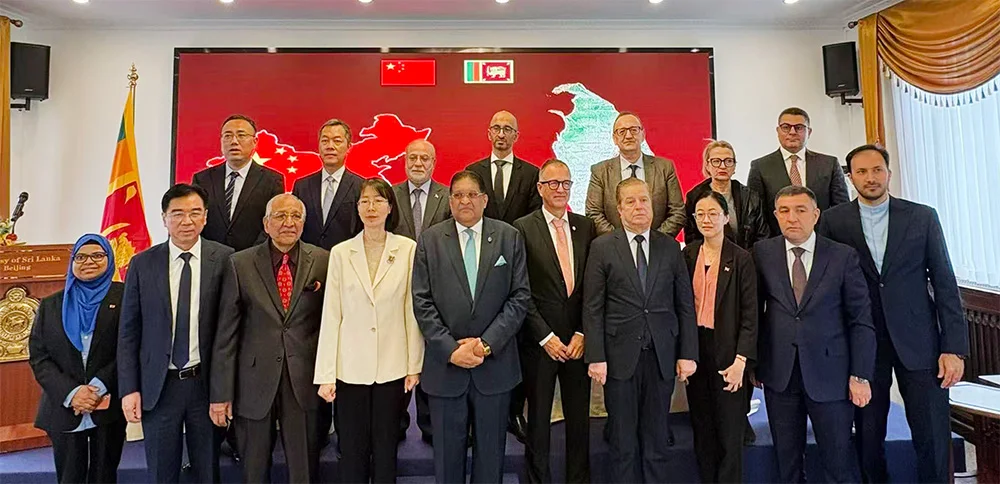
The Chinese Embassy in Colombo launched the commemorative publication in connection with the 70 years of Sri Lanka Diplomatic Relations with China titled, “Sri Lanka – China Relations: Community with a Shared Future” on 03 April 2026 in the presence of a large distinguished audience.
Cao Jing, Deputy Director General of the Asian Department of the Ministry of Foreign Affairs, Officials of the Chinese Foreign Ministry, Diplomatic Corps, Xu Yan of the Chinese People’s Association for Friendship with Foreign Countries, officials of Ministry’s line agencies and state-owned enterprises and several other guests having interests in Sri Lanka participated at the event.
The commemorative publication captures the essence of Sri Lanka’s resilience as a nation by tracing its rich history, civilization and culture. It offers insights into salient features of Sri Lanka that has been recognized for ages as “a land like no other”.
The publication was authored by the distinguished career Ambassador Dr. Ananda Kumarasiri.
In delivering the opening remarks Ambassador Majintha Jayesinghe, expressed his appreciation to the author Dr. Ananda Kumarasiri. Recalling the establishment of Diplomatic Relations in 1957, Sri Lankan Ambassador stated that the impressive tapestry of genuine friendship that exists between our two countries since ancient times have grown exponentially.
Ambassador Majintha Jayesinghe expressed the aspiration that this book will present an insightful account of the rich heritage of Sri Lanka’s relations with China. He hoped that the commemorative publications would encourage future generations to look at the shared history and relations with pride and motivate them to further enhance this unique friendship and goodwill to higher vistas of achievements.
In his address, Ambassador, Dr. Ananda Kumarasiri among other important observations, pointed out that there is much scope for Sri Lanka and China to collaborate in a number of fields. In particular, he highlighted that China’s tremendous technological and industrial progress can be harnessed for Sri Lanka to embark into-the development of alternative sources of energy, backward integration of Sri Lanka’s primary resources that would ensure value added exports and also in recycling wastes from various primary resources.
x
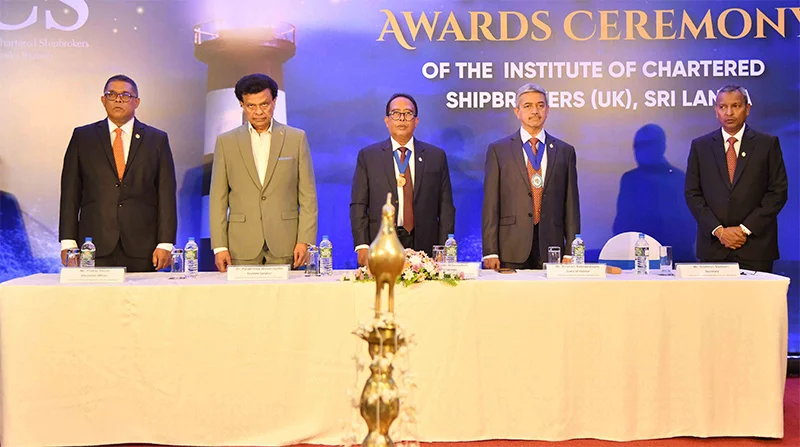
Lalith Witanachchi flanked by Dr. Parakrama Dissanayake, presidential maritime advisor (on his right) and Krishnan Subramaniam, Chairman, Institute of Shipbrokers, UK
Chairman of Institute of Chartered Shipbrokers (Sri Lanka branch) Lalith Witanachchi said that disruption of Hormuz strait due to the ongoing war between Israel-US and Iran underscores the importance of other vital routes.
Addressing the 32 annual awards ceremony of ICS Sri Lanka recently at Cinnamon Lakeside, Witanachchi said that in today’s maritime environment, global events continue to remind us how closely geopolitics and shipping are connected. The ongoing tensions and conflict involving Iran in the Middle East have once again highlighted the strategic importance of maritime trade routes, particularly around the Strait of Hormuz, one of the world’s most critical energy corridors. Such disruptions create uncertainty for global supply chains, but they also reinforce the importance of resilient ports, efficient logistics networks, and well-trained maritime professionals. For countries like Sri Lanka, positioned along major East–West shipping lanes, these shifts also present opportunities to strengthen our role as a reliable maritime hub for the region.
Witanachchi dealt with the transformation of Singapore. Singapore did not simply build a port; they transformed an entire economy. They positioned themselves as a global logistics hub, attracting international shipping lines, investors, and trade flows. What seemed risky at the time became the foundation for decades of sustainable growth, making the Port of Singapore one of the busiest and most efficient ports in the world today.
Delivering the keynote address, Dr. Parakrama Dissanayake, Advisor to the President on Maritime, Ports and Logistics, emphasised the strategic importance of human capital development, professional education, and policy alignment in positioning Sri Lanka as a competitive regional maritime and logistics hub. His address reinforced the need for innovation, knowledge-sharing, and international collaboration in navigating the evolving global shipping environment.
A key highlight of the evening was the recognition of outstanding academic achievers and industry professionals who have demonstrated exceptional commitment, competence, and contribution to the maritime and logistics sectors. These accolades not only celebrated individual excellence but also symbolised the broader progress of professional standards within the industry.
The event also served as a platform to strengthen industry-academia linkages, promote professional qualifications, and encourage the next generation of maritime professionals. The presence of a diverse audience, including corporate leaders, students, and practitioners, reflected the Institute’s ongoing role in fostering a knowledge-driven and globally connected maritime community.

The International Solar Alliance (ISA) is undertaking a high-level mission to Sri Lanka from 6 to 9 April 2026, led by Director General Ashish Khanna, to advance the operationalisation of the ISA–Sri Lanka Country Partnership Strategy (CPS) and accelerate the country’s solar deployment agenda.
The text of ISA statement: “The mission focuses on four key outcomes: formal endorsement of the CPS, signing of a Memorandum of Understanding to establish a Solar Technology Application Resource Centre (STAR-C) at the University of Moratuwa, high-level bilateral engagements with government and development partners focusing on initial support on digital tool for streamlining approval process, support on integration of battery storage and policy and regulatory reforms, along with a dedicated Floating Solar Workshop to advance project readiness.
Sri Lanka’s energy sector is undergoing a structural transition. Installed solar capacity has crossed 1 GW, with a pipeline of over 4 GW identified under the Renewable Energy Project Development Plan (REPDP 2025–2030). Accelerated solar deployment is expected to deliver nearly 75% of national emissions reductions under NDC 3.0 (2026–2035), while reducing fiscal exposure to imported fossil fuels especially under the current global scenario, making timely implementation a national priority.
The ISA–Sri Lanka Country Partnership Framework (CPF), signed at the Asia Pacific Regional Committee Meeting 2025 in Colombo in the presence of Prime Minister Harini Amarasuriya, laid the foundation for long-term collaboration. Building on this, the CPS, developed through extensive technical consultations, including ISA’s technical mission in November 2025, translates Sri Lanka’s REPDP targets and climate commitments into a results-oriented, multi-year implementation roadmap spanning policy reform, project development, capacity building, and investment facilitation.
Underscoring the significance of the mission, Minister of Energy Kumara Jayakody said: “Sri Lanka’s energy transition is well underway, and ISA has been a key partner in this journey. The CPS provides clarity across the solar value chain from policy and regulation to project development, capacity building, and investment mobilisation. This mission is delivering tangible outcomes, including CPS endorsement, alignment on our National Solar Energy Roadmap, BESS priorities, and digital approval processes, while advancing catalytic finance pathways.”
Highlighting ISA’s approach, Director General, ISA Ashish Khanna stated: “The ISA–Sri Lanka partnership is anchored in Sri Lanka’s vision of 4 GW of Renewable Energy by 2030, where the current high global prices of fossil fuels demand acceleration of electrification of economy through renewable energy as part of energy security for Sri Lanka. ISA brings global technical expertise, partnership on institutional strengthening, and use of catalytic tools for accelerating private financing. The STAR-C at the University of Moratuwa is a landmark initiative that will strengthen domestic research, testing, and skills for creation of jobs along with solar deployment at scale. Together with the CPS and the growing project pipeline under REPDP 2025–2030, this mission marks a decisive shift from ambition to implementation.”
The three-day mission includes engagements with the Ministry of Energy, utilities, regulators, and development partners, including the Asian Development Bank and the World Bank, to advance project pipelines, financing pathways, and institutional coordination.

‘Sri Lanka – China relations: Community with a Shared Future’ launched


ISA operationalises country partnership strategy through high-level Sri Lanka mission

Coal-blackened moralists

The university bought AI, now it’s buying back the pencil

University admission crisis: Academics must lead the way

‘Dates have the highest sugar content to fight Coronavirus’

Sunday Island 27 December – Headlines

#SundayIsland 17th December – Headlines

Sunday Island – 28th March

Sunday Island Headlines – 21 March

Sunday Island – 21st February – Headlines
-

 Features3 days ago
Ranjith Siyambalapitiya turns custodian of a rare living collection
-

 News6 days ago
2025 GCE AL: 62% qualify for Uni entrance; results of 111 suspended
-

 News3 days ago
Global ‘Walk for Peace’ to be held in Lanka
-
 Editorial6 days ago
Search for Easter Sunday terror mastermind
-
 Opinion5 days ago
Hidden truth of Sri Lanka’s debt story: The untold narrative behind the report
-

 Opinion6 days ago
Is there hope for Palestine?
-
 Features5 days ago
The Ramadan War
-

 Features3 days ago
Beyond the Blue Skies: A Tribute to Captain Elmo Jayawardena