
Business
SL needs laser-like focus on IMF programme implementation: Dr. Indrajit Coomaraswamy

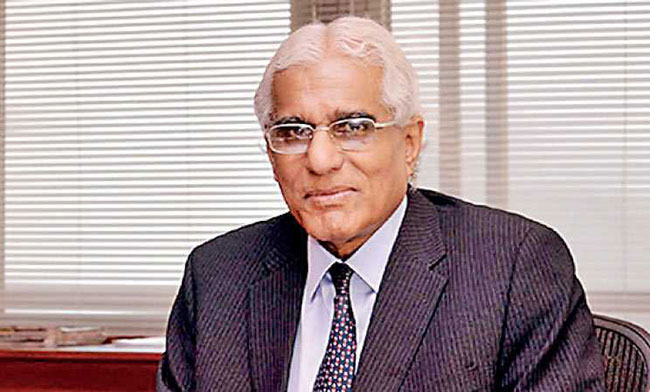
‘If it gets suspended, it would have pretty dramatic consequences’
by Sanath Nanayakkare
There are three most important priorities for Sri Lanka in the wake of the IMF Programme; implementation, implementation and implementation of the agreed upon benchmarks of the programme. Last thing we need to suddenly find is that we have gone off the track of the programme and it is suspended, Dr. Indrajit Coomaraswamy, Former Governor, Central Bank of Sri Lanka said on Friday.
He said so while giving the keynote speech at a Central Bank hosted webinar titled “What is next for Sri Lanka in the wake of IMF Programme?”
Deshal De Mel, Economic Advisor, Ministry of Finance, Murtaza Jafferjee, Managing Director, JB Securities, Bingumal Thewarathanthri, Chief Executive Officer, Standard Chartered Bank were the panelists at the forum where the moderator was Shiran Fernando, Chief Economist at the Ceylon Chamber of Commerce
The following are a few comments made by Dr.Coomaraswamy.
The IMF EFF has now been successfully negotiated. This is in some way the beginning. There is lot more to do. It’s time to start thinking about what happens next. A little under a year ago, there were acute shortages of the most essential good. There were long queues and one or two people passed away while in queue. Prices were skyrocketing and exchange rate was collapsing, inflation was spiking and the Central Bank had to push up interest rates. All this happened only a few months from where we are today. The fact that things have stabilized to a significant extent clearly is a very favourable outcome but actually there is no room for complacency because the stabilization has happened at a low-level equilibrium.
It has happened when the economy experienced a 7.6% contraction last year. It was better than what was anticipated by the IMF and the World Bank, but still it is a very sharp contraction. And we need to get to a situation where we have macro-economic stability with a growth rate of about 4%. There is a lot to be done for this. But this is a very commendable place to get to after all. The Paris Club comprising G7 countries has endorsed our efforts to restore debt sustainability. The non-Paris Club creditors such as India and China also have endorsed and supported our efforts too. So the largest countries and creditors are willing to support Sri Lanka to get back on track in terms of debt sustainability. So this is not a bad place to be.”
“IMF programme implementation has always been a weakness on our part. This time we have already done a lot as prior action but there is more as you would have seen from the documentation tabled in parliament including structural reforms and institutional reform. So we have to have laser-like focus on implementation and move forward with the programme. If the programme gets suspended, it would have pretty dramatic consequences. So we need to keep it on track. We can’t give up the absolutely compelling need for fiscal discipline. What is next for us is; discipline and making the needed economic policy and implementing what e have agreed to do. During our past IMF programmes, the issue was lack of implementation by the Sri Lankan authorities.
Earlier this week Dr. Chandranath Amarasekare, Executive Director at the CBSL arranged for the Irish authorities to brief Sri lankan authorities on the implementation unit set up in Ireland when the global financial crisis hit Ireland which led them to go into an IMF programme. Ireland was meticulous in the way they set up the implementation framework. They identified all the action that had to be taken and assigned parts of it to relevant government entities to implement them. Ireland is back on track now. We need to have the same degree of laser-like focus on implementing the benchmarks. We have to figure out what needs to be done and ascribe responsibility for each action and monitor
carefully how we are going about it. We have to make sue we are hitting all the targets and structural benchmarks as we go along. These are embedded in the IMF programme. Last thing we need is to suddenly find that we have gone off the track of the programme and the programme is suspended. That will constrain the inflows to the country and it will affect the confidence beginning to build up now. All that will get undermined if the programme gets suspended because we are not able to keep it on track. So the Implementation Unit will need a very good authority to reach out to any part of government and get things done. We need this Implementation Unit to be well-structured and running well. And it should have the authority of the President behind it,”he said.


By Hiran H. Senewiratne
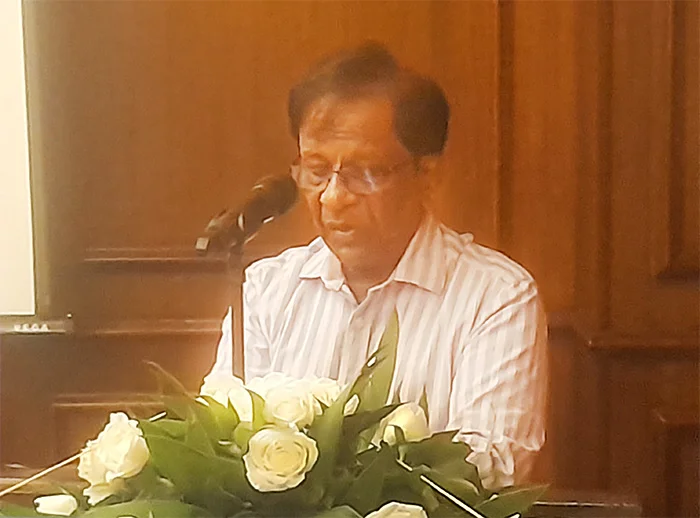
The government is yet to address fully the needs of the Cyclone Ditwah affected populace though one year has elapsed. The devastation cost the country more than US $ 4.1 billion, an Australia-based Chartered Engineer of Sri Lankan origin said.
‘Cyclone Ditwah affected more than 2.2 million people in 25 districts, which is considered to be one tenth of the population. However, only 39 percent of the allocated funds have been spent to date, the speaker, a one-time General Secretary of the JVP, now living in Australia Lionel Bopage said.
He made these comments at a Rotary Club Colombo South monthly meeting held at the Kingsbury Hotel, Colombo recently.
Bopage quoted from a Loughborough University research report published in February to the effect that Sri Lanka has under invested in prevention but over invested in recovery.
Bopage added: ‘The largest single economic category affected were not buildings but the agriculture sector which provides livelihoods for the majority of affected persons. Therefore agricultural livelihoods have been hit most.
‘More than 58,000 hectares of paddy lands were flooded in the Eastern districts alone, while 46 reservoirs reached critical spill level or failed outright following the disaster.
‘A rapid education sector assessment found that 1,682 schools were affected and more than 555,000 children were unable to attend schools. Further, 622 water supply schemes had been left non-functional and apart from that 11300 homes were damaged or destroyed. But reconstruction is happening at a very slow pace.
‘Tens of thousands of households in the hill country and in the East are still living in damaged properties and on unstable slopes drawing water from schemes that have not been restored.
‘ A Post Disaster Needs Assessment put the cost of resilience at US$ 3.4 billion but restoration work is happening at a slow pace even with foreign donor assistance.’

By Hiran H. Senewiratne
The CSE yesterday kicked off on a positive note due to a World Bank forecast that Sri Lanka could achieve 4.4 percent economic growth this year but later lost momentum due to weak investor participation.
Amid those developments both indices moved upwards. The All Share Price Index went up by 132 points while S and P SL20 rose by 21.02 points.
Turnover stood at Rs 1.97 billion with three crossings. Those crossings were; Lanka IOC 2.7 million shares crossed to the tune of Rs 470 million; its shares traded at Rs 127, CCS 2.7 million shares crossed to the tune of Rs 315 million; its shares sold at Rs 118 and JKH five million shares crossed for Rs 91.5 million; its shares traded at Rs 18.30.
In the retail market companies that mainly contributed to the turnover were; Commercial Credit and Finance Rs 126 million (1.3 million shares traded), Lanka IOC Rs 98 million (775,000 shares traded), Asiri Surgical Hospitals Rs 77 million (7.6 million shares traded), Commercial Bank Rs 51.3 million (307,000 shares traded), Sampath Bank Rs 46 million (325,000 shares traded), HNB Rs 37 million (98000 shares traded) and Tokyo Cement Rs 31 million (393,000 shares traded). During the day 50 million share volumes changed hands in 14547 transactions.
It is said that the petroleum sector performed well, especially Lanka IOC, while in the banking sector counters, especially Commercial Bank and Sampath Bank performed well. In the manufacturing sector, JKH impressed.
TAL Lanka Hotels announced that it has scheduled an Extraordinary General Meeting on October 29 to obtain shareholder approval for a proposed Rs 1.87 billion rights issue. The proceeds will be utilized for the repayment of bank borrowings, part refurbishment of the Taj Samudra Hotel in Colombo, settlement of vendor liabilities, and general corporate requirements.
Yesterday the rupee was quoted at Rs 330.95/331.05 to the US dollar in the spot market, weaker from Rs 330.85/95 the previous day, while bond yields were quoted broadly steady, dealers said.
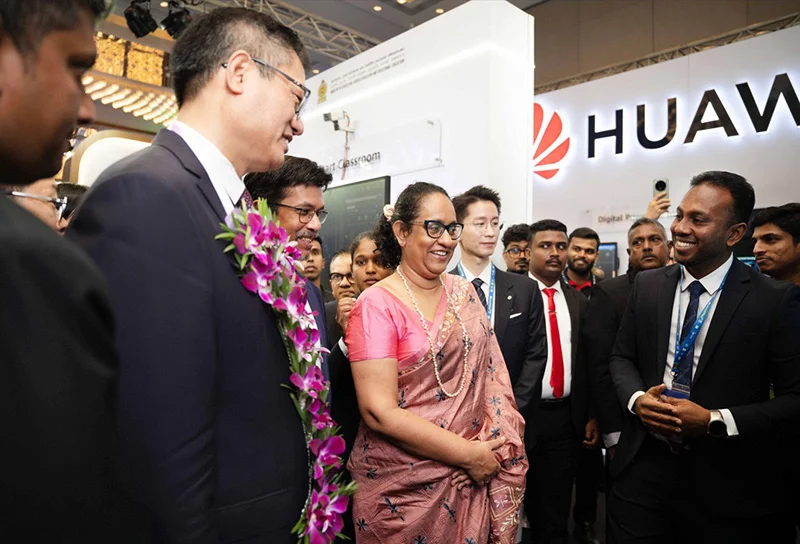
Sri Lanka AI Week 2026 continued into its second day bringing together government, industry, academia and technology partners to explore practical applications of artificial intelligence. As the AI Technology Partner for the second consecutive year, Huawei showcased 18 use cases spanning government, education, finance, industry, green energy and everyday life, demonstrating how AI can be applied to real-world needs.
Prime Minister Dr. Harini Amarasuriya visited the Huawei exhibition together with officials from the Ministry of Education, Higher Education and Vocational Education, experiencing the Smart Classroom, AI in Education and MindGraph by Beijing Normal University demonstrations. The Smart Classroom demostration highlighted how connected technologies can bring teachers and students in different locations into a shared learning environment, while the AI in Education showcase demonstrated how AI can support teachers, enhance learning and enable more personalised education. The Prime Minister praised the efforts of the Ministry of Education, Higher Education and Vocational Education, Huawei and their partners to demonstrate practical applications of AI in education, noting the role of technology in supporting teachers, expanding learning opportunities, and advancing a more inclusive, equitable and future-ready education system.
Later in the day, Deputy Minister of Digital Economy Eng. Eranga Weeraratne, Deputy Minister of Industry and Entrepreneurship Development Chathuranga Abeysinghe, Secretary to the Ministry of Digital Economy Waruna Sri Dhanapala, and Chinese Ambassador Wei Huaxiang visited the Huawei exhibition and explored the AI Hands-On Classroom AI Empowering Industry, AI in Education and Smart Classroom demonstrations. Deputy Minister Weeraratne praised Huawei’s practical approach to showcasing AI applications, noting their relevance to Sri Lanka’s digital transformation across education, industry and skills development. The engagement also extended across the wider AI ecosystem, with industry professionals, technology partners, academics and other visitors engaging with the demonstrations and expressing appreciation for Huawei’s practical approach to applying AI across different areas of society and the economy.
Daniel Wu, CEO of Huawei Sri Lanka, said that Huawei will continue bringing global experience, technology and ecosystem resources to Sri Lanka, while working side by side with local partners to build local capabilities, develop local talent and create real value for the country. “I believe that by working together, we can make AI not only more intelligent, but also more local, more inclusive, and more meaningful for everyone,” he said.

Showers above 100 mm are likely at some places in the Western, Sabaragamuwa, Central, Uva and Southern provinces and in Anuradhapura district

Remembering Juvenal, Coke, Acton and Machiavelli

West Asian conflict undergoing manifold complications

Nissanka absence opens door for Sri Lanka’s young guns

The prelate who walked the talk

Needs of populace hit by Cyclone Ditwah seen as waiting to be addressed

‘Dates have the highest sugar content to fight Coronavirus’

Sunday Island 27 December – Headlines

#SundayIsland 17th December – Headlines

Sunday Island – 28th March

Sunday Island Headlines – 21 March

Sunday Island – 21st February – Headlines
-

 Editorial6 days ago
Colombo Port drug bust: The plot thickens
-

 Features4 days ago
The first woman in the foreign service or Ceylon Overseas Service it was then called
-

 Editorial5 days ago
Fuelling discontent and protest
-

 News3 days ago
Geneva takes up Sallay’s case and govt. ignores opportunity to answer accusations
-

 Latest News5 days ago
Tharindu Rathnayake, bowlers secure Asian Games Bronze for Sri Lanka
-
 Foreign News5 days ago
Ten injured after car crashes into rugby supporters in Australia
-

 Features3 days ago
Sri Lanka Cricket Bill: Governance reform is not yet a cricket strategy
-
 News4 days ago
Nearly 20 Iranian tankers stranded off Lanka amid US sanctions