
News
SL, Iran sign MoUs

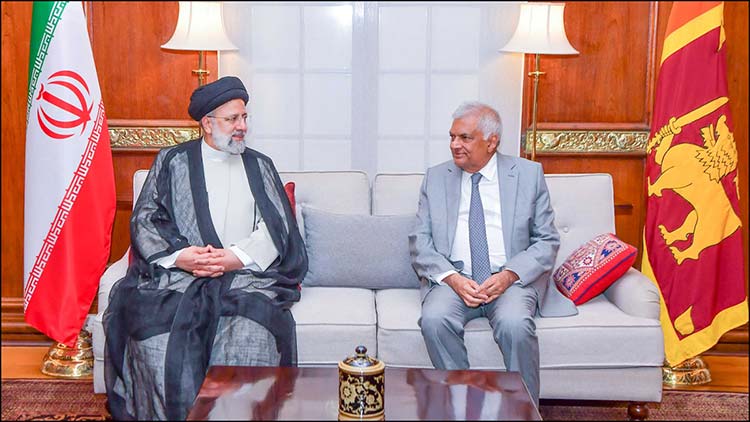
Iranian President Dr. Ibrahim Raisi and President Ranil Wickremesinghe on Wednesday (24) emphasised the need to bolster economic and trade ties while fostering political and cultural cooperation.
Raisi is here to attend the inauguration of the Uma Oya Multipurpose Development Project.
Wickremesinghe said diplomatic ties between Iran and Sri Lanka were established in 1962, predating formal recognition. Historical exchanges between the two nations date back to the Persian era, with trade conducted primarily through the Strait of Hormuz. Iran established its embassy in Colombo in 1975, while Sri Lanka reciprocated by opening its embassy in Tehran in January 1990. Both countries maintain robust cooperation across various sectors and engage in multilateral endeavours.
President Wickremesinghe also expressed his gratitude to President Raisi for the support extended by the Islamic Republic of Iran during Sri Lanka’s recent economic crisis and subsequent debt restructuring efforts.
Issuing a press release, the President’s Media Division (PMD) said uring their discussions, the leaders delved into key areas of mutual interest, emphasizing the need to bolster economic and trade ties while fostering political and cultural cooperation.
Five Memorandums of Understanding were signed between Sri Lanka and the Islamic Republic of Iran in the presence of both leaders.
Minister of Education Susil Premajayantha signed on behalf of Sri Lanka for the Memorandum of Understanding between the National Library and Archives of Iran and the National Library of Sri Lanka, with Minister of Cultural Affairs Mohammad Mehdi Esmaeili representing Iran.
The second Memorandum of Understanding was inked between the National Film Corporation of Sri Lanka and the Ministry of Culture and Islamic Guidance of Iran, witnessed by Minister of Transport, Highways, and Mass Media, Dr. Bandula Gunawardena, and Iranian Minister of Cultural Affairs, Mohammad Mehdi Esmaeili.
The third Memorandum of Understanding was also sealed between Sri Lanka and Iran concerning cooperation in media and tourism. Dr. Bandula Gunawardena, Sri Lanka’s Minister of Transport, Highways, and Mass Media, along with Ali Akbar Mehra Biyan, Iran’s Minister of Energy, signed the agreement.
The fourth agreement encompassing cultural, scientific, and technical collaboration, as well as media, youth, and sports programs between Sri Lanka and the Islamic Republic of Iran, was signed. Foreign Minister Ali Sabri PC represented Sri Lanka, while Minister of Cultural Affairs Mohammad Mehdi Esmaeili represented Iran.
The fifth Memorandum of Understanding was established between the Iran Cooperative Board and the Sri Lanka National Cooperative Board. Chairman of the Sri Lanka National Cooperative Board, G.V. Sarath Weerasiri, and Iran’s Minister of Cultural Affairs, Mohammad Mehdi Esmaeili, signed the agreement on behalf of their respective governments.









Prime Minister Dr Harini Amarasuriya yesterday (17) informed Parliament that three committees had been appointed to address the economic challenges Sri Lanka was facing due to the ongoing conflict in the Middle East, with steps already underway to implement necessary measures.
Addressing the House, the PM said one committee had been tasked with ensuring the uninterrupted supply of essential goods and services to the public while overseeing their management.
She said that a second committee had been appointed to handle services related to maintaining the functioning of the public service.
In addition, the Prime Minister noted that a third committee had been established to meet the country’s energy requirements.

Customs at the Bandaranaike International Airport (BIA) yesterday (17) thwarted an attempt made by five Chinese passport holders to smuggle into the country a consignment of foreign-manufactured cigarettes and used mobile phones valued at around Rs. 18 million.
The suspects, who had arrived in Sri Lanka as tourists, were subjected to searches upon their arrival at BIA from Shanghai on a China Eastern Airlines flight, MU-6017, at 12.10 a.m.
Customs found 497 cartons of Chinese-manufactured cigarettes, containing a total of 99,400 sticks, along with 422 second-hand Chinese-made mobile phones concealed in their luggage.
The suspects have been detained by Customs officers at BIA, and further investigations into the incident are currently underway.

Nuwara Eliya District Member of Parliament V. Radhakrishnan has warned that if the government does not act with a proper understanding of the current global crisis situation regarding essential supplies including fuel and food, public life in Nuwara Eliya will be completely disrupted during the upcoming spring season when tourists visit, and there is also a risk that tourists will not travel to Nuwara Eliya. He made these remarks during a press conference held yesterday (17th) at his office in Nuwara Eliya to comment on the current situation in the country.
Member of Parliament Velayudhan Radhakrishnan said:
“The fuel quotas have dealt a fatal blow to the Nuwara Eliya tourism industry, and if this situation worsens, that sector will collapse, leading to public unrest.”
“As the people of the Nuwara Eliya District are a group who earn their livelihood based on the tourism industry and agriculture, the government should pay more attention to providing the necessary facilities for them to carry out their daily activities. However, the government has not focused on such a programme thus far.”
“In the face of the current war atmosphere in the world, we are always pointing out how the government should face it.”
“Our group of MPs, including Opposition Leader Mr. Sajith Premadasa, is by no means trying to gain political advantage in the face of such a global war situation.”
“What we always point out is the reals situation. Because the government has a large majority, it does not listen to the voice of the opposition. The government does not possess enough wisdom to understand the real situation we are pointing out. If, in some way, they do not heed the voice of the Opposition in the face of this crisis, the country will fall into a great abyss.”
By S.K. Samaranayake

PM informs parliament three committees appointed to ensure measures to keep country ticking

Lanka Business TV’s “Wiyawasayakaya” Business and Investment Summit in Galle

Bourse continues in a bearish sulk as M-E crisis continues to take a toll

Clarification

Bid to smuggle in fags, used mobile phones thwarted

New Anthoney’s Farms sponsors MasterChef Sri Lanka as Official Poultry Supplier

‘Dates have the highest sugar content to fight Coronavirus’

Sunday Island 27 December – Headlines

#SundayIsland 17th December – Headlines

Sunday Island – 28th March

Sunday Island Headlines – 21 March

Sunday Island – 21st February – Headlines
-

 News6 days ago
Historic address by BASL President at the Supreme Court of India
-

 Sports6 days ago
The 147th Royal–Thomian and 175 Years of the School by the Sea
-

 Sports7 days ago
Royal start favourites in historic Battle of the Blues
-

 News7 days ago
CEBEU warns of operational disruptions amid uncertainty over CEB restructuring
-

 Life style3 days ago
From culture to empowerment: Indonesia’s vision for Sri Lanka
-
 Features7 days ago
Indian Ocean zone of peace torpedoed!
-
 News6 days ago
Power sector reforms jolted by 40% pay hike demand
-

 Business2 days ago
Browns EV launches fast-charging BAW E7 Pro at Rs. 5.8 million