
News
SL HC in Bangladesh delivers lecture at National Defence College


High Commissioner of Sri Lanka to Bangladesh, Dharmapala Weerakkody recently delivered a lecture on Contemporary Sri Lanka: Its Foreign Policy, Security, Development Strategy, and Bangladesh-Sri Lanka Relations to the course members of the National Defence Course – 2025 at the National Defence College (NDC) in Dhaka .
The lecture was intended for the National Defence Course – 2025, consisting of 97 members holding the rank of Brigadier General and equivalent from the Armed Forces, Joint Secretaries from the Bangladesh Civil Service, and Deputy Inspectors General from the Bangladesh Police, including 29 foreign nationals from 18 friendly countries.
The High Commissioner also called on the Commandant of the National Defence College, Lieutenant General Mohammad Shaheenul Haque, OSP, BSP, ndc, hdmc, psc.
Established in 1996 and operational since 1999, NDC is Bangladesh’s premier institution for security, strategic, and development studies. Its mission is to train senior officers and civil servants, both domestic and international, to address national and global challenges effectively.
Located in Mirpur Cantonment, the college offers the National Defence Course (NDC), a multidisciplinary, 47-week programme designed for senior military and civil officers, as well as international participants. The course equips them with the knowledge, leadership qualities, and skills essential for national leadership and development.

News
Indonesian Navy Sailing Ship KRI BIMA SUCI – 945 concludes official goodwill visit to Sri Lanka

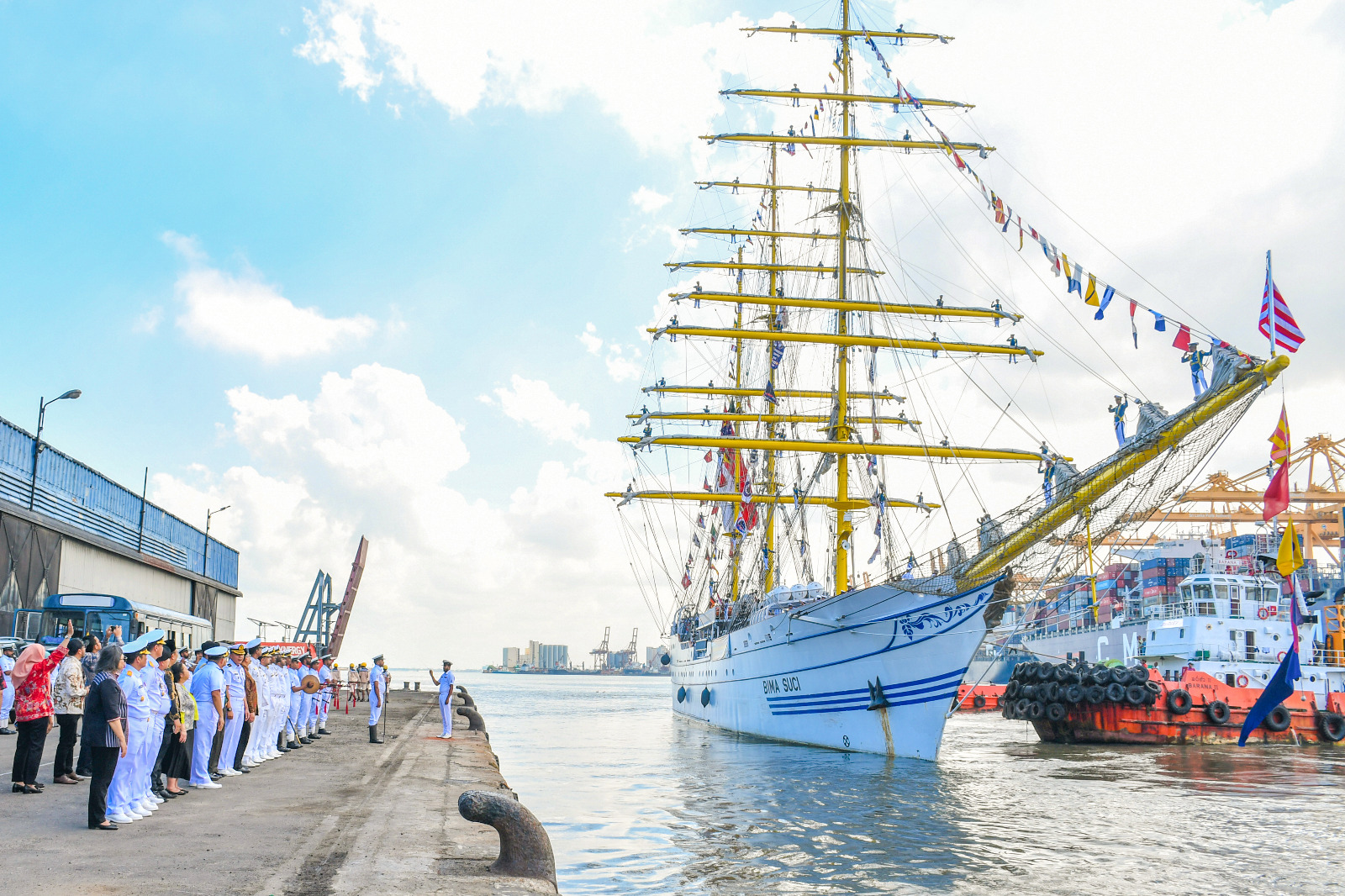
The Indonesian Navy Sailing Ship KRI BIMA SUCI – 945 departed the island on 18 Apr 2026, marking the successful completion of her official goodwill visit.
The ship was accorded a formal farewell by the Sri Lanka Navy in accordance with naval traditions at the Port of Colombo.
The visit also served as a valuable educational platform, as officer under-trainees and other personnel of the Sri Lanka Navy had the opportunity to conduct an observational
tour of the sailing vessel. This exchange of knowledge was complemented by a series of events designed to foster professional and social bonds.
Latest News
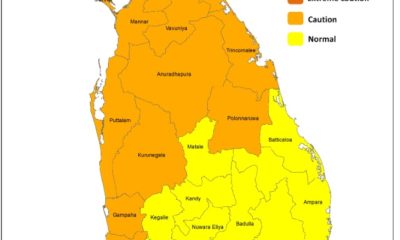
Heat Index at Caution Level in the Northern, North-central, North-western, Western, Sabaragamuwa, Eastern and Southern provinces and in Monaragala district
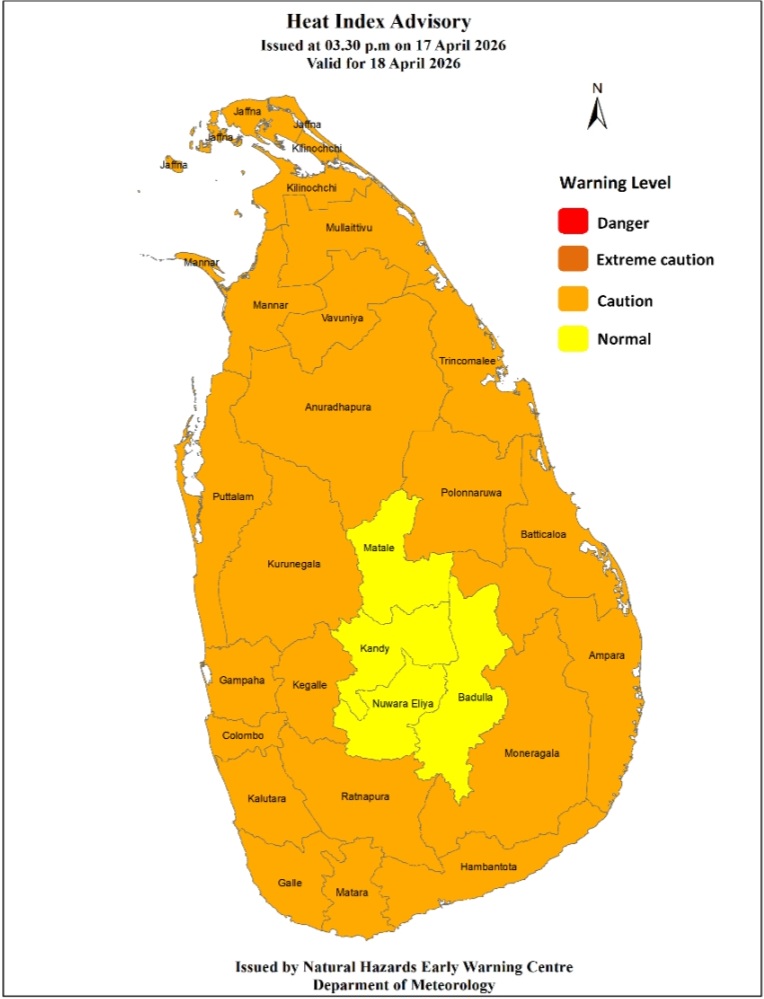
Warm Weather Advisory
Issued by the Natural Hazards Early Warning Centre
Issued at 3.30 p.m. on 18 April 2026, valid for 19 April 2026
The Heat index, the temperature felt on human body is likely to increase up to ‘Caution level’ at some places in the Northern, North-central, North-western, Western, Sabaragamuwa, Eastern
and Southern provinces and in Monaragala district.
The Heat Index Forecast is calculated by using relative humidity and maximum temperature and this is the condition that is felt on your body. This is not the forecast of maximum temperature. It is generated by the Department of Meteorology for the next day period and prepared by using global numerical weather prediction model data.
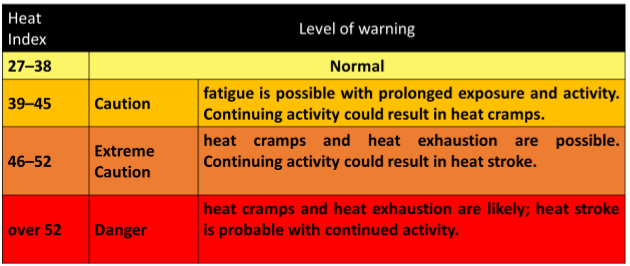
Effect of the heat index on human body is mentioned in the above table and it is prepared on the advice of the Ministry of Health and Indigenous Medical Services.
ACTION REQUIRED
Job sites: Stay hydrated and takes breaks in the shade as often as possible.
Indoors: Check up on the elderly and the sick.
Vehicles: Never leave children unattended.
Outdoors: Limit strenuous outdoor activities, find shade and stay hydrated.
Dress: Wear lightweight and white or light-colored clothing.
Note:
In addition, please refer to advisories issued by the Disaster Preparedness & Response Division, Ministry of Health in this regard as well. For further clarifications please contact 011-7446491.

Warning that “agents of the devil who wish to hide the truth behind a wall of political posturing” were attempting to obstruct investigations into the Easter Sunday terror attacks, the Catholic Church has called for intensified public support and prayer to ensure justice for victims.
In a message issued ahead of the seventh anniversary of the April 21, 2019 bombings, Colombo Archbishop Cardinal Malcolm Ranjith said there were ongoing efforts by various forces to derail credible inquiries into the coordinated attacks that claimed 278 lives and left nearly 500 injured.
The statement noted that many of those killed had been attending Easter Sunday Mass when suicide bombers struck churches, including St. Anthony’s Shrine, Kochchikade, St. Sebastian’s Church, Katuwapitiya, and Zion Church, Batticaloa, causing widespread devastation and long-term suffering among survivors.
Seven years on, the Caridnal said, critical questions remain unanswered, including who masterminded the attacks, their motives, and why places of worship were targeted on Christianity’s most sacred day.
Full text of Cardinal Malcolm Ranjith’s message: On 21st April 2026, the Church in Sri Lanka will be commemorating the 7th Anniversary of the Easter Sunday bomb blasts, which killed 278 of our fellow human beings and brethren in the faith in the most brutal fashion. Most of these people had come to our Churches for Easter Sunday Masses and prayer services. Many families were rendered destitute. Nearly 500 people were injured and some of them carry life long disabilities, suffering from the after effects of these blasts. St. Anthony’s Church Kochchikade and St. Sebastian’s Church Katuwapitiya of the Catholic community and the Zion Church in Batticaloa were, quasi totally destroyed. The economy of the country suffered immensely with untold problems affecting many families, ever since then. However much we try to console the families of these victims, it is something that we humans are unable to achieve as only the Lord can truly console them.
Besides, we still do not know who murdered these people and caused so much of suffering to many others, and why and for what purpose they chose our Churches on a day that was most sacred to us to organize these attacks. After repeated pleas by the Catholic Church, now at last, the incumbent government and the security establishment, seem to be holding a credible inquiry into this episode of mass murder in order to find out who was really behind it.
And there are many forces actively seeking to obstruct these inquiries and divert the direction of the inquiry in an aimless fashion in order to hide the truth behind these attacks. They are nothing but the agents of the devil who wish to hide the truth behind a wall of political posturing. We need to storm Heaven and ask the Lord to strengthen the hands of the investigators to find out what really happened and who was behind this mass murder as well as why it was done to innocent people who had nothing to do with politics.
Hence, I call upon all of you to kindly storm Heaven with your prayers calling upon the Lord to help us find out what really happened that most tragic day. And so, I am declaring Sunday, the 19th of April 2026, as a special day of prayer for this purpose. I shall be most grateful to every one of you, beloved brethren, if you could recite special prayers in all the parishes of the Archdiocese at Sunday Mass on that day and offer prayers at home too for the success of these investigations. The special prayer for truth and justice for the victims of the bomb attacks, already approved by the Catholic Bishops’ Conference, could also be recited. I call upon all our Catholic devotees to join us in this effort.
Let us stand together firmly behind the efforts to find out the truth. Let us not be deceived by attempts of different people to hide the truth or divert attention in all kinds of directions in order to confuse the public.
May the Blessed Mother, our Lady of Lanka, intercede for us in this most important matter.

Bodies of 50 infants dumped at Trinidad graveyard

Indonesian Navy Sailing Ship KRI BIMA SUCI – 945 concludes official goodwill visit to Sri Lanka

Malinga, Reddy sink Chennai Super Kings chase to defend under-par 194 in Hyderabad

Stubbs, Miller win Delhi Capitals a thriller against Royal Challengers Bengaluru

Showers predicted in the Western, Central, Sabaragamuwa, Uva, North-western, North-central and Southern provinces after 1.00 pm.

Heat Index at Caution Level in the Northern, North-central, North-western, Western, Sabaragamuwa, Eastern and Southern provinces and in Monaragala district

‘Dates have the highest sugar content to fight Coronavirus’

Sunday Island 27 December – Headlines

#SundayIsland 17th December – Headlines

Sunday Island – 28th March

Sunday Island Headlines – 21 March

Sunday Island – 21st February – Headlines
-
 Latest News7 days ago
PNS TAIMUR & ASLAT arrive in Colombo
-
 Latest News7 days ago
Prasidh, Buttler set up comfortable win for Gujarat Titans
-

 News4 days ago
PNS TAIMUR & ASLAT set sail from Colombo
-

 Latest News6 days ago
“I extend my heartfelt wishes to all Sri Lankans for a peaceful and joyous Sinhala and Tamil New Year!” – President
-

 Business2 days ago
Harnessing nature’s wisdom: Experts highlight “Resist–Align” path to resilience
-
 Latest News7 days ago
Heat Index at Caution level’ in the Northern, North-central, North-western, Western and Southern provinces and in Trincomalee district.
-

 News2 days ago
Gratiaen Trust announces longlist for the 33rd Annual Gratiaen Prize
-
 News2 days ago
Heroin haul transported on 50-million-rupee contract