
News
SL assures EU that PTA will be replaced


The Sri Lankan government has assured the EU that the PTA will be replaced next year. According to a joint press release issued yesterday (03) following the Sixth Working Group on Governance, Rule of Law and Human Rights meeting on Oct 28 in Colombo, Sri Lanka has expressed its strong commitment to preparing a comprehensive legislative proposal to replace the PTA in accordance with the Constitution, and in line with international norms and best practices, with a view to its finalisation in 2023.
The EU acknowledged the steps taken by Sri Lanka in March 2022 to reform the Prevention of Terrorism Act (PTA), and pointed to the need for further action in line with its commitments. The EU expressed concern on the recent use of the PTA. Sri Lanka assured that the PTA has been invoked only in instances of extreme necessity. The EU noted Sri Lanka’s update on the release of detainees under the PTA in 2021-2022, and encouraged the release of long-term detainees under the PTA who have not been charged.
The following is the text of the statement:
The Working Group meeting took place in the context of regular bilateral interactions between Sri Lanka and the European Union (EU). The full-day proceedings provided for a cordial exchange of views and experiences, in a spirit of cooperation and mutual respect. The two sides discussed the recent developments in Sri Lanka and the EU, and the implementation of relevant action and legislative initiatives regarding the promotion and protection of human rights.
Sri Lanka briefed the EU on progress in reconciliation.The EU reaffirmed its commitment to support Sri Lanka’s efforts to successfully overcome the current unprecedented economic crisis, including the necessary reforms and social protection measures, which would mitigate the adverse impact of the crisis and lead the country towards sustainable growth and prosperity. Sri Lanka and the EU reiterated the importance of social, economic and political inclusion through justice and reconciliation in the advancement of human rights.
Sri Lanka apprised the EU of the 21st Amendment to the Constitution, which is aimed at strengthening democratic governance and independent oversight of key institutions, public scrutiny, as well as anti-corruption measures, with the re-establishment of the Constitutional Council and Independent Commissions. In this context, the two sides discussed the importance of the separation of powers and checks and balances, and the ongoing work of independent institutions. The Working Group was also updated on the electoral reform process. In this context, the EU recalled the work of the 2019 EU election observer mission. The two sides reiterated the importance of the democratic freedoms of opinion and expression, and the rights to freedom of peaceful assembly and association.
The EU welcomed progress in the Justice Sector Reform Programme, which is funded by the EU, and will further improve access to justice and enhance human rights. Sri Lanka appreciated the support extended by the EU in this regard.Sri Lanka and the EU reaffirmed the importance of engaging civil society and giving it the necessary space to function in all its diversity. The EU expressed its readiness to continue supporting Sri Lanka in this process.
The two sides discussed the situation of minorities and the respective measures taken to address hate speech. They also exchanged views on the legislative and other measures taken to protect the rights of women and children, and action taken to advance labour rights including the elimination of child labour. The EU reiterated its call to de-criminalise same sex relations, and noted the Private Member’s Bill in this regard.
The two sides discussed cooperation in the UN Human Rights Council, including treaty bodies, special procedures and the universal periodic review process. The EU encouraged Sri Lanka to continue its engagement with the Human Rights Council and its mechanisms. The two sides also agreed to continue their cooperation in the framework of the 2030 Agenda for Sustainable Development.
The Working Group was updated on the GSP+ monitoring process and its requirements. The EU encouraged tangible progress by Sri Lanka on its GSP+ commitment.The Working Group was co-chaired by Varuni Muthukumarana, Director General Europe, Central Asia, EU and Commonwealth, Ministry of Foreign Affairs of Sri Lanka and Rensje Teerink, Deputy Director and Head of South Asia Division, European External Action Service.

Latest News
Heat Index at Caution level’ in the Northern, North-central, North-western, Western and Southern provinces and in Trincomalee district.


Warm Weather Advisory
Issued by the Natural Hazards Early Warning Centre
Issued at 3.30 p.m. on 12 April 2026, valid for 13 April 2026.
Heat index, the temperature felt on human body is likely to increase up to ‘Caution level’ at some places in the Northern, North-central, North-western, Western and Southern provinces and in Trincomalee district.
The Heat Index Forecast is calculated by using relative humidity and maximum temperature and this is the condition that is felt on your body. This is not the forecast of maximum temperature. It is generated by the Department of Meteorology for the next day period and prepared by using global numerical weather prediction model data.

Effect of the heat index on human body is mentioned in the above table and it is prepared on the advice of the Ministry of Health and Indigenous Medical Services.
ACTION REQUIRED
Job sites: Stay hydrated and takes breaks in the shade as often as possible.
Indoors: Check up on the elderly and the sick.
Vehicles: Never leave children unattended.
Outdoors: Limit strenuous outdoor activities, find shade and stay hydrated.
Dress: Wear lightweight and white or light-colored clothing.
Note:
In addition, please refer to advisories issued by the Disaster Preparedness & Response Division, Ministry of Health in this regard as well. For further clarifications please contact 011-7446491.

On the apparent northward relative motion of the sun, it is going to be directly over the latitudes of Sri Lanka from 05th to 15th of April in this year.
The nearest areas of Sri Lanka over which the sun is overhead today (13th) are Pesalai, Mankulam and Nedunkerny about 12:11 noon.
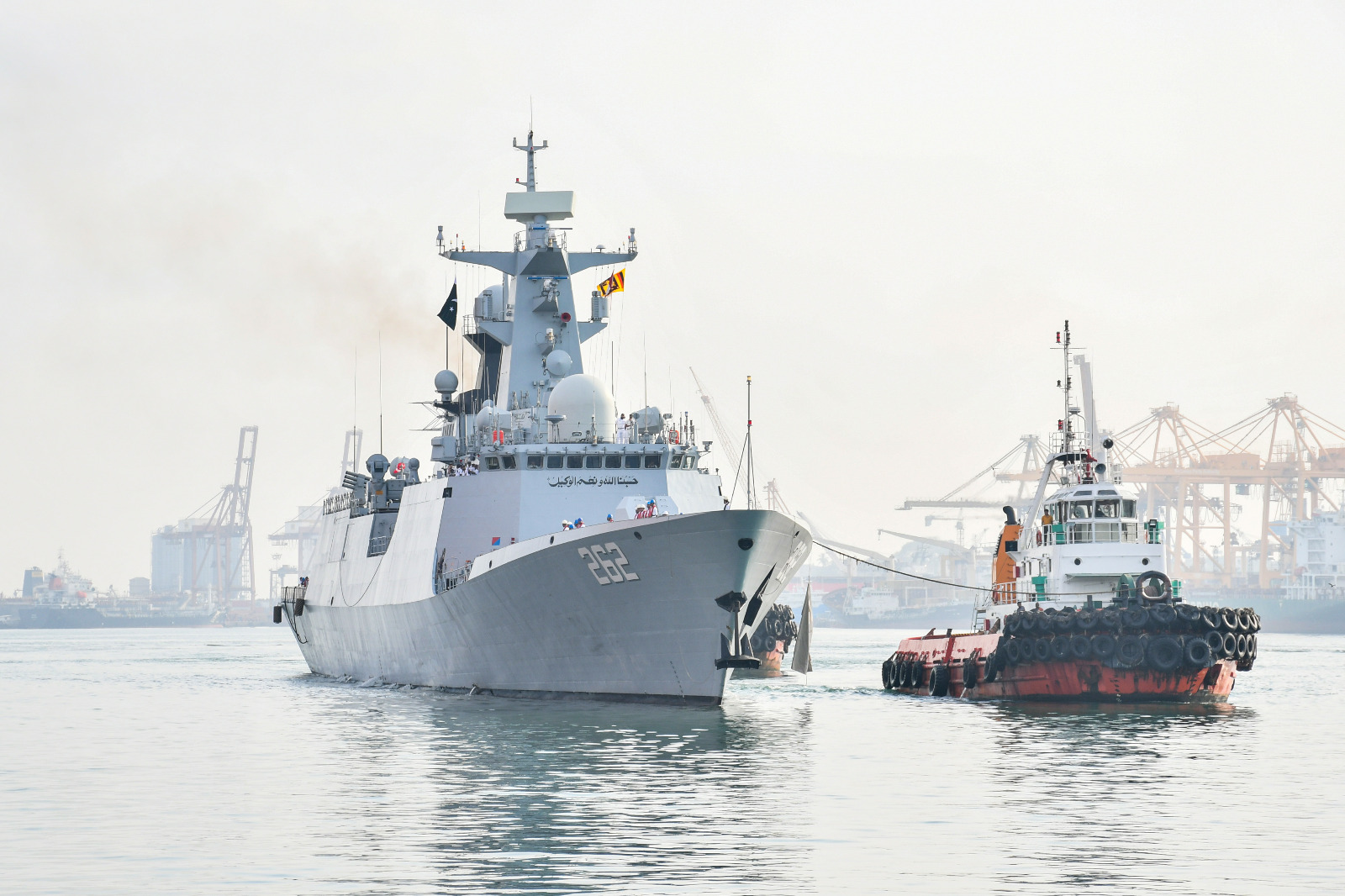
The Pakistan Navy Ship (PNS) TAIMUR and ASLAT arrived at the Port of Colombo on a goodwill visit on 12 Apr 26.
The visiting ships were welcomed by the Sri Lanka Navy in
compliance with naval traditions.
The duo of ships is commanded by Captain NIAMAT SAEED KHAN (PNS TAIMUR) and Captain NADIR MATEEN AFRIDI (PNS ASLAT).
Meanwhile, the ships are expected to conduct a Bilateral Naval Exercise LION STAR V with the Sri Lanka Navy in Colombo seas.

Salt and Patidar power RCB past Mumbai Indians

Prasidh, Buttler set up comfortable win for Gujarat Titans

Heat Index at Caution level’ in the Northern, North-central, North-western, Western and Southern provinces and in Trincomalee district.

Showers above 75 mm are likely at some places in the Western, Sabaragamuwa, Central, Southern and North-western provinces.

Sun directly overhead Pesalai, Mankulam and Nedunkerny about 12:11 noon

PNS TAIMUR & ASLAT arrive in Colombo

‘Dates have the highest sugar content to fight Coronavirus’

Sunday Island 27 December – Headlines

#SundayIsland 17th December – Headlines

Sunday Island – 28th March

Sunday Island Headlines – 21 March

Sunday Island – 21st February – Headlines
-

 News2 days ago
CEB orders temporary shutdown of large rooftop solar systems
-

 News7 days ago
Lankan-origin actress Subashini found dead in India
-

 News5 days ago
AG: Coal procurement full of irregularities
-

 Business4 days ago
Israeli attack on Lebanon triggers local stock market volatility
-

 Business5 days ago
Hayleys Mobility introduces Premium OMODA C9 PHEV
-

 News7 days ago
UN Regional Director launches SL’s first Country Gender Equality Profile during official visit
-

 News7 days ago
Dialog Launches ‘GanuDenu QR’, Making Cashless Transfers Free for All with eZ Cash and Dialog Finance
-

 Business4 days ago
HNB Assurance marks 25 years with strategic transformation to ‘HNB Life’