
News
SJB: SL losing export markets

The government’s failure to manage foreign relations and enforce the law has led to a crisis affecting the public, says the main Opposition Samagi Jana Balawegaya (SJB).
“The recent EU Resolution reflects yet another foreign policy failure of this failed government. While it embarks on pipe-dream investor forums, the government seems intent on rapidly losing the two largest export markets Sri Lanka already has – the United States and the EU,” the SJB says.
Full text of the party statement: “The SJB notes the resolution adopted by the European Parliament on ‘the situation in Sri Lanka, in particular the arrests under the Prevention of Terrorism Act’ on 9 June 2021.
“The resolution observes that ‘the human rights situation in Sri Lanka has been steadily deteriorating, with the new government rapidly backtracking on the limited progress achieved under previous administrations’. It specifically mentions Sri Lanka’s Prevention of Terrorism Act (PTA), and its legacy of abuse leading to serious human rights violations. It mentions in particular the use of the PTA to target vocal critics of the state, including eminent lawyers such as Hejaaz Hizbullah, and artists such as poet Ahnaf Jazeemm, and notes the expansion of the PTA through new regulations issued in March 2021. It also highlights a spate of other major concerns including: discrimination and violence targeting minorities; new proposals to introduce oppressive laws on so-called disinformation; the continued application of archaic criminal law; the acceleration of the militarisation” of civilian government functions in Sri Lanka; and the apparent failure to institute a rigorous, impartial and complete investigation into the 2019 Easter Sunday bombings in line with international legal standards.
“The SJB has repeatedly raised concerns with respect to the rapid deterioration of the human rights situation in Sri Lanka, and the racist, xenophobic, and discriminatory policies of the present government. We have condemned the systematic assault on Sri Lanka’s democratic institutions through the introduction of the Twentieth Amendment, and the establishment of commissions of inquiry to target politicians within the Opposition. We have also denounced the targeting of lawyers, media personnel, environmental activists, and government servants for their legitimate criticism of the government. The government is attempting to further curtail democratic freedoms through the introduction of laws to curb so-called disinformation. We see these as nothing more than a cynical attempt to further suppress the People’s freedom of expression. We have also condemned the government’s failure to uncover the real masterminds behind the Easter Sunday Attacks, and have repeatedly called for thorough and impartial investigations into the Attacks.
In this rapidly deteriorating situation in Sri Lanka, the EU Resolution invites the European Commission ‘to carefully assess whether there is sufficient reason, as a last resort, to initiate a procedure for the temporary withdrawal of Sri Lanka’s GSP+ status and the benefits that come with it, and to report to Parliament on this matter as soon as possible’. Therefore, following this Resolution, Sri Lanka stands to lose its GSP+ status.
“We recall that Sri Lanka regained concessions under the European Union’s GSP+ trade facility in May 2017. Many Sri Lankan exporters, specifically in the garment industry, have benefitted greatly as a direct result of the tariff concessions offered under this facility. One simple condition under which this facility was given was that Sri Lanka takes steps to revise certain problematic sections of the PTA to make them compatible with the International Covenant on Civil and Political Rights. The specific sections were mentioned in a letter sent by the European Commission to the former Minister of External Affairs on 17 June 2010. The Government of Sri Lanka succeeded in regaining GSP+ concessions in 2017 only based on solemn commitments to repeal or amend those specific provisions of the PTA, or replace the PTA with a new counter-terrorism law that is compatible with international best practices.
“Today, the People of Sri Lanka stand to lose the vital support of the European Union because the present government has failed to honour its commitments. Although the present Secretary to the Foreign Ministry has stated in public that the PTA must be revised, the government has failed to introduce any meaningful process to revise the PTA or replace it with a law that is compatible with international best practices. Instead of reforming the PTA, it has exacerbated the crisis by introducing regulations that further expand its scope. We note that these new regulations permit authorities to place suspects in so-called rehabilitation programmes without the need to lead any evidence of wrongdoing before a competent court.
“The government’s continued failure and incompetence in the effective management of its foreign relations, and its total bad faith in the enforcement of law in the country, have directly led to the present crisis that confronts the People of Sri Lanka. The recent EU Resolution reflects yet another foreign policy failure of this failed government. While it embarks on pipedream investor forums, the government seems intent on rapidly losing the two largest export markets Sri Lanka already has – the United States and the EU.
“The SJB, as the main Opposition party in Parliament, does not merely wish to point out the failings of the present government without offering viable solutions. We note that the previous attempt to introduce a new counter-terrorism law was mired in controversy. However, we note that the Sri Lanka Law Commission, a body comprising eminent members of Sri Lanka’s legal fraternity, has produced a draft law on the Protection of National Security, which is a concise and effective piece of legislation that is compatible with international best practices. The SJB is currently studying the Law Commission’s proposals, and will endeavour to initiate a process in parliament through which these proposals are taken up.
“The SJB is of the firm view that a robust and effective national security framework can be developed without compromising human rights and democracy.”


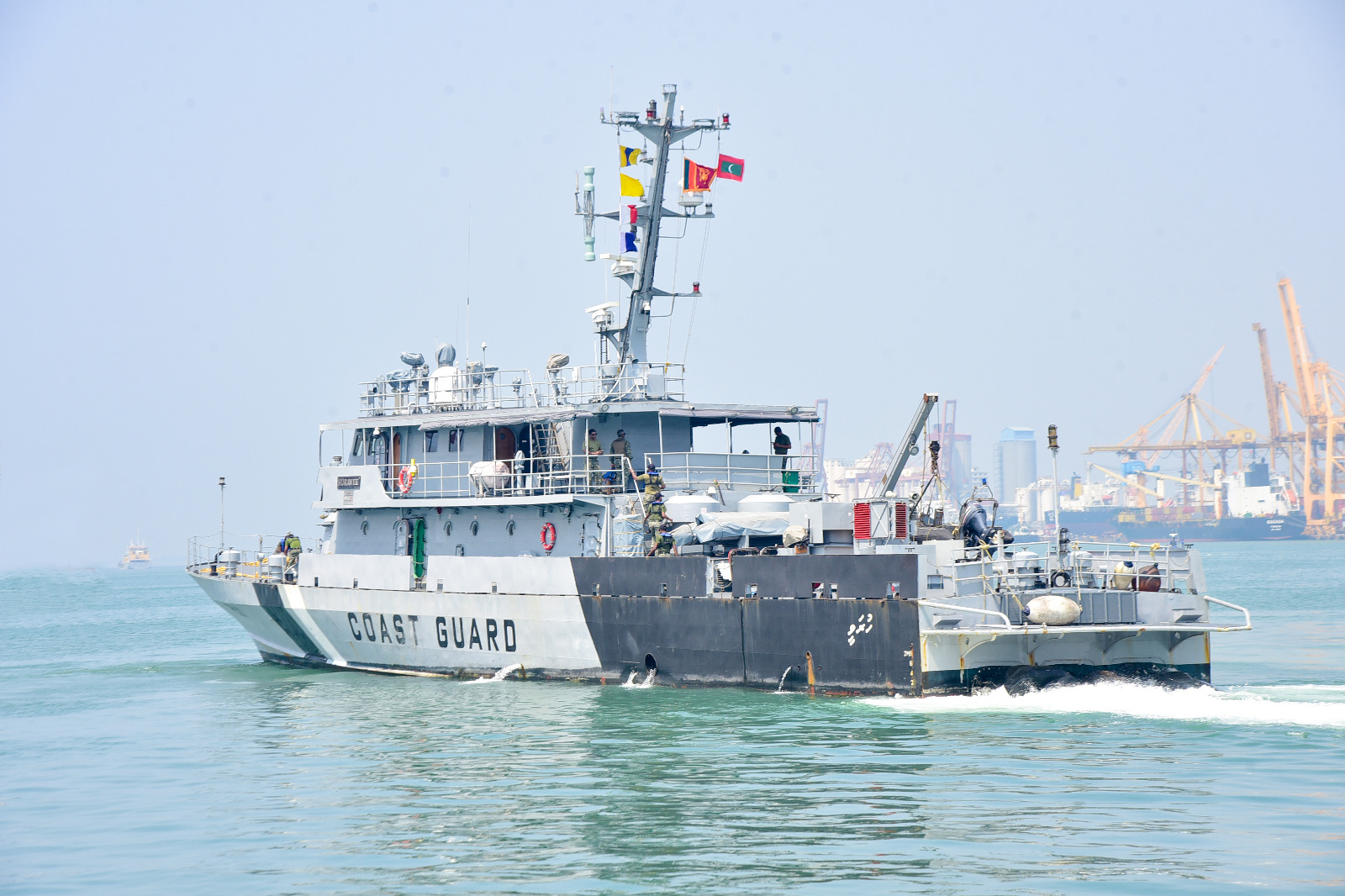
The Maldives Coast Guard Ship Huravee which arrived in Sri Lanka for replenishment purposes, departed the island on 04 Mar 26.
In accordance with naval tradition, the Sri Lanka Navy extended a customary farewell to the departing ship at the Port of Colombo


A day after a US submarine sunk an Iranian Navy warship off the coast of Sri Lanka, the Foreign Minister of Iran, Sayed Abbas Araghchi, has warned that the US would “pay bitterly” for targeting a ship in international waters, The Tribune has reported.
Araghchi posted on social media platform X on Thursday saying, “The US has perpetrated an atrocity at sea, 2,000 miles away from Iran’s shores.”
The frigate IRIS Dena, a guest of India’s Navy carrying almost 130 sailors, was struck in international waters without warning, said the Iran Foreign Minister, adding, “Mark my words: The US will come to bitterly regret the precedent it has set.”
US Secretary of War, Pete Hegseth, on Wednesday confirmed that a US submarine fired a torpedo and sank the Iranian Navy vessel IRIS Dena west of Sri Lanka.
In a way, the Iran and US-Israel conflict has reached close to the Indian coast. The strike today at sea was almost 4,000 kms away from Iran, significantly expanding the radius of war. Already, fearing Iranian missile strikes, several US warships have moved eastward towards India.
These ships are in international waters. India has denied that any US Navy assets were using Indian ports. The Iranian ship, hit on Wednesday, was returning after participating in the international fleet review and exercise Milan hosted by India at Visakhapatnam.
The Iranian ship went down with almost 130 sailors on board missing. The Sri Lankan Navy, acting on a distress call, rescued 32 of the Iranian sailors. Hegseth confirmed the act by the US forces, saying the ship was hit in the Indian Ocean, stating, “an Iranian warship that thought it was safe in international waters. .. Instead, it was sunk by a torpedo”.
Hegseth did not name the Iranian ship that was attacked. But earlier, the Sri Lankan Navy reported the distress call from IRIS Dena when it was some 40 kms west of Galle, located on the south-western part of the island country. On February 16, the Iranian ship had sailed into the port of Visakhapatnam, where seventy-four nations participated.
Warships from Australia, Japan, South Korea, Russia, and dozens of others were anchored alongside the now-sunk Iranian vessel. Iran’s Navy Commander, Rear Admiral Shahram Irani, held talks with India’s Chief of Naval Staff on strengthening maritime security cooperation.
The theme was “United through Oceans.” Notably, the US Navy was supposed to send the guided-missile destroyer USS Pinckney to the exercise Milan; however, the ship was diverted to Singapore on February 15. The US did not field its warship in Milan, which had ships from Russia and Iran.
The exercise ended on February 25. Three days later, on February 28, the United States and Israel launched Operation Epic Fury. The IRIS Dena was transiting home. This morning at 5:08 a.m. local time, the IRIS Dena issued a distress call. Sri Lanka’s Foreign Minister, Vijitha Herath, informed parliament that two navy vessels and an aircraft were deployed. Thirty crew members were rescued and admitted to Karapitiya Hospital in Galle.
The Straits Times reported 32 critically wounded survivors. Reuters reported 101 missing and 78 wounded. The Sri Lankan Navy spokesman said the operation was conducted in line with the International Convention on Maritime Search and Rescue.

The Public Utilities Commission of Sri Lanka (PUCSL) has warned of a possible risk of power cuts due to the use of inferior quality coal affecting generation capacity at the Lakvijaya Power Plant, according to a recent commission report.
The commission said the risk to the continuous electricity supply was assessed based on the peak demand forecast submitted by the Ceylon Electricity Board (CEB) for 2026.
According to the report, the analysis assumed that hydropower plants could contribute up to 1,300 MW to meet the night peak demand, while the Lakvijaya Power Plant (LVPS) would be able to contribute only up to 690 MW due to a capacity shortfall, assuming a 40 MW generation capacity reduction from each unit.
The PUCSL said the assessment was carried out taking into account the planned maintenance schedule submitted by the CEB. Under the schedule, Unit 1 of the Lakvijaya plant is due to undergo maintenance checks and repairs in June for a period of 25 days, while Unit 2 is scheduled for maintenance in July for another 25 days.
The report also noted that the 270 MW West Coast Power Plant is scheduled to undergo maintenance in April for 10 days, while the 150 MW Kelanitissa Combined Cycle Power Plant (KCCP 2) is expected to undergo maintenance during May, June and July.
Under normal conditions, the report said, there is a potential risk of a generation capacity shortage if electricity demand reaches 3,030 MW in April, 3,070 MW in June and 3,000 MW in July.
The highest recorded night peak demand so far in 2026 was 2,949 MW on February 25.
The PUCSL further warned that if one coal unit or any major power plant becomes unavailable from the existing generation mix, there would be a significant risk of a generation capacity shortage to meet the night peak demand, particularly during April, June and July.
Energy sector analysts said the use of substandard coal could further aggravate operational challenges at the Norochcholai plant, potentially affecting generation efficiency and reliability if corrective measures are not taken promptly.
By Ifham Nizam

‘No deal with Iran except unconditional surrender,’ Trump says

Tiny possum and glider thought extinct for 6,000 years found in remote West Papua

Maldives Coast Guard Ship Huravee departs island

Cost to US for war on Iran is $3.7bn in first 100 hours, says think tank

More than 120 killed in Israel’s Lebanon attacks as Beirut, south, east hit

Hungary confirms it is holding seven Ukrainian bank workers and $80m

‘Dates have the highest sugar content to fight Coronavirus’

Sunday Island 27 December – Headlines

#SundayIsland 17th December – Headlines

Sunday Island – 28th March

Sunday Island Headlines – 21 March

Sunday Island – 21st February – Headlines
-

 Features5 days ago
Brilliant Navy officer no more
-

 Opinion5 days ago
Sri Lanka – world’s worst facilities for cricket fans
-
 News2 days ago
Legal experts decry move to demolish STC dining hall
-

 Features5 days ago
A life in colour and song: Rajika Gamage’s new bird guide captures Sri Lanka’s avian soul
-

 Business2 days ago
Cabinet nod for the removal of Cess tax imposed on imported good
-
 Features6 days ago
Overseas visits to drum up foreign assistance for Sri Lanka
-
 Features6 days ago
Sri Lanka to Host First-Ever World Congress on Snakes in Landmark Scientific Milestone
-
 Latest News2 days ago
Around 140 people missing after Iranian navy ship sinks off coast of Sri Lanka