
Features
Sixty-five years after entry to university of Ceylon, Peradeniya


by HM NISSANKA WARAKAULLE
It was sixty five years ago, and that is very long time ago, on 29 June 1959 that a batch of 378 students from all parts of Sri Lanka (then Ceylon) entered the portals of the most beautiful university at that time, the University of Ceylon, situated in the salubrious surroundings in Peradeniya, just four miles from the historic city of Kandy, after having successfully passed the then University Entrance examination conducted by the university itself, to read for our varied degrees in Arts, Oriental Languages, Law, etc.
The atmosphere was filled with excitement and sometimes with dismal and gloomy feelings, varied feelings produced from a sense of uncertainty and new-found freedom. The drive through the campus from the Galaha Road junction through the picturesque setting, well maintained lawns and well-laid out flower beds (Sir Ivor Jennings and Mr. Shirley De Alwis together had done the selection of the trees and shrubs very meticulously to bring out the blending of colours), the imposing architectural marvels of Jayathilaka and Arunachalam Halls, the Arts Theatre, the Senate building, and Hilda Obeysekera Hall and the tree sheltered kissing bend and up the winding road to Marcus Fernando Hall( Mr. Shirley De Alwis had planned out the general scheme, landscaping which was his favourite and all other details), brought thoughts to one’s mind which were mixed with perplexity, bewilderment and abandonment. One was entering a make-believe land, very artificial but, at the same time, very fascinating.
There were two significant things in respect of our batch of 1959. Ours was the last all- English medium batch to enter the university. The second important thing is our batch was the first batch where all the students were admitted directly without a viva voce, as up to the previous batch the students were selected both directly and some after facing a viva voce.
Though sixty-five years have gone by, we have not forgotten the best experience we had during the three or four years we spent in the beautiful campus. It is sad that many of our batch mates are not with us now having left us and moved into another world and not being with us to reminisce the glorious time we spent as residential undergraduates.
To all those who entered the Peradeniya campus before us and to our batch, that university will remain in our minds as the one and only university in then Ceylon as the University of Ceylon, which had been established by the Ordinance No. 20 of 1942 and situated in Colombo. It was in the early nineteen fifties that the campus of the University of Ceylon was established in Peradeniya.
The single university continued until 1959. It was only in 1959 that two other universities were created, namely the Vidyodaya University (now known as the University of Sri Jayewardenepura) and the Vidyalankara University (now known as the University of Kelaniya) which were established by the Vidyodaya University and Vidyalankara University Act No. 45 of 1958.These two universities were created by upgrading the two famous Pirivenas (Vidyodaya and Vidyalanakara) that were functioning at that time.
That period we spent at Peradeniya was one of the most unforgettable periods of our lives. The friendships that we cultivated while in Peradeniya remain and will not be erased from our minds.
It would be of interest to those who followed us much later to read for their degrees how the undergraduates were selected in our time. We sat the University Entrance examination conducted by the University of Ceylon in four centres, namely, Colombo, Kandy, Jaffna and Galle with the Department of Examinations having nothing to do with it. Thank God! However, if any candidate wanted to obtain the Higher School Certificate (HSC) such candidate had to sit the extra paper at the same examination and if successful received the HSC certificate from the Department of Education.
The results of the examination were not sent either to the schools or the candidates’ homes. The results were published in the daily newspapers. As such, the results of our batch were published in the The Ceylon Daily News of Wednesday March 11, 1959. Thereafter, after a lapse of a certain period of time, the successful candidates received letters from the university informing of the date of commencement of sessions of the academic year, the Hall of residence allotted and the date to report at the allotted Hall.
There was also a document indicating what we had to take, such as a raincoat and cape, etc. and the things that should not be done in which there was one item which stated that ceiling walking was prohibited. This was a little puzzling to us, but we understood what it meant later when we were on the campus. All undergraduates who were privileged to be in Peradeniya at the commencement of the campus and may be about four batches after ours had the best of time in a university in Sri Lanka.
During that time all undergraduates resided in the halls of residence throughout their undergraduate carrier, even if a person’s residence was abutting the campus premises. All those who entered from schools in and around Kandy could have easily travelled from home. But the university rules and regulations did not permit us to do so. Anyway, when reminiscing, we think that it was good that all had to be resident within the campus as we would never have got that experience otherwise.
On the occasion of the EFC Ludowyke Centenary at Peradeniya in 2006, Prof. Yasmin Gooneratne, a distinguished alumnus stated thus:
“Of the terms most frequently heard in connection with the life that we experienced there, one is “A Golden Age”’ another is “Arcadia”. 2It was a magical time” says one classmate.” It was idyllic” says another. Our companions-some of them husbands, wives, or children who did not share the Peradeniya experience, and who now have to hear us talk about it ad infinitum, look skeptical. They don’t believe us.”
“Peradeniya? Three years in Paradise” a classmate said once. “And at the end of it, they even gave us a degree”
“It was as if all the intellectual brilliance in our country had been concentrated in one spot. If the university had been a stage, we students would have been witnesses to the performances of a stellar cast”
During our time in Peradeniya the halls of residence for males were Arunachalam, Jayathilaka, Marrs, Ramanathan and Marcus Fernando. The female undergraduates had as their halls, James Peiris, Sangamitta and Hilda Obeysekera (with Mrs. Cooke, Dr. (Mrs.) Ram Aluvihare and Miss Mathiaparanam as the respective Wardens). During our final year in 1961-62(third year in the case of those who had opted to do a special degree course), a new hall was opened, which had been named after D.R. Wijewardena close to the Kandy-Colombo railway line. With this building being opened, there was a change in respect of occupants of some halls. Ramanathan was converted into a women’s hall and James Peris was made a hall for male undergraduates. The newly opened Wijewardena Hall became a men’s hall. With this change, the male undergraduates who were in Ramanathan Hall were transferred to James Peiris and Wijewardena Halls. (To be continued)

From The Pathfinder Collection
By Jennifer Moragoda
jennifermoragoda@sltnet.lk
Let There Be Light
At Lunuganga, Geoffrey Bawa’s country home, a stone bishop stands along the passage from the entrance vestibule, crozier in hand and apparently illuminated from nowhere. Look up and the source reveals itself: a small angled shade, painted white and cut precisely to throw its beam down onto the figure. Channa Daswatte, Bawa’s protégé, told me that it was, in fact, fashioned from a sardine tin—a juxtaposition with the saintly figure that makes the joke all the more irreverent.
Bawa was also an avid collector of beautiful and unusual objects, and among those at Number 11 sits a well-weathered old breudher pan. Its dark, pitted lid contrasts with the worn coppery tones of its spiral-fluted body. The heavy, broad lid, the elegant fluted body perched on long, slender legs, and the small protuberance at the centre of the lid give it an unusual and distinctive appearance, whose logic becomes clearer when the lid is lifted to reveal the tall central column beneath.
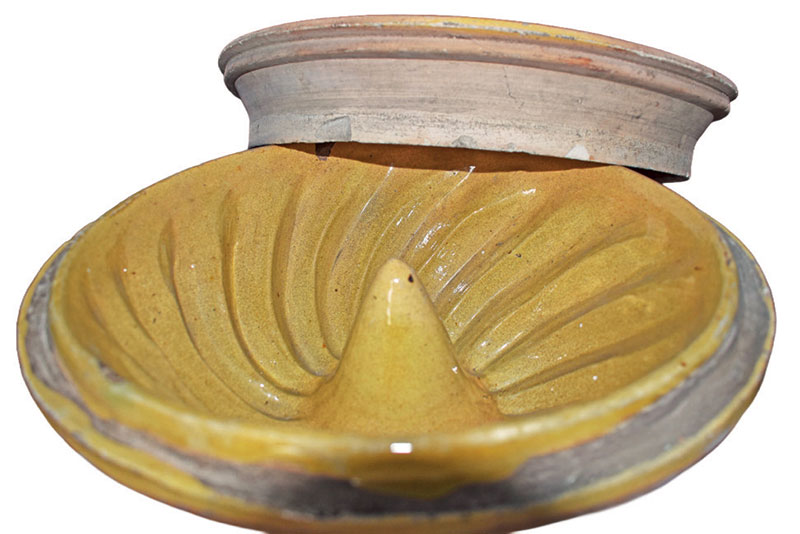
Dutch earthenware broeder mould with lid An earthenware broeder mould with its lid, from the collection of Oudheidkamer Texel, the Netherlands, object OK-0726. The swirled flutes and central cone gave the cake its shape. Its closed cone sits below the rim, allowing the lid to seal the mould for cooking in boiling water. Photograph: Oudheidkamer Texel.
In Pettah, the old quarter of the city, the Dutch Period Museum holds another breudher pan, dating to about 1750–1800. Labelled simply as a “cake mould”, it is identified by Lodewijk Wagenaar in Cinnamon & Elephants as a broeder pot made of copper and tin. It follows the same essential logic as the Bawa vessel: a deep, fluted pan with a tall central column projecting above the rim and three sturdy legs. Unlike the Bawa pan, two prominent curved handles rise from either side and its rectangular legs are much heavier. Seen from above, its broad scalloped rim forms a distinctive petalled outline.
Though the museum vessel survives without a lid, its broad upper flange could have accommodated one. If so, the arrangement would have differed from the Bawa pan: the upturned handles would have prevented a cover from fitting down over the outer lip in the same way. They may have helped steady one from either side. The details differ, but the essential features remain the same.
The provenance of these two vessels remains uncertain. Wagenaar does not mention where the Dutch Period Museum pan was made, although he notes that broederpannen occur repeatedly in eighteenth-century Ceylonese inventories and auction records. His research also shows how easily objects travelled through the Dutch maritime world: goods moved between Holland, Batavia, Ceylon and the VOC settlements of coastal India, while European and Eurasian households acquired characteristically Dutch utensils locally at auction. Their presence in Sri Lanka tells us where they were used and valued, but not necessarily where they were made.
-
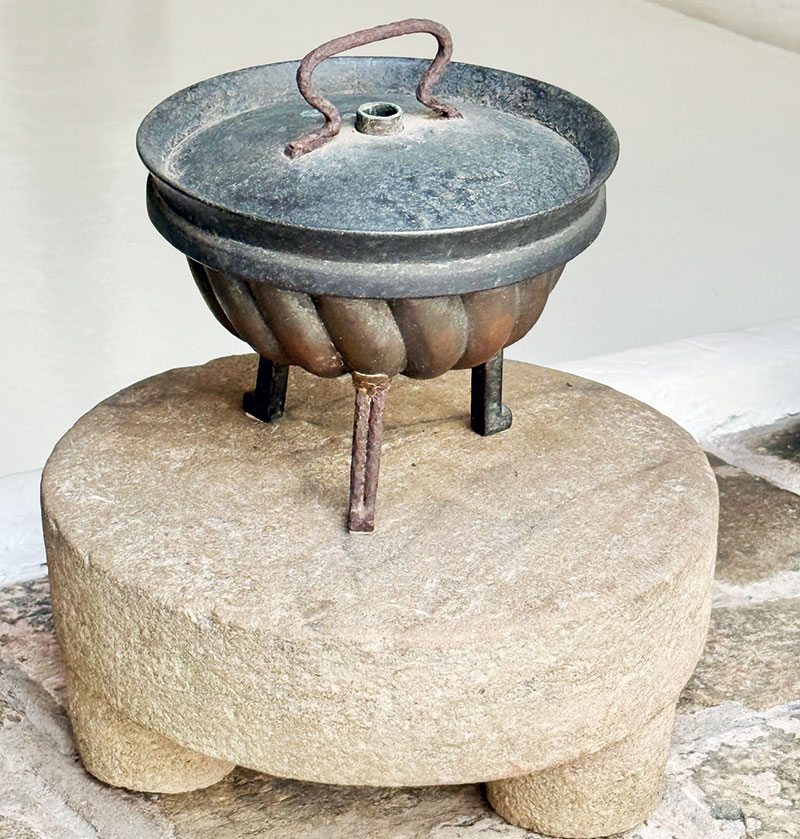
- Bawa’s breudher pan, closed With the heavy lid in place, the central chimney is concealed. Photograph by Jennifer Moragoda
-
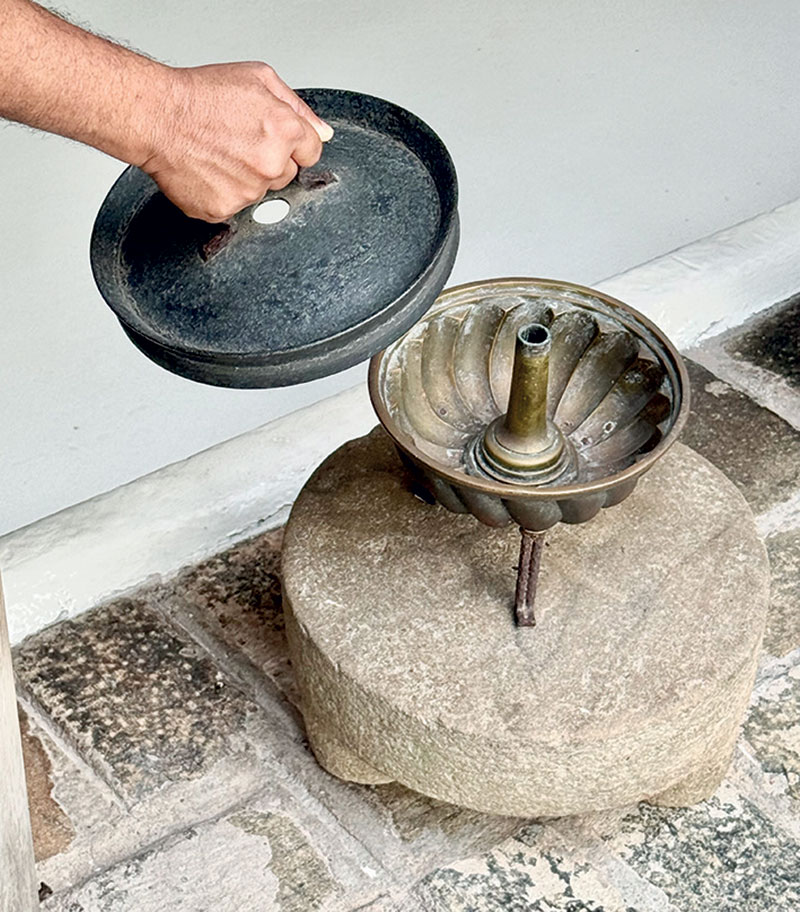
- Bawa’s breudher pan, open Geoffrey Bawa’s breudher pan at No. 11, 33rd Lane, Colombo, with its heavy lid lifted to reveal the fluted brass mould and hollow central chimney. Photograph by Jennifer Moragoda
-
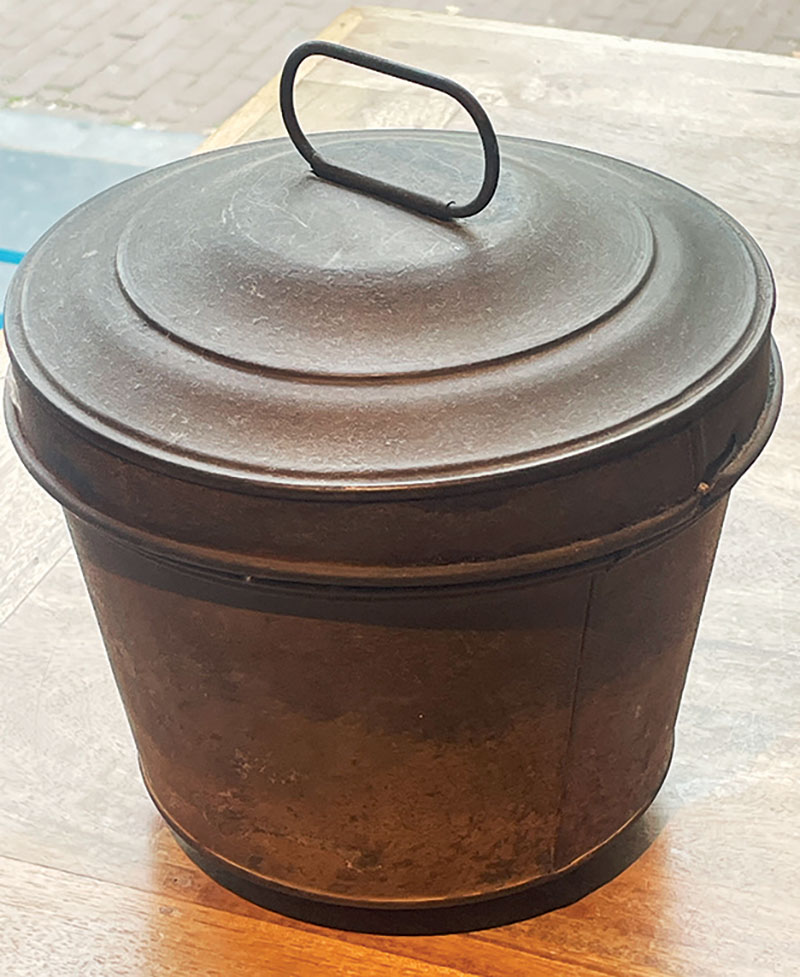
- Bawa’s breudher pan, closed With the heavy lid in place, the central chimney is concealed. Photograph by Jennifer Moragoda
Built for the Hearth
The two pans reveal how breudher was once baked in Sri Lanka: they were designed for the hearth rather than the oven. The Bawa pan makes the engineering especially clear. Its thick metal walls enclosed the dough, while the long legs held the vessel above the embers and the heavy, close-fitting lid could carry hot coals, providing heat from above. Most ingenious was the hollow central column. It reduced the mass of dough through which heat had to travel while acting as a chimney, allowing rising heat to pass through the centre of the bread and out through the lid. The fluting increased the surface exposed to the heated metal while giving the finished bread its tall architecture. Together, these features distributed heat around, above and through the dough—in effect creating a miniature, self-contained oven within the hearth.
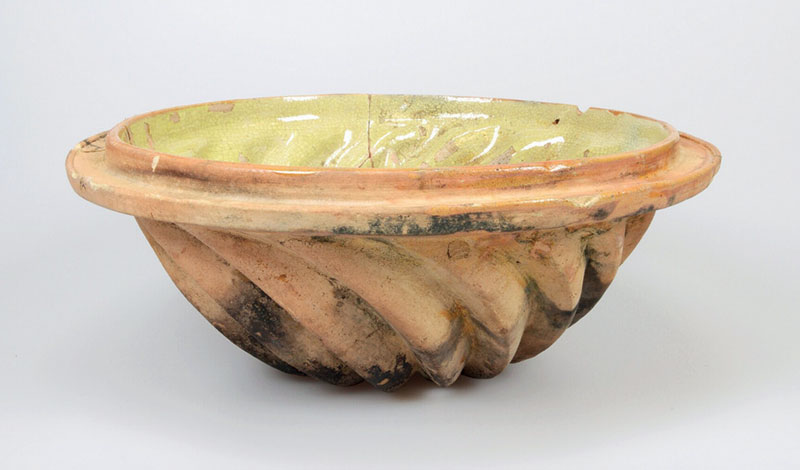
A traditional broeder mould from North Holland, made in Germany around 1880, offers a striking comparison. Shallower and made of earthenware, it shares with the Bawa pan a lid, central column and slanted fluting. German earthenware circulated widely in the Netherlands, so its place of manufacture need not imply a specifically German origin for the form.
Jacco Spil, General Director of the bakery museum in Medemblik, North Holland, explains that a domestic broeder could be cooked either in a special cloth bag or in a lidded mould. Other Dutch museum examples show that such broeders were traditionally boiled or steamed rather than baked directly over the hearth. The same general shape could also be used for tulband, a different, cake-like preparation baked in the oven.
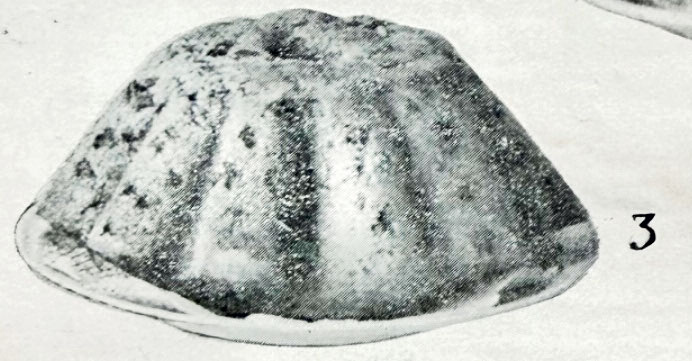
A twentieth-century Broeder A finished Broeder, illustrated in the plate “Dutch and Portuguese Sweets” from the Ceylon Daily News Cookery Book, second edition, 1934.
The surviving Dutch moulds provide an illuminating contrast with the Bawa pan. They have the familiar central tube and fluted ring shape, but the examples examined here have no integral legs. The Bawa pan incorporates the requirements of hearth baking into the vessel itself: long legs hold it above the embers, the heavy lid can carry hot coals while enclosing the dough, and the central tube projects through the lid to channel heat through the centre. It is this integration of functions, above all the projecting chimney, that sets the Bawa pan apart.
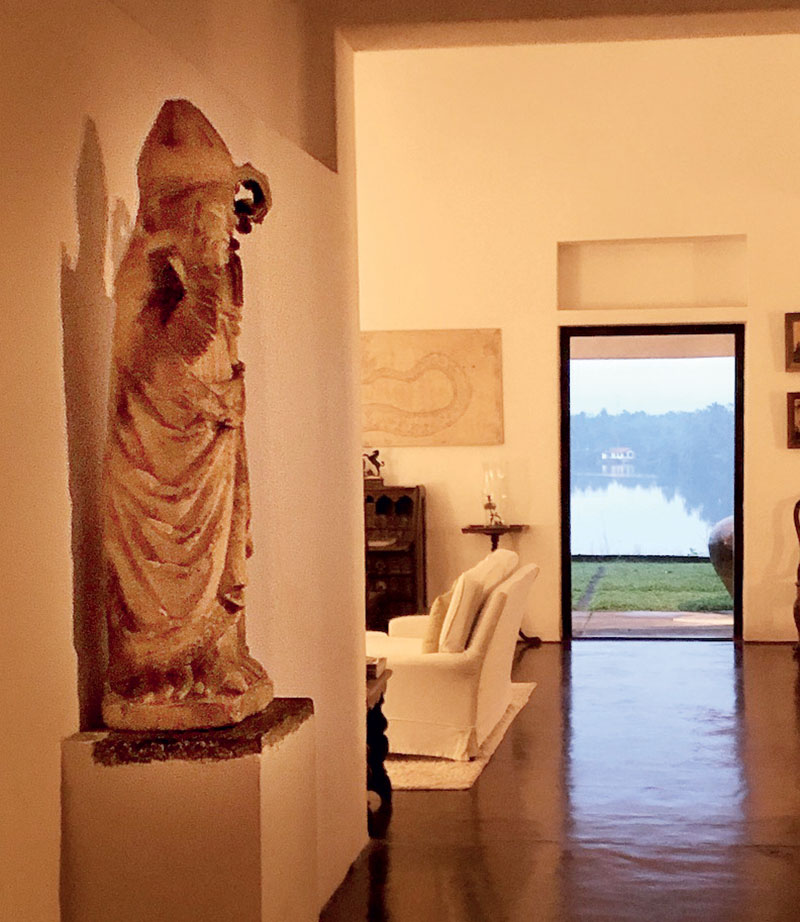
The stone cardinal at Lunuganga The stone cardinal at Lunuganga, Geoffrey Bawa’s country estate near Bentota, Sri Lanka. The figure stands within an interior overlooking the garden and lake. Photograph by Jennifer Moragoda
As the hearth gradually gave way to the oven in Sri Lanka, the breudher pan dispensed with its legs and heavy lid, while the projecting chimney became unnecessary. The central tube was shortened to just below the rim, retaining its role in reducing the thick central mass of dough but no longer functioning as a chimney. The oven had taken over much of the work the old pan once had to perform for itself.
From Broeder to Breudher
English speakers might assume that the Dutch broeder means “bread”, especially since brood is the Dutch word for bread. But broeder means “brother” and can also refer to a member of a religious order. A nineteenth-century Dutch dictionary suggests that the food acquired its name because its rotund, plump shape recalled a stout monastery brother.
Rather than a single fixed preparation, broeder belonged to a broad, regionally variable family. Pagrach-Chandra records versions fried in a heavy pan, steamed in a covered mould as ketelkoek, or boiled in a cloth as Jan in de zak. The names broeder, boffert and Jan in de zak could also overlap in local usage. Such preparations are well represented in eighteenth-century cookery books.
In Ceylon, the Dutch spelling broeder persisted through Dutch rule and well into the British period. Breudher is the modern conventional Sri Lankan English spelling, while in Sinhala the bread has been known as burudala.
Deloraine Brohier places breudher’s origins in “Holland and the Hanseatic Towns of the low-country, and elsewhere in Flanders”. Wagenaar traces the name more specifically to West Friesland in North Holland, home of the VOC chambers at Hoorn and Enkhuizen.
Spil distinguishes between broeders made at home and those produced by professional bakers in West Friesland. The domestic version used a yeast dough, sometimes with currants. The bakery broeder, by contrast, was a baked round loaf containing currants or raisins, with a cinnamon-and-sugar filling at the centre. The Hoornse Broeder belongs to this baked tradition.
In parts of Friesland, boffert could also refer to a yeasted celebration cake baked in a tulband pan. Here the relationship to Sri Lankan breudher becomes closer still: an enriched, yeasted festive bread or cake shaped in a tall ring.
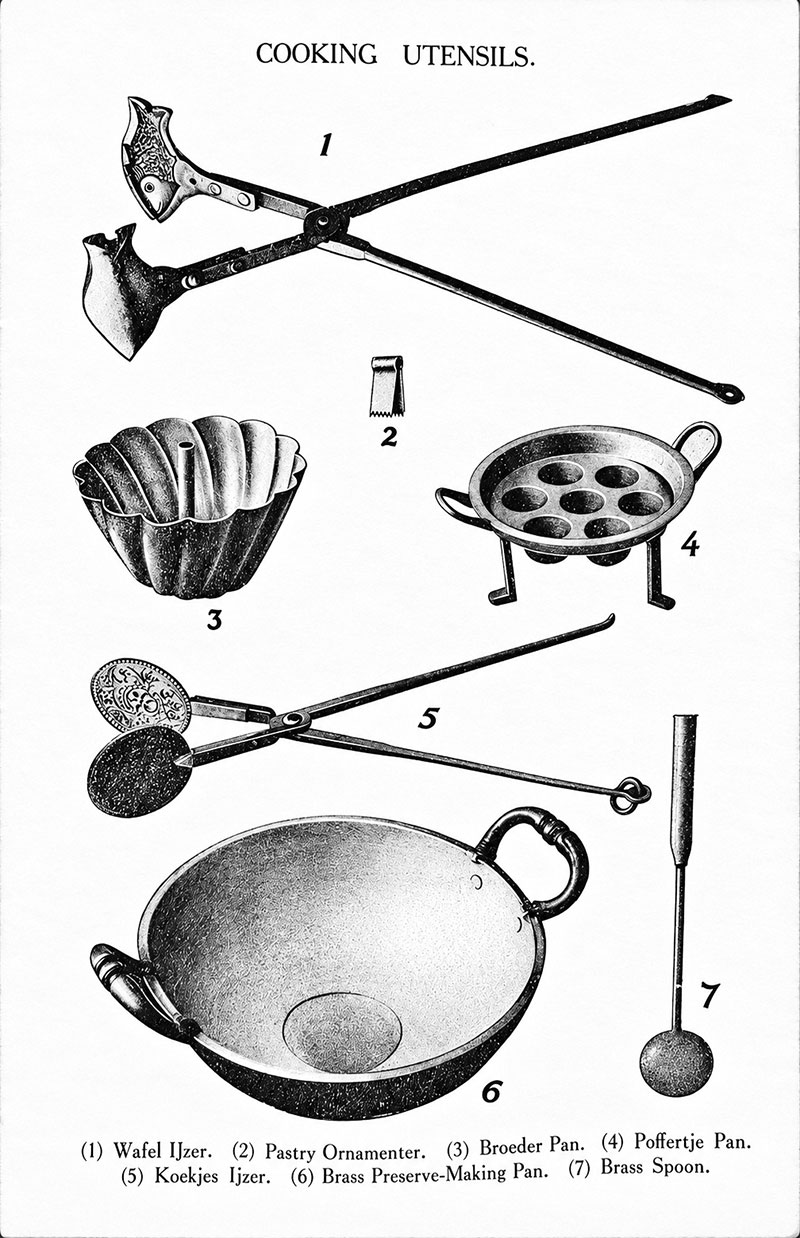
A twentieth-century Broeder Pan A fluted Broeder Pan, illustrated in the plate “Cooking tensils” from the Ceylon Daily News Cookery Book, second edition, 1934.
Beyond the Netherlands, comparable traditions existed in German-speaking Europe. The Dutch tulband and German Gugelhupf belonged to the same broad family of ring-shaped breads and cakes. Maria Riesin’s 1755 cookbook from Franconia, in southern Germany, contains sixteen Gugelhupf recipes, thirteen of them yeast-leavened. The Fränkisches Freilandmuseum, a museum in Franconia that has studied the manuscript, notes that one recipe calls for twenty eggs to a pound of flour—a ratio it describes as high but not unusual—while a “simple” Nuremberg version of 1733 used six yolks.
Thirty Eggs
Deloraine Brohier, in A Taste of Sugar and Spice, records a broeder recipe from what she calls the “Brohier Manuscript”, a slim, yellowed typescript titled Rare Recipes of a Huisvrouw of 1770, found in her father R. L. Brohier’s collection. It calls for only five components:
3 lbs wheaten dough
1 lb butter
1 lb sugar
¼ lb raisins
30 eggs
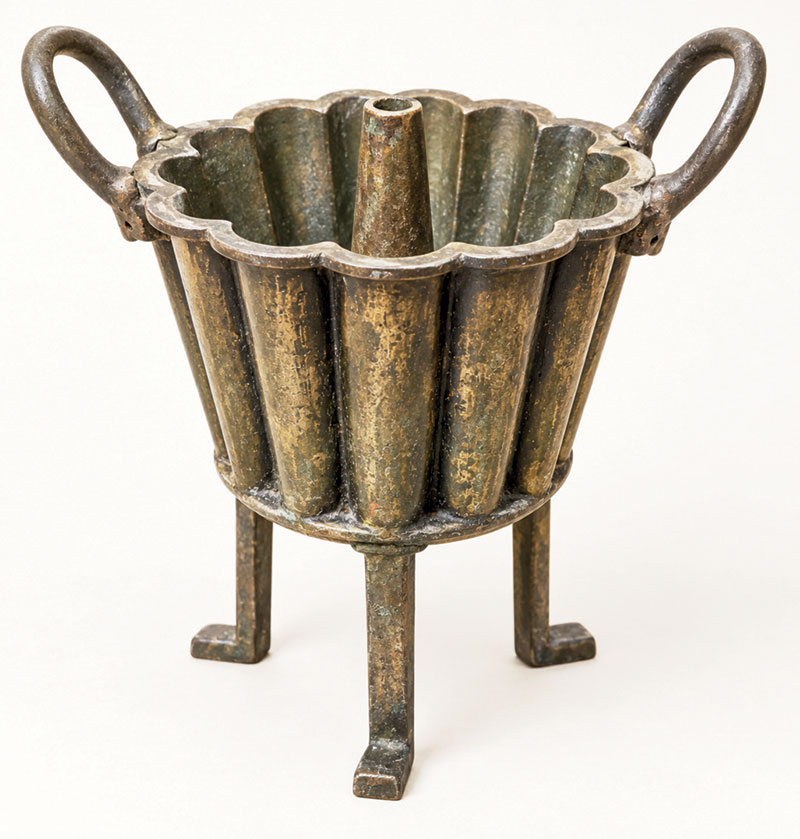
Dutch Period Museum breudher pan A breudher pan in the Dutch Period Museum, Pettah, Colombo, with a deep fluted body, hollow central chimney, two loop handles and three supporting legs. Photograph by Jennifer Moragoda
The recipe is scaled for a large batch, but its proportions are what stand out. One pound of sugar to three pounds of prepared dough is generous for a bread; thirty eggs are startling. Brohier makes clear that only the yolks were used, but even so, the quantity is remarkable.
The curious phrase wheaten dough specifies the flour type, a distinction that may have mattered in a local kitchen where rice and other familiar flours were more common than imported wheat. Yet the recipe says nothing about how the initial dough was made or what leavened it. A 1925 contribution to the Journal of the Dutch Burgher Union, appearing under the heading “Household Hints” as “How to make Broeder”, came from an unnamed female member described as “a much valued lady correspondent”. She notes that dough “can be purchased at any bakery” and would arrive “highly leavened”. The leavening agent used by eighteenth-century bakers may remain unknown, but plain bread dough clearly formed the starting point for breudher.
Breudher-making therefore begins where ordinary bread-making ends: with an already fermented wheat dough transformed through the laborious incorporation of butter, sugar and an exceptional quantity of egg yolks.
From there, Brohier’s instructions are quite clear. The dough is kneaded firm, then butter in pats is gradually worked in. The yolks follow one by one, each thoroughly incorporated before the next is added, and finally the sugar. Kneading continues throughout, alternating with beating or “clapping”; Brohier stresses that this gradual incorporation is necessary to keep the batter firm. The mixture is then placed in the pan and, if possible, left in the sun for half an hour to help it “bake lighter” before going into a “hot oven”. In modern baking terms, gradual enrichment helps such a rich dough retain its structure.
Elsewhere in the book, recalling Christmas in her grandmother’s household, Brohier remembers breudher-making as a whole morning’s work, with her grandmother and aunts “slapping and turning, spooning and twisting” the mixture by hand. Her recollection supplies the time and physical effort compressed by the recipe.
The same correspondent offers a series of practical hints for judging the mixture. If it began to “run”, she advised stopping the addition of yolks because the sugar still had to go in. Incorporating all thirty had been regarded by an earlier generation as “a triumph of culinary art”. She wonders whether success depended on what she calls “the excellency of the dough” supplied to the cook, or simply on the smaller size of village eggs; the reason, she says, “was not clearly known”. In practical baking terms, both could matter: how much yolk the dough could absorb would depend on its condition and fermentation, while larger eggs would contribute more yolk by weight.
Before the raisins were added, the mixture was worked until hollow bubbles appeared, which the writer took as proof that it had been successfully aerated. The desired result was “light and spongy”.
The basic formula proved remarkably durable. The Ceylon Daily News Cookery Book, first published in 1929, still calls for two pounds of dough and twenty yolks, almost exactly preserving the older proportion. Chandra Dissanayake records a three-pound, thirty-yolk version alongside later adaptations using fewer eggs, while Charmaine Solomon simplifies and broadens the formula further. Across the twentieth century, breudher remained recognizable even as cooks adapted it for economy, convenience and changing kitchen practice.
When Recipes Travel
The recipes diverge most clearly in their enrichment. Many domestic Dutch broeders contained little or no sugar in the dough and were sweetened only when served, while the Hoorn and Frisian baked versions were richer. In Sri Lankan breudher, sugar, butter and an unusually large quantity of egg yolks were worked directly into the fermented dough.
Eighteenth-century German Gugelhupf recipes show that yeasted breads or cakes could contain substantial quantities of eggs and fat. Sugar appears more sparingly in these older German recipes and remained expensive. Against that background, the pound of sugar worked into three pounds of prepared dough is notable—and may point elsewhere.
Brohier draws attention to the Portuguese taste for sugar and to the ways Portuguese and Luso-Eurasian foodways entered Dutch-Ceylonese households. Iberian confectionery—particularly the convent traditions of Spain and Portugal—also made conspicuous use of sugar and egg yolks. Together, these parallels make Portuguese influence plausible, perhaps less in breudher’s basic structure than in the degree of richness it acquired in Ceylon.
Many European men serving the VOC married Portuguese-Eurasian women in Sri Lanka and elsewhere in Asia, while cooks and others in colonial households often came from communities shaped by earlier Portuguese influence. Such households offered precisely the setting in which northern European baking traditions and Luso-Eurasian tastes might meet.
It is tempting to imagine that a well-loved festive bread—and perhaps even the specialized vessel used to bake it—travelled with people on VOC voyages, carrying something of home across oceans into unfamiliar places. In new kitchens it acquired new ingredients, techniques and meanings, becoming something more than the dish that had first set out.
(All photos are by the author unless otherwise noted )
by Nilantha Ilangamuwa
A former German intelligence chief has been arrested on suspicion of treasonous espionage just as a former senior CIA official has pleaded guilty after using his government position to defraud the United States of approximately $194 million, including the acquisition of 298 gold bars, both reported last week. David J. Rush fabricated highly classified government programmes to create the appearance of legitimate authority and divert public money into property, gold and luxury assets. US prosecutors also say he admitted giving a foreign government official information identifying a secret American intelligence source.
August Hanning, Germany’s former BND chief, faces a very different set of allegations. German prosecutors accuse him of obtaining classified BND information through a former subordinate who remained inside the agency and of using some of that material in dealings involving foreign intelligence. Hanning denies wrongdoing and hasa not been convicted. The cases differ. One concerns a guilty plea to fraud, the other an espionage investigation. Their near-simultaneous appearance exposes a vulnerability in modern intelligence services. Secret institutions depend on trust, yet that trust creates opportunities for abuse from within, especially when privileged knowledge survives a person’s relationship with the state.
The Bundesnachrichtendienst (BND) is being prepared for a more active role as Germany faces Russian espionage, cyber operations, sabotage and other forms of hybrid pressure. The proposed legislation would expand its ability to interfere with foreign computer systems and conduct disruptive operations. Peter Neumann, the security scholar interviewed by Die Zeit, sees the change as overdue. Germany, he argues, cannot expect French, British and Dutch services to possess capabilities that Germany itself restricts while relying heavily on allied intelligence, particularly from the United States. Former Justice Ministry official Peter Schantz accepts that German capabilities need strengthening but questions whether wider powers provide the answer. His concern centres on sabotage, cyber countermeasures, escalation and political responsibility. The disagreement is about the boundary between intelligence collection and state action.
A failed intelligence operation can produce bad information. A failed sabotage operation can produce casualties, retaliation and an international crisis. Schantz has questioned whether the Independent Control Council, despite its legal review function, provides sufficient political accountability for sensitive operations. Neumann, by contrast, argues that excessive legal and procedural restrictions have made German intelligence slower and less effective than comparable European services. The more consequential an operation becomes, the harder it is to separate legality, secrecy and political responsibility. It concerns the institutional consequences of moving an intelligence service from observing foreign activity towards intervening directly in it. Once the BND possesses capabilities designed to disrupt foreign systems, questions about authorization, review and responsibility become inseparable from the operational purpose of those capabilities.
The Hanning investigation gives this debate a serious internal dimension. Prosecutors allege that Hanning, who led the BND from 1998 to 2005, later obtained roughly 2,000 documents from Manfred D., a former office manager who remained inside the agency and worked for Hanning’s successors until 2026. Investigators allege that some documents came from sensitive BND reporting and could have contained information originating with partner services. The concern is the alleged channel through which it was obtained. A former chief did not allegedly need to penetrate the agency from outside. Prosecutors say a trusted former colleague remained an information link into an organization whose value depends on controlling access. Hanning’s arrest is not proof of guilt, but the allegations raise questions about how effectively the BND detects misuse of privileged relationships.
History provides several reminders. Aldrich Ames betrayed the CIA to the Soviet Union, Robert Hanssen spied for Moscow from inside the FBI, Kim Philby reached senior British intelligence positions while secretly working for the Soviets, and Günter Guillaume penetrated West Germany’s political centre for East German intelligence. These cases are not equivalents of Hanning’s allegations. Their relevance is narrower. Intelligence organizations are unusually exposed to insiders because sensitive information is concentrated in trusted individuals. Hanning’s case, if the allegations are established, would add a different dimension because the alleged access occurred after he had left the BND. The question then extends beyond the classic insider threat to the relationship between intelligence agencies and their former senior personnel.
Senior intelligence officers leave office with knowledge, contacts and reputations built through decades of public service. Moving into consultancy or corporate work is not inherently improper. Yet the boundary between expertise and privileged access can become difficult to police when former officials continue dealing with people connected to foreign governments, security businesses or sensitive disputes. A former intelligence chief can enter a boardroom carrying decades of public investment in his expertise. The issue is whether classified information, institutional relationships or official prestige can become private assets. That concern is particularly relevant when a former official’s commercial value is closely connected to the networks developed while holding public authority. The difficulty lies in the point where legitimate professional experience becomes access to information or relationships that were created for public purposes.
The Rush case shows another side of the same vulnerability. According to US prosecutors, he created fictitious classified programmes and used the authority surrounding them to make fraudulent transactions appear legitimate. The result was a diversion of public money into private wealth. His case is not an espionage equivalent to Hanning’s, but it demonstrates how secrecy and official authority can obstruct ordinary scrutiny. The fewer people authorized to know what a programme is, the more important internal controls become. Secrecy protects intelligence work, but without effective controls it can also shield misconduct.
Germany faces a more difficult security environment. Neumann’s concern about dependence on allied intelligence is legitimate, particularly when Germany expects partners to share sensitive information while its own service has more limited powers. Capability also creates a security burden. An agency authorized to conduct offensive cyber operations will possess more access, more technical capacity and more sensitive information. The question is whether safeguards are equally strong. If partner services believe sensitive material can move from the BND into private networks, cooperation becomes more difficult.
The treatment of former intelligence officers belongs here. Retirement can create a combination of vulnerability and influence. Former officers may lose institutional protection while retaining knowledge valuable to private interests. Professional reputation can become a commercial asset, while accusations can destroy reputations before a court establishes the facts. Hanning remains legally entitled to the presumption of innocence. If the allegations collapse, reputational consequences remain; if proved, the case raises questions about internal controls. The affair demonstrates that retirement is not a clean break from senior intelligence responsibilities. Former officials remain part of the institutional history of the services they once led, and their subsequent activities can affect perceptions of those institutions even when no criminal conduct is established.
Germany’s problem is not unique. Every nation-state faces the dilemma of maintaining capable intelligence services while protecting people who may carry their secrets, networks and responsibilities long after formal service has ended. Greater operational capability also increases the importance of authorization, oversight, internal security and post-service restrictions. If classified material moves into private networks, confidence between intelligence services becomes harder to maintain.
The arrest of Hanning and the Rush guilty plea arrive at a significant moment for modern espionage. Neither case proves that intelligence agencies are inherently corrupt, and the two men face different legal circumstances. Their significance lies in a common institutional problem. Intelligence services concentrate information, authority and trust in a small number of people. That concentration is necessary, but it also creates opportunities for abuse, insider compromise and conflicts of interest.
Excerpted from The Art of Governance, autobiography of MDD Peiris)
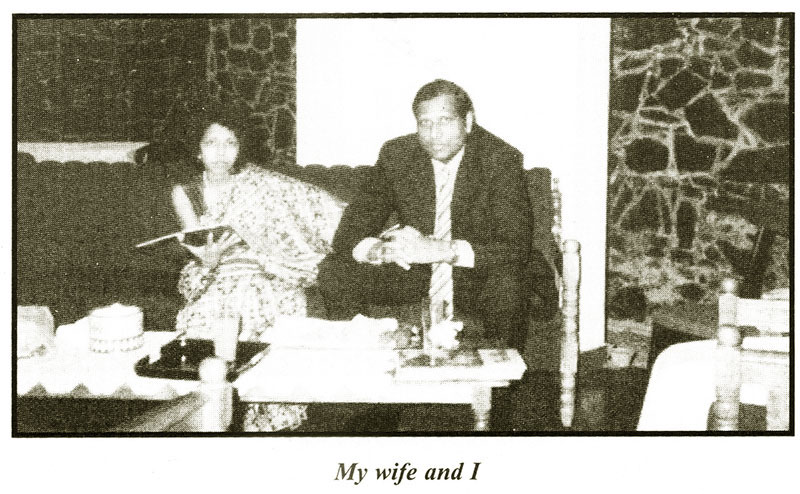
This concludes some of the main events of the first two decades of my life. But this autobiographical interlude would not be complete without some brief reference to persons near and dear who have been closely associated with my life. I have already mentioned my parents in some places in this book. I have written about my wife here and there, essentially a person of considerable gentleness and deep values silently held nursing a fear that these would be discovered and lead to any kind of public recognition or praise.
She does not wish any of her good deeds to be known. Both of us, and our son Navin have been close, but in a non demonstrative way. There is mutual affection, care and concern but not greatly verbalized. But all know it is there. My father-in-law Dr. P.J. Anthonis, too, I have written about in an earlier chapter. He possessed the qualities to be a father rather than a father-in-law to his three sons-in-law. In essence he was a gentle, caring friend devoid of any harshness in word or deed. His death in early 1983 was a severe blow to all including his fond grand children.
It is not customary to praise mothers-in-law. This for some unfortunate reason seems to be an internationally accepted standard and practice. But we acquired a mother-in-law with a basic sense of fun, who would react interestingly to deliberate provocation on our part to draw her out. She was a near workaholic and bit of a perfectionist who always took special delight in seeing that we were well fed and looked after whenever we found the time to visit her. All of us, including the grand children enjoyed her company.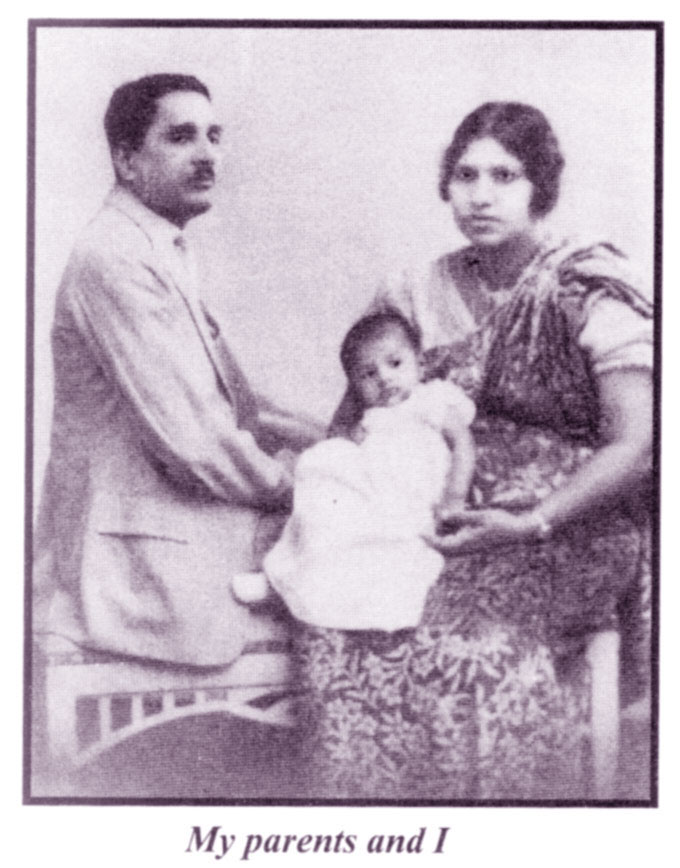
My sisters-in-law, Nimalie and Srimalie are twins who had caused all of us a great deal of inconvenience by deciding to be born on two different days, one, some minutes before midnight, and the other a few minutes after. As a result we have now to wish them for their birthdays on two different days. After this initial thoughtless act, they have turned out to be two delightful characters with visible intelligence, lively minds and a developed ability towards spotting sundry incongruities in life which are then turned into light satire and general good humour devoid of the slightest trace of malice.
They are always good company and steadfast supporters in good times and bad. Chitra and I have also been fortunate in our brothers-in-law, Sarath and Lalith. Sarath Samarasinghe married to Srimalie is a person of varied talents which include music and sports. He is also a person of wide experience and great executive and managerial ability. Starting life as a planter he went on to develop and improve the companies he worked in before taking the bold decision to start his own company. Here, he overcame all odds and with the support of one or two of his colleagues created an enterprise of great range and quality.
Only the ablest can achieve such results, starting from scratch and in mid life, particularly in a country like Sri Lanka. Srimalie entered the university of Colombo to read for a science degree, got bored with the whole proceeding, left, and took to learning German and reading widely, particularly literature. Lalith Senanayake married to Nimalie is a doctor. Nimalie a person of naturally generous instincts who was herself a doctor, swore she would never marry a doctor and ended up doing just that. But then, life is full of contradictions.
Lalith has a good humoured, laid back attitude to life, and a natural flair for comic and diverting observations on men and matters. Sarath possesses a needling kind of good humour, with the disciplined driving effort typical of a CEO. Lalith had developed the art of concealing his abilities, which are considerable. But appropriate to the profession of a practicing doctor, we are only given small doses of these from time to time, and certainly not three times a day. But both brothers-in-law are great fun, particularly when they are together. On such occasions the family is guaranteed high quality entertainment.
This extended family has gradually expanded with the birth of our son Navin, three nephews, two of them Eshan and Tivanka produced by Lalith and Nimalie and one, Chehan, by Sarath and Srimalie. They also produced the only niece, Anouk. All these children have turned out to be great delights, warm, caring persons as human beings and academically and professionally of high quality and achievement.
In recent times all of us have been enriched by the addition to the family, of Namalika Talwatte who married our son Navin, and Nayana Kamalgoda, who married our nephew Chehan. Since then, further additions were taking place, with Chehan and Nayana producing a grand nephew for us, and Navin and Namalika making us grandparents, with a grand daughter Chaya.
We have all been singularly blessed, because the relationships between and amongst all of us have been characterized by caring, friendship, generosity and affection. The approach of all has been, how to help the other and not to get something for oneself. All are willing to give and reluctant to take. Long may this last.
Before I leave my wife’s side of the family, I have to mention one other name. This is of Dr. P.R. Anthonis, her uncle, and the second in a large family of which my father-in-law was the eldest. One of Sri Lankan’s most eminent surgeons, Dr. Anthonis is widely read in Sinhala and English literature, history, archaeology and a number of other subjects and possessed of a powerful retentive memory. A brilliant student in school, who carried away practically every prize on offer, from French and Latin to Physics and Geography, he continued his progress in the medical college, finally passing out with first class honours and various gold medals.
My father-in-law also passed out with first class honours at around the same time, but without gold medals. We had known Dr. Anthonis, long before we came to know his elder brother and family. My parents were friends of his and his kind and gracious wife Ruby. We had visited each other’s homes. When I got into the civil service, I used to meet him at some of the embassy receptions, and served with him together on a committee set up by the then Permanent Secretary to the Ministry of Defence and External Affairs, Mr. N.Q. Dias.
We got on very well and enjoyed each other’s company. Latterly he and his wife played an important role in my marriage to his niece. and many were the days we had dinner at his spacious house in Dharmapala Mawatha, opposite a section of Vihare Maha Devi Park. Thereafter. he and I became even closer friends, and he acquired the habit of discussing some of his more important addresses and speeches with me. He readily came, irrespective of the time of day or night when we had some medical emergency, and he looked after my father with care and affection during- his final illness.
He became the Chancellor of the University of Colombo, and the holder of many other public positions. He is still our first recourse when it comes to any medical advice. It was only the other day that he personally dragged me to Ratnam’s hospital to get an IVP (intravenous pyelogram, which is a specialized X-ray test that uses contrast dye to view the kidneys, ureters, and bladder) done because he was not entirely happy about a urinary infection I had. He is a person therefore, who had played, and still continues to play a most important role in our lives.
On my side of the family too there have been aunts and there are cousins and others who have been, and are consistently helpful in so many matters. Two of my aunts, my mother’s elder sisters, in particular were so fond of me that at times I felt I had three mothers. One of them had lost both her husband and her infant daughter very early in life and had come to live with my mother. Now she transferred all her love and affection to me. She turned out to be a second mother in residence. Particularly when I fell ill, I received the most alert and comprehensive care.
It gave me great satisfaction therefore to care for her in the final stages of her life, bringing the doctor to see her, and personally boiling and sterilizing the needles and giving her the almost daily insulin injections that her diabetes required. I was in the public service by this time, and this was a ritual I performed practically every morning before I went to office.
All this brings to mind, how interdependent we are and how much our lives have been made easier and enriched mentally, physically and psychologically, not only by those relations who were and are close to us, but also by numerous friends and sometimes even by acquaintances. This is not to forget those servants and others who work for us.
At the end of the day, I don’t believe there is anything called single achievement. My own memoirs show how so many assisted and intervened at so many crucial stages of my life. One is humbled by those recollections. They constitute a potent antidote to any over estimation of oneself, and in my case have provided me with a degree of detachment and serenity born out of a gradually developed discipline of watching a process at work rather than an attempt at a grasping and fierce personal ownership of that process. False pride or arrogance would be totally irrelevant in a world where we are dependent on so many others for our welfare and well-being.

Behind the runway Ramani Fernando and CFW

Comeuppance for some, lessons for others

Jayakumar unanimously elected Sri Lanka-Thailand Society president

Lankan refugees in Tamil Nadu seek citizenship, passports

30 Eggs, Bawa’s Breudher Pan and a Culinary Who Did It?

When Spies Go Rogue

‘Dates have the highest sugar content to fight Coronavirus’

Sunday Island 27 December – Headlines

#SundayIsland 17th December – Headlines

Sunday Island – 28th March

Sunday Island Headlines – 21 March

Sunday Island – 21st February – Headlines
-

 News6 days ago
Geneva takes up Sallay’s case and govt. ignores opportunity to answer accusations
-

 News7 days ago
Nearly 20 Iranian tankers stranded off Lanka amid US sanctions
-

 Features5 days ago
Preventing grievances from becoming communal
-

 Sports3 days ago
Nissanka absence opens door for Sri Lanka’s young guns
-

 News4 days ago
Gnansara Thera to be assigned to prison printing section: Officials
-

 Features3 days ago
The Sri Lankan who made Scottish history
-

 Features6 days ago
Sri Lanka Cricket Bill: Governance reform is not yet a cricket strategy
-

 News7 days ago
Lanka enters new phase of prosecutions as hurdles clear