
Foreign News
Sixth foreign tourist dies of suspected methanol poisoning in Laos


A second Australian teenager has died of suspected methanol poisoning, bringing to six the number of foreign tourists who have died after apparently drinking tainted alcohol in Laos.
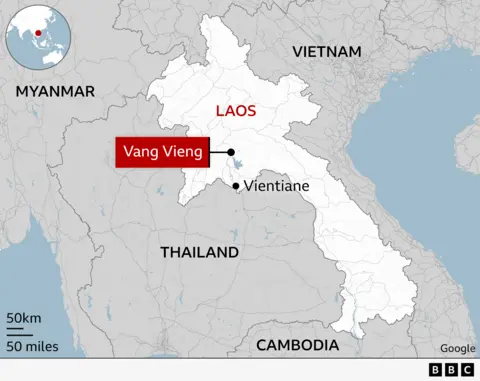
The family of Holly Bowles, 19, said it was with “broken hearts” that they confirmed her death, more than a week after she fell ill in the tourist town of Vang Vieng.
Her friend Bianca Jones, also 19, and British lawyer Simone White, 28, from south-east London, were confirmed to have died on Thursday.
An unnamed US man and two Danish women, aged 19 and 20, are also among the victims of the suspected poisoning, believed to be connected to bootleg alcohol.
In a statement released to media on Friday, Holly’s family said they were taking comfort from the fact she had brought so much “joy and happiness to so many people”.
They added that she had been living “her best life travelling through South East Asia meeting new friends and enjoying incredible experiences” when she became ill.
Australian Foreign Minister Penny Wong said: “All Australians will be heartbroken by the tragic passing of Holly Bowles. I offer my deepest sympathies to her family and friends.”
Holly and Bianca were taken to hospital on Wednesday, 13 November, after they failed to check out of their hostel in the small, riverside town of Vang Vieng, about two hours north of the capital Vientiane.

News reports and testimonies suggest the tourists may have consumed alcohol laced with methanol – a deadly substance often found in bootleg alcohol.
Just a small amount of methanol can be lethal, but it is sometimes added to drinks because it is cheaper than alcohol.
But, as Christer Hogstrand, a professor of molecular ecotoxicology, at King’s College London points out, it is also “not uncommon in home-distilled alcohol”.
“Methanol is like the alcohol in our drinks – colourless and odourless – but its impact on humans can be deadly,” he explained. “It has a different carbon atom structure which completely changes how humans process it in the body, leading to these potentially fatal consequences.”
It is not yet known where any of the people who fell sick or died were poisoned. It can take up to 24 hours for victims to start showing signs of illness.
The Nana Backpacker Hostel – where the Australian teenagers were staying – has said it gave out free shots to around 100 guests the previous evening.
But the hostel’s manager told news agency Associated Press that no other guests had become unwell.
The manager of the hostel has since been detained for questioning by police.
Few details have emerged about any of the other victims and where they may have visited.
Simone White, who lived in Orpington, was reportedly travelling with a group of friends. Ms White was a lawyer with global law firm Squire Patton Boggs, whose work involved general commercial matters, contentious and non-contentious intellectual property law issues according to the firm’s website.
“Simone was a talented colleague with a bright future ahead of her and someone who epitomised our firm values,” the firm said in a statement.
“Our thoughts go out to all of Simone’s family, friends, and those colleagues and clients who had the privilege to work with and know Simone. She will be sincerely missed.”
Australia is pushing authorities to be open about their investigation into the incident.
New Zealand and Dutch officials have also both said they were monitoring incidents involving nationals.
Vang Vieng is a hub for backpackers travelling across south-east Asia. It’s home to the Banana Pancake Trail – a popular backpacking route spanning Thailand, Vietnam, Laos and Cambodia.
[BBC]


A guitar used by David Gilmour on six of Pink Floyd’s albums has sold for a record $14.6m (£10.9m), making it the most expensive guitar ever sold, auction house Christie’s has said.
Gilmour played the 1969 Fender Stratocaster, nicknamed the ‘Black Strat’, on all of the British rock band’s albums between 1970 and 1983, including The Dark Side of the Moon, Wish You Were Here, and The Wall.
The guitar sold to an unnamed buyer after 21 minutes of bidding, as part of a rock memorabilia auction in New York on Thursday.
A piano owned by the Beatles’ John Lennon also sold at the auction for $3.2 (£2.5m), believed to be the highest fee ever paid for a piece of Beatles memorabilia.
(BBC)

China has approved a sweeping new law which claims to help promote “ethnic unity” – but critics say it will further erode the rights of minority groups.
On paper, it aims to promote integration among the 56 officially recognised ethnic groups, dominated by the Han Chinese, through education and housing. But critics say it cuts people off from their language and culture.
It mandates that all children should be taught Mandarin before kindergarten and up until the end of high school. Previously students could study most of the curriculum in their native language such as Tibetan, Uyghur or Mongolian.
The law was approved on Thursday as the annual rubber-stamp parliamentary session drew to an end.
“The law is consistent with a dramatic recent policy shift, to suppress the ethnic diversity formally recognised since 1949,” Magnus Fiskesjö, an associate professor of anthropology at Cornell University said in a university report.
“The children of the next generation are now isolated and brutally forced to forget their own language and culture.”
However, Beijing argues that teaching the next generation Mandarin will help their job prospects.
It also says the law for “Promoting Ethnic Unity and Progress” is crucial for promoting “modernisation through greater unity”.
The law was voted and passed on Thursday at the National People’s Congress in Beijing, which has never rejected an item on its agenda.
The law also provides a legal basis to prosecute parents or guardians who may instil what it described as “detrimental” views in children which would affect ethnic harmony and it calls for “mutually embedded community environments” which some analysts believe could result in the break up of minority-heavy neighbourhoods.
The Chinese government started to push for what it describes as the “sinicisation” of minority groups in the late 2000s and create a more unified national identity by assimilating ethnic groups into the dominant Han culture.
Han Chinese make up more than 90% of the country’s 1.4 billion people.
Beijing has long been accused of restricting the rights of minority ethnic groups in regions like Tibet, Xinjiang and Inner Mongolia.
Critics say assimilation has often been forced on people in these places – a state-led policy that has accelerated under Chinese leader Xi Jinping who has taken a harder line on dissent and protests, especially in areas home to minority ethnic groups,
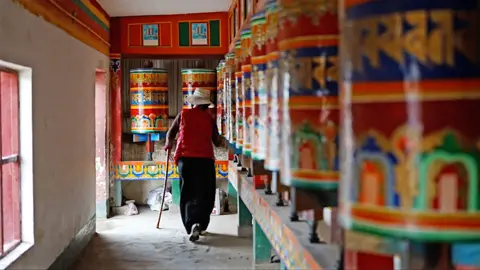
In Tibet, the authorities have arrested monks, and taken control of monasteries to ensure they do not worship the Dalai Lama.
When the BBC visited a monastery that had been at heart of Tibetan resistance in July last year, monks spoke of living under fear and intimidation.
“We Tibetans are denied basic human rights. The Chinese government continues to oppress and persecute us. It is not a government that serves the people,” one of them told us.
In Xinjiang, human rights groups have documented the detention of a million Uyghur Muslims in what the Chinese government calls camps for “re-education”, while the UN has accused Beijing of grave human rights violations.
The BBC’s reporting from 2021 and 2022 found evidence supporting the existence of detention camps, and allegations of sexual abuse and forced sterilisation, which Beijing denies.
In 2020, ethnic Mongolians in northern China staged rare rallies against measures to reduce teaching in the Mongolian language in favour of Mandarin.
Parents even held children back in protest at the policy as some ethnic Mongolians viewed the move as a threat to their cultural identity. Authorities moved quickly to crackdown on what it saw as dissent.
The Communist Party says it embraces different ethnicities. The country’s constitution states that “each ethnicity has the right to use and develop their own language” and “have the right to self-rule”.
But critics believe this new law will cement Xi’s push toward assimilation.
“The law makes it clearer than ever that in Xi Jinping’s PRC non-Han peoples must do more to integrate themselves with the Han majority, and above all else be loyal to Beijing,” Allen Carlson, an associate professor of government at Cornell University said, referencing China by the initials of its official name.
This focus on development and prosperity is “telling”, Professor Ian Chong of the National University of Singapore told the BBC.
“It is easy to read this language as meaning that minority languages and cultures are backward and impediments to advancement.”
Xi’s approach towards minorities is “consistent with his idea of creating a great and strong Chinese nation with a northern Han core… minorities are seen as branching off from that core, and hence in some ways derivative,” he adds.
“In practice, this has prompted concerns about further rounds of increasing control, diminution, and even crackdowns on minority cultures and languages.”
[BBC]
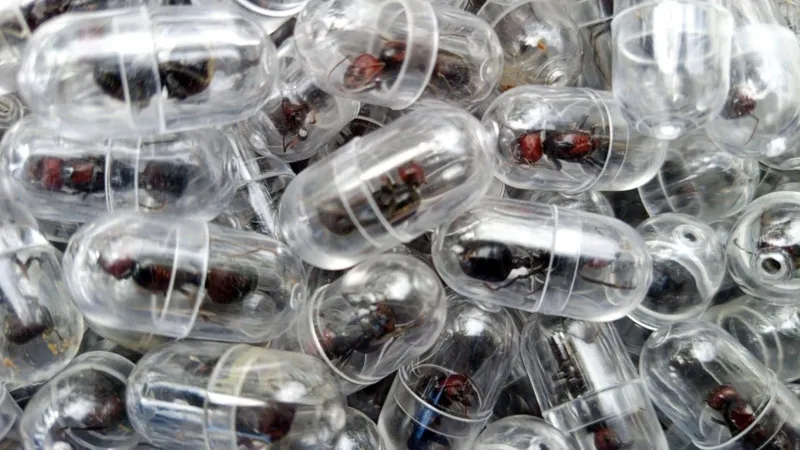
A Chinese national has been arrested in Kenya’s main airport accused of attempting to smuggle more than 2,000 queen garden ants out of the country.
Zhang Kequn was intercepted during a security check at Jomo Kenyatta International Airport (JKIA) in the capital Nairobi after authorities discovered a large consignment of live ants in his luggage bound for China.
He has yet to respond to the accusation but investigators said in court that he was linked to an ant-trafficking network that was broken up in Kenya last year.
The ants are protected by international bio-diversity treaties and their trade is highly regulated.
Last year, the Kenya Wildlife Service (KWS) warned of a growing demand for garden ants – scientifically known as Messor cephalotes – in Europe and Asia, where collectors keep them as pets.
A state prosecutor told the court on Wednesday that Zhang had packed some ants in test tubes, while others were concealed in tissue paper rolls hidden in his luggage.
“Within his personal luggage there was found 1,948 garden ants packed in specialised test tubes,” prosecutor Allen Mulama told the court.
“A further 300 live ants were recovered concealed in three rolls of tissue paper within the luggage,” he added.
The prosecutor asked the court to allow the suspect’s electronic devices – phone and laptop – to be forensically examined.
Duncan Juma, a senior KWS official, told the BBC that more arrests were expected as investigators widen their probe into other Kenyan towns where ant harvesting was suspected to be ongoing.
Last May, a Kenyan court sentenced four men to one year in prison or a fine of $7,700 for trying to smuggle thousands of live queen ants out of the country, in a first-of-its kind case.
The four suspects – two Belgians, a Vietnamese and a Kenyan – had pleaded guilty to the charges after their arrest in what the KWS described as “a co-ordinated, intelligence-led operation”.
The Belgians told the court that they were collecting the highly sought-after ants as a hobby and didn’t think it was illegal.
Investigators now say Zhang was the mastermind behind this trafficking ring but apparently escaped Kenya last year using a different passport.
On Wednesday, the court allowed prosecutors to detain him for five days to enable detectives to conduct further investigations.
The KWS, which is more used to protecting larger creatures, such as lions and elephants, described last year’s ruling as a “landmark case”.
The ants seized last year were giant African harvester ants, which KWS said were ecologically important, noting that their removal from the ecosystem could disrupt soil health and biodiversity.
It is believed that the intended destinations were the exotic pet markets in Europe and Asia.
[BBC]

Showers or thundershowers will occur at several places in the Western, Sabaragamuwa, Central, North-western and Uva provinces and in Galle, Matara, Mannar and Anuradhapura districts after 2.00 pm.

Bahrain & Saudi Arabia Grands Prix to be cancelled

Pink Floyd guitar sold for record-breaking $14.6m

Promoting Local Industries is a key priority of the Government – PM

Crypto loopholes funnel Lankan funds abroad

SLCERT urges Lankans not to get gypped by internet scams in run-up to festive period

‘Dates have the highest sugar content to fight Coronavirus’

Sunday Island 27 December – Headlines

#SundayIsland 17th December – Headlines

Sunday Island – 28th March

Sunday Island Headlines – 21 March

Sunday Island – 21st February – Headlines
-

 News5 days ago
Repatriation of Iranian naval personnel Sri Lanka’s call: Washington
-
 Features5 days ago
Winds of Change:Geopolitics at the crossroads of South and Southeast Asia
-

 News4 days ago
Prof. Dunusinghe warns Lanka at serious risk due to ME war
-

 Sports3 days ago
Royal start favourites in historic Battle of the Blues
-

 Sports2 days ago
The 147th Royal–Thomian and 175 Years of the School by the Sea
-

 News2 days ago
Historic address by BASL President at the Supreme Court of India
-

 News3 days ago
CEBEU warns of operational disruptions amid uncertainty over CEB restructuring
-

 Features7 days ago
The final voyage of the Iranian warship sunk by the US