
Business
Share market surpasses highest intra-day gain of 100 points


By Hiran H.Senewiratne
The CSE strongly bounced back yesterday with the ending of the volatility in the market, surpassing the highest intra-day gain of 100 points. Investors believe that the IMF agreement would be signed before the end of the year due to positive developments, stock market analysts said.Accordingly, shares gained over 1.5 per cent in mid-day trade pushed by foreign buying in the market, “because foreign buying has triggered local buying as well, but it’s on very thin volumes on mixed investments, an analyst said.
In the previous session, the market saw over a Rs 1 billion foreign outflow, the worst in more than 1-year, as an offshore fund sold shares in top private lender Commercial Bank. But yesterday the turnover touched just below the Rs 1 billion market, which needs to improve with the bouncing back of the market, market analysts said.
Amid those developments both indices moved upwards. The All- Share Price Index went up by 96.4 points and S and P SL20 rose by 19.4 points. Turnover stood at Rs 862 million with a single crossing. The crossing was reported in Aitken Spence, which crossed 236,000 shares to the tune of Rs 31.1 million and its shares traded at Rs 132.
In the retail market, top seven companies that mainly contributed to the turnover were, Lanka IOC Rs 158 million (871,000 shares traded), ACL Cables Rs 55.2 million (721,000 shares traded), Lankem Development Rs 38.9 million (1.2 million shares traded), Browns Investments Rs 38.7 million (6.6 million shares traded), JKH Rs 36.3 million (262,000 shares traded), Agsta Rs 34.6 million (1.8 million shares traded) and Expolanka Holdings Rs 33.4 million (216,000 shares traded). During the day 36.2 million share volumes changed hands in 15000 transactions.
During the day mixed interest was observed in Lanka IOC, ACL Cables and Ex-pack Corrugated Cartons, while retail interest was noted in Browns Investments, SMB leasing and Agsta.
Analysts said the outflow was due to the country’s vulnerable banking sector outlook.The Capital Goods sector was the second highest contributor to the market turnover (due to JKH), while the sector index increased by 1.73 per cent. The share price of JKH gained Rs. 4.25 (3.14 per cent) to close at Rs. 139.75.
But overall the market has been on a falling trend as investors awaited cues on policies from the 2023 budget, which is scheduled to be presented next week amid panic- selling from time to time.Yesterday, the Central Bank- announced daily US dollar buying rate was Rs 360.96 and the selling rate Rs 371.75. The inflation rate is 73.70 per cent.











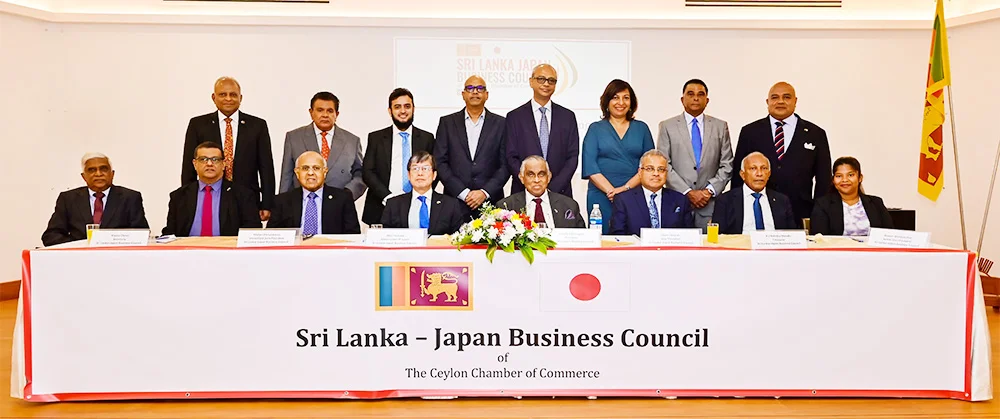
Japan Business Council (SLJBC) of The Ceylon Chamber of Commerce recently held its 47th AGM, with the Ambassador of Japan and the Patron of the Council, Akio ISOMATA, attending as the Chief Guest.
Addressing the gathering, Ambassador ISOMATA outlined three priorities for deepening bilateral economic relations: an effective and forward-looking trade and investment policy, the promotion of domestic industrial policy, and expanded investment in renewable energy. He noted that Sri Lanka’s ongoing review of its Free Trade Agreement policy would be important in shaping the country’s future negotiating landscape. He encouraged Sri Lanka to look Eastward toward Southeast Asia and Japan, proposing that the country adopt an export-oriented industrial model. The Ambassador welcomed the Government’s National Export Development Plan 2026 and National Mineral Policy 2026 as consistent with Japan’s vision of connecting Sri Lanka’s export-related manufacturing sectors with India’s high-growth manufacturing base.
In his address, President Athulla R F Edirisinghe reflected on nearly seven decades of humanitarian and development support extended by Japan to Sri Lanka, and paid tribute to the Chairman of the Sasakawa Peace Foundation Yohei Sasakawa, for his magnanimity in establishing the Foundation. Reflecting on the history of Japanese investment in the region from the 1970s onward, he observed that Sri Lanka had missed many opportunities to attract Japanese foreign direct investment. Highlighting the 2025 proposal for a Sri Lanka – Japan Economic Corridor by the Ministry of Economy, Trade, and Industry Japan, he called on Sri Lankan businesses, industry associations, and the wider community to come together in dialogue with the Government to ensure the country does not miss this opportunity as well.
2026/27 Committee: President: Athulla R F Edirisinghe – Director, Hirohama Ceylon (Pvt) Ltd, Senior Vice President – Ruwan Waidyaratne – Managing Director, Hayleys Advantis Ltd, Vice – President – Shamil Mendis – Managing Director, Spear International (Pvt) Ltd, Treasurer – Rohitha Mendis – Managing Director of Prudential Shipping Lines (Pte) Ltd, Immediate Past President – Mahen Kariyawasan – Managing Director, Andrew The Travel Company (Pvt) Ltd, representatives from Amano Lanka Engineering (Pvt) Ltd, BOV Capital (Pvt) Ltd, Brandix Apparel (Pvt) Ltd, Heritage Teas (Pvt) Ltd, Kalhari Enterprises (Pvt) Ltd, Lanka Harness (Pvt) Ltd, Dentsu Grant (Pvt) Ltd, MAC Holdings (Pvt) Ltd, and Vidullanka PLC. By invitation: HVA Foods PLC (subsidiary of George Steuart & Co), Spillburg Holdings (Pvt) Ltd, and Vaughan Chemicals (Pvt) Ltd.
The Sri Lanka – Japan Business Council plays an important role in promoting trade, tourism, and investments between Japan and Sri Lanka. For membership inquiries contact Kiyara at The Ceylon Chamber of Commerce via E-mail: businesscouncils1@chamber.lk or Tel.: 011 5588875/ 5588800.
By Ifham Nizam
What started 30 years ago as an effort to protect sea turtles has evolved into a community-based economic model that has generated livelihoods, attracted tourists and transformed Rekawa into one of Sri Lanka’s best-known nature tourism destinations.
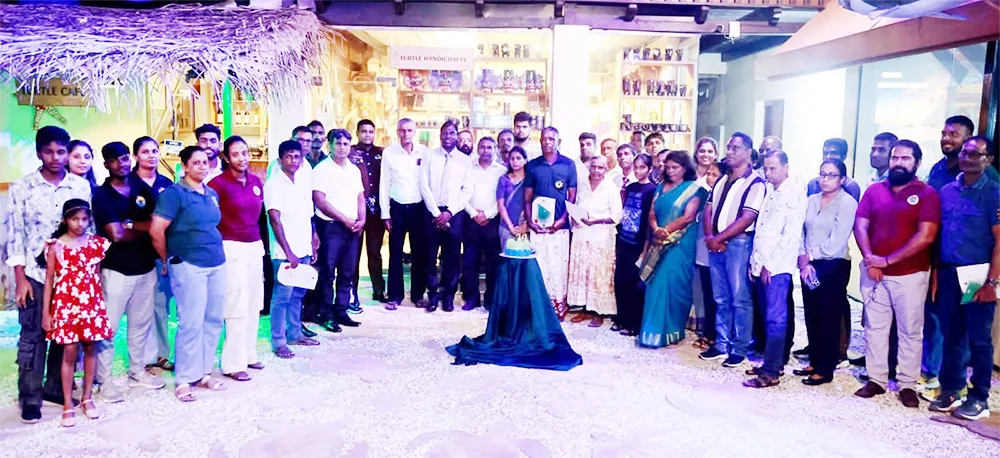
The Rekawa Turtle Conservation Project, launched on September 2, 1996, by the Turtle Conservation Project (TCP) in partnership with the Department of Wildlife Conservation and the Rekawa community, marked its 30th anniversary last week, demonstrating how biodiversity protection can become an economic opportunity for communities living alongside sensitive natural resources.
Speaking at the anniversary celebrations, TCP chairman Thushan Kapurusinghe said the project currently provides direct livelihoods for 28 people, but its economic impact extends considerably beyond those directly employed by the programme.
‘Today, 28 people directly earn their livelihood through this project. But its impact goes far beyond those 28 individuals, Kapurusinghe said.
He pointed to the transformation of the area over the past three decades, arguing that the growth of tourism in the community has been closely linked to the turtle conservation programme.
‘If you travel from Netolpitiya to this area, you can clearly see how much the village has transformed over the years. There is no doubt that the growth of tourism in this community has been driven by the Turtle Conservation Project, he said.
The economic significance of Rekawa lies in its ability to convert the protection of a natural asset into a source of recurring community income.
Tourists do not come to Rekawa merely to see a beach. They come to witness sea turtles emerging from the ocean and nesting in their natural habitat—a tourism experience that depends directly on the continued protection of the nesting beach.
Kapurusinghe said tour operators regularly bring visitors to Rekawa, with some tourists traveling there after visiting major attractions such as the Kandy Esala Perahera.
The model represents a fundamental shift from viewing conservation as an expense to recognising biodiversity as an economic asset that can generate sustainable livelihoods when properly managed.
The 30th anniversary celebration at the Rekawa Turtle Conservation Project Information Centre brought together Southern Wildlife Region Director of the Department of Wildlife Conservation Channa Suraweera, government officials, conservation organisations, community representatives and long-standing supporters of the initiative.
Individuals who had contributed to the project over the past three decades were also recognised with awards for their service to sea turtle and environmental conservation.
Rekawa’s experience has attracted international attention because of precisely this combination of conservation and community development. The project has received international recognition as well as the Green Employment Award from the Ministry of Environment and Natural Resources. Earlier international recognition included a highly commended ‘Tourism for Tomorrow’ award, while the project’s turtle-watch programme subsequently received further recognition in responsible tourism and conservation.
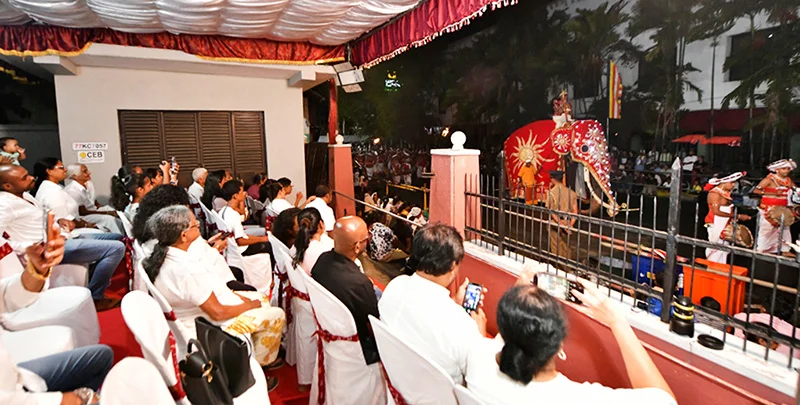
For an evening, the timeless spectacle of the Kandy Esala Perahera unfolded at especially close quarters for a select group of Ceylinco Life’s most valued policyholders and their families, who were hosted to an exclusive viewing experience by the Company’s Customer Relations Division.
Held at the Ceylinco Life Kandy Branch on Kings Street, the annual event coincided with the second Randoli Perahera, bringing guests into the heart of one of Sri Lanka’s most spectacular expressions of culture, tradition and pageantry.
As the procession made its majestic passage through the streets of Kandy, guests enjoyed VIP seating at a prime vantage point, allowing them to experience the colour, movement and grandeur of the Perahera up close. The evening offered a fitting setting for Ceylinco Life to celebrate its enduring relationships with its premium clientele.
The experience extended well beyond the spectacle outside. Guests were welcomed with evening refreshments and an exclusive dinner buffet presented by the prestigious Amaya Hills Resort, adding a fine-dining dimension to an already memorable evening.
Families, too, were at the centre of the occasion. A private movie theatre experience provided entertainment for children and adults alike, while each attending family received a beautifully framed family photograph as a personalised souvenir, a tangible reminder of an evening shared together against the backdrop of one of Sri Lanka’s most treasured cultural traditions.
Besides being a much sought-after opportunity to watch the Perahera, the occasion was an expression of appreciation. Through its continuing Customer Relationship Management activities, Ceylinco Life seeks to create experiences that recognise its most valued policyholders not simply as customers, but as relationships to be celebrated and nurtured. And on this particular August evening, the enduring splendour of the Kandy Perahera provided the perfect setting for doing just that.

Italian Naval Vessel ‘ITS Giuseppe Garibaldi’ arrives in Colombo

England Women appoint Leah Poulton as managing director

Bangladesh bank on bowlers in bid to bring India down

Avindu makes history with first World University gold for Sri Lanka

Establishment of National Trade Negotiation Committee (NTFC) and Trade Policy Consultation Committee.

Showers will occur in the Western and Sabaragamuwa provinces and in Galle and Matara districts

‘Dates have the highest sugar content to fight Coronavirus’

Sunday Island 27 December – Headlines

#SundayIsland 17th December – Headlines

Sunday Island – 28th March

Sunday Island Headlines – 21 March

Sunday Island – 21st February – Headlines
-

 News7 days ago
Denied of promotion to SC despite vacancies, justice Gurusinghe retires
-

 News7 days ago
22A: SC urged to suspend hearing, appoint full bench
-

 News5 days ago
Namal remanded until Sept. 18 over Airbus deal investigation
-

 Latest News4 days ago
Tharanga creates history with Diamond League crown in Brussels
-
 News7 days ago
Govt. seeks NATO assistance
-

 News4 days ago
Dispute which triggered listed company director being detained at BIA resolved
-

 Editorial7 days ago
Strange arithmetic goes unchallenged
-

 Features3 days ago
After the parade: What a traffic OIC’s walk-out tells us