
Sports
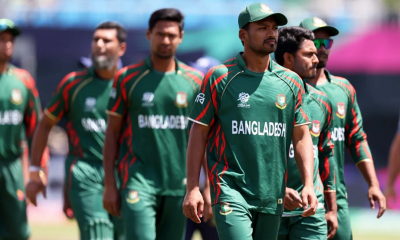
Shakib, Mustafizur star on comeback as Bangladesh go 4-0 up against Zimbabwe

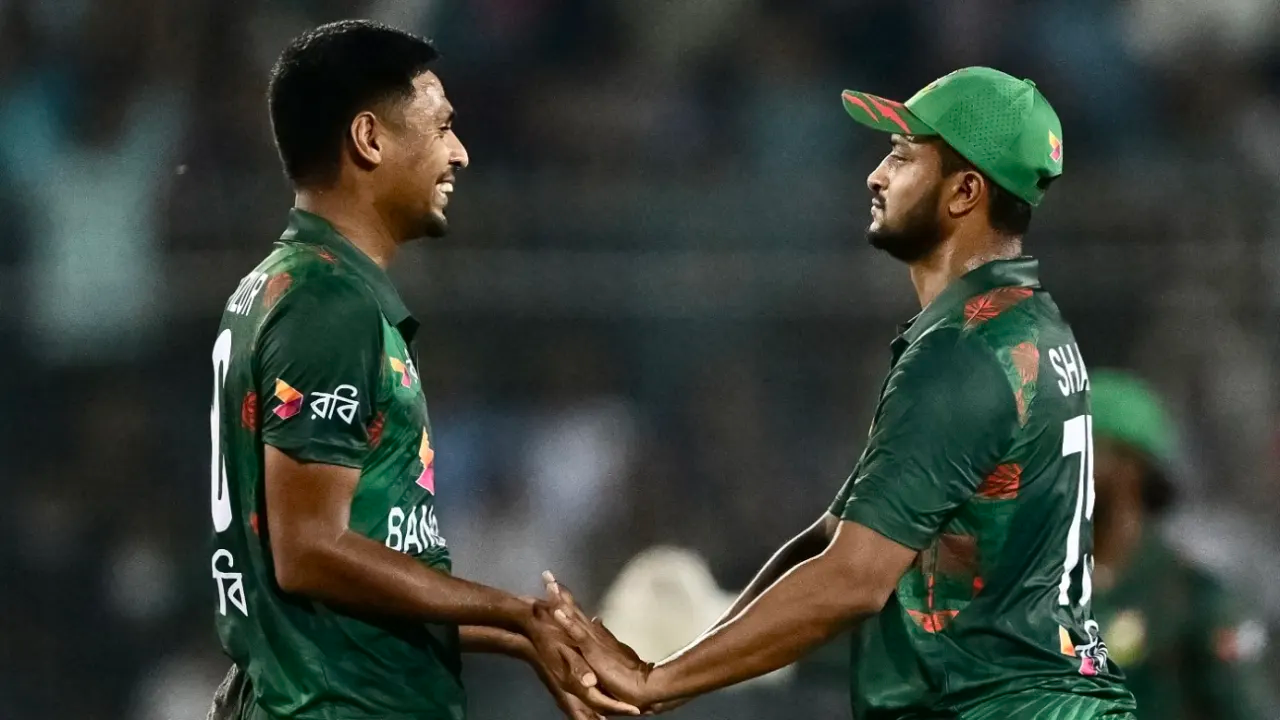
Zimbabwe again got close to Bangladesh’s total but couldn’t quite get the job done. This time in Dhaka, Bangladesh beat them by five runs to extend their lead in the T20I series to 4-0. With big hits towards the end, tailenders Wellington Masakadza and Blessing Muzarabani got everyone excited and nervous – depending on which side you were supporting.
Then Shakib Al Hassan took the two remaining wickets in the last over, but not before Muzarabani struck him for a straight six when 13 runs were needed. Shakib finished with 4 for 35 in his first T20I in ten months. Mustafizur Rahman also returning to the side, took three wickets, while Taskin Ahmed took two and Rishad Hossain one.
Bangladesh had given Zimbabwe a massive lifeline when they collapsed from 101 for no loss to be bowled out for 143. The last ten wickets fell in 8.4 overs as the hosts failed to last all 20 overs. Luke Jongwe led the visitors’ fightback with the ball, taking 3 for 20. His third wicket got him to 64 wickets in the format, as he beat Tendai Chatara to become Zimbabwe’s highest wicket taker in T20Is.
But before all that, Tanzid Hasan and Soumya Sarkar kept the home side on top.
Tanzid went after the bowling almost on his own in the powerplay. He reached 40 off 27 balls with seven fours, leaving Soumya with little to do at the other end. Soumya faced just nine balls during the powerplay, before he opened up in the next two overs. He reverse swept Brian Bennett in the seventh over before lofting Jongwe over the covers.
At the end of the ninth over, Tanzid reached his second fifty in the series with a single off Faraz Akram, as he continued to impress in his debut series. Soon after, Tanzid and Soumya reached their hundred stand, the third by a Bangladsh opening pair in T20Is. That partnership from the openers suggested Bangladesh would get a big score. But it all went downhill pretty soon.
Both openers fell in the 12th over when Johnathan Campbell took a good catch to remove Tanzid, before Soumya missed Jongwe’s slower yorker and was trapped lbw for 41. Despite the solid platform, the rest of the batters simply didn’t give the big crowd a chance to cheer for the rest of the innings.
Towhid Hridoy, the Player of the Match in the last two matches, slogged Sikandar Raza towards deep square leg where, Bennett took a fine catch. Bennett then got into the act with his offspin in the following over. He got the ball to sneak through Shakib’s bat and pad with his first ball, before Najmul Hossain Shanto played all around a tossed-up delivery off the last ball.
Richard Ngarava removed Jaker Ali in the 17th over, before a mix-up between Rishad and Taskin. Taskin hared out of the crease but Rishad sent him back, pointing towards the midwicket fielder; but by then it was too late, and Taskin couldn’t return to his crease in time.
Jongwe, Ngarava and Muzarabani took the last three wickets to fall. In the last over, though, Zimbabwe missed a run-out chance. As Bangladesh’s last pair Tanvir Islam and Mustafizur tried to take an extra run from an overthrow, Mustafizur was well short at the non-striker’s end. Campbell, however, couldn’t parry the ball on to the stumps, much to the packed house’s amusement.
In the chase, Zimbabwe once again failed to get off to a good start. Bennett couldn’t replicate his bowling effectiveness with the bat when he fell in the first over. Taskin hurried him into a pull shot, resulting in Shakib taking the catch at mid-on. Sikandar Raza, promoting himself to No. 3, struck four boundaries in the first two overs but lasted only till the fourth over. With Raza on 17, Taskin removed him with a good-length ball that uprooted his middle stump.
Tadiwanashe Marumani, who struck Shakib for two fours in the third over, followed Raza back to the dugout in the fifth over. Shakib trapped him lbw when Marumani missed an attempted slog sweep. When Madande fell in the tenth over, missing his reverse sweep, Rishad got him lbw for 12.
Bangladesh dropped two chances after they had Zimbabwe on the ropes in the tenth over. But Hridoy dropped Campbell on 12, before Jaker spilled Ryan Burl’s skier when he was on 1. The pair combined to take 20 runs off Tanzim Hasan in the 13th over. Campbell struck a six and a four, before Burl’s clip sent the ball high into the stands above square leg.
But their brief resistance ended with Mustafizur bowling the 15th over, where he struck twice. Soumya took a fine running catch from long-on to end Burl’s stay on 19. Jongwe guided his second ball to Rishad at point to make it 94 for 6. Shakib removed Campbell in the 17th over, with Shanto taking the skier at mid-off.
In the same over that Campbell fell, Masakadza struck Shakib for a four and six. But Tanzim brought things back with six runs in the 18th over, before Mustafizur conceded just seven runs in the penultimate over, where he also removed Akram.
Tanzid, who took a good catch to remove Akram, then dropped an easier chance of Masakadza off first ball of the last over. Muzarabani struck the big six next ball, but Shakib cleverly bowled a wide one to him as Muzarabani advanced, and Jaker completed the stumping. Ngarava then got bowled next ball to relieve the home crowd.
Brief scores:
Bangladesh 143 in 19.5 overs (Tanzid Hasan 52, Soumya Sarkar 41; Sikandar Raza 1-24, Blessing Muzarabani 1-30, Richard Ngrava 2-27, Brian Benett 2-20, Luke Jongwe 3-20) beat Zimbabwe 138 in 19.4 overs (Johnathan Campbell 31; Taskin Ahmed 2-20, Shakib Al Hasan 4-35, Mustafizur Rahman 3-19, Rishad Hossain 1-06) by five runs







Sri Lanka Cricket have strengthened their backroom staff ahead of the World Cup by roping in former India opener Vikram Rathour as Batting Coach, SLC sources told The Island.
The 56-year-old brings a weighty CV to the dressing room, having been part of the Indian coaching set-up that lifted the T20 World Cup in the Caribbean in 2024. Rathour is currently serving as assistant coach of IPL franchise Rajasthan Royals, but will join the Sri Lankan camp next week.
Rathour is expected to stay on through the six-match white-ball series against England at R. Premadasa Stadium and Pallekele International Cricket Stadium, before overseeing the team’s final tune-up for the World Cup. With a proven track record and a reputation for technical clarity, SLC will be hoping he can help the batters find their range before the big dance.
SLC have steadily been bolstering their support staff. Power-hitting coach Julian Wood was hired last year and continues to work with both the men’s and women’s teams from the High Performance Centre.
Former India Fielding Coach R. Sridhar has also had a stint with Sri Lanka overseeing fielding standards and is currently in Dambulla working with the squad involved in the three-match T20I series against Pakistan.

+94 66 204 0700 @jetwinglake
Adding further firepower to the coaching arsenal, Sri Lanka great Lasith Malinga has been drafted in as fast-bowling coach up to the World Cup.
Sri Lanka have been placed in Group B of the 20-nation tournament alongside Australia, Oman, Zimbabwe and Ireland. The former champions open their campaign on February 8 against Ireland and are expected to progress to the second round, with Australia the only side ranked above them in the group.
An 18-member squad has already been named for the ongoing Pakistan series, with the final 15-man World Cup squad expected to be announced shortly.
The Sri Lankan leg of the tournament will be staged at R. Premadasa Stadium, Sinhalese Sports Club Ground and Pallekele International Cricket Stadium, while India will host the bulk of the competition, including the semi-finals and final. However, should Pakistan advance to the knock-out stages, both their semi-final and final will be played in Colombo under the hybrid model.
There has also been speculation that Bangladesh’s World Cup fixtures could be shifted to Colombo amid ongoing political tensions with India.

Under 19 Cricket
St. Benedict’s pulled off an exciting three wickets victory over St. Aloysius’ as Mewan Dissanayake held the batting line up together with an unbeaten half century in the Under 19 Division I tier ‘B’ match at Karandeniya on Wednesday.
Bens beat St. Aloysius’ by three wickets at Karandeniya
Scores
St. Aloysius’ 167 all out in 54.5 overs
(Chanul Sanketh 23, Vinod Danushka 23, Sevitha Dumal 37, Dulsath Nimviru 29; Yohan Edirisinghe 2/18, Vihanga Rathnayake 3/24, Lithika Jayasundara 3/09) and 116 all out in 52.1 overs (Chanul Sanketh 44; Ayesh Gajanayake 3/27, Lithika Jayasundara 2/16, Mewan Dissanayake 3/30)
St. Benedict’s 144 for 5 overnight 167 all out in 45 overs
(Tehan Bitar 30, Vihanga Rathnayake 28, Sithum Hasaranga 36, Lithika Jayasundara 31; Chenul Nethmina 4/42, Hiviru Nimtharana 4/22) and 117 for 7 in 31.3 overs (Mewan Dissanayake 52n.o.; Hiviru Nimtharana 2/09, Oshadha Devinda 3/39)
First innings win for Thurstan at Thurstan ground
Scores
Thurstan 257 all out in 74.4 overs (Akhen de Alwis 25, Yohan Senanayake 34, Rison Jansen 20, Sethru Fernando 57, Rachintha de Silva 29, Udarsha Nimsara 23, Dewmika Hewapathirana 21; Minaga Ariyadasa 5/88, Thenusha Nimsara 2/92, Nethuja Bashitha 2/25) and 121 for 4 decl.in 30.3 overs (Yohan Senanayake 44, Rachintha de Silva 63n.o.)
Richmond 69 for 2 overnight 166 all out in 53.5 overs
(Chalindu Karunaratne 52, Ameesha Rasanjana 25; Yovun Silpa 3/46, Thanuga Palihawadana 4/44) and 68 for 3 in 25 overs (Ameesha Rasanjana 24n.o.; Thanuga Palihawadana 3/39)

Dialog Television announced that it has secured the exclusive media rights in Sri Lanka for all International Cricket Council (ICC) events from 2026 to 2028, alongside a free-to-air broadcast collaboration with TV Supreme.
This landmark agreement positions Dialog Television as the official Pay-TV broadcaster of ICC events in Sri Lanka, covering all major tournaments across Men’s, Women’s and Under-19 formats. The rights include the ICC Cricket World Cups and T20 World Cups for both Men and Women, the ICC World Test Championship Final, and other ICC-sanctioned international events during the 2026–2028 period.
Dialog Television also holds the exclusive OTT and mobile streaming rights for ICC events in Sri Lanka, enabling fans to follow the action across smartphones, tablets, and connected devices. Supported by Dialog’s high-speed mobile network and expanding 5G capabilities, this ensures a smooth, high-quality viewing experience, allowing fans to enjoy ICC matches seamlessly via the Dialog ViU+ app, wherever they choose to watch.
Complementing its Pay-TV coverage, Dialog Television has partnered with TV Supreme as the official free-to-air (FTA) broadcast partner in Sri Lanka, ensuring nationwide access to ICC events. TV Supreme is a fast-growing free-to-air television network with an established presence in cricket broadcasting.

US seizes two ‘shadow fleet’ tankers linked to Venezuelan oil

Showers above 100 mm are likely at some places in the Eastern and Uva provinces and showers about 50-75 mm in other areas

Easter Sunday attacks: Govt. says wife of Katuwapitiya Church bomber alive

Indian Army Chief here

Kelaniya Duruthu Perahera

Govt. not controlled by ‘Power Mafias’; electricity prices will fall further – Jayakody

‘Dates have the highest sugar content to fight Coronavirus’

Sunday Island 27 December – Headlines

#SundayIsland 17th December – Headlines

Sunday Island – 28th March

Sunday Island Headlines – 21 March

Sunday Island – 21st February – Headlines
-

 News2 days ago
Interception of SL fishing craft by Seychelles: Trawler owners demand international investigation
-
 News2 days ago
Broad support emerges for Faiszer’s sweeping proposals on long- delayed divorce and personal law reforms
-

 News3 days ago
Private airline crew member nabbed with contraband gold
-

 News1 day ago
Prez seeks Harsha’s help to address CC’s concerns over appointment of AG
-

 News1 day ago
Govt. exploring possibility of converting EPF benefits into private sector pensions
-

 News5 days ago
Health Minister sends letter of demand for one billion rupees in damages
-

 Features2 days ago
Educational reforms under the NPP government
-

 Features3 days ago
Pharmaceuticals, deaths, and work ethics