
Foreign News
Selfies and smiles: South Korea seeks ‘new phase’ in ties with China


South Korea’s President Lee Jae Myung has called for a “new phase” in ties with China as he met its leader Xi Jinping in Beijing on Monday.
Regional security and lifting Beijing’s unofficial ban on Korean pop culture is high on Lee’s agenda, as he continues his four-day trip in China. He is set to meet China’s Premier Li Qiang and the chairman of parliament, Zhao Leji on Tuesday.
It marks the first visit by a South Korean leader since 2019. Bilateral ties had soured under Lee’s predecessor, impeached ex-president Yoon Suk Yeol, who was very critical of China.
Xi, meanwhile, has appeared keen to shore up ties with South Korea amid a diplomatic row between China and Japan.
South Korea is a US security ally – like Japan – but also relies on China for trade. Experts say Lee is expected to keep walking a diplomatic tightrope between Beijing and Tokyo.
The visit marks the second time the two leaders have met since November when Xi visited South Korea for a regional economic summit.
On Monday Lee stated that the visit was “a crucial opportunity” for the “full-scale restoration of South Korea-China relations”, reported South Korean newspaper Chosun. “We want to usher in a new phase in the development of South Korea-China relations.”
Government officials and companies from both countries signed a series of cooperation agreements on technology, trade and environment.
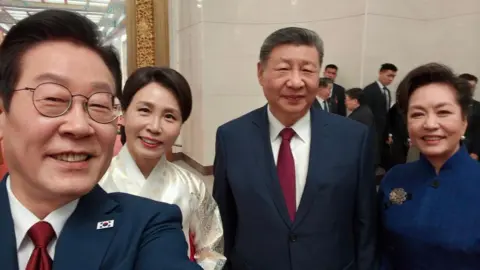
Lee also took selfies with Xi, using a Xiaomi phone that the Chinese president had gifted him last year.
“The image quality is certainly good, right?” Lee posted on X along with the photos.
Xi noted that the “international situation is becoming more turbulent and complex”.
The meeting followed the US’s capture of Venezuelan president Nicolas Maduro over the weekend.
Xi urged Lee to “firmly stand on the right side of history and make correct strategic choices”, China’s official Xinhua news agency reported.
He also brought up the two countries’ shared history of resisting Japan militarism, saying that China and South Korea should now “work hand in hand to safeguard the outcomes of the victory of World War Two and uphold peace and stability in Northeast Asia”.
Xi’s eagerness to meet Lee signals the pressure he faces in finding a regional ally, Park Seung-chan, professor of China studies at Yongin University told the BBC.
“China may beat around the bush but its demand is clear: side with China and denounce Japan.”
During his four-day trip to China, Lee is expected to hold a memorial service in Shanghai for activists who fought for Korea’s independence from Japan.
But while South Korea is “still showing all its deference towards China”, it wants to “strengthen its relationships with both Japan and China”, Mr Park said.
Lee is reportedly planning to visit Japan later this month to meet Prime Minister Sanae Takaichi.
Security on the Korean Peninsula has also been part of the discussions. Lee has sought to engage North Korea diplomatically, but there has been little progress so far. He needs Chinese cooperation in pressuring the North’s Kim Jong Un to give up his nuclear weapons. Beijing is one of Pyongyang’s biggest supporters, economically and diplomatically.
Lee vowed on Monday to work with China on “viable alternatives for peace on the Korean Peninsula”.
On Sunday Seoul’s military said Pyongyang fired ballistic missiles off its east coast. And on Monday the North’s state news agency said the country test-fired hypersonic missiles to assess deterrence capabilities following recent developments, in an apparent reference to the US’s seizure of Maduro.
It remains unclear how much Lee will be able to push China on North Korea. In September, Xi had pledged to strengthen Beijing’s “traditional friendship” with Pyongyang.
And Seoul and Beijing are not natural allies.
US troops have been stationed in South Korea for decades in case of an attack from the North, and last year the two sides agreed to cooperate on building nuclear-powered submarines. The announcement drew warnings from China.
Lee has also sought to put a stop to China’s build-up of maritime structures in waters between the two countries. Beijing says the structures are fish-farming equipment, but they have sparked security concerns in Seoul.
The two leaders agreed on Monday to continue “constructive” dialogue on the matter, South Korea’s presidential spokesperson said.
Another item high on Lee’s agenda is China’s unofficial restrictions on South Korean music and dramas that have been in place for a decade. K-pop and K-dramas are either unavailable or difficult to access on Chinese media platforms.
While China has never acknowledged a ban on Korean artists, it’s believed to be a protest against South Korea’s decision to deploy a US anti-missile system in 2016, which China sees as a threat to its military operations in the region.
China is a massive market for Korean entertainment, which is already a huge global success.
At a Korea-China business forum on Sunday, Lee encouraged deeper bilateral collaboration in beauty products, food and cultural content including movies and music.
A South Korean presidential spokesperson said on Monday that the two leaders agreed to discuss the gradual expansion of cultural exchanges – without specifying concrete commitments on K-dramas or K-pop.
A Chinese foreign ministry spokesperson similarly told reporters on Tuesday that both sides have agreed to “carry out orderly, healthy, and beneficial cultural exchanges”.
Speaking before Korean residents in Beijing on Sunday, Lee said his visit would “serve as a new starting point to fill in the gaps in Korea-China relations, restore them to normal and upgrade them to a new level”.


China has approved a sweeping new law which claims to help promote “ethnic unity” – but critics say it will further erode the rights of minority groups.
On paper, it aims to promote integration among the 56 officially recognised ethnic groups, dominated by the Han Chinese, through education and housing. But critics say it cuts people off from their language and culture.
It mandates that all children should be taught Mandarin before kindergarten and up until the end of high school. Previously students could study most of the curriculum in their native language such as Tibetan, Uyghur or Mongolian.
The law was approved on Thursday as the annual rubber-stamp parliamentary session drew to an end.
“The law is consistent with a dramatic recent policy shift, to suppress the ethnic diversity formally recognised since 1949,” Magnus Fiskesjö, an associate professor of anthropology at Cornell University said in a university report.
“The children of the next generation are now isolated and brutally forced to forget their own language and culture.”
However, Beijing argues that teaching the next generation Mandarin will help their job prospects.
It also says the law for “Promoting Ethnic Unity and Progress” is crucial for promoting “modernisation through greater unity”.
The law was voted and passed on Thursday at the National People’s Congress in Beijing, which has never rejected an item on its agenda.
The law also provides a legal basis to prosecute parents or guardians who may instil what it described as “detrimental” views in children which would affect ethnic harmony and it calls for “mutually embedded community environments” which some analysts believe could result in the break up of minority-heavy neighbourhoods.
The Chinese government started to push for what it describes as the “sinicisation” of minority groups in the late 2000s and create a more unified national identity by assimilating ethnic groups into the dominant Han culture.
Han Chinese make up more than 90% of the country’s 1.4 billion people.
Beijing has long been accused of restricting the rights of minority ethnic groups in regions like Tibet, Xinjiang and Inner Mongolia.
Critics say assimilation has often been forced on people in these places – a state-led policy that has accelerated under Chinese leader Xi Jinping who has taken a harder line on dissent and protests, especially in areas home to minority ethnic groups,
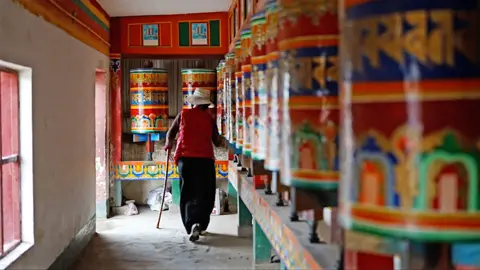
In Tibet, the authorities have arrested monks, and taken control of monasteries to ensure they do not worship the Dalai Lama.
When the BBC visited a monastery that had been at heart of Tibetan resistance in July last year, monks spoke of living under fear and intimidation.
“We Tibetans are denied basic human rights. The Chinese government continues to oppress and persecute us. It is not a government that serves the people,” one of them told us.
In Xinjiang, human rights groups have documented the detention of a million Uyghur Muslims in what the Chinese government calls camps for “re-education”, while the UN has accused Beijing of grave human rights violations.
The BBC’s reporting from 2021 and 2022 found evidence supporting the existence of detention camps, and allegations of sexual abuse and forced sterilisation, which Beijing denies.
In 2020, ethnic Mongolians in northern China staged rare rallies against measures to reduce teaching in the Mongolian language in favour of Mandarin.
Parents even held children back in protest at the policy as some ethnic Mongolians viewed the move as a threat to their cultural identity. Authorities moved quickly to crackdown on what it saw as dissent.
The Communist Party says it embraces different ethnicities. The country’s constitution states that “each ethnicity has the right to use and develop their own language” and “have the right to self-rule”.
But critics believe this new law will cement Xi’s push toward assimilation.
“The law makes it clearer than ever that in Xi Jinping’s PRC non-Han peoples must do more to integrate themselves with the Han majority, and above all else be loyal to Beijing,” Allen Carlson, an associate professor of government at Cornell University said, referencing China by the initials of its official name.
This focus on development and prosperity is “telling”, Professor Ian Chong of the National University of Singapore told the BBC.
“It is easy to read this language as meaning that minority languages and cultures are backward and impediments to advancement.”
Xi’s approach towards minorities is “consistent with his idea of creating a great and strong Chinese nation with a northern Han core… minorities are seen as branching off from that core, and hence in some ways derivative,” he adds.
“In practice, this has prompted concerns about further rounds of increasing control, diminution, and even crackdowns on minority cultures and languages.”
[BBC]

A Chinese national has been arrested in Kenya’s main airport accused of attempting to smuggle more than 2,000 queen garden ants out of the country.
Zhang Kequn was intercepted during a security check at Jomo Kenyatta International Airport (JKIA) in the capital Nairobi after authorities discovered a large consignment of live ants in his luggage bound for China.
He has yet to respond to the accusation but investigators said in court that he was linked to an ant-trafficking network that was broken up in Kenya last year.
The ants are protected by international bio-diversity treaties and their trade is highly regulated.
Last year, the Kenya Wildlife Service (KWS) warned of a growing demand for garden ants – scientifically known as Messor cephalotes – in Europe and Asia, where collectors keep them as pets.
A state prosecutor told the court on Wednesday that Zhang had packed some ants in test tubes, while others were concealed in tissue paper rolls hidden in his luggage.
“Within his personal luggage there was found 1,948 garden ants packed in specialised test tubes,” prosecutor Allen Mulama told the court.
“A further 300 live ants were recovered concealed in three rolls of tissue paper within the luggage,” he added.
The prosecutor asked the court to allow the suspect’s electronic devices – phone and laptop – to be forensically examined.
Duncan Juma, a senior KWS official, told the BBC that more arrests were expected as investigators widen their probe into other Kenyan towns where ant harvesting was suspected to be ongoing.
Last May, a Kenyan court sentenced four men to one year in prison or a fine of $7,700 for trying to smuggle thousands of live queen ants out of the country, in a first-of-its kind case.
The four suspects – two Belgians, a Vietnamese and a Kenyan – had pleaded guilty to the charges after their arrest in what the KWS described as “a co-ordinated, intelligence-led operation”.
The Belgians told the court that they were collecting the highly sought-after ants as a hobby and didn’t think it was illegal.
Investigators now say Zhang was the mastermind behind this trafficking ring but apparently escaped Kenya last year using a different passport.
On Wednesday, the court allowed prosecutors to detain him for five days to enable detectives to conduct further investigations.
The KWS, which is more used to protecting larger creatures, such as lions and elephants, described last year’s ruling as a “landmark case”.
The ants seized last year were giant African harvester ants, which KWS said were ecologically important, noting that their removal from the ecosystem could disrupt soil health and biodiversity.
It is believed that the intended destinations were the exotic pet markets in Europe and Asia.
[BBC]
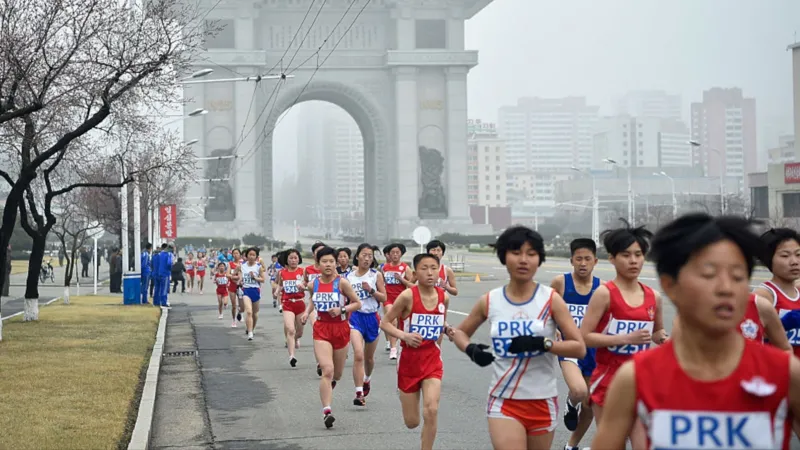
North Korea has cancelled the Pyongyang marathon for unspecified reasons, a tour agency linked to the event has said.
British-owned Koryo Tours, which describes itself as the official partner of the marathon, said on Monday that it had received notice of the cancellation from North Korea’s athletics association.
A message it attributed to the association said the marathon was being cancelled “due to some reasons”.
The annual event was established in 1981 to celebrate the birth of North Korea’s founding leader Kim Il Sung. The 2026 race was set to take place on 5 April.
The message, purportedly from the North Korea athletics association’s general secretary, thanked “all the Elite Marathoners and Amateur Runners of the world who are interested in Pyongyang International Marathon”.
The message gave no further explanation on what the reasons for the cancellation were.
Koryo Tours said it understood the decision was final and had been taken “at a level above the organisers of the event itself”.
It said it would be seeking clarification on the circumstances surrounding the decision.
The tour company added that neither organisers nor event partners were involved in making the decision, and said it recognised “this announcement will be disappointing to many runners who had already registered or were planning to participate”.
Koryo Tours, based in Beijing, China, offers several marathon packages to foreigners, departing from Beijing, Shanghai and Shenyang.
Packages start from €2,190 ($2,529; £1,894) for 2.5 nights in the North Korean capital, Pyongyang, including a marathon place and “highlights” of the capital and tickets were sold out this year, according to the agency’s website.
It said all deposits paid will be returned and runners have the option to retain their deposit for a future event or North Korea tour.
A date for the 2027 marathon has not yet been set.
The event had only returned last year after it was suspended for five consecutive years due to the Covid pandemic.
It is open to both amateur and some professional athletes and offers several race distances – 5km (3.1 miles), 10km (6.2 miles), half marathon (21.1km; 13.1 miles) or full marathon (42.2km; 26.2 miles).
[BBC]

Qantas agrees to pay $74m over Covid-19 travel voucher refunds

Navy seize 654kg of narcotics and haul of arms off South Coast

Heat Index likely to increase up to ‘Caution level’ at some places in the Western, Sabaragamuwa, Southern and North-western provinces and in Monaragala and Mannar districts

Showers above 50 mm can be expected at some places in the Western and Sabaragamuwa provinces and in the Galle and Matara districts

Govt. bends rules, lowers coal standards in favour of errant company: FSP

Lanka requests diesel from India

‘Dates have the highest sugar content to fight Coronavirus’

Sunday Island 27 December – Headlines

#SundayIsland 17th December – Headlines

Sunday Island – 28th March

Sunday Island Headlines – 21 March

Sunday Island – 21st February – Headlines
-

 News6 days ago
Peradeniya Uni issues alert over leopards in its premises
-

 News4 days ago
Repatriation of Iranian naval personnel Sri Lanka’s call: Washington
-

 News6 days ago
Wife raises alarm over Sallay’s detention under PTA
-
 Features4 days ago
Winds of Change:Geopolitics at the crossroads of South and Southeast Asia
-

 News3 days ago
Prof. Dunusinghe warns Lanka at serious risk due to ME war
-

 Latest News6 days ago
Heat Index at ‘Caution Level’ in the Sabaragamuwa province and, Colombo, Gampaha, Kurunegala, Anuradhapura, Vavuniya, Hambanthota and Monaragala districts
-

 Sports2 days ago
Royal start favourites in historic Battle of the Blues
-

 Features6 days ago
The final voyage of the Iranian warship sunk by the US