
News
Scientists discover a new, unexpected way that cancer cells spread

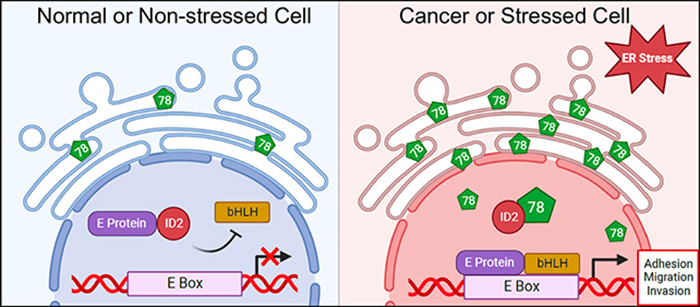
One of the challenges in treating cancer is stopping it from metastasizing and a new study reveals one of the fundamental mechanisms through which this happens. Now we know about this mechanism, perhaps we can stop it, according to a report published by Science Alert.
The report filed by David Nield says the key to this newly discovered process is GRP78, and it’s what’s known as a chaperone protein. It’s a type of protein that lends a hand in the folding or unfolding of larger proteins, basically building them up (or tearing them down), which then affects whether they’re biologically active and functional.
“A team led by the Keck School of Medicine at the University of Southern California (USC) in the US found that cancer cells can hijack GRP78, using the protein to spread further in the body and resist treatment.
This appears to happen because the protein migrates when under stress. GRP78 is usually found in the endoplasmic reticulum part of a cell, but this research shows it moving to the nucleus and changing the cell behavior.
“Seeing GRP78 in the nucleus controlling gene expression is a total surprise,” says Amy Lee, a biochemist and molecular biologist at USC.
“When it comes to the basic mechanisms of cancer cells, this is something novel that, to my knowledge, no one has observed before.”
“The discovery came about by analyzing how GRP78 regulates the gene EGFR, previously linked with cancer. Advanced 2D and 3D imaging techniques – including confocal microscopy, where separate beams of light are used to increase resolutions, were used to confirm the migration of GRP78.
“Cells with (top row) and without (bottom row) GRP78 – blue shows the nucleus, green shows cytoskeletal protein. (Ze Liu/Amy Lee)
“Further methods, including RNA sequencing (taking a snapshot of cell activity), were then used to get a closer look at what the GRP78 protein was actually doing. It turns out that the key genes it was regulating were involved in cell migration and invasion.
“Another important discovery made by the researchers was how GRP78 binds or interacts with another cellular protein, ID2. It seems that GRP78 stops ID2 from doing its regular job, which is limiting the activity of genes involved in cell migration, including EGFR.
“While this might all seem very technical, once scientists understand how proteins like GRP78 operate regarding cancer metastasis, they can start thinking about ways to control them. By stopping GRP78 from moving around or blocking ID2, for example, we might be able to prevent cancer cells from spreading.
“Getting to that stage will require a lot more research, but discoveries are being made on a regular basis when it comes to cancer growth – whether that’s how they get into the blood or spread to the bones.
“This is a new concept,” says Lee. “The protein itself is the soldier that does the job, but now we’re thinking it’s not just about the soldier, but also where the soldier is deployed.”
The research has been published in PNAS.



Representatives from the ’The Ceylon Chamber of Commerce’ met with Prime Minister Dr. Harini Amarasuriya on Wednesday [24th of June] at the Parliament premises.
During the meeting, discussions focused on the Sri Lanka Economic and Investment Summit 2026 (SLEIS 2026), which is scheduled to be held on 12 and 13 October 2026. Attention was also given to digitalization initiatives, the introduction of digital technologies in schools under new education reforms, and the transformative role of Artificial Intelligence (AI) in Sri Lanka’s education sector.
Representatives of the Chamber noted that the summit would serve as an important platform for encouraging both local and foreign investment, while also contributing to the shaping of the country’s future economic policies.
The meeting was attended by Krishan Balendra, Chairman of The Ceylon Chamber of Commerce; Vinod Hirdaramani, Deputy Vice Chairman; Shiran Fernando, Secretary General and Chief Executive Officer; Aliki Perera, Deputy Secretary General and Chief Operating Officer; and Anagi Rodrigo-Weerasekera, Chief Economist and Head of Economic Intelligence, along with several other representatives.
[Prime Minister’s Media Division]

A discussion to review the progress of the housing project under which 4,700 houses are being constructed for the Malayagam community with Indian assistance was held this afternoon (24) at the Presidential Secretariat under the chairmanship of the Chief of Staff to the President, Prabath Chandrakeerthi.
Under this housing programme, 2,026 houses are to be provided to families identified by the National Building Research Institute (NBRI) as being at disaster risk. The remaining houses are expected to be allocated to eligible workers residing in the plantation sector.
Accordingly, the houses will be provided to Malayagam community families living on estates belonging to 22 Regional Plantation Companies, as well as estates under the State Plantations Corporation, Janawasama and Elkaduwa Plantations.
For the construction of each house, the Government of India has allocated Rs. 2.8 million, while the Government of Sri Lanka has contributed Rs. 400,000.
During the discussion, Chandrakeerthi instructed officials to ensure that the housing project is completed before the end of this year. He further directed that land identified for the construction of houses be released without delay and that the National Building Research Institute provide the necessary reports to identify suitable land for the project.
The housing project is being implemented jointly by the Ministry of Plantation and Community Infrastructure, the National Housing Development Authority, the State Engineering Corporation and the Plantation Human Development Trust.
Among those present were Additional Secretary (Development) of the Ministry of Plantation and Community Infrastructure, K. S. Wijayakeerthi; Director General (Engineering), N. D. N. Pushpakumara; Director General (Planning), W. A. K. S. Damayanthi; the Secretary General of the Planters’ Association; and officials from the National Housing Development Authority, the State Engineering Corporation, relevant institutions and plantation companies.
(PMD)

It has been reported that Attorney at Law Rakitha Rajapakshe, the son of former Minister of Justice Wijeyadasa Rajapakshe, has been arrested by the Commission to Investigate Allegations of Bribery or Corruption (CIABOC) over alleged links with the underworld.

Representatives from the Ceylon Chamber of Commerce meet PM

Progress of Housing Project for Malayagam Community families funded by India reviewed

South Africa stun South Korea to reach World Cup knockouts for the first time

Tremors of 7.5, 7.2 kill 32, injure hundreds in Venezuela

Former Minister Wijeyadasa Rajapakshe’s son arrested by CIABOC

Morocco come back after historic Haiti goals to reach World Cup last 32

‘Dates have the highest sugar content to fight Coronavirus’

Sunday Island 27 December – Headlines

#SundayIsland 17th December – Headlines

Sunday Island – 28th March

Sunday Island Headlines – 21 March

Sunday Island – 21st February – Headlines
-

 News6 days ago
Creditor receives USD 2.5 mn as Lankan public bears loss from theft of Treasury funds
-

 News5 days ago
Creditor not yet paid
-

 News5 days ago
Consumers bearing 22% tax burden despite 18% VAT claim: Dr. Harsha de Silva
-

 Features4 days ago
Nanda Pethiyagoda Wanasundara as three generations of family saw her
-

 Features3 days ago
Sri Lanka developing independent hydrographic capabilities
-

 Opinion6 days ago
SriLankan Airbus struck by lightning
-

 Editorial4 days ago
Fuel crisis: Beyond price debate
-

 Latest News4 days ago
Sooryavanshi thumps fastest List A fifty as India A win tri-series