
Foreign News
Saudi Arabia’s dilemma as it tries to stay out of US-Iran war


Saudi Arabia is facing a difficult dilemma. Ever since the US and Israel launched their war on Iran on 28 February, the Saudis have largely tried to stay out of it.
But now, after being attacked from three sides, the Saudis have had enough. This week, they carried out joint strikes with the US on Irananian proxy militias in Iraq who they believe have been launching drones at the Kingdom.
For Saudi Arabia the dilemma now is whether to keep on hitting back as a deterrent, or whether to try to de-escalate the situation, perhaps by paying off some of their adversaries.
So who is attacking who and why?
First, a bit of context. There are broadly two sides in the conflict that has been consuming the Gulf and other parts of the Middle East for five months now.
On one side there is Iran and its Islamic Revolutionary Guards Corps (IRGC). Allied to them are the Houthis in Yemen, a tribal group who took over much of the country in 2014.
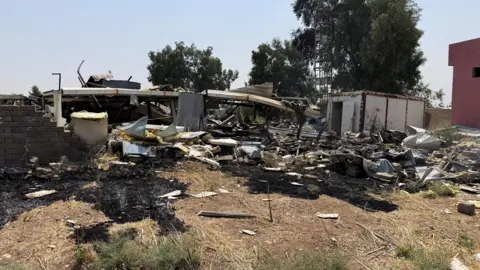
Also backed by Iran are the Popular Mobilisation Forces in Iraq, the paramilitary group that has allegedly carried out 30 drone strikes on Saudi Arabia and has now been attacked in return.
Then there is Hezbollah in Lebanon, still a potent force but one that is currently lying low.
On the opposite side of this conflict is the US with its immensely powerful Central Command (Centcom) forces plus – to varying degrees – the Gulf Arab states and Jordan. Israel remains a close US ally but is currently not an active participant in this war.
Iran has most recently been concentrating its drone and missile attacks on Jordan, Kuwait and Bahrain, as well as targeting any commercial shipping that tries to slip through the Strait of Hormuz while avoiding Iran’s new rules and routing.
The addition of Iraqi militias and the Houthis in Yemen is a relatively new phenomenon and it shows how – without a lasting peace deal between the US and Iran – the region risks becoming ever more embroiled in a widening conflict.
There are a number of reasons why Saudi Arabia is trying not to get sucked into a full-scale conflict.
Its de facto ruler, the relatively young Crown Prince Mohammed Bin Salman, has embarked the country on a course known as “Vision 2030”.
His aim is to diversify the Kingdom away from its dependence on oil revenues and create vibrant, modern, domestic industries that will provide meaningful jobs for the hundreds of thousands of graduates and school leavers pouring onto the job market each year.
Part of Vision 2030 involves attracting foreign investment. Part of it also involves building things like data centres that are vulnerable to attack.
This is not going to work if Saudi Arabia finds itself under an enduring, long-term threat from drones fired across its southern border by the Houthis in Yemen or ballistic missiles fired directly by Iran.
Back in September 2019, the Saudis suffered an unpleasant shock.
With relations with Iran in a poor state, the Saudis woke up to find that an Iranian proxy militia in Iraq had launched a fleet of drones at two of its most vital oil facilities, at Abqaiq and Khurais.
At the time there was a suggestion that the attack had come from the Houthis in Yemen but I visited the site straight afterwards and I could clearly see the holes in the superstructures all facing northwards.
That attack knocked half of Saudi oil exports offline for several days and it was a wake-up call to Riyadh as to just how vulnerable its critical national infrastructure is to attack.
On Monday, satellite images showed the Abqaiq oil facility was struck by drones launched once again by Iranian proxy militias in Iraq.
Then there is oil, still the lifeblood of the Saudi economy.
Iran retaliated against US and Israeli attacks in February by effectively closing off the Strait of Hormuz, a critical shipping channel between Iran and the Gulf through which 20% of the world’s oil and liquified natural gas travelled.
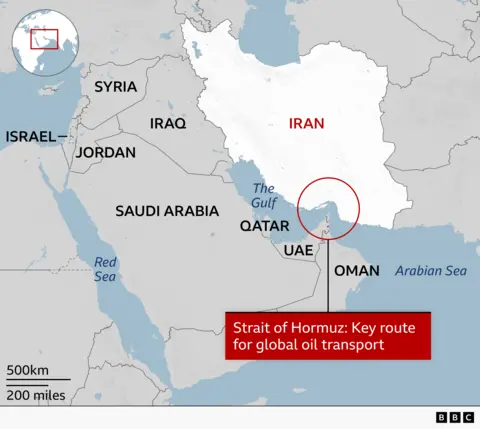
In response, the Saudis pumped as much oil as they could – around five million barrels per day – through their east-west pipeline to their export terminal on the Red Sea, on their opposite coast, at Yanbu.
From there it was loaded onto tankers that headed south, out into the Arabian Sea and off to markets in Asia.
So far so good.
But on 13 July, the Saudis bombed Sanaa airport just outside the Yemeni capital. The strike was claimed by Yemen’s Saudi supported government, which said it wanted to prevent an Iranian plane from landing. In retaliation, the Houthis attacked regional Saudi airports at Abha and Jizan.
More worryingly for Riyadh, the Houthis have begun attacking Saudi shipping in the Red Sea, making it extremely dangerous for ships to pass through the narrow Bab El Mandeb strait at the southern end of the Red Sea. That in turn chokes off Saudi oil exports to Asia.
Saudi Arabia spent seven years trying to bomb the Houthis into submission and failed.
The war that raged across Yemen was one of the worst humanitarian disasters of our time and its effects are still being felt.
In 2022, Saudi Arabia agreed to an uneasy truce with the Houthis and there were reports of payoffs, but now the richest country in the region, Saudi Arabia, is once more facing the threat of drone and missile attacks from its southern neighbour at the same time as attacks from Iraq to the north.
None of this was envisaged in the plans for Vision 2030.
[BBC]


US authorities have found debris from a medical transport aircraft that went missing with six people on board.
The Federal Aviation Administration told the BBC it had lost contact with the Gulfstream G-100 plane just after 01:00 local time (05:00 GMT) on Saturday, while it was travelling from Bermuda to Boston, Massachusetts.
The search for survivors continues off the coast of Nantucket, a Massachusetts island, the US Coast Guard said.
Authorities have notified the next of kin of those on the flight, four Canadian nationals and two Bermudian nationals.
“Search crews located a debris field confirmed to be from the aircraft off the coast of Nantucket,” the US Coast Guard said in an update on Saturday night. It added that ships, helicopters and planes were involved in searches that would through continue the night.
The plane departed from Bermuda’s L.F. Wade International Airport at 23:40 local time, according to flight data from FlightAware, and was due to land at Boston’s Logan International at 01:30 EDT (05:30 GMT).
According to the tail number released by the Coast Guard, the plane belonged to Latitude Air Ambulances, a company that provides international medical flights for patients returning home.
Among those on board were two pilots and two medical staff, both Canadian, Clarence Togeretz, director of flight operations at Latitude, told CBC News.
The crew flew to Bermuda to collect a patient and their relative, who are not Canadian, Togeretz said.
FlightAware’s tracker shows the aircraft significantly dropped in altitude before its communications went dark, plummeting from around 7,300m (24,000ft) to 3,300m (11,000ft).
Radio transmissions shows trouble with communications between the air traffic controller and the pilot, the Boston Globe reported based on transmissions provided by LiveATC.net.
“You’re coming in blind? Is that what you said?,” the air traffic controller asked. “Are you declaring an emergency, or no?”
The pilot’s response was inaudible.
“You’re coming in a little weak so I didn’t hear what your response was, if you were declaring an emergency or not,” the air traffic controller said, according to the Globe.
The air traffic controller later confirmed the pilot had declared an emergency.
An area fire dispatcher asked emergency crews just after 01:00 EDT to prepare to meet a plane with an “electrical issue”.
The dispatcher later said “the aircraft has lost radio and radar”.
The Coast Guard said it would provide an update on Sunday morning local time.
[BBC]
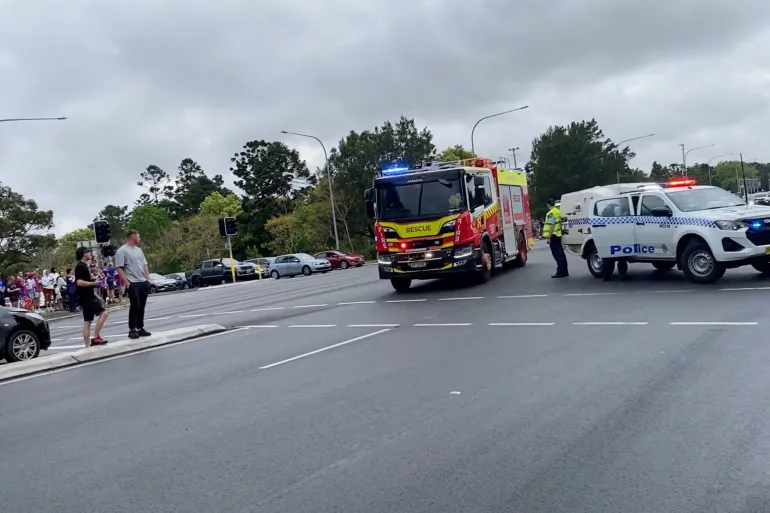
A car has crashed into a crowd of rugby league supporters in the eastern Australian city of Newcastle, injuring 10 people, including three children.
New South Wales police said on Saturday that two of the injured – a five-year-old girl and a 67-year-old man – were in a critical condition and the other eight were in stable condition in hospital.
Police said they had arrested the 18-year-old man driving the vehicle and were investigating what happened. They said the crash was not believed to be related to “terrorism”.
The crowd had gathered to farewell the local rugby league side, the Newcastle Knights, ahead of their grand final against the Sydney Roosters on Sunday.
Newcastle Lord Mayor Gavin Morris said the driver, a rugby league fan, had lost control of his vehicle and had been taken into custody.
“He was revving the car, he was excited, he was a supporter, he was there for the joy of the moment,” Morris told the national broadcaster ABC.
“Somehow he lost control of the car … and he’s gone into the crowd,” he added.
Prime Minister Anthony Albanese said: “My thoughts are with everyone injured or involved in the horrible incident this morning in Newcastle.”
“Rugby league brings people together, and this should have been a weekend of excitement and pride for Newcastle fans,” he wrote in a social media post.
[Aljazeera]
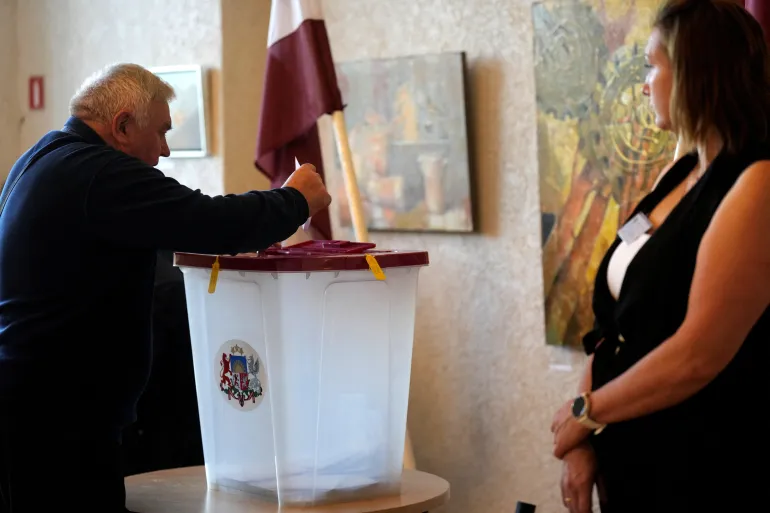
Polls have opened in Latvia for an election taking place against the backdrop of perceived security threats from Russia and a nationwide cost-of-living squeeze.
Saturday’s vote is the first electoral test for Prime Minister Andris Kulbergs after coming to power in May this year when his predecessor resigned due to a backlash from stray drone incursions from Ukraine.
Kulbergs, whose right-wing United List party is currently polling at about 20 percent, is expected to hold onto his position, but the decline of two allies in his current coalition means he is set for a complicated negotiation over the makeup of any future government.
Polls opened at 05:00 GMT and will close at 17:00 GMT. The results are not expected to change Latvia’s pro-European and pro-Ukrainian course.

About 1.5 million people are eligible to vote in the country’s 11th parliamentary election since independence from the Soviet Union in 1991.
Latvian politics are highly fragmented, with parties rarely seeing above 20 percent vote share and coalitions being the norm.
This year, 14 electoral lists are contesting the election, but polls indicate only seven are likely to enter parliament, with the rest expected to fail to meet the minimum 5 percent vote threshold.
Rising living costs, low wages, strains on the healthcare system and long-term population decline have all featured prominently in campaign debates.
Most parties in Latvia are pro-Ukraine; however, the populist Sovereign Power party – which says it wants Ukraine to win but argues money spent supporting Kyiv would be better spent at home – looks likely to become the country’s second-biggest party, with more than 9 percent of the vote. Most other parties have ruled out forming a coalition with Sovereign Power.
Latvia First, a pro-Ukraine and populist nationalist party currently polling at about 9 percent, could be a potential coalition partner for PM Kulbergs.
The Progressives, a pro-European social democratic party, are polling at 6 percent.
Ethnic Russians make up roughly one in four Latvian citizens, but their vote, which has traditionally been cast along identity-based lines, looks set to be made according to economic and social issues.
Latvia is the poorest of the Baltic states, and it has sharply increased its defence spending since Russia invaded Ukraine, now allocating nearly 5 percent of its gross domestic product (GDP) to defence.
[Aljazeera]

Govt. urged to halt ‘illegal’ presidential pardons

GL urges cautious handling of Saudi death row case, blasts govt. over BRICS affair

Shiranthi files anticipatory bail application

Sri Lanka renews Honorary Consul appointment in Mombasa

Govt. plans to amalgamate NDF and ‘Api Wenuwen Api’ Fund

SLPP Gen. Secy. alleges political persecution and institutional decay

‘Dates have the highest sugar content to fight Coronavirus’

Sunday Island 27 December – Headlines

#SundayIsland 17th December – Headlines

Sunday Island – 28th March

Sunday Island Headlines – 21 March

Sunday Island – 21st February – Headlines
-

 Latest News6 days ago
Gold winner Tharanga gets brand-new Honda Vezel from SLAAJ
-

 Features6 days ago
Why Sri Lanka needs an Inclusive Civic Nationalism – urgently
-

 News5 days ago
US-assisted ‘Ice’ detection: NPC to examine IGP’s move to transfer drug-busting team
-

 Editorial4 days ago
Colombo Port drug bust: The plot thickens
-

 News6 days ago
Civil society activist accuses govt. of favouring Ven. Gnanasara
-

 Editorial6 days ago
When crime bosses rise above law and shrines
-

 Midweek Review6 days ago
Dappula’s Easter Sunday ‘grand conspiracy’ claim demolished
-

 News6 days ago
75 new inmates sent to Bogambara re-establishing it as a correctional facility