
Features
Samadhi Statue, Guard-stones and Moonstones

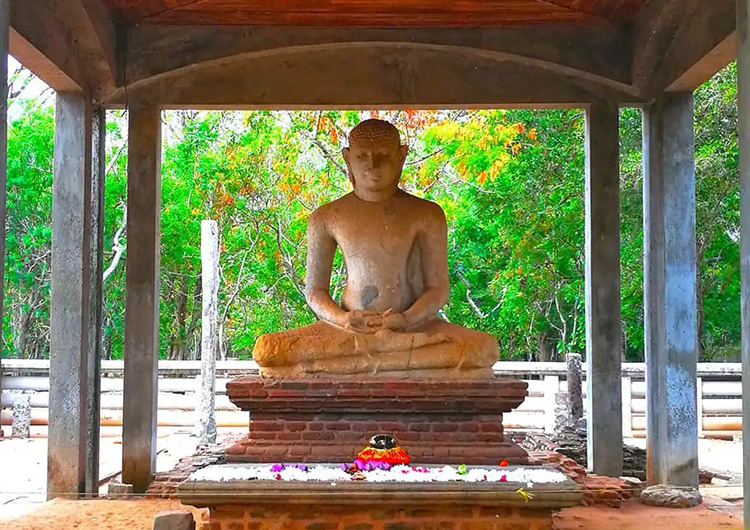
by ACB Pethiyagoda
This ‘Pilima Vahanse’ is said to belong to the Abeygiriya period of the third or fourth century of Sri Lanka’s history. It is not known in whose period of rule it was sculptured but is thought to be one of four similar statues facing the North, South, East and West – this faces North.
The statue was found in 1888, with the nose damaged, at the very site it is now in. Ravenhart in his “Ceylon – History in Stone” says that the repaired nose is over sharp and overlarge. Perhaps the repair was carried out by an ordinary mason who had no idea of proportions or aesthetics. This is not unusual, as there are many such instances of poor quality repairs in this country of damaged statues, stone carvings and particularly restoration of ancient temple paintings.
The Statue is 7’3″ in height, hewn from a single granite rock and said to have had two jewels for the eyes which are said to have gone missing in around 1914. The veracity of this is in question as the eves are closed with no place for jewels. The canopy over the statue was constructed in 1959/60.
Ananda Coomaraswamy wrote that the statue is “certainly the created work of art in Ceylon and is not surpassed in India”
Jawaharlal Nehru admired it when he first saw the statue in 1931. A year later, when he was in the Dehra Dun, jail a friend in Ceylon sent him a picture which he had with him in his cell and “it became a precious companion” he said.
Benjamin Rawland in his book “Art and Architecture of India” describes the statue as “The perfect embodiment of the idea of Samadhi (which) is conveyed through the very simplicity of conception; the perfect material equilibrium of the figure connotes the perfect mental state of the Sakyamuni through the massive stability of the triangular base formed by the inter locked legs mounted by the erect column body which supports the perfectly impassive mask like face.”
The Samadhi statue is symbolic of the tranquility of mind, with no attraction or repulsion from the world outside to disturb.
Guard-stones
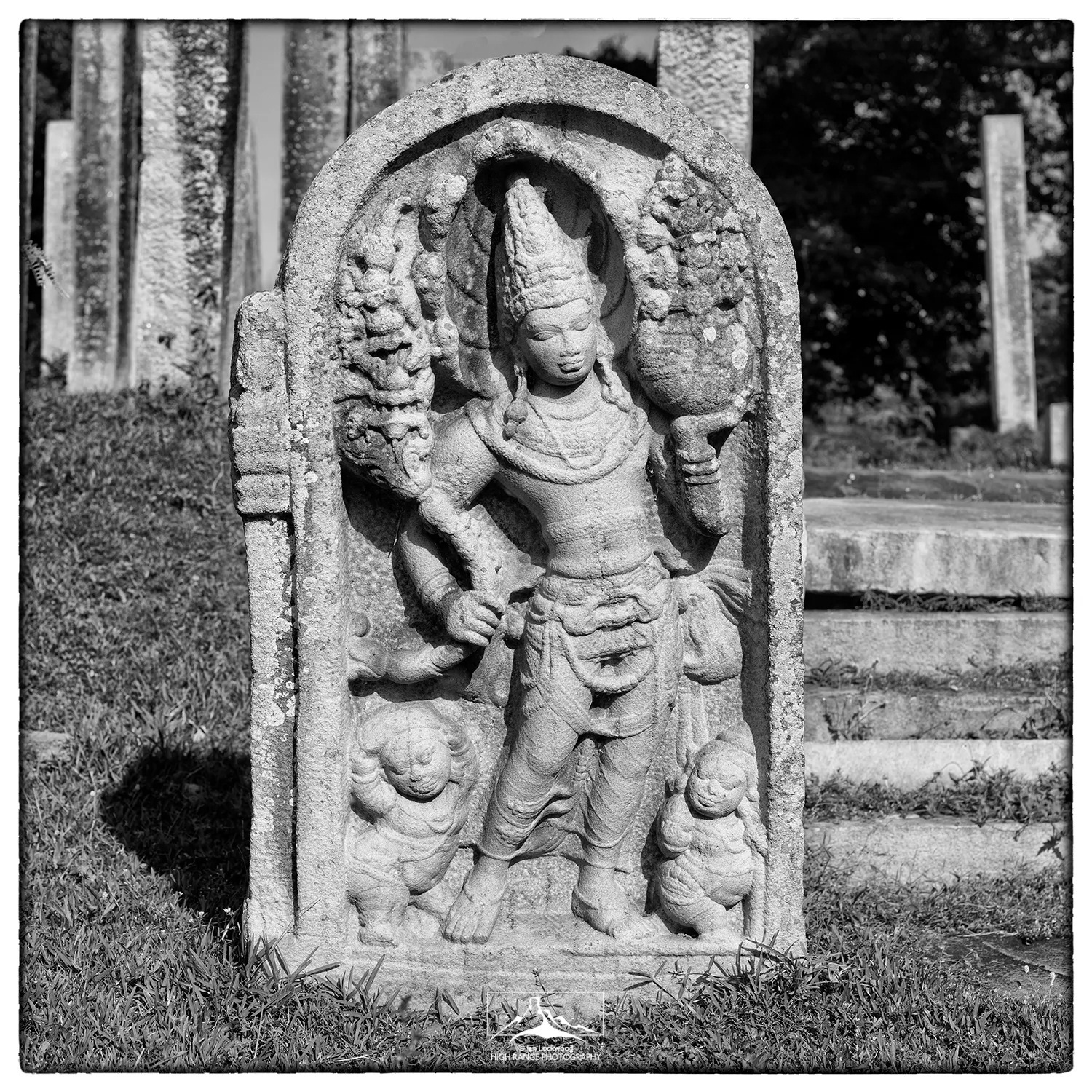
The guard-stone or ‘doratupala/muragala’ at the top of the flight of steps which follow the moonstone leading to the Isurumuniya Rock temple was built by King Devanampiya Tissa in the Golden Age of Anuradhapura. It is one of the eight places (Atamasthana) of Buddhist worship in Anuradhapura.
The figure is of a Naga – a mythical human species closely associated with cobras whose function is to protect Buddhist temples from evil influences and to ensure peace, serenity, piety and prevent theft and sacrilege. Nagas carved on granite as guardians of places of worship built during the Anuradhapura period of Sri Lanka’s history are common. The workmanship is delicate and exquisite but bear a distinct Indian influence. In later times, such as the Polonnaruwa period the carvings are said to be inferior in quality and beauty.
The Nagas on guard stones are richly bejewelled, crowned and adorned with a halo of five or nine cobra hoods. This particular carving carries five such hoods. The chest is bare but the neck, ears, waist and ankles are decked in jewelry with a sword at the waist.
The figure is protected by three arches and in the Naga’s left hand is a vase of flowers while the right hand carries a sprig of flowers with a pot of flowers at its feet – all being symbols of prosperity. At the feet are also two Ganas or dwarfs who are believed to be attendants of Kuvera, the God of Wealth.
Moonstones
The Sinhala for the moonstone is ‘Sandakadapahana’ (sanda-moon, kanda-half, and pahana stone). It is a semi circular slab of hard granite, gneiss or limestone, depending on ready availability and is the first in a flight of steps leading to a Buddhist place of worship. These are richly decorated in concentric semi circular bands of low relief carvings of flowers, creepers, birds and animals. Many scholars regard moonstones as some of the finest examples of the ancient Sinhalese artists, which is the reason for reference to them in the Mahavamsa itself.
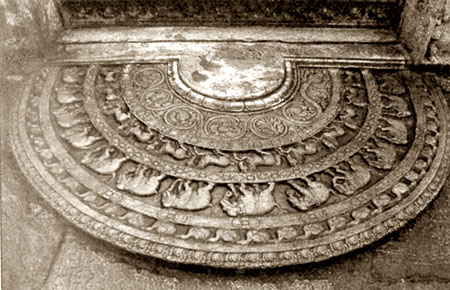
The moonstone is also called Irahandagala’; (ira-sun, handa-moon, gala-stone) in Sinhala. The sun comes into the word because from the earliest of times very many cultures of the world venerated the sun as giver of life, fertility and growth. The ancient Sinhala people were no different as the sun was given a predominant place in their poetry, paintings, sculpture, flags, etc.
Its importance is such that their main cultural and social celebration, the Sinhala New Year, around the April 14 each year, is related to positions of the sun. Thus the significant position of the lotus flower in the moonstone emphasizes the importance of the sun to life itself and is symbolized by the flower which blooms with the rising sun and stays open only so long as it shines.
The moonstone is therefore considered to have beneficial magical powers which ensures prosperity when people came in physical contact with it even by merely stepping on it. The moonstone was the first step to the entrance of the then temple of the Sacred Tooth Relic at Anuradhapura and is described as a classic example of the “best of the class of the decorated type of moonstone…..”
The protective wrought iron fence erected round it in recent times, does not unfortunately allow a picture to be taken in bright sunlight without its shadow falling on some part of the subject at most times of the day unless taken from a considerable height, requiring specialized equipment or perhaps under conditions of overcast skies.
The centre panel of this moonstone consists of two rows of lotus petals followed by a row of geese between two rows of a creeper followed by a panel consisting of elephants, horses, lions and bulls. The outermost semi circle depicts flames of fire.
S. Paranavitana in his “Significance of the Sinhalese Moonstone” explained as follows the significance of each carved panel which according to him represents a spiritual stage in a human’s ascent to Nirvana.
“i. the arc of flower petals (palapethi) motif; the fires of worldly existence.
ii. the arc of four beasts – elephant, lion, horse and bull : the four mortal perils birth, disease, decay and death
the arc of undulating scrolls of leaves and flowers forming the liyavel piyaveli motif; desire or craving (tanha)
iii. the arc of swans or geese (hansa): the thoughtful ones who have left their worldly abodes.
the arc containing a second liyavela motif: the heavenly worlds.
iv. the arc of lotus petals turned outwards, the arc of lotus petals turned inwards and seed-cup in the centre forming together half a lotus: Nirvana.”
All moonstones do not follow this decorative arrangements as some have a panel or two more indicating that the ancient sculptors enjoyed a great deal of freedom in the expression of their art. Some are even more than a semi circle in shape while in others the innermost panel with the lotus flower are raised and are at a higher level than the other panels. Some moonstones of the later part of the Polonnaruwa period are devoid of the bull as in those times the influence of Hinduism was significant and stepping on a figure of the bull was considered sacrilegious as the cow is sacred to Hindus.
Paranvitana saw a “deep metaphysical interpretation” in the panels while D.T. Devendra thought the moonstone was a mere decorated doormat. While the choice between the two very divergent views is the reader’s, only the ancient sculptors themselves knew the reason for their labours. Some of them could have been inspired by great religious fervour while others may have carried out the task purely for material rewards. On the other hand it could have even been a mix of both. We would never know for certain.
V. Vitharana in his essay, “The Moonstone and its Fertility Associations” supports Paranavitana’s interpretation and goes further to say that moonstones are so numerous in Sri Lanka that even an approximation of the numbers is difficult to make. With excavations going on more are likely to add to these numbers.
The origin of the moonstone is traced to the time of the Buddha. It is said that the floors of the Pabbarama monastery in Savarthi built by the wealthy devotee, Visakha, were covered entirely with rich and rare cloth before she offered it to the Lord. Another wealthy lady who also wished to offer such a cloth could however not find a place to lay it on.
Ananda Thero seeing the lady’s disappointment advised her to place her offering at the foot of the stairway leading to the building where the Buddha and monks in attendance would step on after their feet were washed at the entrance to the building. This was done and since that time the first step at the entrance to places of Buddhist worship began to be beautified in various ways and in due course with stones decorated with carvings. At first the carvings were very simple and as time went on these became more elaborate resulting in the moonstones seen today.
Hence, the origin of the moonstone was in India and was later introduced to Sri Lanka with the advent of Buddhism. C. Godakumbura in his book ‘Moonstones’ describes a few seen in Andhra, Sanchi, Ajanta and Elora and goes on to say that some of those were partly decorated while others were carved fully but all these had a connection with Buddhist places of worship. Later on even entrances to palaces came to be adorned with moonstones.
Among the hundreds of moonstones available in Sri Lanka, a few of the most outstanding in beauty and technical perfection are said to be the ones described above and those at Mahasena’s pavilion in the Abayagiri area, in the premises of the Sri Maha Bodhi in Anuradhapura and the Vatadage in Polonnaruwa.
The moonstone at the entrance to the Sri Dalada Maligawa in Kandy was of exquisite beauty and perfection but was marred by the LTTE terrorists when they attacked the temple.
(These articles by the late ACB Pethiyagoda were first published in this newspaper in 2001 and 2002. The author was a retired tea planter who ended his career managing Ceylon Tobacco Company’s agricultural projects.)


 by Kaushalya Perera
Time has, by and large, stood still in the business of academic staff recruitment to state universities. Qualifications have proliferated and evolved to be more interdisciplinary, but our selection processes and evaluation criteria are unchanged since at least the late 1990s. But before I delve into the problems, I will describe the existing processes and schemes of recruitment. The discussion is limited to UGC-governed state universities (and does not include recruitment to medical and engineering sectors) though the problems may be relevant to other higher education institutions (HEIs).
How recruitment happens currently in SL state universities
Academic ranks in Sri Lankan state universities can be divided into three tiers (subdivisions are not discussed).
* Lecturer (Probationary)
– recruited with a four-year undergraduate degree. A tiny step higher is the Lecturer (Unconfirmed), recruited with a postgraduate degree but no teaching experience.
* A Senior Lecturer can be recruited with certain postgraduate qualifications and some number of years of teaching and research.
* Above this is the professor (of four types), which can be left out of this discussion since only one of those (Chair Professor) is by application.
State universities cannot hire permanent academic staff as and when they wish. Prior to advertising a vacancy, approval to recruit is obtained through a mind-numbing and time-consuming process (months!) ending at the Department of Management Services. The call for applications must list all ranks up to Senior Lecturer. All eligible candidates for Probationary to Senior Lecturer are interviewed, e.g., if a Department wants someone with a doctoral degree, they must still advertise for and interview candidates for all ranks, not only candidates with a doctoral degree. In the evaluation criteria, the first degree is more important than the doctoral degree (more on this strange phenomenon later). All of this is only possible when universities are not under a ‘hiring freeze’, which governments declare regularly and generally lasts several years.
Problem type 1
– Archaic processes and evaluation criteria
Twenty-five years ago, as a probationary lecturer with a first degree, I was a typical hire. We would be recruited, work some years and obtain postgraduate degrees (ideally using the privilege of paid study leave to attend a reputed university in the first world). State universities are primarily undergraduate teaching spaces, and when doctoral degrees were scarce, hiring probationary lecturers may have been a practical solution. The path to a higher degree was through the academic job. Now, due to availability of candidates with postgraduate qualifications and the problems of retaining academics who find foreign postgraduate opportunities, preference for candidates applying with a postgraduate qualification is growing. The evaluation scheme, however, prioritises the first degree over the candidate’s postgraduate education. Were I to apply to a Faculty of Education, despite a PhD on language teaching and research in education, I may not even be interviewed since my undergraduate degree is not in education. The ‘first degree first’ phenomenon shows that universities essentially ignore the intellectual development of a person beyond their early twenties. It also ignores the breadth of disciplines and their overlap with other fields.
This can be helped (not solved) by a simple fix, which can also reduce brain drain: give precedence to the doctoral degree in the required field, regardless of the candidate’s first degree, effected by a UGC circular. The suggestion is not fool-proof. It is a first step, and offered with the understanding that any selection process, however well the evaluation criteria are articulated, will be beset by multiple issues, including that of bias. Like other Sri Lankan institutions, universities, too, have tribal tendencies, surfacing in the form of a preference for one’s own alumni. Nevertheless, there are other problems that are, arguably, more pressing as I discuss next. In relation to the evaluation criteria, a problem is the narrow interpretation of any regulation, e.g., deciding the degree’s suitability based on the title rather than considering courses in the transcript. Despite rhetoric promoting internationalising and inter-disciplinarity, decision-making administrative and academic bodies have very literal expectations of candidates’ qualifications, e.g., a candidate with knowledge of digital literacy should show this through the title of the degree!
Problem type 2 – The mess of badly regulated higher education
A direct consequence of the contemporary expansion of higher education is a large number of applicants with myriad qualifications. The diversity of degree programmes cited makes the responsibility of selecting a suitable candidate for the job a challenging but very important one. After all, the job is for life – it is very difficult to fire a permanent employer in the state sector.
Widely varying undergraduate degree programmes.
At present, Sri Lankan undergraduates bring qualifications (at times more than one) from multiple types of higher education institutions: a degree from a UGC-affiliated state university, a state university external to the UGC, a state institution that is not a university, a foreign university, or a private HEI aka ‘private university’. It could be a degree received by attending on-site, in Sri Lanka or abroad. It could be from a private HEI’s affiliated foreign university or an external degree from a state university or an online only degree from a private HEI that is ‘UGC-approved’ or ‘Ministry of Education approved’, i.e., never studied in a university setting. Needless to say, the diversity (and their differences in quality) are dizzying. Unfortunately, under the evaluation scheme all degrees ‘recognised’ by the UGC are assigned the same marks. The same goes for the candidates’ merits or distinctions, first classes, etc., regardless of how difficult or easy the degree programme may be and even when capabilities, exposure, input, etc are obviously different.
Similar issues are faced when we consider postgraduate qualifications, though to a lesser degree. In my discipline(s), at least, a postgraduate degree obtained on-site from a first-world university is preferable to one from a local university (which usually have weekend or evening classes similar to part-time study) or online from a foreign university. Elitist this may be, but even the best local postgraduate degrees cannot provide the experience and intellectual growth gained by being in a university that gives you access to six million books and teaching and supervision by internationally-recognised scholars. Unfortunately, in the evaluation schemes for recruitment, the worst postgraduate qualification you know of will receive the same marks as one from NUS, Harvard or Leiden.
The problem is clear but what about a solution?
Recruitment to state universities needs to change to meet contemporary needs. We need evaluation criteria that allows us to get rid of the dross as well as a more sophisticated institutional understanding of using them. Recruitment is key if we want our institutions (and our country) to progress. I reiterate here the recommendations proposed in ‘Considerations for Higher Education Reform’ circulated previously by Kuppi Collective:
* Change bond regulations to be more just, in order to retain better qualified academics.
* Update the schemes of recruitment to reflect present-day realities of inter-disciplinary and multi-disciplinary training in order to recruit suitably qualified candidates.
* Ensure recruitment processes are made transparent by university administrations.
Kaushalya Perera is a senior lecturer at the University of Colombo.
(Kuppi is a politics and pedagogy happening on the margins of the lecture hall that parodies, subverts, and simultaneously reaffirms social hierarchies.)
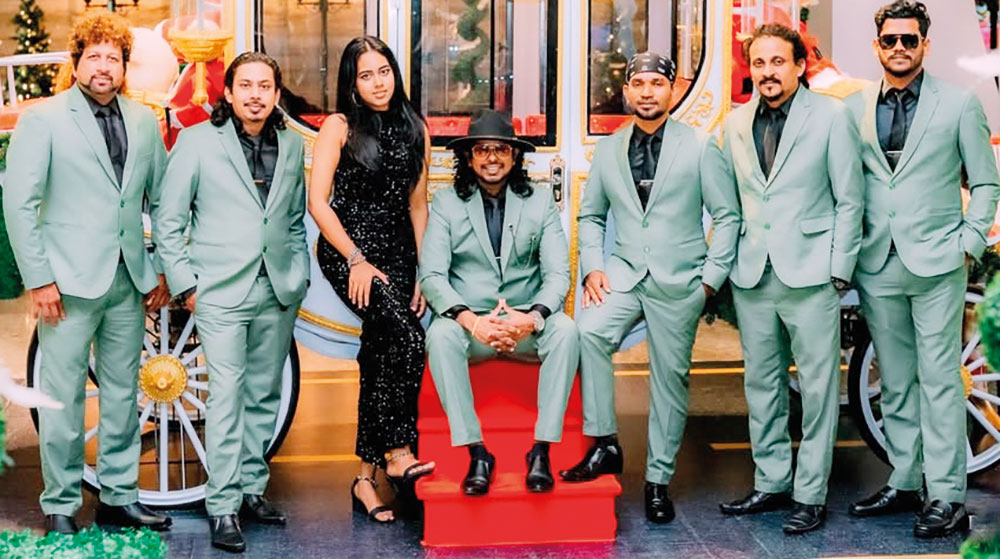
 This week, too, the spotlight is on an outfit that has gained popularity, mainly through social media.
Last week we had MISTER Band in our scene, and on 10th February, Yellow Beatz – both social media favourites.
Talento is a seven-piece band that plays all types of music, from the ‘60s to the modern tracks of today.
The band has reached many heights, since its inception in 2012, and has gained recognition as a leading wedding and dance band in the scene here.
The members that makeup the outfit have a solid musical background, which comes through years of hard work and dedication
Their portfolio of music contains a mix of both western and eastern songs and are carefully selected, they say, to match the requirements of the intended audience, occasion, or event.
Although the baila is a specialty, which is inherent to this group, that originates from Moratuwa, their repertoire is made up of a vast collection of love, classic, oldies and modern-day hits.
The musicians, who make up Talento, are:
Prabuddha Geetharuchi:

Geilee Fonseka: Dynamic and charismatic vocalist
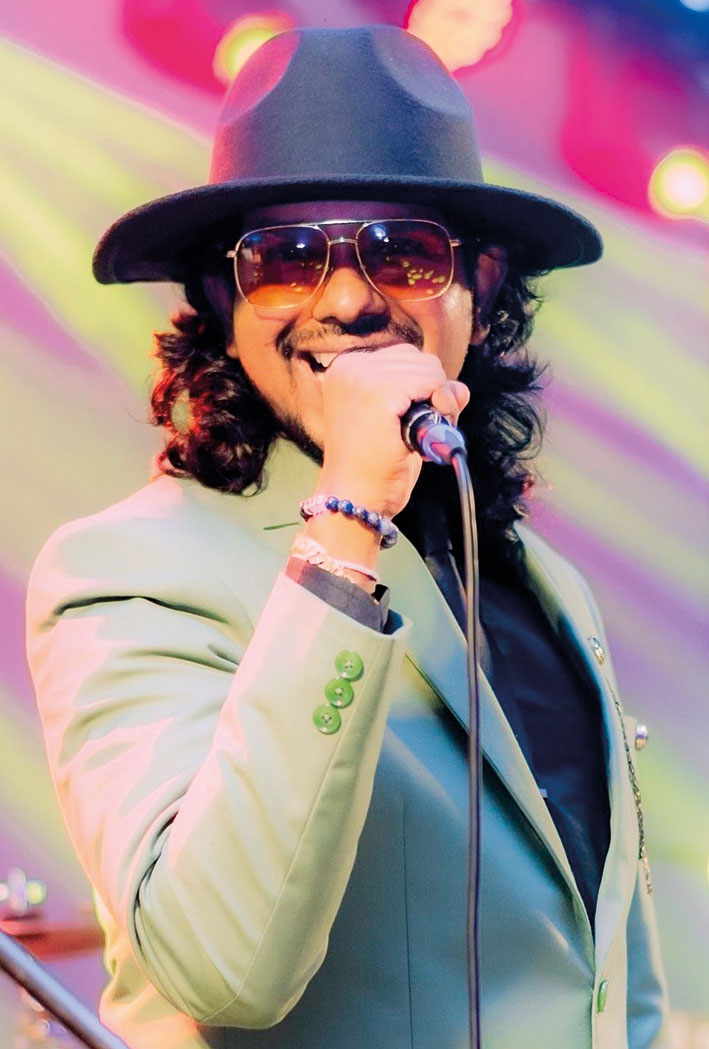
Prabuddha Geetharuchi: The main man behind the band Talento
(Vocalist/ Frontman). He is an avid music enthusiast and was mentored by a lot of famous musicians, and trainers, since he was a child. Growing up with them influenced him to take on western songs, as well as other music styles. A Peterite, he is the main man behind the band Talento and is a versatile singer/entertainer who never fails to get the crowd going.
Geilee Fonseka (Vocals):
A dynamic and charismatic vocalist whose vibrant stage presence, and powerful voice, bring a fresh spark to every performance. Young, energetic, and musically refined, she is an artiste who effortlessly blends passion with precision – captivating audiences from the very first note. Blessed with an immense vocal range, Geilee is a truly versatile singer, confidently delivering Western and Eastern music across multiple languages and genres.
Chandana Perera (Drummer):
His expertise and exceptional skills have earned him recognition as one of the finest acoustic drummers in Sri Lanka. With over 40 tours under his belt, Chandana has demonstrated his dedication and passion for music, embodying the essential role of a drummer as the heartbeat of any band.
Harsha Soysa:
(Bassist/Vocalist). He a chorister of the western choir of St. Sebastian’s College, Moratuwa, who began his musical education under famous voice trainers, as well as bass guitar trainers in Sri Lanka. He has also performed at events overseas. He acts as the second singer of the band
Udara Jayakody:
(Keyboardist). He is also a qualified pianist, adding technical flavour to Talento’s music. His singing and harmonising skills are an extra asset to the band. From his childhood he has been a part of a number of orchestras as a pianist. He has also previously performed with several famous western bands.
Aruna Madushanka:
(Saxophonist). His proficiciency in playing various instruments, including the saxophone, soprano saxophone, and western flute, showcases his versatility as a musician, and his musical repertoire is further enhanced by his remarkable singing ability.
Prashan Pramuditha:
(Lead guitar). He has the ability to play different styles, both oriental and western music, and he also creates unique tones and patterns with the guitar..
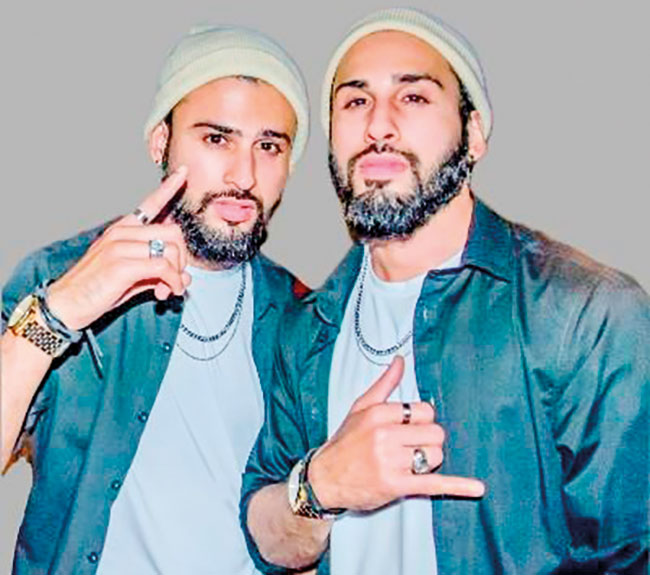
The JJ Twins, the Sri Lankan musical duo, performing in the Maldives, and known for blending R&B, Hip Hop, and Sri Lankan rhythms, thereby creating a unique sound, have come out with a brand-new single ‘Me Mawathe.’
In fact, it’s a very special milestone for the twin brothers, Julian and Jason Prins, as ‘Me Mawathe’ is their first ever Sinhala song!
‘Me Mawathe’ showcases a fresh new sound, while staying true to the signature harmony and emotion that their fans love.
This heartfelt track captures the beauty of love, journey, and connection, brought to life through powerful vocals and captivating melodies.
It marks an exciting new chapter for the JJ Twins as they expand their musical journey and connect with audiences in a whole new way.
Their recent album, ‘CONCLUDED,’ explores themes of love, heartbreak, and healing, and include hits like ‘Can’t Get You Off My Mind’ and ‘You Left Me Here to Die’ which showcase their emotional intensity.
Readers could stay connected and follow JJ Twins on social media for exclusive updates, behind-the-scenes moments, and upcoming releases:
Instagram: http://instagram.com/jjtwinsofficial
TikTok: http://tiktok.com/@jjtwinsmusic
Facebook: http://facebook.com/jjtwinssingers
YouTube: http://youtube.com/jjtwins
-

 Opinion4 days ago
Jamming and re-setting the world: What is the role of Donald Trump?
-
 Features4 days ago
An innocent bystander or a passive onlooker?
-
 Features5 days ago
Ratmalana Airport: The Truth, The Whole Truth, And Nothing But The Truth
-
 Features6 days ago
Building on Sand: The Indian market trap
-
 Opinion6 days ago
Future must be won
-

 Business6 days ago
Dialog partners with Xiaomi to introduce Redmi Note 15 5G Series in Sri Lanka
-
 Business5 days ago
IRCSL transforms Sri Lanka’s insurance industry with first-ever Centralized Insurance Data Repository
-

 Opinion1 day ago
Sri Lanka – world’s worst facilities for cricket fans