
Latest News
Rutherford, spinners lead West Indies to second straight win

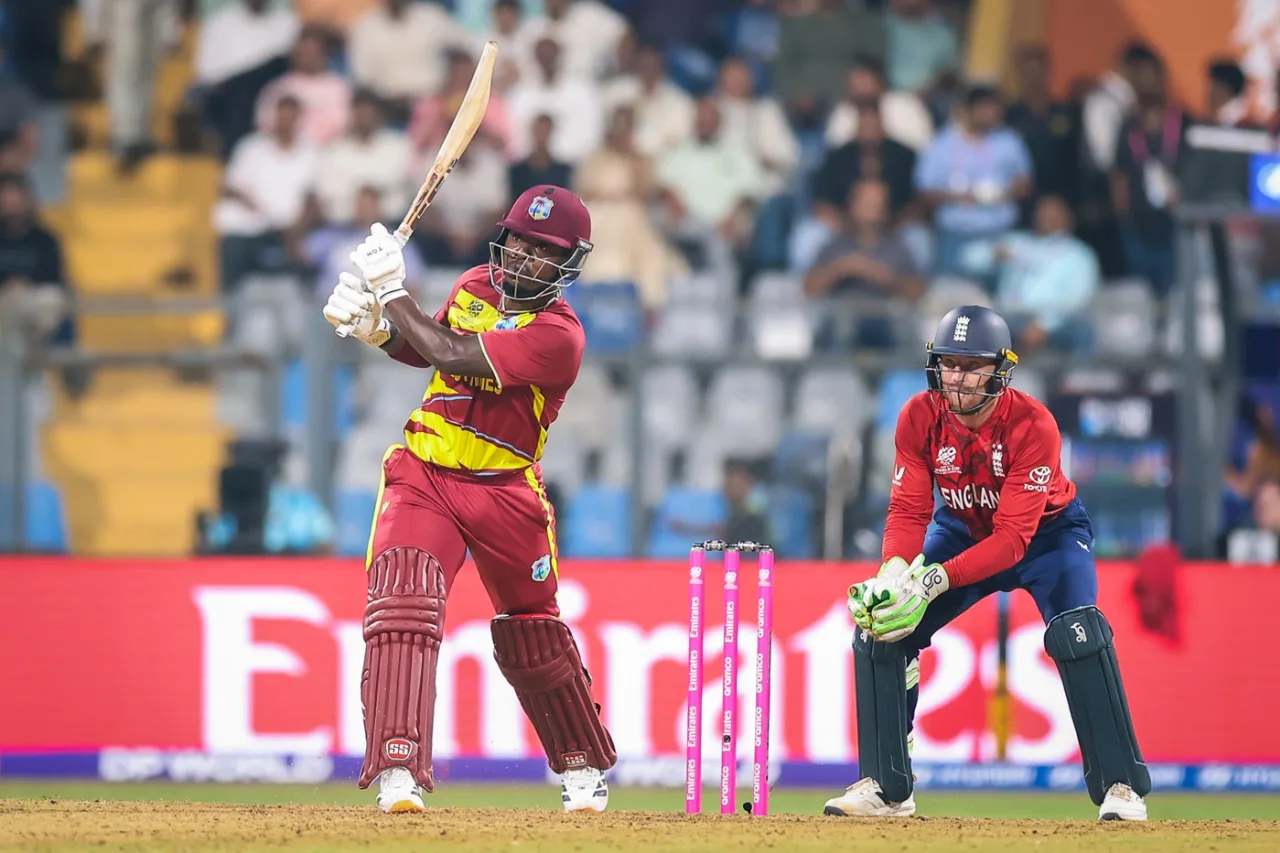
Given all the pre match hype about their 2016 encounter, this contest could well have been set up for a fall. Instead, all the chat about their T20 glory days inspired West Indies with bat and ball, as they landed a brilliant 30-run victory under the floodlights at the Wankhede Stadium, thanks to a calculated but powerful half-century from Sherfane Rutherford, and a stunning spin strangle in dewy conditions, led by Gudakesh Motie’s three wickets.
England looked to have the match in their grasp on numerous occasions: when West Indies slumped to 8 for 2 after losing what seemed a vital toss; when Adil Rashid bounced back from a rough day against Nepal with a stunning boundary-less spell of 2 for 16; when Phil Salt came clattering out of the starting gates to power England along to 67 for 1 in the powerplay.
But the walls closed in on them as soon as West Indies turned to spin. Motie and Roston Chase dovetailed magnificently through the middle overs for combined figures of 5 for 62 in eight, which became 6 for 94 in 12 when Akeal Hosein ended what he had begun by picking off England’s seventh wicket – Jamie Overton – in the covers.
Jofra Archer’s dawdling run-out by a Jason Holder direct hit epitomised an England performance that had run out of road, long before Sam Curran was left high and dry on 43 not out, with Chase’s tumbling catch at deep square leg off Rashid being a fitting way to cap a fine personal display. Having edged over the line against Nepal in their previous game, England’s impressive run of 11 wins in 12 T20Is came to a shuddering halt, and against a familiar World Cup nemesis.
With the 7pm start and heavy prospect of dew, England seemed to have stolen a march by getting the chance to bowl first. Archer, pumped up but erratic, touched 148kph in an opening over that included seven runs in wides, but a wicket as well, as Shai Hope rocked back to slam a cut to deep cover. Curran then made it 8 for 2 after seven legal deliveries, as Brandon King picked out deep point with a similar launch for the stands.
But, almost before they could cement their early advantage, England had it ripped clean from them. In his second over, Curran beat Shimron Hetmyer with a slower ball, then attempted a repeat dose and got smoked through midwicket for six. And Will Jacks, such a threat on Sri Lanka’s spinning decks last week, proved meat and drink with the field up for the powerplay. His loose first over was picked off for 19, including Hetmyer’s second six, high over backward square.
It takes more than one bad day for England to lose faith in their one-day trump card. Rashid’s habitual entry at the end of the powerplay came with the baggage of his brutal treatment against Nepal. But in his three-run opening over, he showcased a ripping legbreak to Chase and a skidding googly past Rutherford’s edge, and from that moment on, West Indies had no option but to treat him with utter deference, seeing him off in a boundary-less four-over spell.
Brook stretched his impact as far as he could dare, first through a change of ends while Overton’s heavy lengths – deemed surplus against Nepal – helped to keep a lid on West Indies’ progress. Rashid’s initial return, for the tenth over, delivered the wicket of Chase for 33 from 29, nailed on the back leg by a wonderful ripping googly, while his two overs were held way back, until the 16th and 18th overs, with Rovman Powell’s miscued slog to long-off capping fabulous final figures of 2 for 16.
As Rashid inadvertently showed in his final over, when dropping Rutherford’s steepling slog across the line on 56, his personal match-up against West Indies’ key man was extremely favourable – and ten balls for ten runs continued that trend.
The trouble was coming at the other end, with England unable to contain a typical West Indies pain-train acceleration, particularly when Rutherford found – in Holder – the ideal long-levered sidekick to clear the Wankhede’s tight boundaries. Jacks returned for a second over but was monstered over the leg-side for back-to-back sixes; Archer’s third was dispatched for 17, including another six for Rutherford that Rashid at deep third parried onto the rope.
Holder got in on the act with four sixes as their stand gathered momentum into the back of a toiling innings, and though he holed out to Overton for 33 from 17 in the final over, Rutherford nailed his seventh six over long-on to close out the innings in style. Without Rashid, England might have been chasing 220. Even with him, West Indies’ outscored England by 13 sixes to six. It was a very throwback means to make the difference.
Salt’s ability to hit fifth gear from the get-go is a rare and enviable trait. He clubbed Hosein’s first ball of the reply through long-off for four, but it was his second-over assault on Holder that ignited England’s powerplay. A match-up that has long been in his favour delivered a 24-run pummeling, as Salt sat deep to the length balls for two sixes over midwicket and carved with impunity through the width for three further fours.
Had he carried on as he’d begun, it might have been a different tale. But he couldn’t, as Romario Shepherd’s harder length cramped his advances for a 14-ball 30. Even so, Jacob Bethell’s left-handedness unlocked the angles against Hosein’s cramping spin, and when Jos Buttler capped a 67-run powerplay with a square-driven four off Shamar Joseph, England seemed very much in control.
Buttler’s first six, from his 13th ball, looked like being the moment that his innings would go into overdrive. Instead, Chase challenged him to repeat his stroke with another determined offbreak on a good length, and long-on was waiting to spring the trap, with Buttler’s 21 leaving him just shy of his 4,000th T20I run.
Enter Motie, an unassuming nemesis maybe, but a player who has seen plenty of this England line-up over the past two years, and whose left-arm spin found just enough purchase amid the rising dew to scupper England’s bid to keep their tempo high.
His spell was not perfect: in particular, his change-up legbreak proved an erratic option, but two balls after Bethell had clubbed a full-toss over midwicket, Tom Banton was picked off at short covers as he failed to time his drive.
One over later, Bethell’s promising stay was done in by Motie’s skiddy line from over the wicket, as he was beaten for pace off the wicket to lose his off stump for 33, and as he bowled his four overs off the reel between overs eight and 14, Motie signed off with the biggest remaining fish. Harry Brook had played within himself for a 14-ball 17, biding his time for the big finish, but he fell within himself too; a tame prod looping back to the bowler to cap a killer spell of 3 for 33.
It wasn’t entirely clear who had been slip-streaming who. But by the end of his four overs, Chase’s figures were even more frugal, 2 for 29, with Jacks’ poor day ending with plumb lbw for 2. England’s lack of bowling partnerships was glaring in the final analysis. It makes their Kolkata Cup clash with Scotland on Saturday all the more compelling.
Brief scores:
West Indies 196 for 6 in 20 overs (Shimron Hetmyer 23, Sherfane Rutherford 76*, Roston Chase 34, Rovman Powell 14, Jason Holder 33; Jofra Archer 1-48, Sam Curran 1-36, Jamie Overton 2-33, Adil Rashid 2-16) beat England 166 in 19 overs (Phil Salt 30, Jos Buttler 21, Jacob Bethell 33, Harry Brook 17, Sam Curran 43*; Akeal Hosein 1-32, Romario Shepherd 1-07, Shamar Joseph 1-30, Gudakesh Motie 3-33, Roston Chase 2-29) by 30 runs
[Cricinfo]


Nepalis go to the polls today [5 March] to elect a new government.
The general election is the country’s first since deadly youth-led anti-corruption protests toppled the government in September 2025.
The Himalayan republic has since been led by an interim government under former chief justice Sushila Karki, which promised to hold fresh elections and hand over power within six months.
The election commission has promised to release the results of the 165 directly elected seats within 24 hours from when counting starts, but the process of collecting ballot boxes from across the mountainous country and delivering them to count centres typically takes at least a day.
It could take another two to three days to tally the results of the proportional representation vote, officials said.
So if the election commission keeps its word it would be a huge departure from how long it typically takes for results to be released in the country.
Ram Prasad Bhandari, the chief election commissioner, says he is committed to finish counting by 9 March.
During the last election in 2022, it took nearly two weeks for results to be released.
This is because some polling stations are located in difficult, hilly terrain – more than 80% of Nepal is mountainous – which makes the collection of ballot boxes a challenging logistical exercise.
Some need to be carried down by hand, for instance, while others have to be airlifted in and out of polling stations.
Planes and helicopters are also not allowed into some remote areas after dark, which often means collection can begin only the next morning. Bad weather also interferes with the collection process.
[BBC]

[Cricbuzz]

The United States government has announced it is collaborating with Ecuador to combat “terrorists” in the South American country.
On Wednesday, US Southern Command, the military unit overseeing operations in Central and South America, posted that joint efforts had already begun in Ecuador.
“On March 3, Ecuadorian and US military forces launched operations against Designated Terrorist Organizations in Ecuador,” General Francis Donovan said.
“The operations are a powerful example of the commitment of partners in Latin America and the Caribbean to combat the scourge of narco-terrorism.”
The statement was accompanied by video footage of military helicopters taking off, as well as black-and-white aerial surveillance imagery of figures boarding helicopters on the ground.
The announcement appears to be part of US President Donald Trump’s broader push against criminal networks and drug cartels in Latin America.
The scope of the Ecuadorian operation is not yet known, but several US news outlets have reported that it is so far limited to supporting Ecuadorian troops through logistics and intelligence, citing government sources.
At a Wednesday news briefing, White House Press Secretary Karoline Leavitt praised the joint operation.
“Together, we are taking decisive action to confront narco-terrorists who have long inflicted terror, violence and corruption on citizens throughout the hemisphere,” she told reporters.
Since taking office for a second term last year, Trump has moved to label multiple prominent cartels as “foreign terrorist organisations”, a term typically reserved for armed groups with political aims.
His administration has paired those labels with an increasingly militaristic approach to combatting drug trafficking, including through the bombing of suspected smuggling vessels.
Critics have pointed out, however, that drug trafficking is considered a crime under international law, not an act of war, and that such lethal actions can be considered extrajudicial killings.
At least 44 aerial strikes have been carried out against alleged drug-smuggling boats and other maritime vessels in the Caribbean Sea and eastern Pacific Ocean.
The result has been 150 known deaths. The identities of the victims have yet to be confirmed by US officials, and no charges against them have been made public.
Two survivors who were recovered from an October attack on a submarine were quickly repatriated to their home countries, Ecuador and Colombia, where they were subsequently released.
Some families from Colombia and Trinidad and Tobago, meanwhile, have claimed that the deceased were fishermen or informal workers transiting between Venezuela and nearby islands, not drug traffickers.
The Trump administration has also launched military actions on Venezuelan soil, one in late December and a second on January 3. In both cases, it justified the strikes as law enforcement actions against drug traffickers.
The first targeted a dock allegedly used by the transnational gang Tren de Aragua. The second culminated in the abduction of Venezuelan President Nicolas Maduro, who was subsequently imprisoned and charged with drug trafficking and weapons charges in a US federal court.
That operation was likewise condemned as a violation of international law, with experts at the United Nations warning that it was “part of a broader and deeply troubling pattern” of unprovoked military aggression.
The Trump administration, however, has suggested it plans to expand its military operations against suspected drug traffickers to other land-based targets. The announcement from Ecuador suggests a new front for its military offensive.
Wednesday’s announcement comes two days after General Donovan, the head of the US Southern Command, visited Ecuadorian President Daniel Noboa and his defence ministers on March 2 in the capital of Quito.
Since the outbreak of the COVID-19 pandemic in 2020, Ecuador has seen a spike in homicides and other violent crimes, as criminal networks make inroads in the country.
Previously, Ecuador had some of the lowest rates of violent crime in the region, earning the country a reputation as an “island of peace” in Latin America.
But experts say the leap can be attributed to a number of factors, including high youth unemployment during the pandemic, economic instability, and a desire to exploit Ecuador’s strategic location on the Pacific coast, between major cocaine producers like Colombia and Peru.
Noboa, a right-wing leader who has been in office since 2023, campaigned for re-election last year on the pledge that he would tamp down on the uptick in crime. He has become closely associated with the “mano dura” or “iron fist” approach to law enforcement.
Trump too has encouraged Latin American leaders to be more aggressive in their handling of criminal networks, and both Noboa and Trump have threatened Colombia, led by left-wing leader Gustavo Petro, for allegedly failing to comply.
On March 1, for instance, Noboa plans to raise tariffs on Colombian imports to 50 percent as punishment for failing to crack down on cocaine trafficking.
On Wednesday, General Donovan praised the Ecuadorian military for their “unwavering commitment” to the fight “against narco-terrorists in their country”.
“Together, we are taking decisive action to confront narco-terrorists who have long inflicted terror, violence, and corruption on citizens throughout the hemisphere,” he said in a statement.
President Noboa, who has hosted Trump administration officials like Homeland Security Secretary Kristi Noem multiple times over the past year, also welcomed the increased collaboration.
“We are beginning a new phase in the fight against drug trafficking and illegal mining,” Noboa wrote on social media on March 2.
“The security of Ecuadorians is our priority, and we will fight for peace in every corner of the country. To achieve this peace, we must act decisively against criminals, wherever they may be.”
Still, critics responded to Wednesday’s announcement with scepticism and alarm about the increasing US military operations overseas.
Brian Finucane, a senior adviser at the International Crisis Group think tank, wrote on social media that the US has yet to clarify what its role in the joint operations was and what its targets were.
“My sense is that some in the administration have been itching to put US military boots on the ground somewhere for an operation against ‘narco-terrorists’ and then publicly brag about it,” Finucane said.
“Ecuador was more amenable than, say, Mexico.”
[Aljazeera]

Nepal election 2026: When will we get the results?

‘It’s so good to be home’ – passengers on Dubai-Dublin flight

India’s momentum meets Wankhede’s memory in big semifinal bout

Afternoon showers expected in the Uva and Sabaragamuwa provinces and in Hambantota, Nuwara-Eliya and Ampara districts

Trump administration launches US military operation in Ecuador

US sinks Iranian warship off Galle returning from Indian naval exercise

‘Dates have the highest sugar content to fight Coronavirus’

Sunday Island 27 December – Headlines

#SundayIsland 17th December – Headlines

Sunday Island – 28th March

Sunday Island Headlines – 21 March

Sunday Island – 21st February – Headlines
-

 Features3 days ago
Brilliant Navy officer no more
-

 Opinion6 days ago
Jamming and re-setting the world: What is the role of Donald Trump?
-
 Features6 days ago
An innocent bystander or a passive onlooker?
-

 Opinion3 days ago
Sri Lanka – world’s worst facilities for cricket fans
-

 Business6 days ago
An efficacious strategy to boost exports of Sri Lanka in medium term
-

 Business22 hours ago
Cabinet nod for the removal of Cess tax imposed on imported good
-

 Features4 days ago
Overseas visits to drum up foreign assistance for Sri Lanka
-

 Features3 days ago
A life in colour and song: Rajika Gamage’s new bird guide captures Sri Lanka’s avian soul