
News
Ruination of last Maha cultivation: Farmers not paid compensation at all

India on behalf of Sri Lanka placed order for urea from Oman
By Shamindra Ferdinando
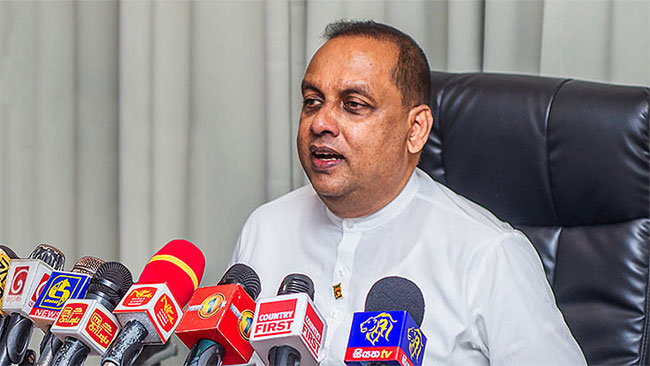
Agriculture, Wildlife and Wildlife Conservation Minister Mahinda Amaraweera on Monday (20) admitted that contrary to repeated assurances given by the government, those who suffered crop losses due to the disastrous decision to ban urea and agro chemicals had not been paid a cent.
The SLFPer said that required funds hadn’t been allocated, though a Cabinet paper was submitted in that regard. The Hambantota district lawmaker declared that the government lacked the wherewithal to compensate the farmers.
Co-Cabinet spokesman Amaraweera made the revelation on the Hiru Salakuna programme. Responding to a three-member panel comprising Chamuditha amarawickrema, Madushan Silva and Kalindu Vithanage, MP Amaraweera estimated that the government required Rs 15,000 mn to sufficiently compensate the farmers.
The minister essentially denied personal responsibility for the failure on the part of the government to compensate farmers as that particular assurance hadn’t been given by him.
The interviewers reminded the minister he couldn’t take that stand as he too was a member of the same government.
Minister Amaraweera indicated that the farmers were very much unlikely to receive compensation for crop losses experienced during the Maha season.
Lawmaker Amaraweera acknowledged that the overnight declaration of mandatory carbonic agriculture policy was their primary blunder. The minister explained that the farmers never demanded compensation. They asked for fertilizer, water and other requirements. But instead, the government offered compensation though the promise was not met, MP Amaraweera said.
Mahinda Amaraweera received ministerial appointment on May 23 following the dissolution of the Cabinet-of-Ministers with the resignation of Premier Mahinda Rajapaksa close on the heels of May 09 violence.
Minister Amaraweera said that the government hadn’t been able to procure urea though the ban was lifted in last November. Therefore, India’s assistance had been sought, Minister Amaraweera said, revealing that Sri Lanka would receive 65,000 metric tons of urea ordered by India from Oman. The minister contradicted previous government statement that India would provide urea to Sri Lanka in spite of a ban on fertilizer exports. Responding to questions, MP Amaraweera said that Sri Lanka’s order for urea, too, had been placed by India. Asked whether the Indian quality stands in respect Omani urea would be compatible with Sri Lanka’s soil, Minister Amaraweera said that in spite of concerns raised in some quarters he was quite confident there wouldn’t be any issue at all.
The payment for the urea would be made via the Indian credit line, the Minister said. The SLFPer dismissed concerns raised by the panel of journalists as regards the suitability of the shipment scheduled to arrive in Colombo on July 06.The Hiru panel asked the minister whether the government had forgotten the circumstances leading to Sri Lanka being compelled to compensate a Chinese state company to the tune of USD 6.7 mn in spite of China supplied carbonic fertilizer failing quality testing.
Minister Amaraweera denied accusations that he interfered with the quality control process relating to the planned urea shipment via India. According to the Agriculture Minister, the urea would be made available to those who cultivated paddy after about third week of July.
At the onset of the interview, Minister Amaraweera claimed that as a result of rapid action taken to increase cultivated paddy lands the country no longer faced threat of famine. Acknowledging the warnings issued by Prime Minister Ranil Wickremesinghe, Speaker Mahinda Yapa Abeywardena and various experts, lawmaker Amaraweera said that at the time he took over the agriculture portfolio late last month, relevant authorities estimated a significant shortfall of rice of the required supply as only 275,000 hectares were cultivated. But since late May, additional land had been cultivated, MP Amaraweera said, estimating the cultivated land at 475,000 hectares.
Even if the total yield was going to be low due to a variety of reasons, including the non-availability of fertilizer and agro chemicals, cultivation of approximately 200,000 hectares of additional land would certainly make a difference.
Referring to recent COPE (Committee on Public Enterprises) proceedings, Minister Amaraweera said that earlier those in authority estimated the country needed to procure approximately 800,000 mt of rice to meet the shortfall this year. The minister claimed that they would be able to bring this down to 400,000 mt of rice due to substantial increase in the cultivated land.
During the interview, Minister Amaraweera admitted that so far this year 365,000 mt of rice had been imported. The Hiru panel repeatedly pointed out that the country had to squander foreign currency on rice imports due to the ruination of paddy cultivation caused by overnight banning of urea.
Lawmaker Amaraweera said that he desired either environment or industries portfolio but President Gotabaya Rajapaksa offered him agriculture. The minister briefly described how stability suffered due to political crisis triggered by the debt crisis.
Responding to President of Rice Millers Association and Chairman of Araliya Group Dudley Sirisena declaration that he would ensure the availability of rice at government controlled price- Nadu at Rs 220 a kilo, Samba at Rs 230 and Keeri Samba at Rs 260, those big and small millers had no option to release their stocks ahead of government intervention. The minister said that both President Gotabaya Rajapaksa and Premier Ranil Wickremesinghe gave the go ahead for tangible measures to bring the situation under control. Lawmaker Amaraweera alleged that Dudley Sirisena made that announcement in response to government moves, including importation of 50,000 mt of rice.
Minister Amaraweera side-stepped questions on how Dudley Sirisena and a few other major millers , including lawmaker Siripala Gamlath made massive profits at the expense of hapless consumers struggling to make ends meet.
The minister emphasized that rice would never be available again under 100 rupees.


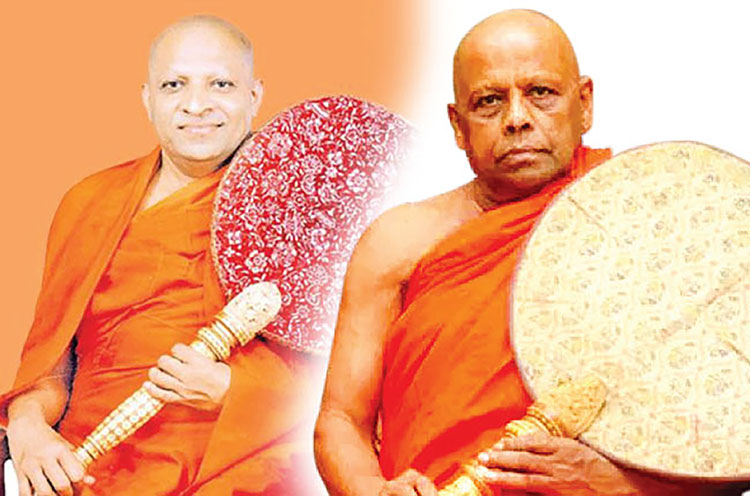
MONETABRIEF– Sri Lanka’s two most senior Buddhist chapters, Malwatte and Asgiriya, demanded special concessions for monks serving prison sentences, following the disrobing of convicted monk Ven. Galagodaatte Gnanasara in line with established procedures.
The chief prelate of the Asgiriya chapter, Most Venerable Warakagoda Sri Gnanarathana, told Prisons Commissioner Senaka Palletenna that Ven. Gnanasara, who is serving a six-year sentence for contempt of court, must be released immediately.
Prison authorities have no power to release or pardon convicts, but Palletenna told the monk in Kandy on Friday that he would convey his request to the relevant government authorities.
“There is no point in talking about this and that… The entire country has been shaken (??????? ) . He must be released,” the Asgiriya chief prelate said.
The Malwatte chief prelate, Most Venerable Thibbatuwawe Sri Siddhartha Sumangala, appeared to accept the court verdict against Ven. Gnanasara, but asked the prisons chief whether a separate section could be established for convicted monks.
Palletenna noted that a special ward for the clergy already existed at Welikada Prison.
At least 63 convicted Buddhist monks are currently incarcerated within Sri Lanka’s criminal justice system.
Meanwhile, a group of 34 Buddhist monks named in a Colombo Fort Magistrate’s Court order to vacate the vicinity of the Presidential Secretariat ended their protest and dispersed after lunch on Friday.The monks are demanding an unconditional pardon for Ven. Gnanasara, who has previously been imprisoned, making him a reconvicted prisoner.
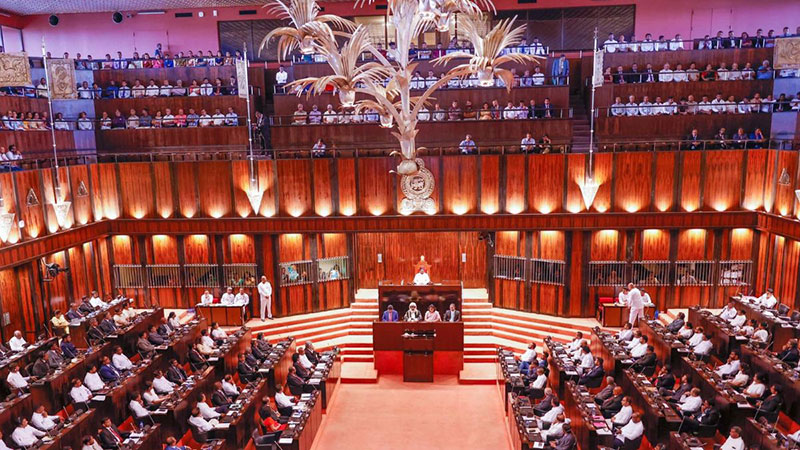
The debate on the no-confidence motion against Speaker Dr. Jagath Wickramaratne, submitted by the Samagi Jana Balawegaya (SJB), has been postponed indefinitely pending the Attorney General’s opinion on certain technical issues in the motion.
Government representatives raised the matter at a meeting of the Committee on Parliamentary Business, pointing out that several provisions of the motion required clarification and that the Attorney General’s advice should be obtained.
As obtaining the opinion would take time, the debate could not be scheduled for the next parliamentary week, parliamentary sources said.
Chief Opposition Whip Gayantha Karunatilaka said a date for the debate would be decided after the Attorney General’s advice was received.
Meanwhile, Parliament is scheduled to meet from October 20 to 23, Secretary General of Parliament Kushani Rohanadeera announced.
The parliamentary business for the week was finalised at a meeting of the Committee on Parliamentary Business held on Friday (16) under the chairmanship of Deputy Speaker Dr. Rizvie Salih.
On each sitting day, the period from 9.30 a.m. to 10 a.m. will be allocated for parliamentary business under Items 1 to 6 of Standing Order 22. Questions for Oral Answers will be taken up from 10 a.m. to 11 a.m., followed by questions under Standing Order 27(2) from 11 a.m. to 11.30 a.m.
On Tuesday, October 20, an Opposition-sponsored Adjournment Motion will be debated from 11.30 a.m. to 5.30 p.m.
On Wednesday, October 21, a resolution under the Public Debt Management Act and a Supplementary Estimate will be taken up for debate and approval from 11.30 a.m. to 5 p.m. The annual reports of five statutory institutions will subsequently be presented for approval without debate, while questions at the Adjournment Time will be taken up from 5 p.m. to 5.30 p.m.
On Thursday, October 22, the Second Reading debates on two Bills to amend the Poisons, Opium and Dangerous Drugs Ordinance (Bills Nos. 79 and 80) will be held from 11.30 a.m. to 5 p.m.
The annual reports of five statutory institutions will then be taken up for approval without debate, followed by an Opposition-sponsored Adjournment Motion from 5 p.m. to 5.30 p.m.
On Friday, October 23, the Second Reading debate on the Elimination of Rabies and Registration of Dogs Bill will be held from 11.30 a.m. to 5 p.m. A Government-sponsored Adjournment Motion will be debated during the final half-hour of the sitting.

Former Navy Commander Admiral Wasantha Karannagoda had, by letter dated May 19, 2014, requested the Secretary to the Ministry of Defence to approve the funds required for former Navy Lieutenant Yoshitha Rajapaksa, son of former President Mahinda Rajapaksa, to attend the Royal Navy Young Officers Course at the Royal Navy Training College in the United Kingdom, the Colombo High Court was told on Thursday (15).
The court was informed that £24,536 in public funds had been spent on the training programme. The details emerged during testimony by a Navy representative appearing on behalf of former Navy Commander Admiral Travis Sinniah before Colombo High Court Judge Udesh Ranatunga, when the money laundering case against Rajapaksa was taken up for hearing.
Responding to questions during cross-examination, the witness explained that payments for Navy officers attending overseas training programmes were generally made in foreign currencies, including US dollars and British pounds.
Meanwhile, Navy Captain Nuwan Thushara Arangala, testifying for the prosecution, told court that Rajapaksa had received a total of Rs. 5,159,626.37 in salaries and allowances during his nine years of service in the Navy.
The court was informed that Rajapaksa had served as a Navy Lieutenant from December 14, 2006, to February 28, 2017, although his service had been suspended on February 28, 2016.
According to the testimony, his monthly gross salary was Rs. 16,390, in addition to allowances for food, uniforms, housing and special duties.
The witness clarified that these allowances did not include payments made for overseas training programmes or participation in sporting events while representing the Navy.
During the proceedings, the prosecution also submitted Rajapaksa’s annual declarations of assets and liabilities for the period from 2009 to 2015.
A National Savings Bank official also testified regarding savings accounts and fixed deposits maintained by Rajapaksa, stating that no withdrawals had been made from the accounts since they were opened.
Rajapaksa is facing charges under the Prevention of Money Laundering Act over his alleged failure to explain the source of nearly Rs. 735 million acquired between August 1, 2012, and August 29, 2013, in Rajagiriya and Bambalapitiya.
The prosecution alleges that funds suspected to have been derived from unlawful activities were deposited in bank accounts and fixed deposits.
The court also heard testimony concerning the appointment of a guardian for Daisy Forrest, the second defendant in the case, and matters relating to the clearance of an imported outside broadcasting (OB) truck associated with CSN television.
Further examination of witnesses was scheduled for October 30, with the court directing 11 prosecution witnesses to appear on that date.

Showers or thundershowers will occur in most parts of the island after 1.00 p.m.

Buddhist hierarchy demands prison perks for monk convicts

Debate on NCM against Speaker postponed indefinitely

Karannagoda pushed for £24,536 for Yoshitha’s UK training, Court told

Flu cases surge across Lanka

Lankan rubies among treasures of London’s Cheapside Hoard

‘Dates have the highest sugar content to fight Coronavirus’

Sunday Island 27 December – Headlines

#SundayIsland 17th December – Headlines

Sunday Island – 28th March

Sunday Island Headlines – 21 March

Sunday Island – 21st February – Headlines
-

 Latest News6 days ago
Farhan and Sadaqat help Pakistan seal series in style
-

 Latest News5 days ago
Nissanka’s return headlines Sri Lanka’s Test squad against Pakistan
-
 Features6 days ago
Intake 16: 45 years of duty and honour
-
 News6 days ago
Malwathu Chapter issues statement on talks with President over Gnanasara Thera’s robes
-
 News6 days ago
CP alleges NPP has taken the blame for illegal US sanctions on Iranian vessels
-

 Opinion6 days ago
How long can Sri Lanka remain silent on its demographic crisis?
-

 News4 days ago
Sri Lanka, India caught in US-Iran ship crisis
-
 Latest News4 days ago
Kusal Mendis’ unbeaten 87 hands Sri Lanka consolation win