
News
Rubber growers call for immediate government intervention to solve ‘rubber industry’s COVID-19′


by Sanath Nanayakkare
Sri Lanka’s rubber plantations are potentially on the brink of being wiped out, battered by a fast-spreading leaf disease and the sector could be nearing the ‘point of no-return’, commercial rubber growers claim, requesting for urgent government intervention to address the pressing issue.
The crisis, which evokes comparisons with the ‘coffee rust’ blight which wiped out Sri Lanka’s coffee plantations in the late 1800s, need to be immediately addressed since output has declined by nearly a third already in some rubber plantations and the industry is fast becoming unviable, growers claim.
Regional Plantation Companies (RPCs) that are involved in the commercial-scale cultivation of rubber, have joined together to voice the critical need to halt the spread of ‘Pestalotiopsis’, by requesting the government to ensure the availability of suitable fertilizer and agrochemicals in sufficient quantities, together with a proven mechanism which would allow the application of the necessary agrochemicals.
“This leaf disease is possibly best described as the equivalent of COVID-19 in the case of the rubber industry, considering both its devastation and the rapid speed at which it is spreading,” rubber industry veteran, Manoj Udugampola says. Udugampola has more than 30 years of experience in the sector and is the current Vice Chairman of the Colombo Rubber Traders’ Association (CRTA) and the Chief Operating Officer – Rubber of Pussellawa Plantations Ltd.
According to Udugampola, up to now, Pestalotiopsis, which causes leaves of rubber trees to fall off, has affected more than 20,000 hectares across nearly all rubber-growing regions in Sri Lanka. According to the statistics of Rubber Development Department (RDD), the extent of rubber cultivation under tapping in Sri Lanka (by both smallholders and commercial plantations) stood at 107,000 hectares in 2018. Hence, the leaf disease has already spread to approximately a fifth of the country’s rubber cultivation under tapping, based on 2018 figures.
Beyond the extent, the speed of the spread of Pestalotiopsis has also been alarming. While the issue only came into prominence in Sri Lanka during the second half of last year, Pestalotiopsis has spread rapidly from affecting 10,000 hectares of cultivation at the end of 2020 to double the extent by August 2021. However, Udugampola, like many others in the industry, fear that the worst is yet to come, based on the experiences of other rubber producing countries which have been previously affected by the leaf disease.
“Unfortunately, the wet weather conditions in many areas in which rubber is grown in Sri Lanka are ideal for the disease. The key issue is that while rubber trees need good foliage to produce output, Pestalotiopsis causes the leaves to fall off, so production declines significantly. When we look at the experiences of other rubber producing countries with this disease, the situation becomes even more grim.”
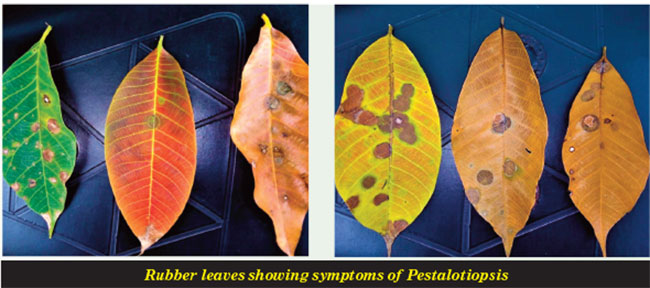
The industry’s fears appear to be well-founded, considering foreign news reports on Pestalotiopsis outbreaks in other rubber producing countries. By August 2019, a rubber cultivation extent equivalent to nearly three times Sri Lanka’s total rubber extent under cultivation in 2018, had been affected by the disease in Indonesia, resulting in the country reducing its annual rubber output target for the year by 15%. Similarly, news reports from Thailand, which too saw vast extents of plantations far greater than Sri Lanka’s total rubber cultivation extent being affected in 2019 by Pestalotiopsis, notes that the disease can halve the output of rubber plantations.
“By around April – May this year we were already seeing a 10 % to 20% reduction in output from rubber plantations due to Pestalotiopsis,” Udara Premathilake, Director Plantations (Rubber), Kelani Valley Plantations PLC says, supporting the views of Udugampola. “Since we continue to incur huge fixed costs including labour costs in running our operations, the reduction in output is reducing our revenue substantially and therefore our profits, so the industry is fast becoming unviable.”
“At this rate by year-end we are looking at a 15% to 20% reduction of the annual output. We are not sure where the industry would stand by next year. Companies are already looking at other crops like cardamom, pepper and cinnamon, which could spell the end of Sri Lanka’s rubber cultivation,” Premathilake said.
His prognosis is backed by Udugampola, who also points out that the Pestalotiopsis and related issues extend far beyond short-term remedies and is threatening the industry’s long-term viability.
“When this disease spreads to immature plants, their long-term growth will be badly affected. Since rubber trees have a life span of around 30 years this translates to a long-term decline in production. As concerted action should be taken at least now, or the industry will be unviable both in the short and the long-run.”
One of the key issues in addressing Pestalotiopsis is the lack of necessary fertilizer and the required agrochemicals (Carbendazim and Hexaconazole) in sufficient quantities. Since rubber trees lose their foliage due to the disease, to compensate and provide extra nourishment for foliage re-growth, Rubber Research Institute’s main recommendations is to apply additional fertilizer. However, following the fertilizer and agrochemical ban, let alone additional quantities, not even the required quantities are available, according to the Regional Plantation Companies (RPCs).
While earlier at least these inputs had been available at exorbitant prices (at double the amount prior to the ban), now there is no fertilizer available in the market at present. In addition, the recommendation is to apply fertilizer for mature rubber fields primarily before July/August, which was not possible due to the ban of fertilizer.
The RPCs also point out that despite Rubber Research Institute’s significant efforts and the appointment of a taskforce by the Plantation Ministry to arrest the spread of the disease, a solution is yet to be provided on how agrochemicals can be applied, since existing equipment is not sufficiently powerful to spray agrochemicals to the canopies of full-grown rubber trees.
However, RPCs’ have taken proactive measures themselves to halt the spread of Pestalotiopsis, but these efforts have not yielded the expected results.
“Bearing significant costs, we tested the feasibility of using drones to apply pesticides to the canopies of mature rubber trees in some of our plantations,” Albert Peries, General Manager– Estate Management of Lalan Rubbers Private Limited said. “However, despite being extremely costly, it was not entirely successful, particularly since most rubber plantations are steep land, rather than flat areas, which appears to be an issue for the drones.”
“Hence, we need a commercially-viable solution for Pestalotiopsis and we need one right now, since the industry is in no condition to bear these kinds of exorbitant costs continuously.”
Peries notes that even the spraying of chemicals would only provide temporary protection for a period of few months. He points out that even if one plantation applies agrochemicals but the adjoining one fails to do so, the disease can still spread from the untreated cultivation.
Hence, it is critical that the disease must be dealt with at the national-level by the government, considering especially that a vast majority of Sri Lanka’s rubber plantations are managed by smallholders, not commercial growers.
An immediate solution to Pestalotiopsis
While calling on the government’s intervention to finding a commercially viable solution to apply the necessary agrochemicals, the industry highlights that ensuring the availability of sufficient fertilizer and agrochemicals could provide a starting point in addressing the issue, especially since application of additional fertilizer and agrochemicals are a key recommendation in mitigating the disease’s impact on rubber cultivations.
In the long-run, the industry stresses the need to strengthen the mechanisms available to deal with similar issues, if rubber plantations are to prosper.
“We do appreciate the efforts of government institutions such as the Rubber Research Institute,” Premathilake says. “However, unfortunately, they lack sufficient resources and their capabilities such as research need to be strengthened if we are to effectively tackle these issues. Small growers also need to be made more aware of Pestalotiopsis, since they may not fully know its danger.”
Pieris concurs with this view, also pointing out that the lack of a viable solution to Pestalotiopsis carries a significant opportunity cost to both the industry and the country as a whole.
“As an export industry, rubber has great potential to become an important player to generate much needed foreign exchange for Sri Lanka. In fact, the conditions now are ideal for this purpose since rubber prices are at their highest since 2011. This could have been a golden opportunity even for smallholders to earn a good income and to revive the industry, which has been declining in terms of production volumes since around 2013 due to low prices.”
“However, unfortunately, due to Pestalotiopsis the volumes produced are significantly lower than the potential, despite high prices and both the industry and the country is losing out.”
“While the industry is eager to collaborate and address the issue, with no solution in sight, the clock appears to be ticking for Sri Lanka’s rubber industry, an important earner of foreign exchange for the economy, a provider of employment and livelihoods and a source of pride for the country, considering its global reputation as a high-quality rubber supplier. However, a solution, together with ensuring the availability of the necessary fertilizer and agrochemicals, could still potentially save Sri Lanka’s rubber cultivations, a matter now entirely in the hands of the government.”, Pieris said.



The Commissioner General of Essential Services, Prabath Chandrakeerthi has announced that, after taking into consideration the current fuel situation in Sri Lanka, the Government has decided to declare Wednesdays of every week as a holiday for government sector employees, all government schools, universities, and courts with effect from March 18, 2026, until further notice
The holiday will not apply to essential service sectors including Healthcare, Ports, Water Supply and Customs.
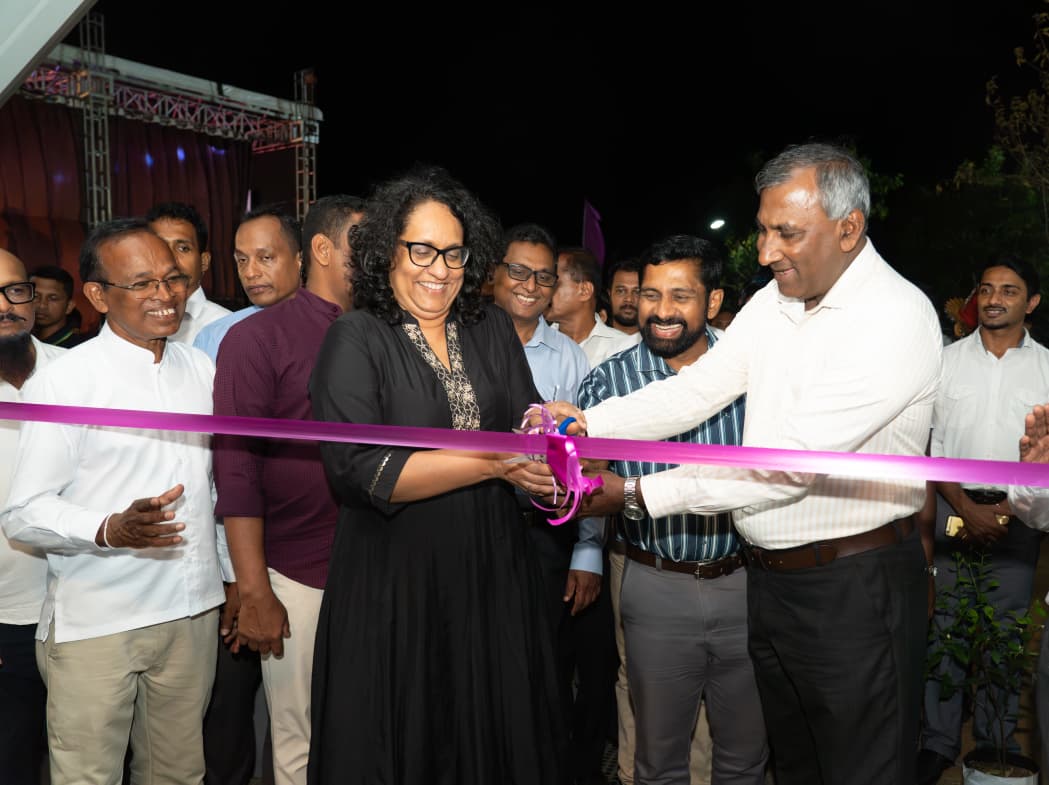
Prime Minister Dr. Harini Amarasuriya stated that leisure had long been limited to only a privileged segment of society, and that the government’s objective is to create opportunities for all citizens to equally experience and enjoy that leisure.
The Prime Minister made these remarks on Sunday (15th of March) while opening the multi-purpose development project associated with the Angunakolapelessa Tank, developed under the “Pohosath Gamak” programme of the Ministry of Rural Development, Social Security and Community Empowerment for the public.
In parallel with the multi-purpose development project carried out associating the Angunakolapelessa Leisure Island, a boating facility and the Leisure Island cafeteria were also officially opened.
Addressing the gathering the Prime Minister stated:
“The multi-purpose development project associated with the Angunakolapelessa Tank has received voluntary support from the community of more than 700 days.
With the funding from the Ministry of Rural Development, Social Security and Community Empowerment, the Angunakolapelessa Pradeshiya Sabha, together with the divisional councils, public safety committees, youth societies, trade associations, and many others in the community, was able to transform this site into a major development project within a remarkably short period of time.
This project serves as a powerful example of what can be achieved when people unite collectively for a noble purpose. Developing a country is not a task that the government alone can accomplish.
When intellectuals, religious leaders, youth, entrepreneurs, and the public come together with strong and responsible leadership, we can build a nation so resilient that no hostile force will be able to weaken it.
People in rural communities who live demanding and hardworking lives also deserve to enjoy. For a long time, leisure was limited to only a privileged segment of society. As a government committed to fostering a dignified cultural life for all citizens, it is important to create more spaces like this where people can relax, walk, enjoy themselves, and spend time with peace of mind.
The occasion was graced by the presence of the members of the Maha Sangha, and attended by the Minister of Rural Development, Social Security and Community Empowerment Upali Pannilage, other ministers and parliamentarians, government officials, and local residents.

(Prime Minister’s Media Division)

As a key frontline stakeholder in the national mission, ‘A Nation United,’ the Navy continues to conduct maritime operations in the waters surrounding the island, in coordination with other law enforcement agencies.
During a recent successful operation on the high seas south of Sri Lanka, the Navy intercepted a local multi-day fishing trawler and apprehended five suspects (05) in connection with the smuggling of a stock of suspected drugs.
During a special inspection at the Dickowita fisheries harbour today (16 Mar26), the Police Narcotic Bureau (PNB) confirmed the presence of over one hundred and thirty-three (133)
kilograms of heroin.
The Deputy Minister of Defence, Major General Aruna Jayasekara (Retd), accompanied by the Commander of the Navy, Vice Admiral Kanchana Banagoda, was present in Dickowita to inspect the seized items.
Addressing the media, the Deputy Minister stated that the tri-forces, particularly the Navy, along with the Coast Guard, Police, and other law enforcement agencies, are executing the
government’s vision for national security. He noted that the recent naval operation in the southern seas, which seized a large consignment of narcotics and weapons, demonstrates the government’s success in combating criminal networks involved in narcotics, arms and human trafficking.
He added that such successful outcomes result from the Navy’s meticulous planning, surveillance, intelligence analysis, and inter-agency coordination. He affirmed that no leniency will be shown to drug trafficking networks, and conveyed admiration, on behalf of the President, for the distinctive contribution made by the Sri Lanka Navy, in collaboration with other stakeholders,
towards ensuring public safety and protecting the younger generation from the menace of drugs.
Highlighting the scale of the Navy’s impact, he revealed that naval operations in 2025 seized narcotics valued over Rs. 75 billion, and operations so far in 2026 have seized over Rs. 20 billion worth of drugs.
The Deputy Minister warned that traffickers are increasingly using the guise of legitimate fishing activities to smuggle narcotics. Besides, he emphasized that the responsibility lies not only with law enforcement agencies but with all sectors of society to eradicate the networks associated with drug trafficking. He issued a firm directive to traffickers, dealers, and distributors to “quit,” asserting that there is no loophole, whether by sea or air, that the security forces cannot close. He
further urged drug users to abandon this destructive habit.
He announced plans for legal amendments to impose stricter penalties for drug offenses. Noting that law enforcement agencies have operational autonomy, he appealed to the public to report information on drug trafficking to hotlines 1818 and 1997.
He also commended the media for their responsible reporting in educating the public on the drug menace.
The trawler, the suspects, the communication equipment and the stock of narcotics held in this operation were handed over to the PNB for onward investigation and legal proceedings.

Wednesdays declared a government holiday with effect from 18th March

Iran hits key UAE oil port and Dubai airport

PM declares open Angunukolapelessa Leisure Island

Navy’s successful high-seas bust nets over 133kg haul of heroin

Chinnaswamy stadium receives government clearance to host IPL 2026 final

Tanzid 107, Taskin four-for trump Agha 106 to give Bangladesh series

‘Dates have the highest sugar content to fight Coronavirus’

Sunday Island 27 December – Headlines

#SundayIsland 17th December – Headlines

Sunday Island – 28th March

Sunday Island Headlines – 21 March

Sunday Island – 21st February – Headlines
-

 News7 days ago
Prof. Dunusinghe warns Lanka at serious risk due to ME war
-

 News5 days ago
Historic address by BASL President at the Supreme Court of India
-

 Business6 days ago
BOI launches ‘Invest in Sri Lanka’ forum
-

 Sports6 days ago
Royal start favourites in historic Battle of the Blues
-

 Sports5 days ago
The 147th Royal–Thomian and 175 Years of the School by the Sea
-

 News6 days ago
CEBEU warns of operational disruptions amid uncertainty over CEB restructuring
-

 Features6 days ago
Indian Ocean zone of peace torpedoed!
-

 News5 days ago
Power sector reforms jolted by 40% pay hike demand