
Editorial
Roshan in crooks’ crosshairs


Wednesday 8th November, 2023
It has become manifestly clear once again that all state institutions are geared to protect the interests of the corrupt and not those of the public. When Sports Minister Roshan Ranasinghe plucked up the courage to sack the Sri Lanka Cricket (SLC) Executive Committee and appoint an interim committee headed by former Test Captain Arjuna Ranatunga, the cricket-crazy public exulted, but while welcoming his bold action yesterday we warned that the crooks concerned would strike back with might and main. Latest developments on the political and legal fronts show that the corrupt are planning an all-out counterattack with the help of the powers that be.
Having pitted himself against a gang of powerful crooks and incurred the wrath of their political masters, Minister Ranasinghe is now a marked target. Cricket always gains when SLC is run by interim committees. But the appointment of the current interim committee has run into stiff resistance from some government bigwigs themselves. A Cabinet sub-committee has been appointed to look into the gazette issued by Minister Ranasinghe appointing the SLC interim committee and some other matters. This is widely considered a move aimed at restoring the status quo ante at SLC. The government however has baulked at forcing Minister Ranasinghe to abolish the newly-appointed interim committee because it is aware that he and Arjuna have the public on their side. But the ruling party politicians who protect the corrupt know more than one way to shoe a horse. Minister Ranasinghe had better look over his shoulder!
Ink was still wet on the gazette announcing Minister Ranasinghe’s action to cleanse SLC, which is Sri Lanka’s Augean stables, when the government declared that he had done so unbeknownst to President Ranil Wickremesinghe. It may be recalled that in 2002, Wickremesinghe, as the Prime Minister, signed a ceasefire agreement with LTTE leader Prabhakaran without the then President Chandrika Bandaranaike Kumaratunga’s knowledge. Unlike that truce pact which stood the LTTE in good stead, what Minister Ranasinghe has done is beneficial to the country. Is it that a minister cannot take action to serve the interests of the public in keeping with powers vested in him or her, without obtaining permission from the President?
Minister Ranasinghe has proved that he is made of sterner stuff. He has gone on record as saying that he can have the SLC bigwigs incarcerated for 15 years or more for their rackets if the President, the Attorney General and the IGP assist him in the task. It is hoped that they will help him save cricket from the corrupt instead of slapping obstacles in his path. The Auditor General has exposed specific instances of financial irregularities at SLC, and Minister Ranasinghe deserves everyone’s help to ensure that the culprits are made to face the full force of the law.
Sri Lanka, however, is a land like no other—for the corrupt. Whenever crooks find themselves up a creek, the ruling party politicians who benefit from their largesse leap to their defence. The government is taking great pains to get a bunch of crooks off the hook in the Health Ministry as well. Irrefutable evidence is now available to prove some very serious allegations against a group of officials who have facilitated substandard drug/equipment imports and lined their pockets. It has also been found that some Health Ministry panjandrums were involved in a drug racket where a company sold the government a stock of immunoglobulin, claiming to have imported it; investigations have revealed that the drug was produced locally, but Health Minister Dr. Ramesh Pathirana has said facilities are not available here for it to be manufactured! Strangely, no action has been taken against the officials concerned. Perhaps, the government is wary of having them arrested lest it should end up opening a can of worms; no racketeer can operate in the state sector without the backing of ruling party politicians. Minister Pathirana has chosen not to confront the corrupt so that he can avoid trouble, unlike Minister Ranasinghe, who has stuck his neck out. Hats off to Ranasinghe!
The government has not cared to mend its ways despite last years’ popular uprising. It continues to shield crooks. No wonder its approval rating has plummeted, according to a Verite Research opinion survey, and public anger is welling up.



Youth-led protests are spreading across India. “Cockroaches” have emerged far too strong to be crushed under hobnailed boots. What began as a satirical cockroach hashtag campaign, following a judge’s disparaging remark about the Indian youth, has meteorically morphed into a youth-led mass protest movement. Young Indians, led by the online political initiative, Cockroach Janatha Party, have taken to the streets in defiance of the mighty BJP-led government.
The triggers behind the current protest campaign in India were the cancellation of NEET-UG, a nationwide entrance examination for admission to undergraduate medical and certain allied health science courses, following an alleged paper leak, and activist Sonam Wangchuk’s hunger strike. Fasts have a strong, historical resonance in India, as evident from the tectonic shifts in Indian politics, caused by the hunger strikes of famous freedom fighters like Mahatma Gandhi and Potti Sriramulu and anti-corruption campaigners like Anna Hazare. But the surge of youth anger in India cannot be reduced to those factors alone. Reflected in the aggressive protests in India are public concerns over governance issues. However, the ongoing protests are not without a ‘me-too’ dimension, coming in the wake of mass uprisings in South Asia that forced a President out of office in Sri Lanka and brought down governments in Bangladesh and Nepal.
The Congress Party, desperately looking for something to hold on to in a bid to make a comeback, is accused of trying to hijack the ongoing youth protests. It is not likely to succeed in its endeavour. The Indian youth cannot be unaware of how opportunistic political forces manipulated a genuine youth-led protest campaign in Sri Lanka to capture power.
The powerful Modi government has had to bite the bullet to negotiate with the Cockroach Party protesters, who are openly clashing with the police. Perhaps, having seen how counterproductive the use of brutal force to crush protests was in Bangladesh, the Modi government has chosen to act with restraint and is trying to throw some bureaucrats to the wolves. It has also vowed to build a secure future for the Indian youth. But it remains to be seen whether the BJP-led government will be able to deflect the blame and assuage public anger.
Mass uprisings aimed at engineering regime changes in democratic countries warrant a fresh look at the changing dynamics of the fundamental relationship between the citizenry and the state. In most parts of the world, people no longer live in a chaotic state of nature, which is believed to have led their ancestors to accept restrictions on their freedom in return for benefits such as social order, security and justice, as Locke, Hobbs, Rousseau and others have argued. These factors may still define people’s relationship with the state, but in some countries the line between the state and the government has blurred, with their rulers overstepping their limits, like King Louis XIV of France, who said, “I am the state”. In this day and age, people are conscious of their rights more than ever, and their needs and aspirations have undergone radical changes during the past several decades. It looks as if a need had arisen for a new social contract, as it were, in a highly interconnected, well-informed world.
The expansion of social media and the rise of web-based activism with unlimited potential have created a situation where people seek to influence, or even make direct interventions in the affairs of the state, a trend that suggests what could be considered a tendency of the modern society to move towards more openness and direct democracy through citizens’ initiatives, etc.
India is doing well on the economic front. According to World Bank data, India remains one of the fastest-growing, large economies. If Sri Lanka’s economy had been so vibrant, perhaps there would not have been a popular uprising in 2022. When mass protest campaigns, such as the Arab Spring, Aragalaya, and youth-led uprisings in Bangladesh and Nepal, are examined, it becomes evident that protesters were driven not only by prevailing politico-economic issues but also by a quest for value-based governance or the practice of governing according to ethical principles and shared social values, ensuring that public decisions promote justice, trust and the common good. Governments, especially in this part of the world, have to come to terms with this new reality and adapt to the changing role of the informed and active citizenry if they are to retain public confidence and remain relevant.

Saturday 25th July, 2026
The Opposition’s no-faith motion against Justice and National Integration Minister Harshana Nanayakkara was debated and defeated yesterday. Nobody expected its passage by any stretch of the imagination.
Notwithstanding the defeat of the no-faith motion, some of the points raised by the Opposition during yesterday’s debate are valid. The Negombo Prison riots which claimed 31 lives including those of 10 officers and caused extensive damage to state property could have been prevented if the warring inmates had been transferred to other prisons after their first clash. Why the two violent groups were kept together thereafter defies comprehension. As a prison officer told Minister Nanayakkara at the Prison Headquarters, the incident could have been nipped in the bud. There were serious lapses on the part of the prison authorities and the government, and they cannot absolve themselves of the blame for the loss of life.
However, it is not fair to hold the incumbent government responsible for all chronic prison ills. Overcrowding, which is one of the main causes of prison unrest and violence, is not of recent origin. It has been reported that Sri Lanka’s prison system, designed to accommodate around 11,000 inmates, is currently holding more than 42,000 prisoners, resulting in severe overcrowding and placing immense pressure on prison infrastructure and staff. Prisons are also characterised by a chronic shortage of officers. These issues would not have arisen if the previous governments had taken action to expand the prison system and recruit more personnel.
SJB MP Ajith P. Perera told Parliament during yesterday’s debate that there were about 42,000 inmates in the country’s prisons, and out of them more than 30,000 were drug offenders. In other words, the previous governments carried out anti-narcotics campaigns without increasing the prison capacity to hold more suspects and convicts. MP Perera revealed that more than 15,000 people were languishing behind bars as delays on the part of the Government Analyst’s Department (GAD) had prevented them from obtaining bail. This amounts to a blatant violation of their human rights. It is an indictment of all political parties that have been in power. As the old saying goes, when one finger is pointed at another, three fingers point back at the accuser; criticism of others should be accompanied by self-reflection.
GAD is reportedly experiencing a shortage of personnel and other resource constraints. Why didn’t the previous governments solve these problems? What action has the incumbent administration taken to resolve them? Are there reasons other than resource shortages for GAD’s failure to submit reports to courts expeditiously? It is hoped that the government and the Opposition will stop trading allegations and make a joint effort to ensure that suspects are not held on remand due to institutional delays and lapses.
Meanwhile, the defeat of a no-faith motion does not necessarily translate into the exoneration of the minister against whom it is moved. As for Minister Nanayakkara, the issue has now moved beyond Parliament into the court of public opinion. It will not go away, as evident from the fate that befell Minister Keheliya Rambukwella and those who circled their wagons around him and defeated the motion of no confidence moved against him for fraudulent procurement of drugs, etc., during the previous government. Rambukwella was arrested, remanded and prosecuted. He now has court cases to contend with. Most of those who defended Rambukwella either lost their seats at the last general election or did not have the courage to contest it. This is something the present-day rulers should bear in mind. Those who do not learn from history are said to be doomed to repeat it.

Friday 24th July, 2026
Sri Lanka has succeeded in defeating terrorism but failed to neutralise the netherworld of drugs and crime. Successive governments have launched ambitious operations against the underworld but crime syndicates are still going strong as evident from frequent incidents violence and drug detections. Now, a notorious drug dealer, Mohamed Imran aka Kanjipani Imran, has reportedly threatened to attack the Devinuwara Sri Vishnu Maha Devalaya perahera over a dispute between two kavadi dance groups.
The underworld has emerged so powerful as to pose threats to a perahera held in honour of God Vishnu, one of Sri Lanka’s four guardian deities, and therefore the vulnerability of the mere mortals vis-a-vis crime syndicates goes without saying. Underworld threats to the Devinuwara perahera remind us of the Sura-Asura war, a legendary, cosmic conflict in mythology between deities and demons.
Basnayake Nilame of the Vishnu Devalaya is reported to have lodged a complaint with the police about underworld threats. An investigation has got underway, and the police say they will intensify the security cordon during the Devinuwara festival. The police must not leave anything to chance in making security arrangements to ensure the safety of the public, the participants in the Perahera and the Devalaya officials. It may be recalled that there was a devastating attack on a religious ceremony 17 years ago in the Matara District, where the Devinuwara shrine is located.
An LTTE suicide bomber attacked a religious event at a mosque in Akuressa, in 2009, killing about 15 people and injuring another 60, including the then Minister Mahinda Wijesekera, a former Basnayake Nilame of the Devinuwara Vishnu Devalaya. Wijesekera, who suffered permanent injury and left politics, died a few months ago at the age of 83. One can only hope that nothing untoward will happen in Devinuwara.
Terrorism and other forms of violence have not spared all four major religions in this country. Mobs who carried out the 1983 anti-Tamil pogrom, looted and torched Hindu temples besides the houses and business places of their victims. The LTTE attacked Buddhist temples, massacred Buddhists including monks and Muslims inside mosques as part of its ethnic cleansing campaign. The National Thowheed Jamaath (NTJ) attacked churches, killing Christians. Now, an organised criminal gang is threatening one of Sri Lanka’s oldest shrines venerated by Buddhists and Hindus alike.
Underworld threats to the Vishnu Devalaya perahera remind us of the NTJ’s original plan to attack the Dalada Perahera in Kandy. The Presidential Commission of Inquiry, which probed the Easter Sunday terror attacks (2019), revealed that NTJ’s plan had been to attack the Dalada Perahera, but it had been changed due the detection of explosives in Wanathawilluwa and external factors such as ISIS losing ground in Syria and Iraq. Subsequently, the NTJ attacked churches and hotels.
Interestingly, while underworld kingpins are instigating prison riots, carrying out narcotic operations and killings, and threatening to attack a holy festival, Deputy Minister of Defence Maj. Gen. (Retd.) Aruna Jayasekera has elevated himself to celestial heights, as it were. He is reported to have claimed at a public event that no one in the Opposition is capable of challenging President Anura Kumara Dissanayake in a future presidential contest effectively, and only those who have descended from heaven, like him (Jayasekera), are equal to such tasks. His speech was aired on television and a video of it has gone viral in the digital realm. We thought there were only fallible earthlings in the parliament of Sri Lanka, but now the Deputy Minister of Defence would have us believe that even celestial beings have representation in the JVP-led NPP government.
It is ironic that notorious criminals, released on bail, are carrying out various underworld operations and threatening to attack religious events, while former intelligence officers who were instrumental in defeating terrorism are being detained. Imran was arrested together with another underworld leader, Makandure Madush, in Dubai and extradited in 2019. He was released on bail in December 2022 although it was obvious that he would flee the country and operate from overseas, as we pointed out in an editorial comment on 02 Jan., 2023. A probe must be conducted to find out how Imran managed to obtain bail while everything possible is done to bring him to justice.

Typhoon Noul makes landfall in China, with hundreds of thousands evacuated

Colombo Kaps down Dambulla Sixers by 21 runs

Kandy Royals win by 11 runs
Showers will occur in the Western, Sabaragamuwa and North-western provinces and in Galle, Matara, Kandy and Nuwara-Eliya districts

Govt. launches EPF, ETF shake-up

SLPI concerned over the proposed Chartered Institute of Media Professionals of Sri Lanka

‘Dates have the highest sugar content to fight Coronavirus’

Sunday Island 27 December – Headlines

#SundayIsland 17th December – Headlines

Sunday Island – 28th March

Sunday Island Headlines – 21 March

Sunday Island – 21st February – Headlines
-
 Midweek Review5 days ago
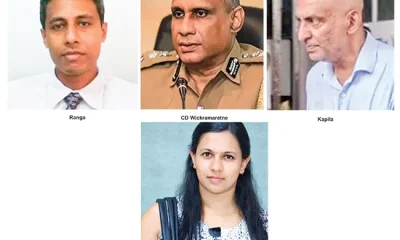
Three high-profile alleged suicides shaping key investigations
-

 News2 days ago
Fort Magistrate orders arrest of MP Archchuna
-

 Editorial2 days ago
An indictment of all parties
-

 News5 days ago
Customs asked to resume probe or face legal action
-
Editorial6 days ago
Welcome bid to tackle rolling death traps
-

 Opinion3 days ago
Ukraine’s power struggle spills on to the streets
-

 News2 days ago
National-level cybersecurity facility Lab established
-

 News6 days ago
Merchant Shipping Secretariat probes bribery scandal