
News
Road development plan encroaching on Knuckles Conservation Forest?


A controversial road development project cutting through the Knuckles Conservation Forest — part of Sri Lanka’s UNESCO World Heritage Central Highlands — has sparked outrage among conservationists, who warn it could devastate one of the island’s most ecologically sensitive mountain ecosystems, said Sajeewa Chamikara of Movement for Land and Agricultural Reform (MONLAR).
Chamikara said that tourism operators and several safari jeep owners, in collaboration with Kandy District MPs E.M. Basnayake and Jagath Manuwarna, have reportedly secured approval to carpet and open an eight-kilometre forest trail between Thangappuwa and Corbett’s Gap for jeep safaris. The decision, facilitated at a meeting on August 22, 2025, by officials of the Land Use Policy Planning Department, was made despite the area falling within a legally protected conservation zone.
Construction is already underway on the section from Rangala to Thangappuwa, which lies outside the protected boundary. Once completed, the project aims to extend into the Knuckles forest reserve itself — widening paths, cutting slopes, and laying asphalt through the core zone.
Environmental experts warn the move is illegal under the Forest Ordinance and National Environmental Act, which prohibit land clearing, road construction, or development activities within conservation forests without environmental impact assessments and central approvals. Violators face imprisonment or heavy fines.
Chamikara said the initiative is being driven by a group of hoteliers and business owners in Thangappuwa and Rangala and several other local entrepreneurs.
He said that scientists had pointed out that the Knuckles-Dumbara range is home to numerous endemic species found nowhere else on Earth — including rare amphibians like the Dumbara shrub frog, unique reptiles such as the Dumbara horned lizard, and more than 30 endemic bird species. Any disturbance, they warn, could destroy critical microhabitats, increase temperatures, and accelerate species extinction.
Chamikara said that the project directly contradicts the government’s own “Prosperous Country, Beautiful Life” policy, which pledges to uphold ecological justice and protect sensitive zones. By supporting illegal development, MPs and officials are accused of violating these commitments and undermining public trust.
Conservationists urge the President and Environment Minister to immediately intervene to halt the project, stressing that the Knuckles range — the principal watershed of the Mahaweli River — is too valuable to be sacrificed for short-term commercial gain.
“This is not development. It is the destruction of a world heritage site,” Chamikara said.
Relevant ministers and officials were unavailable for comment as they were attending the budget debate in Parliament on Friday.


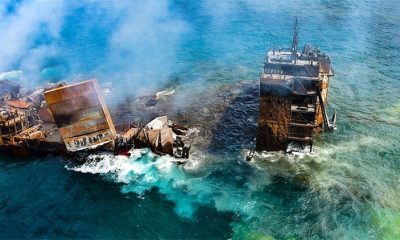



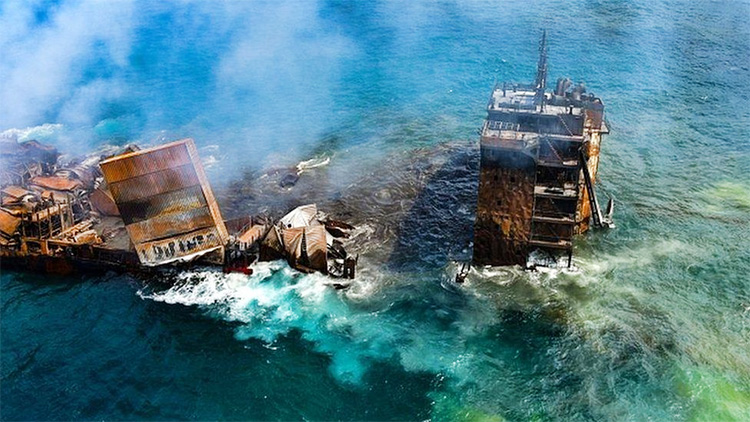
Nearly five years after the catastrophic sinking of the X-Press Pearl, off Sri Lanka’s western coast, the environmental scars remain visible — from contaminated beaches to disrupted fisheries. Now, that tragedy has become a rallying point for an international coalition of scientists, demanding urgent reforms to global maritime law.
A group of leading researchers and environmental experts is calling on the International Maritime Organisation (IMO) to formally recognise plastic pellets — commonly known as nurdles — as hazardous to the marine environment. They argue that existing international shipping regulations fail to adequately address the environmental devastation caused by pellet spills.
Their appeal comes through a newly accepted scientific commentary, published in Cambridge Prisms: Plastics, consolidating decades of research on the impacts of plastic pellet pollution.
Plastic pellets are small, lentil-sized (2–5 mm) particles made from virgin or recycled plastic and used to manufacture a vast range of plastic
products. Scientists say that spills occur frequently during handling and transport, both on land and at sea. Once released into the ocean, pellets persist for decades, spreading across vast distances and entering marine food chains.
Dr. Jennifer Lavers, who studies pollutants in seabirds, warned that the scale of plastic ingestion has reached crisis levels.
“Today the volumes of plastic pellets entering the marine environment are enough to ‘feed’ millions of young seabirds,” she said. “In some areas we are seeing nearly a 100% rate of plastic ingestion, with pellets being particularly problematic.”
Beyond physical harm such as digestive blockages in wildlife, pellets also pose chemical threats. According to Dr. Sinja Rist of DTU Aqua, they are far from inert materials.
“Pellets are persistent, widely dispersed, readily ingested by wildlife, and capable of transporting hazardous chemicals,” she explained, noting that they can absorb and release toxic substances across oceans.
Sri Lanka’s experience with the X-Press Pearl disaster, in 2021, highlighted these dangers on an unprecedented scale. The burning container ship released vast quantities of chemicals and billions of plastic pellets into the sea, causing widespread marine contamination and severe economic losses to coastal communities.
Hemantha Withanage, Chairperson of the Centre for Environmental Justice in Sri Lanka, said the disaster exposed major gaps in international maritime regulation.
“After studying the aftermath of the X-Press Pearl disaster, it is impossible to argue that plastic pellets are harmless cargo,” Withanage stressed. “The impacts in Sri Lanka were immediate, widespread, and long-lasting. Stronger international regulation is essential to prevent this from happening again.”
Under the International Convention for the Prevention of Pollution from Ships (MARPOL), the intentional discharge of plastics is banned. However, scientists argue that current rules are inadequate when it comes to preventing or responding to accidental spills, especially those involving container ships.
The researchers are urging the IMO to assign plastic pellets a specific United Nations classification number. Such recognition would formally acknowledge their environmental hazard potential and trigger stricter requirements for packaging, labelling, and emergency notification during shipping.
Dr. Therese Karlsson, lead author of the commentary and Science Advisor for the IPEN, said the scientific case is clear.
“There are decades of studies highlighting threats from plastic pellets released into the oceans, including risks to marine animals and the food chain,” she said. “Plastics contain thousands of chemicals, many known to cause harm to the environment and human health. It is past time for global regulations to protect our oceans.”
The European Union has recently introduced measures aimed at preventing pellet losses throughout the supply chain, and in 2021 the IMO committed to addressing pellet pollution as part of broader efforts to reduce marine plastic litter. Yet experts warn that without binding global action, pellet spills will continue.
For Sri Lanka, still recovering from one of the worst maritime environmental disasters in its history, the international call carries particular urgency.
Scientists say the message from the island nation’s experience is unmistakable: plastic pellets must no longer be treated as ordinary cargo, but as hazardous materials demanding strict global oversight.
By Ifham Nizam

Minister of Foreign Affairs, Vijitha Herath, has underscored the urgent global need for enduring peace, security, and strengthened multilateral cooperation, warning that rising geopolitical tensions have created deadlocks in global disarmament efforts and posed serious challenges to international humanitarian law.
The Minister said so while addressing the High-Level Segment of the Conference on Disarmament (CD) in Geneva on Monday (23 Feb), reaffirming Sri Lanka’s firm commitment to global disarmament and multilateral cooperation.
Minister Herath said that safeguarding the future of humanity must be treated as a paramount priority, stressing that trust and mutual respect are essential foundations for effective decision-making in multilateral forums. He reaffirmed that Sri Lanka remains committed to ensuring a secure and stable world for future generations.
Highlighting Sri Lanka’s longstanding role in nuclear disarmament, he recalled the country’s contribution to the 1964 Non-Aligned Movement Summit in Cairo, which called for the establishment of nuclear-free zones. He reiterated that Sri Lanka continues to strongly support such initiatives, particularly in the Middle East, and emphasiSed that total elimination and non-proliferation remain the only guarantees against the use of nuclear weapons.
Sri Lanka also urged that non-nuclear-weapon states must receive unconditional, non-discriminatory, legally binding security assurances, achievable through the work of the Conference on Disarmament.
On humanitarian demining, Minister Herath noted that Sri Lanka remains an active partner in that effort and currently serves as a senior member of the victim assistance committee of the Anti-Personnel Mine Ban Convention. He further reaffirmed Sri Lanka’s continued commitment to the Cluster Munitions Convention, which the country presided over in 2019.
Recognising the rapidly evolving threat landscape, the Minister warned of the impact of emerging technologies that have already reshaped the global disarmament architecture while putting international humanitarian law at significant risk. In this context, he said Sri Lanka has been advocating for the early start of negotiations on a legally binding instrument to prohibit lethal autonomous weapon systems.
He also addressed growing threats to outer space security, stressing that Sri Lanka, long a supporter of disarmament in outer space, continues to back negotiations on a legally binding instrument to prevent an arms race beyond Earth.
Minister Herath concluded by affirming Sri Lanka’s readiness to work with all nations to ensure global efforts toward a safer world are accelerated and achieved at the earliest opportunity.
News
CoPF orders officials to establish legal framework for Rs. 200 for estate workers daily attendance allowance

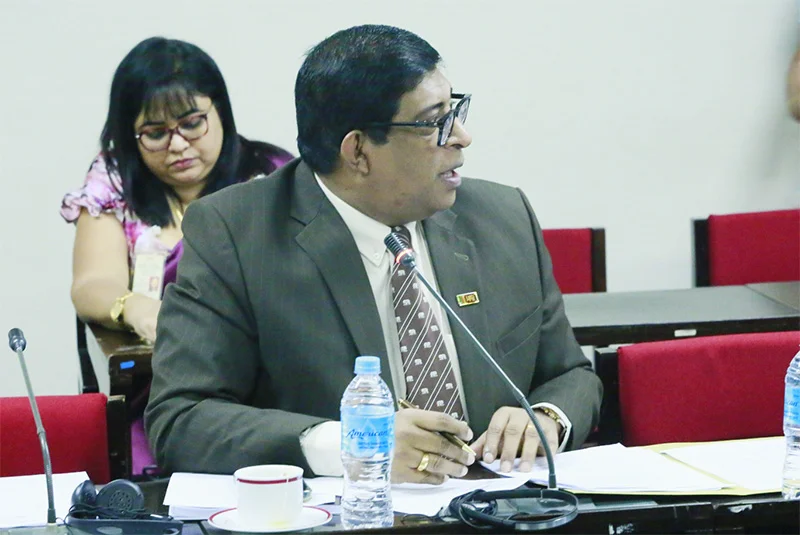
The Parliamentary Committee on Public Finance has directed officials to establish a proper legal framework for the Rs. 200 daily attendance allowance provided by the Government to estate workers.
During the Committee meeting on February 17, 2026, chaired by MP Dr. Harsha de Silva, members emphasised that while there is no objection to increasing estate worker wages, the current payment mechanism lacks a formal legal basis. The allowance is being distributed under a Memorandum of Understanding (MoU) with private plantation companies without gazette notification, leaving the arrangement vulnerable to termination and excluding contributions to the Employees’ Provident Fund (EPF) and Employees’ Trust Fund (ETF), according to parliament sources.
Officials noted that the MoU with plantation companies was valid for three years, and thereafter a policy decision would be required to continue the payments. The Committee stressed that public funds should not be used to pay salaries in private institutions without proper financial discipline, despite the allowance being approved under the 2026 Budget as a “development subsidy.” The Deputy Secretary to the Treasury suggested the payment would be more appropriately classified as a “production incentive,” though existing payments and MoUs did not specify such requirements.
The Committee also reviewed disaster relief efforts for those affected by Cyclone Ditwah. Officials reported that approximately Rs. 24.4 billion had been disbursed under various relief programs, including allowances for house cleaning, household purchases, and school assistance. Delays in housing reconstruction and rental support were attributed to damage assessments and land identification, with Committee members urging faster delivery of housing aid.
Officials from the National Insurance Trust Fund (NITF) highlighted reinsurance claims of around Rs. 11 billion following Cyclone Ditwah, noting that although NITF had not reinsured its exposure internationally since 2023, it was capable of settling existing claims.

Fair weather except for a few showers in the Southern province and in Rathnapura and Monaragala districts after 2.00 p.m

X-Press Pearl disaster fuels global call to classify plastic pellets as hazardous

Foreign Minister Herath decries deadlock in global disarmament

CoPF orders officials to establish legal framework for Rs. 200 for estate workers daily attendance allowance

Colombo drives nearly half of Lanka’s TB cases: Officials

Fonseka clears Rajapaksas of committing war crimes he himself once accused them of

‘Dates have the highest sugar content to fight Coronavirus’

Sunday Island 27 December – Headlines

#SundayIsland 17th December – Headlines

Sunday Island – 28th March

Sunday Island Headlines – 21 March

Sunday Island – 21st February – Headlines
-

 Features4 days ago
Why does the state threaten Its people with yet another anti-terror law?
-

 Features4 days ago
Reconciliation, Mood of the Nation and the NPP Government
-

 Features4 days ago
Victor Melder turns 90: Railwayman and bibliophile extraordinary
-

 Features3 days ago
LOVEABLE BUT LETHAL: When four-legged stars remind us of a silent killer
-

 Features4 days ago
Victor, the Friend of the Foreign Press
-

 Latest News5 days ago
New Zealand meet familiar opponents Pakistan at spin-friendly Premadasa
-

 Latest News5 days ago
Tariffs ruling is major blow to Trump’s second-term agenda
-

 Latest News5 days ago
ECB push back at Pakistan ‘shadow-ban’ reports ahead of Hundred auction