
Business
Rising School Dropouts: The Plight of Estate Children in Sri Lanka


By Himani Vithanage
Although Sri Lanka has performed well in basic education indicators such as a high literacy rate and near-universal participation in primary and secondary schooling, there are striking disparities across regions in the country. Specifically, the education performance of the estate sector consisting of plantation communities is dismal, with a high level of school dropouts. Based on a study carried out by the Institute of Policy Studies of Sri Lanka (IPS), this blog discusses the issue of school dropouts in the estate sector and how prolonged school closures following the COVID-19 outbreak and the ongoing economic crisis have increased school dropouts in estate regions.
School Dropouts in the Estate Sector
A sector-wise comparison of school dropouts prior to the COVID-19 outbreak reveals the estate sector to have the highest percentage of dropouts in all three levels of education – primary, secondary and collegiate – with the percentage rising as the level of education advances from primary to the collegiate level, as observable from figure 1. As such, approximately 4% of primary, 20% of secondary, and 26% of collegiate students had dropped out of school in the estate sector. In contrast, the corresponding rates in urban and rural sectors are much lower, reflecting the disparity across sectors.
Although Sri Lanka’s primary education is almost universalised, the estate sector is lagging. Around 13% of all school dropouts in the estate sector are from primary grades, suggesting that a considerable proportion of dropouts in the region may not even have completed their primary level of education, which is an issue of concern. The high percentage of dropouts beyond primary level could be attributed mainly to the fact that many schools in estates are Type 3 schools with only primary grades, which discourages many estate children from advancing into lower secondary grades as they have to enrol into schools far away from the estates. For instance, in Nuwara Eliya district, which has one of the largest estate sectors in the country, 50.2% of schools are Type 3 schools (School Census, 2020), which influences many children to drop out of school after completing their primary education due to the lack of schools with higher grades in the region.
Given the high level of school dropouts in the estate sector, the IPS study identifies estate children in higher grades, those from extended family households, those from indebted households, those from low-income households, whose fathers have low education qualifications, whose mothers live away from home (abroad or outstation), those who spend more time on housekeeping activities, and those who engage in economic activities to be more likely to drop out of school.
Impact of Child Labour on School Dropouts in the Estate Sector
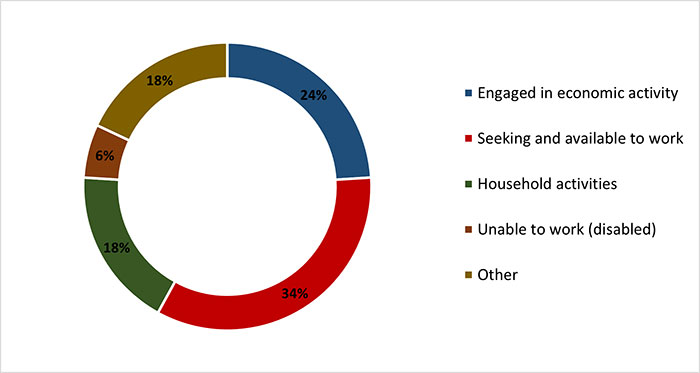
Notably, the prevalence of child labour in a community is revealed to significantly impact estate children dropping out of school. While those considered under child labour are children within the age group 5-17, the finding that around 58% of estate sector school dropouts in this age group engage in or seek to engage in economic activities indicates how child labour influences estate children to drop out of school.
While Sri Lanka is committed to attaining the goal of zero child labour by 2025, as set in the Sustainable Development Goals agenda, eliminating child labour would solve this issue of school dropouts to a certain extent. However, ever since the COVID-19 pandemic emerged, along with the ongoing economic crisis in the country, this goal of eliminating child labour by 2025 has become even more challenging. Evidence suggests that the number of children engaging in economic activities has increased significantly in these estate regions after the pandemic that led to prolonged school closures.
School Dropouts after COVID-19
“There were 56 O-Level students in our school, but when school reopened after the pandemic, only 36 students returned to school. The remaining 20 students were found to be doing jobs. So, we teachers had to go from house to house to meet their parents, and we could only persuade the parents of six students to send them back to school while the others dropped out and continued to do jobs. There were similar cases in grades 6-10 as well.” – School teacher in the estate sector
During pandemic school closures, online classes were the main mode of education for estate children despite it not being viable among them. As such, the lack of access to devices (smartphones, laptops etc.), signal and network coverage issues, along with the financial difficulties they faced, have hindered many children in plantation communities from attending online classes. Concerningly, there is evidence that a segment of those students that had no/low attendance for online classes during that period continue not to attend school even though schools are now reopened and that such students have either dropped out or are currently at the risk of dropping out of school.


By Ifham Nizam
A USD 57.4 million investment package is set to reshape the economics of electricity for small and medium-sized businesses, while creating a stronger platform for private investment in rooftop solar and other distributed renewable-energy projects.
The financing package—comprising a USD 35 million concessional loan from the Asian Development Bank (ADB), a EUR 15.4 million grant from the European Union (EU), equivalent to USD 16.94 million, and a USD 5.5 million grant from the Japan Fund for the Joint Crediting Mechanism (JFJCM)—will finance a five-year programme to modernise the electricity distribution system from 2026 to 2030.
For the business community, one of the most significant elements is the planned introduction of Virtual Net Metering (VNM), which will be implemented in the country for the first time.
The EU-funded component will support 25 MW of aggregated rooftop solar PV capacity, specifically aimed at helping reduce the electricity-bill burden of small and medium-scale entrepreneurs.
The move could open a new investment channel for SMEs that have traditionally faced difficulties in absorbing high energy costs and making the upfront investment required for renewable-energy systems.
Rather than viewing rooftop solar simply as a household energy solution, the programme positions distributed solar as an important business-cost management tool.
For SMEs, which operate with considerably tighter margins than many large corporates, electricity expenditure can have a direct impact on competitiveness, cash flow and the ability to expand operations.
By allowing electricity generated from qualifying rooftop solar installations to be applied through a virtual net-metering arrangement, the programme is expected to broaden the economic benefits of solar power beyond individual premises.
The financial significance of the scheme extends beyond the initial 25 MW.
By establishing the infrastructure and regulatory framework required to manage aggregated distributed generation, the project could help create greater investor confidence in the development of decentralised renewable-energy assets.
The investment therefore has the potential to leverage additional private capital into the renewable-energy sector rather than functioning solely as a government-funded infrastructure programme.
The financing package is particularly notable because a substantial portion comes in the form of grants and concessional funding, reducing the cost of financing technologies that would otherwise require significant upfront capital.
The ADB loan will support the wider modernisation programme, while the EU and Japanese grant components will help finance renewable-energy integration and technologies designed to strengthen the grid.
At EDL, the investment will upgrade the existing CEBAssist platform with Advanced Metering Infrastructure (AMI), a Distributed Energy Resource Management (DERM) system and distribution control centres supported by an Advanced Distribution Management System (ADMS).
These systems will give the utility real-time visibility of electricity consumption and distributed generation, allowing it to manage an increasingly decentralised power system more efficiently.
That digital infrastructure is critical to the business case for expanding rooftop solar.
As more SMEs and other consumers generate their own electricity, the distribution network needs to know where generation is taking place, how much electricity is entering the grid and how those flows are affecting local network conditions.

Renault has taken another significant step in its return to the Sri Lankan market with the opening of the Renault Experience Centre at Majestic City, Colombo, offering customers an opportunity to discover the brand and experience its latest models.
The Centre was officially declared open by Jawahar Ganesh, Group Managing Director of Associated Motorways (Private) Limited, accompanied by Prasanna de Silva, Director – Sales, AMW. The occasion was attended by AMW management and staff, members of the media, customers, well-wishers and other invited guests.
Located at the lobby of Majestic City, the Centre features three Renault models being introduced to the Sri Lankan market – the Renault Kwid, Renault Kiger and Renault Triber. Visitors can explore the vehicles, learn about their features and specifications, and take advantage of test drives available at the location.
Adding to the convenience for customers, AMW has ample stocks of Renault vehicles available in Sri Lanka, allowing customers to take delivery of their chosen vehicle without having to wait for months for it to arrive. Subject to completion of the necessary documentation and registration, customers can look forward to driving away in their new Renault within as little as one day, making the purchase experience faster and more convenient.
Customers can also enjoy greater peace of mind with a three-year manufacturer warranty, supported by dedicated Renault aftersales facilities to provide professional service and support throughout their ownership journey.
Commenting on the opening, Jawahar Ganesh, Group Managing Director of AMW, said, “We are delighted to welcome Renault back to Sri Lanka and to open the Renault Experience Centre at Majestic City. Renault is a brand with an exceptional heritage, a strong global presence and a reputation for innovation and distinctive automotive design. Through AMW, we are bringing that heritage and experience closer to Sri Lankan customers”.
Business
Dialog and Indira Cancer Trust continue breast cancer awareness initiative through Yeheli.lk

Dialog Axiata PLC, Sri Lanka’s #1 connectivity provider, marked the beginning of Breast Cancer Awareness Month by illuminating its Corporate Head Office in pink, in partnership with the Indira Cancer Trust, to stand in solidarity with individuals and families affected by breast cancer and encourage greater awareness, regular screening and early detection.
Building on previous breast cancer awareness campaigns conducted through Dialog’s Yeheli.lk platform in collaboration with the Indira Cancer Trust, this year’s initiative will continue throughout October under the theme, ‘A Pledge from the Heart’. As part of the campaign, members of the public can visit yeheli.lk to register for a free monthly SMS reminder and take their pledge for early detection throughout Breast Cancer Awareness Month.

Afghanistan fast bowlers hit back after Bangladesh’s strong start

Sri Lanka chose to bat first in Rawalpindi

Sutherland and Litchfield lead Australia to quick and convincing win in ODI series opener

USS Tulsa departs Colombo

Appointments for 1,540 Grama Niladhari Officers

Trump says US will not strike Iran before midterm elections

‘Dates have the highest sugar content to fight Coronavirus’

Sunday Island 27 December – Headlines

#SundayIsland 17th December – Headlines

Sunday Island – 28th March

Sunday Island Headlines – 21 March

Sunday Island – 21st February – Headlines
-

 Features6 days ago
The first woman in the foreign service or Ceylon Overseas Service it was then called
-

 News5 days ago
Geneva takes up Sallay’s case and govt. ignores opportunity to answer accusations
-

 Editorial7 days ago
Fuelling discontent and protest
-

 Foreign News6 days ago
Ten injured after car crashes into rugby supporters in Australia
-

 News6 days ago
Nearly 20 Iranian tankers stranded off Lanka amid US sanctions
-

 Latest News7 days ago
Tharindu Rathnayake, bowlers secure Asian Games Bronze for Sri Lanka
-

 Features5 days ago
Sri Lanka Cricket Bill: Governance reform is not yet a cricket strategy
-

 Features4 days ago
Preventing grievances from becoming communal