
Features
Rice Genetic Improvement Odyssey of Past Centuries

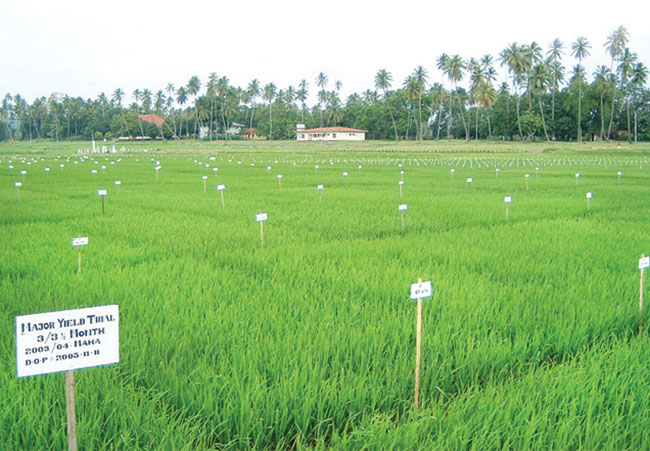
by M. P. Dhanapala
Former Director, Rice Research and Development Institute, Batalagoda
Email: maddumadhanapala@yahoo.com
History is important. It keeps you away from reinventing the wheel and repeating the mistakes already committed in the past. In history, there should not be hidden expressions to read between lines as “the ten giants of King Dutugamunu were fed with traditional rice,”concealing the details of what the others were eating and why they were not giants or that “we have been exporting rice during the past in such and such era” without disclosing the quantities and the recipient countries. For that matter if you go through the export details, we do export rice even now.
The green revolution was criticized as the contributing factor for the so called unidentified Kidney Disease of Unknown Origin (CKDu) which was reported primarily from the North Central Province. Whatever the causal factor of CKDu is, Norman Borlaug or his green revolution has nothing to do with the kidney disease or rice in Sri Lanka. It is true that his innovative ideology in wheat breeding induced the rice breeders worldwide to develop a physiologically efficient rice plant type by changing the plant stature and canopy characteristics. The Sri Lankan rice varieties were developed within the country, by the Sri Lankan scientists. It was an extension of the breeding process initiated by the British scientists during the colonial era. The progress of rice breeding from its inception by different generations will be unfolded in this write-up to judge the calculated decisions taken by the ancestral breeders to improve rice productivity in the country.
I would like to lay the baseline from a report published by Edward Elliott, a British Civil Servant in 1913. (Tropical Agriculturist, Vol. XLI, No. 6, Dec. 1913). He states that the forced labor (Rajakariya) that existed then was abolished in 1832. Subsequently, the communal cooperation system (Atththam) also ceased to exist gradually. These two incidents were cited as the major reasons for the neglect of irrigation structures and subsequent decline of rice production in the mid 19th Century. The annual rice production estimated for the period of 10 years ending in 1856 was 5.5 million bushels, the lowest in the recorded history.
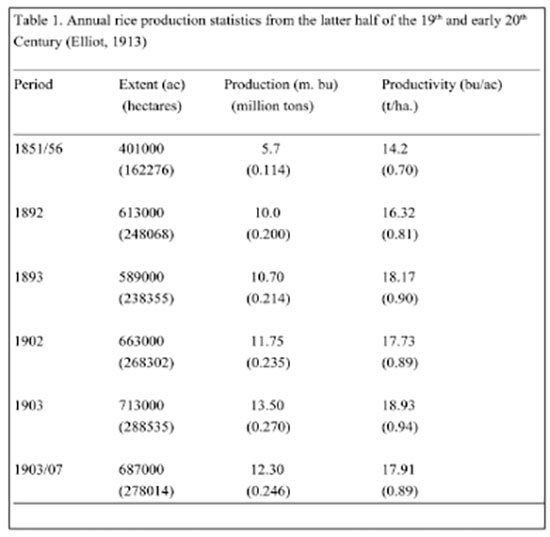
Enacting the Paddy Ordinance in 1857 allowed voluntary restoration of old irrigation structures which eventually led to the gradual increase in the cultivated extent and the annual rice production. Estimated rice production data during this era and at the turn of the century are summarized in Table 1. The original data were in acres and bushels. The data were transformed into hectares and kilograms and tonnes assuming 20 kg as the bushel weight. The transformed data in Table 1 appear within parentheses.
See table 1.
Annual rice production statistics from the latter half of the 19th and early 20th Century (Elliot, 1913)
The rice production data above are estimates based on returns from paddy, probably grain tax, in the Government Blue Books. You may realize that these estimates are sometimes too high when actual data appear towards 1940s. However, at the turn of the 19th Century, the rice varieties were exclusively traditional types maintained by farmers and the Department of Agriculture was not established.
Many critics maintain that we had innumerable different varieties of rice in the past. The earliest recorded in the history was a collection of 300 rice varieties displayed by Nugawela Dissawe for the agri-horticultural exhibition held in 1902 (Molegoda, 1924) (Trop. Agric. XLII (4): 218-224.). This probably represented almost all the cultivars in the field during this period. This was the largest collection of rice varieties in the recorded history in Ceylon, leaving out the recent collections performed in the latter half of the 20th century. Molegoda explains very comprehensively the status of rice varieties and the procedure followed in naming them.
The rice cultivation at the beginning of 20th century was entirely organic manure dependent. The farmers then were apparently more competent in traditional methods of rice cultivation. The most striking feature during this era was that the average yields were below one ton/ha (<20 bu/ac) even in the best productive year, 1903 (Table 1).
In 1914, an encouraging note on Extension of Paddy Cultivation by A. W. Beven (Trop. Agric. XLIII (6): 421-424.) appears with the suggestion of seed selection to improve rice yields. He states that in the year 1913 the yield estimate of 9,622,320 bushels was too high a target, i.e.14.2 bu/ac (0.71 t/ha), for the cultivated extent of 671,711ac (271,827ha), but suggests that with seed selection accompanied by proper land preparation, manuring and transplanting, the yields could be increased up to 25 bu/ac (1.25t/ha). This suggestion was at the inception of the Department of Agriculture which was established in 1912.
The earliest record on rice varietal improvement dates back to seed selection in 1914 by Dr. Lock at Peradeniya. This was done more or less parallel with the establishment of Johannsen’s pure line theory (1903). In the literature, Dr. Lock’s improved Hatial (a seven month variety) appears from time to time as a standard variety in yield tests.
The next most important step was the pure-line selection. Initially, three Economic Botanists, F. Summers (1921), R.O. Iliffe (1922), L. Lord (1927) and at latter stages Paddy Officer G.V. Wickremasekera were involved in the selection of pure- lines (Trop. Agric. LVIII (2): 67-70; Trop. Agric. LXVIII (5): 309-318). Pure-line selection exploited heterogeneity within the farmer maintained traditional rice cultivars. Each cultivar composed of different types within it. As a result, individual plant selection within cultivars produced progenies with better genetic potential, but resembling the mother plant selected; they bred true to type as rice is an obligate inbreeder. This was the essence of pure-line theory established by Johannsen (1903).
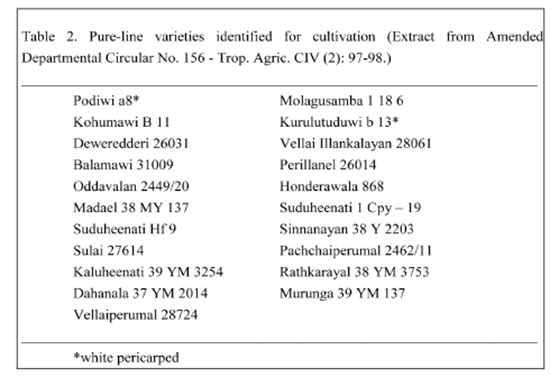
Pure-line selection was initiated with a representative collection of traditional varieties. The most popular varieties were included in the process. Pure-line selection was done at two major locations, Mahailluppallama and Peradeniya. Subsequently, selection was regionalized to accommodate regionally adapted varieties in the process. The best isolated progenies were tested at 19 test locations in different agro-ecological regions for adaptability, prior to recommendation. The best adapted pure-lines (21 lines – Table 2) were identified for purity maintenance at four different paddy stations – Ambalantota (nine lines), Mahailluppallama (eight lines), Madampe (two lines) and Batalagoda (two lines). Further multiplication of seeds was done in government farms under the supervision of Agricultural Officers and distributed as seed paddy for cultivation (Trop. Agric. CIV (2): 97-98.).
See table 2.
Pure-line varieties identified for cultivation (Extract from Amended Departmental Circular No. 156 – Trop. Agric. CIV (2): 97-98.)
While the pure-line selection process was on, Joachim (1927) (Trop. Agric. LXIX 137) warned that the sustenance of increased yields by cultivation of high yielding pure-lines has to be met with liberal manuring. However, despite of all these attempts during the two decades from 1920s, the paddy yields were not substantially increased (Table 3). Rice yield data presented in Table 3 shows lower values compared to yield estimates from Government Blue Books presented in Table 1. The data in Table 3 being more reliable, the Table 1 data could be overestimates.
However, the majority of the harvested rice crop in the 1940s could be from potentially better pure-line selections, but the yields were much below the anticipated levels. The total production was around 15 million bushels (0.3 m tons) and yields stagnated at around 14 bu/ac (0.7 t/ha).
The Draft Scheme for Development of the Paddy Industry in Ceylon drawn in 1945 (Trop. Agric. CI (3) 191-195) begins with the statement that only a third of the annual requirement is met by the local rice production.
The balance was imported; the population was less than seven million during that period and the paddy cultivation was done organically with the best adapted pure-lines of traditional cultivars, though it failed to deliver what was intended.
The importance of inorganic (chemical) fertilizer was felt during this period as the only option to improve paddy yields further. Use of sodium nitrate (Na NO3) as the source of nitrogen (N) was attempted in rice prior to 1905 based on American experience in soybean cultivation, but nitrite (NO2–) toxicity under reduced conditions in submerged paddy soils prohibited its use. Superiority of NH4 form of N was demonstrated by Nagaoka (1905) and Daikuhara and Imaseki (1907). However, the application of N promoted vegetative growth in pure-lines derived from traditional rice varieties causing premature lodging. Furthermore, two fungal diseases, blast and brown spot, became prominent. Around this period some introduced varieties were tested without much success. Among them, Ptb 16 from Pathambi, India, popularly called Riyan wee, with long panicles and slender grains (Buriyani rice) became popular, but self sufficiency in rice appeared to be far away.
Transition to another phase in rice breeding began as the rice breeders over the world employed cross-bred populations to create genetic variability to bring together desirable characteristics of different rice cultivars to develop better varieties. Rice hybridization techniques were developed around early 1920s and a major break through in changing the plant-type was accomplished in Japan with the use of Jikkoku, a dwarf natural mutant of Japonica rice. The performance of Japonica varieties exhibited substantial improvement with this transition. Influenced by the Japanese experience, the Food and Agriculture Organization sponsored a cross breeding program of Japonica with Indica rices in Cuttak, India to change the Indica plant type too in this direction, but without success due to incompatibility between the two groups (Japonica and Indica) leading to grain sterility in subsequent generations.
In Sri Lanka, the first paper on rice hybridization techniques was published in 1951 by J.J. Niles, an assistant in Economic Botany, guided by Prof. M. F. Chandraratne, the Economic Botanist (Trop. Agric. CVII (1):25-29.). Prof. Chandraratne was instrumental in initiation of rice hybridization. Simultaneously rice hybridization work began at the Dry Zone Agricultural Research Station at Mahailluppallama under the guidance of Dr. Ernest Abeyratne. The Central Rice Breeding Station, Batalagoda was established in 1952 and Dr. H. Weeraratne was transferred from Mahailluppallama to Batalagoda as the rice breeder with the hybrid populations already developed at Mahailluppallama.
Dr. Weeraratne, influenced by his superiors, Prof. Chandraratne and Dr. Abeyratne, continued rice hybridization to create genetic variability for selection. The hybridization techniques adopted by him were published in 1954 (Trop. Agric. CX (2) 93-97). Apparently, the labor intensive pedigree method was employed by Dr. Weeraratne to identify and fix desirable genotypes from segregating populations. And this was the beginning of the “H” series of varieties that revolutionized the rice sector in Sri Lanka. The letter “H” was used to imply that the varieties were of hybrid origin and were different from traditional varieties or pure-lines, but not to imply that they are hybrids.
Fig. 1,
The Central Rice Breeding Station, Batalagoda, Department of Agriculture
The first of the series, H4 (4.5 month, red bold), released in 1957, reached its peak popularity after a five year lapse of time and covered over 60% of the cultivated extent in Maha season, 62/63. The others in the series were H7 (3.5 month, white bold), H8 (4.5 month, white samba), H9 (5-6 month, white bold), H10 (3 month, red bold). Release of H varieties (1) minimized crop losses due to blast disease, (2) changed rice cropping pattern from single to double cropping, (3) use of N fertilizer increased by 350% due to their moderate response to fertilizer, (4) increased national yield level up to 3.5 t/ha (Senadhira et. al., Rice Symposium, Department of Agriculture, 1980). This effort, though appreciated widely, fell short of self sufficiency again.
The most controversial phase for the critics in rice breeding was initiated in mid 1960s, while “H” varieties were replacing the pure-lines and the traditional varieties from paddy fields. The International Rice Research Institute was established in 1960 and the plant physiologists conceptualized the plant type structure of rice to make it physiologically efficient. The development of “H” varieties (Old Improved Varieties) abruptly ended with these new innovations.
The breeders responsible for developing this new plant type in Sri Lanka, specifically the Bg varieties, were Dr. H. Weeraratne, Dr. N. Vignarajah, Dr. D. Senadhira and Mr. C.A. Sandanayake. None of them are among us any more. I joined the team in the late 1960s, at the tail end of H varieties and continued the process till the country reached the brim of self reliance in rice.
The Bg and other modern varieties are physiologically efficient. They are devoid of unproductive plant tissues and ineffective tillers. The plant structure is designed to reduce mutual shading of leaves and trap solar radiation effectively by every leaf in the canopy thus reducing the respiratory losses and promoting the net assimilation rate. They out yield traditional and H varieties at any level of soil fertility and show positive grain yield response to added fertilizer. They are lodging resistant and incorporated with resistance/tolerance to major pests and diseases prevalent in the country. More preciously, we have reversed the source-sink relationship of the rice plant to translocate photosynthates to produce more grains and less straw. The potential yield of improved varieties exceeds 6t/ha. All these traits listed above have been tested in controlled experiments in the field to confirm the superiority of new improved varieties. We reap around 4.5 tons/ha as our national average yield at present; the country is self sufficient in rice, the dream every political leader had since independence.
This in a nut shell is what the rice breeders have accomplished and for which they were given the title “Kumbandayas” in an article written apparently by a medical professional. The local rice scientists embark only on innovations backed by scientific facts. They do not have to exaggerate or lie. They know little more than those who seek cheap popularity by being critical about the accomplishments of rice scientists. This country needs people dedicated and confined to their respective professions allowing other professionals to play their own role. At any time rice breeders can take the country back to the traditional rice era if you want to begin all over again from the beginning. The traditional accessions are in long-term storage at the Plant Genetic Resource Center (PGRC), Gannoruwa, Department of Agriculture, and can be taken out for multiplication at any time as the seed samples are viable.
Now I repent why we produced rice with more grains and less straw. There appears to be unsatisfied demand for straw. I like to conclude this disclosure with a statement made by Dr. N. M. Perera at the University of Ceylon, Peradeniya in the mid 1960s. “Comrade, I can give you facts and figures, but I am sorry; I am unable to implant a brain in you”.
(The writer holds a Ph D, Genetics and Plant Breeding, North Dakota University, USA, 1990, M Sc., Plant Breeding, Saga University, Japan, 1978 and B sc. Agric. University of Ceylon, Sri-Lanka, 1968. He has served as Research Officer, Rice Breeding (1969 – 1995) Central Rice Breeding Station, Batalagoda, Director, Rice Research and Development Institute, (1996 – 2000), Batalagoda, Affiliate Scientist, International Rice Research Institute (2000 – 2003), Philippines and Technical Advisor, JICA,, Tsukuba International Center, (2004 – 2012), Japan)

 The headlines are seductive: 2.36 million tourists in 2025, a new “record.” Ministers queue for photo opportunities. SLTDA releases triumphant press statements. The narrative is simple: tourism is “back.”
But scratch beneath the surface and what emerges is not a success story but a cautionary tale of an industry that has mistaken survival for transformation, volume for value, and resilience for strategy.
Problem Diagnosis: The Mirage of Recovery
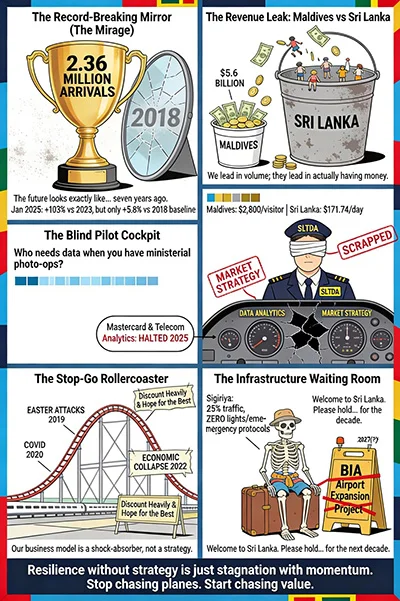
Yes, Sri Lanka welcomed 2.36 million tourists in 2025, marginally above the 2.33 million recorded in 2018. This marks a full recovery from the consecutive disasters of the Easter attacks (2019), COVID-19 (2020-21), and the economic collapse (2022). The year-on-year growth looks impressive: 15.1% above 2024’s 2.05 million arrivals.
But context matters. Between 2018 and 2023, arrivals collapsed by 36.3%, bottoming out at 1.49 million. The subsequent “rebound” is simply a return to where we were seven years ago, before COVID, before the economic crisis, even before the Easter attacks. We have spent six years clawing back to 2018 levels while competitors have leaped ahead.
Consider the monthly data. In 2023, January arrivals were just 102,545, down 57% from January 2018’s 238,924. By January 2025, arrivals reached 252,761, a dramatic 103% jump over 2023, but only 5.8% above the 2018 baseline. This is not growth; it is recovery from an artificially depressed base. Every month in 2025 shows the same pattern: strong percentage gains over the crisis years, but marginal or negative movement compared to 2018.
The problem is not just the numbers, but the narrative wrapped around them. SLTDA’s “Year in Review 2025” celebrates the 15.6% first-half increase without once acknowledging that this merely restores pre-crisis levels. The “Growth Scenarios 2025” report projects arrivals between 2.4 and 3.0 million but offers no analysis of what kind of tourism is being targeted, what yield is expected, or how market composition will shift. This is volume-chasing for its own sake, dressed up as strategic planning.
Comparative Analysis: Three Decades of Standing Still
The stagnation becomes stark when placed against Sri Lanka’s closest island competitors. In the mid-1990s, Sri Lanka, the Maldives, started from roughly the same base, around 300,000 annual arrivals each. Three decades later:
Sri Lanka: From 302,000 arrivals (1996) to 2.36 million (2025), with $3.2 billion
Maldives: From 315,000 arrivals (1995) to 2.25 million (2025), with $5.6 billion
The raw numbers obscure the qualitative difference. The Maldives deliberately crafted a luxury, high-yield model: one-island-one-resort zoning, strict environmental controls, integrated resorts layered with sustainability credentials. Today, Maldivian tourism generates approximately $5.6 billion from 2 million tourists, an average of $2,800 per visitor. The sector represents 21% of GDP and generates nearly half of government revenue.
Sri Lanka, by contrast, has oscillated between slogans, “Wonder of Asia,” “So Sri Lanka”, without embedding them in coherent policy. We have no settled model, no consensus on what kind of tourism we want, and no institutional memory because personnel and priorities change with every government. So, we match or slightly exceed competitors in arrivals, but dramatically underperform in revenue, yield, and structural resilience.
Root Causes: Governance Deficit and Policy Failure
The stagnation is not accidental; it is manufactured by systemic governance failures that successive governments have refused to confront.
1. Policy Inconsistency as Institutional Culture
Sri Lanka has rewritten its Tourism Act and produced multiple master plans since 2005. The problem is not the absence of strategy documents but their systematic non-implementation. The National Tourism Policy approved in February 2024 acknowledges that “policies and directions have not addressed several critical issues in the sector” and that there was “no commonly agreed and accepted tourism policy direction among diverse stakeholders.”
This is remarkable candor, and a damning indictment. After 58 years of organised tourism development, we still lack policy consensus. Why? Because tourism policy is treated as political property, not national infrastructure. Changes in government trigger wholesale personnel changes at SLTDA, Tourism Ministry, and SLTPB. Institutional knowledge evaporates. Priorities shift with ministerial whims. Therefore, operators cannot plan, investors cannot commit, and the industry lurches from crisis response to crisis response without building structural resilience.
2. Fragmented Institutional Architecture
 Tourism responsibilities are scattered across the Ministry of Tourism, Sri Lanka Tourism Development Authority (SLTDA), Sri Lanka Tourism Promotion Bureau (SLTPB), provincial authorities, and an ever-expanding roster of ad hoc committees. The ADB’s 2024 Tourism Sector Diagnostics bluntly notes that “governance and public infrastructure development of tourism in Sri Lanka is fragmented and hampered.”
No single institution owns yield. No one is accountable for net foreign exchange contribution after leakages. Quality standards are unenforced. The tourism development fund, 1% of the tourism levy plus embarkation taxes, is theoretically allocated 70% to SLTPB for global promotion, but “lengthy procurement and approval processes” render it ineffective.
Critically, the current government has reportedly scrapped sophisticated data analytics programmes that were finally giving SLTDA visibility into spending patterns, high-yield segments, and tourist movement. According to industry reports in late 2025, partnerships with entities like Mastercard and telecom data analytics have been halted, forcing the sector to fly blind precisely when data-driven decision-making is essential.
3. Infrastructure Deficit and Resource Misallocation
The Bandaranaike International Airport Development Project, essential for handling projected tourist volumes, has been repeatedly delayed. Originally scheduled for completion years ago, it is now re-tendered for 2027 delivery after debt restructuring. Meanwhile, tourists in late 2025 faced severe congestion at BIA, with reports of near-miss flights due to immigration and check-in bottlenecks.
At cultural sites, basic facilities are inadequate. Sigiriya, which generates approximately 25% of cultural tourist traffic and charges $36 per visitor, lacks adequate lighting, safety measures, and emergency infrastructure. Tourism associations report instances of tourists being attacked by wild elephants with no effective safety protocols.
SLTDA Chairman statements acknowledge “many restrictions placed on incurring capital expenditure” and “embargoes placed not only on tourism but all Government institutions.” The frank admission: we lack funds to maintain the assets that generate revenue. This is governance failure in its purest form, allowing revenue-generating infrastructure to decay while chasing arrival targets.
The Stop-Go Trap: Volatility as Business Model
What truly differentiates Sri Lanka from competitors is not arrival levels but the pattern: extreme stop-go volatility driven by crisis and short-term stimulus rather than steady, strategic growth.
After each shock, the industry is told to “bounce back” without being given the tools to build resilience. The rebound mechanism is consistent: currency depreciation makes Sri Lanka “affordable,” operators discount aggressively to fill rooms, and visa concessions attract price-sensitive segments. Arrivals recover, until the next shock.
This is not how a strategic export industry operates. It is how a shock-absorber behaves, used to plug forex and fiscal holes after each policy failure, then left exposed again.
The monthly 2023-2025 data illustrate the cycle perfectly. Between January 2018 and January 2023, arrivals fell 57%. The “recovery” to January 2025 shows a 103% jump over 2023, but this is bounce-back from an artificially depressed base, not structural transformation. By September 2025, growth rates normalize into the teens and twenties, catch-up to a benchmark set six years earlier.
Why the Boom Feels Like Stagnation
 Industry operators report a disconnect between headline numbers and ground reality. Occupancy rates have improved to the high-60% range, but margins remain below 2018 levels. Why?
Because input costs, energy, food, debt servicing, have risen faster than room rates. The rupee’s collapse makes Sri Lanka look “affordable” to foreigners, but it quietly transfers value from domestic suppliers and workers to foreign visitors and lenders. Hotels fill rooms at prices that barely cover costs once translated into hard currency and adjusted for inflation.
Growth is fragile and concentrated. Europe and Asia-Pacific account for over 92% of arrivals. India alone provides 20.7% of visitors in H1 2025, and as later articles in this series will show, this is a low-yield, short-stay segment. We have built recovery on market concentration and price competition, not on product differentiation or yield optimization.
There is no credible long-term roadmap. SLTDA’s projections focus almost entirely on volumes. There is no public discussion of receipts-per-visitor targets, market composition strategies, or institutional reforms required to shift from volume to value.
The Way Forward: From Arrivals Theater to Strategic Transformation
The path out of stagnation requires uncomfortable honesty and political courage that has been systematically absent.
First, abandon arrivals as the primary success metric. Tourism contribution to economic recovery should be measured by net foreign exchange contribution after leakages, employment quality (wages, stability), and yield per visitor, not by how many planes land.
Second, establish institutional continuity. Depoliticize relevant leaderships. Implement fixed terms for key personnel insulated from political cycles. Tourism is a 30-year investment horizon; it cannot be managed on five-year electoral cycles.
Third, restore data infrastructure. Reinstate the analytics programs that track spending patterns and identify high-yield segments. Without data, we are flying blind, and no amount of ministerial optimism changes that.
Fourth, allocate resources to infrastructure. The tourism development fund exists, use it. Online promotions, BIA expansion, cultural site upgrades, last-mile connectivity cannot wait for “better fiscal conditions.” These assets generate the revenue that funds their own maintenance.
Resilience without strategy is stagnation with momentum. And stagnation, however energetically celebrated, remains stagnation.
If policymakers continue to mistake arrivals for achievement, Sri Lanka will remain trapped in a cycle: crash, discount, recover, repeat. Meanwhile, competitors will consolidate high-yield models, and we will wonder why our tourism “boom” generates less cash, less jobs, and less development than it should.
(The writer, a senior Chartered Accountant and professional banker, is Professor at SLIIT, Malabe. The views and opinions expressed in this article are personal.)

 The hype around educational reforms has abated slightly, but the scandal of the reforms persists. And in saying scandal, I don’t mean the error of judgement surrounding a misprinted link of an online dating site in a Grade 6 English language text book. While that fiasco took on a nasty, undeserved attack on the Minister of Education and Prime Minister Harini Amarasuriya, fundamental concerns with the reforms have surfaced since then and need urgent discussion and a mechanism for further analysis and action. Members of Kuppi have been writing on the reforms the past few months, drawing attention to the deeply troubling aspects of the reforms. Just last week, a statement, initiated by Kuppi, and signed by 94 state university teachers, was released to the public, drawing attention to the fundamental problems underlining the reforms https://island.lk/general-educational-reforms-to-what-purpose-a-statement-by-state-university-teachers/. While the furore over the misspelled and misplaced reference and online link raged in the public domain, there were also many who welcomed the reforms, seeing in the package, a way out of the bottle neck that exists today in our educational system, as regards how achievement is measured and the way the highly competitive system has not helped to serve a population divided by social class, gendered functions and diversities in talent and inclinations. However, the reforms need to be scrutinised as to whether they truly address these concerns or move education in a progressive direction aimed at access and equity, as claimed by the state machinery and the Minister… And the answer is a resounding No.
The statement by 94 university teachers deplores the high handed manner in which the reforms were hastily formulated, and without public consultation. It underlines the problems with the substance of the reforms, particularly in the areas of the structure of education, and the content of the text books. The problem lies at the very outset of the reforms, with the conceptual framework. While the stated conceptualisation sounds fancifully democratic, inclusive, grounded and, simultaneously, sensitive, the detail of the reforms-structure itself shows up a scandalous disconnect between the concept and the structural features of the reforms. This disconnect is most glaring in the way the secondary school programme, in the main, the junior and senior secondary school Phase I, is structured; secondly, the disconnect is also apparent in the pedagogic areas, particularly in the content of the text books. The key players of the “Reforms” have weaponised certain seemingly progressive catch phrases like learner- or student-centred education, digital learning systems, and ideas like moving away from exams and text-heavy education, in popularising it in a bid to win the consent of the public. Launching the reforms at a school recently, Dr. Amarasuriya says, and I cite the state-owned broadside Daily News here, “The reforms focus on a student-centered, practical learning approach to replace the current heavily exam-oriented system, beginning with Grade One in 2026 (https://www.facebook.com/reel/1866339250940490). In an address to the public on September 29, 2025, Dr. Amarasuriya sings the praises of digital transformation and the use of AI-platforms in facilitating education (https://www.facebook.com/share/v/14UvTrkbkwW/), and more recently in a slightly modified tone (https://www.dailymirror.lk/breaking-news/PM-pledges-safe-tech-driven-digital-education-for-Sri-Lankan-children/108-331699).
The idea of learner- or student-centric education has been there for long. It comes from the thinking of Paulo Freire, Ivan Illyich and many other educational reformers, globally. Freire, in particular, talks of learner-centred education (he does not use the term), as transformative, transformative of the learner’s and teacher’s thinking: an active and situated learning process that transforms the relations inhering in the situation itself. Lev Vygotsky, the well-known linguist and educator, is a fore runner in promoting collaborative work. But in his thought, collaborative work, which he termed the Zone of Proximal Development (ZPD) is processual and not goal-oriented, the way teamwork is understood in our pedagogical frameworks; marks, assignments and projects. In his pedagogy, a well-trained teacher, who has substantial knowledge of the subject, is a must. Good text books are important. But I have seen Vygotsky’s idea of ZPD being appropriated to mean teamwork where students sit around and carry out a task already determined for them in quantifying terms. For Vygotsky, the classroom is a transformative, collaborative place.
But in our neo liberal times, learner-centredness has become quick fix to address the ills of a (still existing) hierarchical classroom. What it has actually achieved is reduce teachers to the status of being mere cogs in a machine designed elsewhere: imitative, non-thinking followers of some empty words and guide lines. Over the years, this learner-centred approach has served to destroy teachers’ independence and agency in designing and trying out different pedagogical methods for themselves and their classrooms, make input in the formulation of the curriculum, and create a space for critical thinking in the classroom.
Thus, when Dr. Amarasuriya says that our system should not be over reliant on text books, I have to disagree with her (https://www.newsfirst.lk/2026/01/29/education-reform-to-end-textbook-tyranny ). The issue is not with over reliance, but with the inability to produce well formulated text books. And we are now privy to what this easy dismissal of text books has led us into – the rabbit hole of badly formulated, misinformed content. I quote from the statement of the 94 university teachers to illustrate my point.
“The textbooks for the Grade 6 modules . . . . contain rampant typographical errors and include (some undeclared) AI-generated content, including images that seem distant from the student experience. Some textbooks contain incorrect or misleading information. The Global Studies textbook associates specific facial features, hair colour, and skin colour, with particular countries and regions, and refers to Indigenous peoples in offensive terms long rejected by these communities (e.g. “Pygmies”, “Eskimos”). Nigerians are portrayed as poor/agricultural and with no electricity. The Entrepreneurship and Financial Literacy textbook introduces students to “world famous entrepreneurs”, mostly men, and equates success with business acumen. Such content contradicts the policy’s stated commitment to “values of equity, inclusivity and social justice” (p. 9). Is this the kind of content we want in our textbooks?”
Where structure is concerned, it is astounding to note that the number of subjects has increased from the previous number, while the duration of a single period has considerably reduced. This is markedly noticeable in the fact that only 30 hours are allocated for mathematics and first language at the junior secondary level, per term. The reduced emphasis on social sciences and humanities is another matter of grave concern. We have seen how TV channels and YouTube videos are churning out questionable and unsubstantiated material on the humanities. In my experience, when humanities and social sciences are not properly taught, and not taught by trained teachers, students, who will have no other recourse for related knowledge, will rely on material from controversial and substandard outlets. These will be their only source. So, instruction in history will be increasingly turned over to questionable YouTube channels and other internet sites. Popular media have an enormous influence on the public and shapes thinking, but a well formulated policy in humanities and social science teaching could counter that with researched material and critical thought. Another deplorable feature of the reforms lies in provisions encouraging students to move toward a career path too early in their student life.
The National Institute of Education has received quite a lot of flak in the fall out of the uproar over the controversial Grade 6 module. This is highlighted in a statement, different from the one already mentioned, released by influential members of the academic and activist public, which delivered a sharp critique of the NIE, even while welcoming the reforms (https://ceylontoday.lk/2026/01/16/academics-urge-govt-safeguard-integrity-of-education-reforms). The government itself suspended key players of the NIE in the reform process, following the mishap. The critique of NIE has been more or less uniform in our own discussions with interested members of the university community. It is interesting to note that both statements mentioned here have called for a review of the NIE and the setting up of a mechanism that will guide it in its activities at least in the interim period. The NIE is an educational arm of the state, and it is, ultimately, the responsibility of the government to oversee its function. It has to be equipped with qualified staff, provided with the capacity to initiate consultative mechanisms and involve panels of educators from various different fields and disciplines in policy and curriculum making.
In conclusion, I call upon the government to have courage and patience and to rethink some of the fundamental features of the reform. I reiterate the call for postponing the implementation of the reforms and, in the words of the statement of the 94 university teachers, “holistically review the new curriculum, including at primary level.”
(Sivamohan Sumathy was formerly attached to the University of Peradeniya)
Kuppi is a politics and pedagogy happening on the margins of the lecture hall that parodies, subverts, and simultaneously reaffirms social hierarchies.
By Sivamohan Sumathy
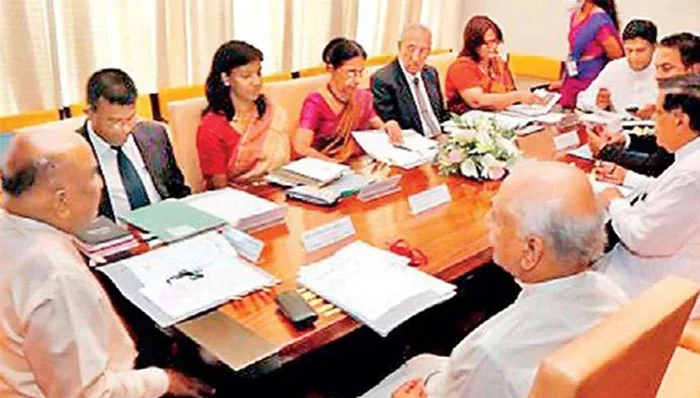
The Constitutional Council stands out as one of Sri Lanka’s most important governance mechanisms particularly at a time when even long‑established democracies are struggling with the dangers of executive overreach. Sri Lanka’s attempt to balance democratic mandate with independent oversight places it within a small but important group of constitutional arrangements that seek to protect the integrity of key state institutions without paralysing elected governments. Democratic power must be exercised, but it must also be restrained by institutions that command broad confidence. In each case, performance has been uneven, but the underlying principle is shared.
Comparable mechanisms exist in a number of democracies. In the United Kingdom, independent appointments commissions for the judiciary and civil service operate alongside ministerial authority, constraining but not eliminating political discretion. In Canada, parliamentary committees scrutinise appointments to oversight institutions such as the Auditor General, whose independence is regarded as essential to democratic accountability. In India, the collegium system for judicial appointments, in which senior judges of the Supreme Court play the decisive role in recommending appointments, emerged from a similar concern to insulate the judiciary from excessive political influence.
The Constitutional Council in Sri Lanka was developed to ensure that the highest level appointments to the most important institutions of the state would be the best possible under the circumstances. The objective was not to deny the executive its authority, but to ensure that those appointed would be independent, suitably qualified and not politically partisan. The Council is entrusted with oversight of appointments in seven critical areas of governance. These include the judiciary, through appointments to the Supreme Court and Court of Appeal, the independent commissions overseeing elections, public service, police, human rights, bribery and corruption, and the office of the Auditor General.
JVP Advocacy
The most outstanding feature of the Constitutional Council is its composition. Its ten members are drawn from the ranks of the government, the main opposition party, smaller parties and civil society. This plural composition was designed to reflect the diversity of political opinion in Parliament while also bringing in voices that are not directly tied to electoral competition. It reflects a belief that legitimacy in sensitive appointments comes not only from legal authority but also from inclusion and balance.
The idea of the Constitutional Council was strongly promoted around the year 2000, during a period of intense debate about the concentration of power in the executive presidency. Civil society organisations, professional bodies and sections of the legal community championed the position that unchecked executive authority had led to abuse of power and declining public trust. The JVP, which is today the core part of the NPP government, was among the political advocates in making the argument and joined the government of President Chandrika Bandaranaike Kumaratunga on this platform.
The first version of the Constitutional Council came into being in 2001 with the 17th Amendment to the Constitution during the presidency of Chandrika Bandaranaike Kumaratunga. The Constitutional Council functioned with varying degrees of effectiveness. There were moments of cooperation and also moments of tension. On several occasions President Kumaratunga disagreed with the views of the Constitutional Council, leading to deadlock and delays in appointments. These experiences revealed both the strengths and weaknesses of the model.
Since its inception in 2001, the Constitutional Council has had its ups and downs. Successive constitutional amendments have alternately weakened and strengthened it. The 18th Amendment significantly reduced its authority, restoring much of the appointment power to the executive. The 19th Amendment reversed this trend and re-established the Council with enhanced powers. The 20th Amendment again curtailed its role, while the 21st Amendment restored a measure of balance. At present, the Constitutional Council operates under the framework of the 21st Amendment, which reflects a renewed commitment to shared decision making in key appointments.
Undermining Confidence
The particular issue that has now come to the fore concerns the appointment of the Auditor General. This is a constitutionally protected position, reflecting the central role played by the Auditor General’s Department in monitoring public spending and safeguarding public resources. Without a credible and fearless audit institution, parliamentary oversight can become superficial and corruption flourishes unchecked. The role of the Auditor General’s Department is especially important in the present circumstances, when rooting out corruption is a stated priority of the government and a central element of the mandate it received from the electorate at the presidential and parliamentary elections held in 2024.
So far, the government has taken hitherto unprecedented actions to investigate past corruption involving former government leaders. These actions have caused considerable discomfort among politicians now in the opposition and out of power. However, a serious lacuna in the government’s anti-corruption arsenal is that the post of Auditor General has been vacant for over six months. No agreement has been reached between the government and the Constitutional Council on the nominations made by the President. On each of the four previous occasions, the nominees of the President have failed to obtain its concurrence.
The President has once again nominated a senior officer of the Auditor General’s Department whose appointment was earlier declined by the Constitutional Council. The key difference on this occasion is that the composition of the Constitutional Council has changed. The three representatives from civil society are new appointees and may take a different view from their predecessors. The person appointed needs to be someone who is not compromised by long years of association with entrenched interests in the public service and politics. The task ahead for the new Auditor General is formidable. What is required is professional competence combined with moral courage and institutional independence.
New Opportunity
By submitting the same nominee to the Constitutional Council, the President is signaling a clear preference and calling it to reconsider its earlier decision in the light of changed circumstances. If the President’s nominee possesses the required professional qualifications, relevant experience, and no substantiated allegations against her, the presumption should lean toward approving the appointment. The Constitutional Council is intended to moderate the President’s authority and not nullify it.
A consensual, collegial decision would be the best outcome. Confrontational postures may yield temporary political advantage, but they harm public institutions and erode trust. The President and the government carry the democratic mandate of the people; this mandate brings both authority and responsibility. The Constitutional Council plays a vital oversight role, but it does not possess an independent democratic mandate of its own and its legitimacy lies in balanced, principled decision making.
Sri Lanka’s experience, like that of many democracies, shows that institutions function best when guided by restraint, mutual respect, and a shared commitment to the public good. The erosion of these values elsewhere in the world demonstrates their importance. At this critical moment, reaching a consensus that respects both the President’s mandate and the Constitutional Council’s oversight role would send a powerful message that constitutional governance in Sri Lanka can work as intended.
by Jehan Perera

BCB receives investigation report on sexual misconduct allegation

Trump confirms talks with Iran as US military shoots down Iranian drone

Shower will occur in the Northern, North-central, Eastern and Uva provinces and in Nuwara-Eliya and Matale districts

House erupts over suspension of Deputy Secretary General

78th Independence Day celebrations at Bogambara Stadium

Colombo-Kandy railway line to be fully restored this year – Minister Bimal

‘Dates have the highest sugar content to fight Coronavirus’

Sunday Island 27 December – Headlines

#SundayIsland 17th December – Headlines

Sunday Island – 28th March

Sunday Island Headlines – 21 March

Sunday Island – 21st February – Headlines
-
 Opinion6 days ago
Sri Lanka, the Stars,and statesmen
-
 Business7 days ago
Climate risks, poverty, and recovery financing in focus at CEPA policy panel
-

 Business5 days ago
Hayleys Mobility ushering in a new era of premium sustainable mobility
-
 Business2 days ago
SLIM-Kantar People’s Awards 2026 to recognise Sri Lanka’s most trusted brands and personalities
-

 Business5 days ago
Advice Lab unveils new 13,000+ sqft office, marking major expansion in financial services BPO to Australia
-
 Business5 days ago
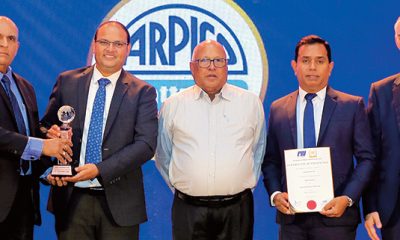
Arpico NextGen Mattress gains recognition for innovation
-

 Business4 days ago
Altair issues over 100+ title deeds post ownership change
-

 Business4 days ago
Sri Lanka opens first country pavilion at London exhibition