
Business
Revamping welfare: Is Aswesuma the salvation Sri Lanka’s poor hoped for?


Lakshila Wanigasinghe is a Research Officer at the IPS with research interests in poverty, social welfare, development, education, and health. She holds an MSc in Economics with a concentration in Development Economics and a BA in Economics with concentrations in International, Financial and Law and Economics from Southern Illinois University Carbondale (SIUC), US. (lakshila@ips.lk)
By Lakshila Wanigasinghe
With the introduction of Aswesuma as a brand-new initiative targeting the poor and vulnerable, social protection in Sri Lanka has been a much-debated subject lately.
Aswesuma primarily intends to overcome some key weaknesses of existing social protection programmes – at least on paper – but several challenges prevail. However, opinions regarding its capabilities to accomplish this remain ambiguous. The public has been protesting the scheme, and opposition party critics have called it an unfair political gimmick. Initially scheduled for disbursement in July 2023, the benefits for July finally commenced distribution last Monday (28th August) for 800,000 beneficiaries.
This blog delves into the key areas that warrant clarification, with the hope that authorities will address these concerns transparently.
Eligibility and Beneficiary Selection
Aswesuma introduces a multi-dimensional approach to poverty assessment, a notable improvement from the family size-based method employed by its predecessor, Samurdhi. Aswesuma employs six criteria measured by 22 indicators to determine if a household is non-poor or poor and deserving of assistance. Accordingly, eligible families receive assistance under four social groups (Table 1).
Publication of Aswesuma’s initial eligibility lists sparked concerns as many households called it unfair and demanded re-evaluations. As a result, 982,770 appeals and 62,368 objections arose from the process that followed. The sizeable appeals and objections raise questions about the accuracy of the selection process. Nearly 650,000 appeals were from already approved beneficiaries requesting an upgrade to a higher allowance category. However, without information on the cut-off points for the total number of families per beneficiary category and criteria determining allowance amounts, it is difficult to draw any conclusions regarding the methodologies’ ability to identify the most deserving families. The appropriateness of certain indicators, such as those assessing the “economic level”, comes under scrutiny due to their sensitivity to fluctuations like electricity consumption patterns and inconsistent monthly incomes.
Fate of Samurdhi Recipients
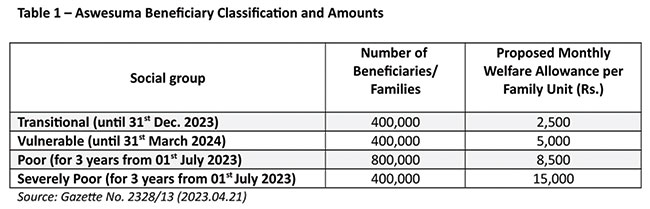 In 2022, Samurdhi cash transfers supported approximately 1.76 million beneficiaries. In contrast, Aswesuma aims to support 2 million beneficiaries annually. So far, Aswesuma has over 1.7 million eligible beneficiaries, of which nearly 950,000 are families that did not previously receive government welfare assistance. Over 1.28 million Samurdhi recipient households applied for Aswesuma, of which only 887,653 are eligible.
Cabinet approval was recently granted to extend Samurdhi cash transfers to 393,094 existing Samurdhi recipients unqualified for Aswesuma until the appeals and objections process concludes. Perhaps some of them will be included in Aswesuma’s final beneficiary list; however, it is unlikely that all will. Since Aswesuma attempts to correct Samurdhi’s targeting errors, understandably, some existing Samurdhi recipients are left out. However, it is important to ensure that those truly in need are included. Failure to do so will remove the support these families receive through Samurdhi and leave them without Aswesuma. Additionally, uncertainties linger for recipients who did not apply for Aswesuma (households that were unaware of the application process, missed the deadline, etc.), leaving them without any support.
Monitoring and Evaluation
Aswesuma will conduct annual beneficiary evaluations to ensure support to the most deserving. While eliminating non-deserving beneficiaries (one of Samurdhi’s key weaknesses) is much needed, concerns exist as it is unclear how reassessments will occur. Conducting household surveys annually is tedious, especially considering that beneficiaries are expected to be selected for Aswesuma’s second year even before the official commencement of the first.
The transitional and vulnerable beneficiary categories only receive assistance for a short period. Given this, will new beneficiaries be added to these categories after the end of the allowance period or following yearly revaluations?
Samurdhi Bank Regulation
Aswesuma benefits will be dispensed as direct deposits to beneficiary bank accounts. This is only to involve banks regulated under the Central Bank of Sri Lanka (CBSL). This approach aims to prevent third-party involvement in the process, as seen with Samurdhi, where cash transfers were done via the Samurdhi Department.
Interest has been shown to regulate Samurdhi banks and bring them under the purview of the CBSL. In this regard, discussions are underway on developing a credible system to regulate the Samurdhi banking system. Samurdhi banks established under the Samurdhi Authority Act operate as independent bodies. Hence, regulating them would likely require amendments to the Act, which is a complex and time-consuming task.
After regulation, using Samurdhi banks for the Aswesuma benefit disbursement seems like the obvious choice. Samurdhi is a familiar entity among villagers, and its widespread banking network makes it easily accessible rurally. However, the regulation has not yet been confirmed, and if it were to occur, it cannot be done within a short span of time, and hence, its ability to support Aswesuma in its initial three years is unlikely.
Continuity of Aswesuma
Attempting to correct the weaknesses of existing poverty alleviation programmes is a good starting point. However, this must be done in a logical manner. On paper, Aswesuma seems somewhat convincing, yet its practical application is to be seen.
With a three-year timeline, Aswesuma’s true impact on poverty alleviation remains uncertain. Whether the programme will be extended or if Aswesuma will conclude as a short-term relief initiative and be replaced with a new long-term poverty-targeted programme remains undisclosed.
Nonetheless, the success or failure of Aswesuma depends not on its ability to provide temporary relief but on whether it helps families graduate from poverty. Ultimately, the focus of any poverty-targeted programme should be to strive towards poverty alleviation. Although this is a long-term goal, benefits received through Aswesuma should at least push recipients toward improving their lives and livelihoods. Aswesuma should have a mechanism to support families in discontinuing their reliance on government assistance. Irrespective of whether this is done through Aswesuma or Samurdhi, it is important to communicate these plans with all relevant parties clearly.
Aswesuma’s continuity involves better information dissemination to avoid confusion among recipients, policymakers, and implementors. Flexibility will be key as this is undoubtedly a learning experience with corrective measures to be taken along the way. As the scheme encountered several practical challenges during implementation, addressing them and providing the first instalment to the most deserving families is of utmost importance now.
Link to original blog: https://www.ips.lk/talkingeconomics/2023/09/05/revamping-welfare-is-aswesuma-the-salvation-sri-lankas-poor-hoped-for/





Ceylinco Life’s Ambalantota branch agent AIP Manjula has been named one of three global finalists for the prestigious Insurance Agent of the Year award at the 11th Asia Trusted Life Agents & Advisers Awards (ATLAA) 2026.
The recognition places a Sri Lankan insurance professional among the finalists in a regional field spanning South Asia, Southeast Asia, East Asia and the wider Asia-Pacific region.
Ceylinco Life said the achievement reflected the calibre and customer-focused approach of its agency force, while recognising Manjula’s professionalism and commitment to policyholders.
The award evaluates insurance agents on criteria extending beyond sales performance, including ethical conduct, client service, policy persistency, digital adoption, innovative practices and contributions to the insurance industry and community.
The awards are organised by Asia Advisers Network and Asia Insurance Review, with LIMRA as co-organiser. An independent judging and balloting process is monitored by KPMG as the official scrutineer. The judging panel comprises senior insurance executives, association presidents and industry experts from across the Asia-Pacific region.
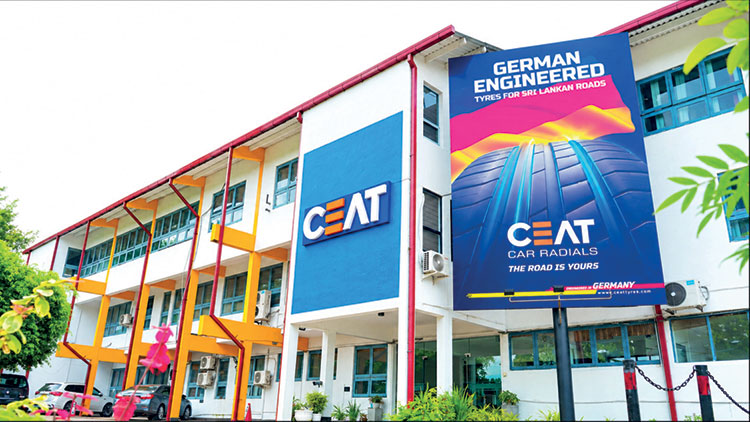
CEAT Kelani Holdings (CKH) has retained its National Long-Term Rating of ‘AA+(lka)’ with a Stable Outlook from Fitch Ratings for the sixth consecutive year, reflecting the company’s financial resilience and leading position in Sri Lanka’s pneumatic tyre market.
The ‘AA+(lka)’ rating, the second-highest on Fitch’s national scale, indicates a very strong capacity to meet financial commitments.
Fitch said CKH’s established market leadership and resilient financial profile remained key strengths, while noting its exposure to price-sensitive, cyclical and highly competitive markets.
The Stable Outlook reflects expectations that the company will maintain its market position despite rising input costs and increasing competition from imported tyres, while preserving adequate credit metrics during periods of weaker earnings and higher investment.
Fitch expects CKH’s established brand, extensive dealer network and adaptive pricing strategies to support its market position. Planned production facility upgrades are also expected to improve product quality, particularly in the radial tyre segment.
The rating agency expects near-term pressure on margins from higher raw material and energy costs but said the company’s low leverage and sound liquidity would provide a cushion.
CKH Chairman Chanaka De Silva said the rating reinforced the company’s focus on disciplined financial management, operational adaptability and long-term investment.

SLT-MOBITEL Enterprise, the enterprise services arm of Sri Lanka Telecom PLC, has launched its Premium Cloud service powered by Nutanix, aimed at helping Sri Lankan businesses modernise their IT infrastructure and accelerate digital transformation.
The service was unveiled at the Lanka Tech Summit 2026 held recently at ITC Ratnadipa, Colombo.
The Premium Cloud combines hybrid multi-cloud capabilities with enterprise-grade performance, enabling businesses to run mission-critical workloads, scale cloud deployments and strengthen business continuity through disaster recovery capabilities.
Hosted on SLT-MOBITEL’s Tier III data centre infrastructure, the platform is designed to provide enhanced security, reliability and flexibility while supporting the growing technology requirements of enterprises.
SLT-MOBITEL Enterprise said the platform would also support organisations seeking to adopt AI-ready capabilities and improve the management and performance of IT workloads.
A key feature of the launch was SLT-MOBITEL Enterprise joining the Nutanix Elevate Service Provider Program (NESPP), which the company said made it the first service provider in the region to join the programme.
Powered by Nutanix’s hybrid multicloud platform, the service enables application and data mobility across on-premises environments, public clouds and edge locations.
The company said the partnership combined Nutanix’s cloud technology with SLT-MOBITEL’s local expertise and support, strengthening its multi-cloud portfolio.

Buttler out of Oval decider as Lawrence earns ODI call-up

Showers will occur in the Western, Eastern, Uva and Sabaragamuwa provinces and in Galle, Matara, Kandy and Nuwara-Eliya districts.

Nor’easter brings flooding as New York and New Jersey declare emergency 2 hours ago

Trump rejects Iran deal to reopen Strait of Hormuz in seven days

Govt plans to hire 121,000 state workers, redistribute tax revenue

Parliament clears 22A amid protests

‘Dates have the highest sugar content to fight Coronavirus’

Sunday Island 27 December – Headlines

#SundayIsland 17th December – Headlines

Sunday Island – 28th March

Sunday Island Headlines – 21 March

Sunday Island – 21st February – Headlines
-

 News5 days ago
Mastermind Naufer Moulavi among 15 found guilty
-

 News7 days ago
Hatton youth protest against reported death sentence for Lankan in Saudi Arabia
-

 News7 days ago
Mahaweli rises as heavy rain triggers flood, landslide fears
-
 News6 days ago
Protest against setting up of cement factory in highly populated area near BIA
-

 Midweek Review5 days ago
Thileepan’s fast unto death: An authentic narrative that many missed
-
 Latest News4 days ago
Showers above 100 mm are likely at some places in the Western, Sabaragamuwa, Central and North-western provinces and in Galle and Matara Districts
-

 Editorial6 days ago
Trouble beginning in earnest
-
Editorial5 days ago
Big Bad Bills